Best Cheap Keyboards in 2026: 5 Budget Picks Worth Buying
You don’t need to spend a fortune to start making music.
Today’s affordable keyboards can give beginners touch-sensitive keys, hundreds of sounds, built-in lessons, accompaniment, USB connectivity and even music-production features at surprisingly accessible prices.
But there’s an important catch:
Cheap keyboards are not all designed for the same purpose.
A lightweight 61-key keyboard can be excellent for a child learning music, a songwriter experimenting with sounds or someone who simply wants an inexpensive instrument at home.
But if your real goal is learning traditional piano technique, you may be better off buying an affordable 88-key digital piano with weighted keys.
That’s why this guide doesn’t simply list the five cheapest instruments we could find.
Instead, we’ve selected five affordable keyboards and digital pianos that serve different kinds of musicians.
Our picks are:
- Yamaha PSR-E383 — Best Overall Cheap Keyboard
- Casio CT-S300 — Best Cheap Portable Keyboard
- Alesis Recital — Best Cheap 88-Key Keyboard
- Donner DEP-20 — Best Cheap Weighted 88-Key Digital Piano
- Roland GO 3 — Best Budget Keyboard for Creativity
Let’s see which one makes the most sense for you.
Disclosure: Some links on Pianos-Galore are affiliate links. If you purchase through these links, we may receive a small commission at no additional cost to you.
Best Cheap Keyboards: Quick Comparison
| Model | Keys | Key Type | Best For |
|---|---|---|---|
| Yamaha PSR-E383 | 61 | Touch-sensitive, non-weighted | Best Overall Cheap Keyboard |
| Casio CT-S300 | 61 | Touch-sensitive, non-weighted | Best for Portability |
| Alesis Recital | 88 | Semi-weighted | Best Cheap 88-Key Keyboard |
| Donner DEP-20 | 88 | Weighted | Best Cheap Weighted Piano |
| Roland GO 3 | 61 | Velocity-sensitive | Best for Creativity |
Quick Recommendation
If you’re a complete beginner and simply want an affordable, versatile keyboard, we’d start with the Yamaha PSR-E383.
If portability is your priority, the Casio CT-S300 is extremely attractive.
If you specifically want 88 keys without spending heavily, consider the Alesis Recital.
For someone serious about developing piano technique on a budget, the Donner DEP-20 deserves a closer look because of its weighted 88-key action.
And if songwriting, sounds and music creation excite you more than traditional piano practice, the Roland GO 3 is the most creative choice here.
What Does “Cheap Keyboard” Really Mean?
There’s a difference between cheap and good value.
A keyboard is good value when it provides the features you actually need at an affordable price.
A keyboard is simply cheap when its limitations prevent you from progressing.
The lowest-priced instrument isn’t necessarily the smartest purchase.
For example, an absolute beginner may initially be satisfied with a keyboard that has:
- 61 keys
- No touch sensitivity
- Basic piano sound
- Few connectivity options
But after several months of lessons, those limitations can become frustrating.
Spending slightly more for touch sensitivity—or for weighted keys if you’re serious about piano—can save you from replacing the instrument too soon.
So before comparing prices, decide what you actually want to learn.
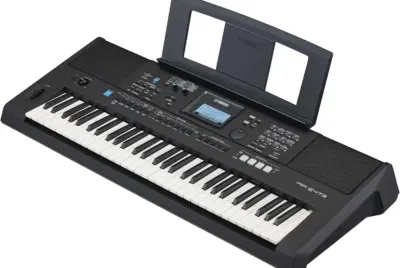
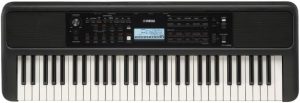
1. Yamaha PSR-E383 — Best Overall Cheap Keyboard
Best for:
Beginners, children, casual players and families wanting an affordable first keyboard with excellent learning and entertainment features.
The Yamaha PSR-E383 is our best overall choice because it gets the fundamentals right without becoming complicated or expensive.
It offers:
- 61 touch-sensitive keys
- 650 instrument voices
- 260 accompaniment styles
- 48-note polyphony
- 125 preset songs
- Built-in lesson functions
- Duo mode
- Split and Dual modes
- Arpeggio functions
- USB audio/MIDI
- Built-in speakers
- Battery operation
For a beginner keyboard, that’s an impressive collection of features.
Why Touch Sensitivity Matters
This is one of the most important advantages of the PSR-E383.
Touch sensitivity means the keyboard responds to how you play.
Press a key gently and the note can sound softer.
Strike it more firmly and it can sound louder.
That introduces beginners to one of the fundamental ideas in musical performance:
Dynamics.
An inexpensive keyboard without touch sensitivity may teach you where the notes are, but it can’t respond as expressively to your fingers.
That’s why I would prioritize touch sensitivity over having hundreds of additional sounds.
650 Voices
That said, the PSR-E383 certainly doesn’t lack sounds.
Its large voice library lets beginners experiment with instruments including:
- Acoustic piano
- Electric piano
- Organ
- Strings
- Brass
- Guitar
- Bass
- Synths
- Percussion
Will a beginner use all 650?
Almost certainly not.
But the variety makes the keyboard much more entertaining, particularly for children and casual players.
260 Accompaniment Styles
The automatic accompaniment system allows the keyboard to generate backing parts based on the chords you play.
This can help beginners explore:
- Chord progressions
- Rhythm
- Song structure
- Improvisation
- Different musical genres
It can also make solo practice much more enjoyable.
Built-In Learning Features
Yamaha includes several lesson-oriented functions.
These can supplement:
- Private lessons
- Online lessons
- YouTube tutorials
- Self-directed practice
A keyboard can’t replace a good piano teacher, but built-in practice tools can encourage beginners to spend more time playing.
Who Should Buy the PSR-E383?
Choose it if:
- This is your first keyboard.
- You’re buying for a child.
- Your budget is limited.
- You want touch sensitivity.
- You want lots of sounds and rhythms.
- You need built-in speakers.
- You want something easy to move.
- You’re still deciding how seriously you’ll pursue music.
For most people searching for an inexpensive first keyboard, the PSR-E383 is an excellent place to begin.
[Check Yamaha PSR-E383 Price on Amazon →]
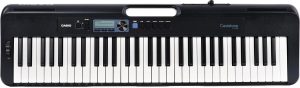
2. Casio CT-S300 — Best Cheap Portable Keyboard
Best for:
Beginners and casual musicians who want an extremely lightweight keyboard they can easily carry or store.
The Casio CT-S300 takes a different approach.
Its greatest strength is convenience.
You get:
- 61 touch-responsive keys
- 400 tones
- 77 rhythms
- 48-note polyphony
- 60 built-in songs
- Automatic accompaniment
- Pitch-bend wheel
- USB connectivity
- Built-in speakers
- Battery operation
And the entire instrument weighs only about 3.3 kg.
That’s remarkably portable.
Portability Is the CT-S300’s Superpower
Not everyone has a dedicated music room.
Maybe your keyboard needs to live:
- Under a bed
- In a closet
- Against a wall
- On a dining table
- In a child’s bedroom
Or perhaps you want to take it:
- To lessons
- To school
- To a friend’s house
- On trips
- To rehearsals
In those situations, weight matters.
An instrument that’s easy to set up is more likely to get played.
Touch Response
The CT-S300 has touch response, an important distinction from some cheaper Casio models.
That means beginners can start learning to control dynamics rather than simply pressing the correct notes.
For anyone learning music seriously, that’s a feature I would strongly prefer.
Pitch-Bend Wheel
The CT-S300 also includes a pitch-bend wheel.
That’s not particularly important for traditional piano practice.
But it becomes fun when playing sounds such as:
- Guitar
- Synth lead
- Brass
It gives the player additional expressive control and makes the CT-S300 useful beyond basic piano practice.
Who Should Buy the CT-S300?
Choose it if:
- Portability is extremely important.
- You have limited storage space.
- You’re buying for a beginner.
- You want touch-sensitive keys.
- You want battery operation.
- You want a fun, uncomplicated keyboard.
If your primary goal is serious piano study, however, I’d move up to an 88-key option.
[Check Casio CT-S300 Price on Amazon →]
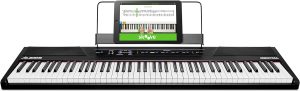
3. Alesis Recital — Best Cheap 88-Key Keyboard
Best for:
Beginners who want the full 88-key piano range at a very affordable price.
This is where our comparison starts moving away from ordinary portable keyboards.
The Alesis Recital gives you 88 full-size semi-weighted keys.
That’s important.
A standard piano has 88 keys, so the Recital allows students to learn on the full keyboard range rather than five octaves.
Why 88 Keys Matter
Do beginners need all 88 keys immediately?
No.
Many beginner pieces use only a portion of the keyboard.
But having 88 keys means you don’t eventually run into the physical limitation of a 61-key instrument.
This becomes increasingly important if you progress into:
- Classical music
- More advanced piano repertoire
- Wide left-hand accompaniments
- Pieces using extreme registers
So if you’re reasonably sure that piano, rather than general keyboard playing, is your goal, buying 88 keys from the beginning can make sense.
But There’s an Important Compromise
The Alesis Recital uses semi-weighted keys.
That isn’t the same thing as a fully weighted hammer-action digital piano.
This distinction matters.
Semi-weighted keys provide more resistance than many lightweight keyboard actions, but they don’t reproduce acoustic-piano hammer behavior as convincingly as a good hammer-action system.
That’s why the Recital occupies an interesting middle ground:
61-key portable keyboard → Alesis Recital → weighted hammer-action digital piano
It’s an inexpensive way to get the full 88-key range.
Who Should Buy the Alesis Recital?
Choose it if:
- You want 88 keys.
- Your budget is very limited.
- You’re learning piano.
- You want something more piano-oriented than a 61-key keyboard.
- You’re not ready to pay for a higher-level hammer-action instrument.
Don’t choose it solely because “88 must be better than 61.”
If you mainly want beats, hundreds of sounds and creative features, a 61-key keyboard may actually suit you better.
Best Alesis keyboards and digital pianos
[Check Alesis Recital Price on Amazon →]
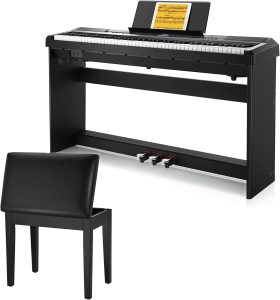
4. Donner DEP-20 — Best Cheap Weighted 88-Key Digital Piano
Best for:
Budget-conscious beginners who want to develop traditional piano technique on weighted keys.
The Donner DEP-20 represents another important step.
Rather than simply giving you 88 keys, it provides an 88-key weighted action.
That makes it much more relevant to someone asking:
“What’s the cheapest type of instrument I should consider if I actually want to learn piano?”
Weighted Keys Make the Difference
On an acoustic piano, keys have substantial mechanical resistance.
Learning to control that resistance is part of developing piano technique.
Weighted digital-piano actions attempt to reproduce this physical experience.
This can help students develop:
- Finger control
- Dynamic control
- Strength
- Coordination
- More appropriate piano technique
The transition between digital and acoustic pianos may also be less dramatic than when moving from an extremely light keyboard.
More Than Just Piano
The DEP-20 is also unusually feature-rich for a budget weighted instrument.
It provides a large selection of tones, allowing players to experiment with sounds beyond acoustic piano.
This makes it an interesting compromise for someone who wants:
piano-oriented weighted keys + lots of sounds
rather than a stripped-down digital piano.
Who Should Buy the DEP-20?
Choose it if:
- You’re serious about learning piano.
- You want 88 keys.
- Weighted action is important.
- You’re shopping on a limited budget.
- You want more sounds than many traditional digital pianos provide.
The trade-off is obvious:
An 88-key weighted instrument is larger and heavier than a compact 61-key keyboard.
If portability is your priority, choose differently.
But if piano technique is the priority, the DEP-20 is the more appropriate kind of instrument.
Best Donner digital pianos
[Check Donner DEP-20 Price on Amazon →]
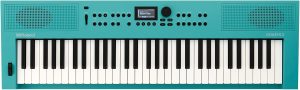
5. Roland GO 3 — Best Budget Keyboard for Creativity
Best for:
Songwriters, teenagers, aspiring producers and musicians who want to create music rather than simply practice piano.
The Roland GO 3 is the wild card in this comparison.
It isn’t trying to be an inexpensive acoustic-piano substitute.
It’s designed around music creation.
It provides:
- 61 velocity-sensitive keys
- Roland ZEN-Core sound engine
- More than 1,000 tones
- Dozens of drum kits
- More than 200 accompaniment styles
- Chord sequencer
- Built-in speakers
- Bluetooth audio
- Bluetooth MIDI
- USB audio/MIDI
- Effects
- Roland Cloud expansion possibilities
That’s a very different feature set from the Alesis Recital or Donner DEP-20.
Over 1,000 Sounds
The GO 3 draws on Roland’s ZEN-Core technology.
The sound library covers far more than acoustic piano.
You can explore:
- Synths
- Pads
- Electric pianos
- Organs
- Strings
- Brass
- Bass
- Guitars
- Electronic sounds
- Drum kits
For a creative player, this is enormously appealing.
Chord Sequencer and Accompaniment
You don’t have to build every song from scratch.
The GO 3 includes accompaniment styles and chord-sequencing tools that can help players develop musical ideas.
This is particularly useful for someone interested in:
- Songwriting
- Arranging
- Pop
- Electronic music
- Contemporary music production
Rather than practicing scales for an hour and switching the keyboard off, you might end up building an entire musical idea.
Bluetooth
Bluetooth support is another practical advantage.
Bluetooth audio allows you to stream music through the keyboard’s speaker system.
Bluetooth MIDI can communicate performance data wirelessly with compatible devices and applications.
There’s also USB audio/MIDI for computer and mobile-device workflows.
That makes the GO 3 considerably more connected than many inexpensive beginner keyboards.
Who Should Buy the GO 3?
Choose it if:
- You enjoy experimenting with sounds.
- You’re interested in songwriting.
- You want contemporary sounds.
- You want Bluetooth.
- You want accompaniment.
- You may eventually work with music software.
- Creativity matters more than realistic piano action.
If your ambition is playing Chopin, choose an 88-key weighted digital piano instead.
If your ambition is creating your own songs, the GO 3 becomes much more interesting.
Roland digital pianos and keyboards
[Check Roland GO 3 Price on Amazon →]
Cheap Keyboards Compared: Which One Should You Buy?
Here’s the simplest way to decide.
Choose Yamaha PSR-E383 if:
You’re a beginner and don’t yet know exactly where music will take you.
It’s the best all-round starting point.
Choose Casio CT-S300 if:
You need something light, compact and easy to store or transport.
Choose Alesis Recital if:
You want 88 keys for the lowest practical entry cost but don’t necessarily need full hammer action.
Choose Donner DEP-20 if:
You’re serious about learning piano and want affordable weighted keys.
Choose Roland GO 3 if:
You want to write songs, explore sounds and create music.
61 Keys vs 88 Keys: Which Is Better for Beginners?
This is more important than choosing between brands.
61 Keys
Advantages:
- Smaller
- Lighter
- Easier to store
- Often less expensive
- Excellent for general music learning
- Plenty for many pop songs
- Good for songwriting
Limitations:
- Less than the full piano range
- Usually not hammer-weighted
- Can eventually limit classical repertoire
88 Keys
Advantages:
- Full piano range
- Better for traditional piano study
- Better for classical repertoire
- Often available with weighted action
- Less likely to be outgrown
Disadvantages:
- Larger
- Heavier
- Usually more expensive
Our Recommendation
If you’re simply exploring music, 61 touch-sensitive keys are perfectly reasonable.
If you already know you want to become a pianist, buy 88 weighted keys if your budget allows.
Weighted vs Semi-Weighted vs Non-Weighted
Understanding these terms can prevent an expensive mistake.
Non-Weighted Keys
These generally feel light and quick.
Good for:
- Beginners
- Synth playing
- Organ
- Pop
- General keyboard use
Semi-Weighted Keys
These provide additional resistance but usually don’t simulate acoustic hammer action fully.
Good for:
- Budget-conscious beginners
- MIDI work
- General keyboard playing
- Players wanting more resistance without heavy action
Weighted/Hammer-Action Keys
These attempt to recreate acoustic-piano resistance more closely.
Good for:
- Piano lessons
- Classical music
- Serious practice
- Pianists
Can You Really Learn Piano on a Cheap Keyboard?
Yes.
But there’s a difference between:
learning music
and
developing piano technique.
You can learn:
- Notes
- Chords
- Scales
- Rhythm
- Reading music
- Song structure
- Harmony
on an inexpensive 61-key keyboard.
But traditional piano technique is influenced by the physical action beneath your fingers.
If you plan to study piano seriously, weighted hammer-action keys become increasingly valuable.
That’s why I wouldn’t tell every beginner to buy the cheapest keyboard possible.
Sometimes spending more at the beginning prevents you from needing to replace your instrument six months later.
Best digital pianos for beginners
How Much Should a Beginner Spend?
Don’t start with an arbitrary price.
Start with your intended use.
Casual Beginner
A touch-sensitive 61-key keyboard may be enough.
Look at:
PSR-E383 or CT-S300.
Serious Piano Beginner on a Very Tight Budget
Consider:
Alesis Recital.
Serious Piano Beginner Wanting Weighted Keys
Consider:
Donner DEP-20.
Creative Beginner
Consider:
Roland GO 3.
The cheapest instrument is only good value if it actually supports what you want to learn.
What Features Matter Most in a Cheap Keyboard?
Ignore the marketing noise and prioritize these.
1. Touch Sensitivity
This is one of the first features I’d insist on for most learners.
2. Key Count
Decide whether 61 keys will be enough or whether your piano goals justify 88.
3. Key Action
If serious piano playing is your goal, action matters more than having 500 additional sounds.
4. Headphone Connection
Extremely useful for home practice.
5. Sustain Pedal Support
Important as piano playing progresses.
6. USB/MIDI
Useful for:
- Apps
- Computers
- Recording
- Virtual instruments
7. Built-In Speakers
Convenient for beginners because you can simply turn the instrument on and play.
Best digital pianos for every budget
Features You Probably Shouldn’t Pay Extra for
Beginners can easily be distracted by huge specification numbers.
Don’t automatically pay more because a keyboard has:
- 1,000 sounds
- Hundreds of rhythms
- Dozens of effects
- Advanced sequencing
- Professional controls
unless you will actually use them.
For someone learning piano, I’d rather have:
a better keyboard action with 20 excellent sounds
than
a poor action with 1,000 sounds.
For a songwriter, the answer might be completely different.
That’s why intended use matters so much.
Best Cheap Keyboard for Kids
For most children, we’d choose between:
Yamaha PSR-E383
Best overall beginner package.
Casio CT-S300
Best when portability and compact size are especially important.
Both provide touch response, which I strongly prefer over the cheapest non-touch-sensitive keyboards.
If a child is beginning formal piano lessons, however, ask the teacher whether an 88-key weighted instrument would be preferable.
Best Cheap Keyboard for Adults
Adult beginners often underestimate how quickly they may progress.
If you’re an adult who has wanted to learn piano for years and you’re finally committed to doing it, consider skipping the cheapest 61-key category.
An 88-key instrument may make more sense.
If budget permits, weighted action is even better.
That’s where the Donner DEP-20 becomes particularly relevant.
Best Cheap Keyboard for Songwriting
The Roland GO 3 is our favorite here.
Its sound library, accompaniment, chord sequencing, Bluetooth and USB capabilities are far more oriented toward creating music.
The Yamaha PSR-E383 can certainly be used for songwriting, but the Roland provides considerably more creative room.
Best Cheap Keyboard for Piano Lessons
I’d divide this into two levels.
Tightest Budget:
Alesis Recital
You get the full 88-key range.
Better for Piano Technique:
Donner DEP-20
The weighted action makes it more piano-oriented.
For serious long-term study, you can also explore our dedicated beginner digital-piano recommendations.
[Internal link: Best Digital Pianos for Beginners]
Best Cheap Keyboard for Portability
Casio CT-S300.
At approximately 3.3 kg, it is extraordinarily easy to move.
For students traveling to lessons or people living in small apartments, that convenience shouldn’t be underestimated.
10 Mistakes to Avoid When Buying a Cheap Keyboard
1. Buying purely on price
The cheapest option may be replaced quickly.
2. Ignoring touch sensitivity
Dynamics are fundamental to expressive playing.
3. Assuming 88 keys automatically means weighted keys
It doesn’t.
4. Confusing semi-weighted with hammer action
They aren’t equivalent.
5. Buying 61 keys when you’re committed to classical piano
You may eventually outgrow the range and action.
6. Buying 88 weighted keys when all you want is a portable songwriting keyboard
More isn’t automatically better.
7. Choosing by number of sounds
You’ll probably use only a fraction of them.
8. Forgetting accessories
Check whether you’ll need:
- AC adapter
- Stand
- Bench
- Sustain pedal
- Headphones
9. Ignoring physical size
An 88-key piano requires considerably more space than a 61-key keyboard.
10. Buying for today instead of next year
Think about where your playing is heading.
Frequently Asked Questions
What is the best cheap keyboard for beginners?
For most beginners, our overall choice is the Yamaha PSR-E383 because it combines touch-sensitive keys, learning functions, hundreds of sounds, accompaniment and good connectivity.
What’s the best cheap keyboard with 88 keys?
The Alesis Recital is an attractive low-cost way to get the full 88-key range.
If you want weighted action for more serious piano practice, consider the Donner DEP-20.
Are cheap keyboards good for learning piano?
Yes, especially during the early stages.
However, serious piano students should eventually consider 88 weighted keys.
Do I need weighted keys as a beginner?
Not necessarily.
A complete beginner can learn a great deal on touch-sensitive non-weighted keys.
But weighted action is preferable if traditional piano technique is your goal.
Are 61 keys enough?
For beginners, pop music, songwriting and general keyboard playing, often yes.
For advanced classical piano, no.
What’s the difference between touch-sensitive and weighted keys?
Touch sensitivity affects how the sound responds to playing force.
Weighting affects how the key physically feels beneath your fingers.
A keyboard can be touch-sensitive without being weighted.
Which cheap keyboard is easiest to carry?
Among our five picks, the Casio CT-S300 is the portability standout.
Which is best for making music?
The Roland GO 3 is our choice for creativity and songwriting.
Should I buy a keyboard or digital piano?
Buy a keyboard if you prioritize:
- Portability
- Sounds
- Accompaniment
- Creativity
- Lower cost
Consider a digital piano if you prioritize:
- Piano technique
- Weighted keys
- 88-key range
- Classical music
- Realistic piano feel
Digital Piano vs Keyboard: Which Should You Buy in 2026?
Is buying a cheap keyboard a waste of money?
No—provided it matches your goals.
An affordable keyboard that gets played every day is a far better purchase than an expensive instrument that sits unused.
Final Verdict: Which Cheap Keyboard Should You Buy?
The best cheap keyboard isn’t necessarily the one with the lowest price.
It’s the least expensive instrument that can properly support what you want to do.
Best Overall Cheap Keyboard — Yamaha PSR-E383
Our first recommendation for most beginners.
It offers an excellent combination of touch sensitivity, sounds, accompaniment, lessons and connectivity.
Best Cheap Portable Keyboard — Casio CT-S300
Choose this if compact size and low weight are major priorities.
Best Cheap 88-Key Keyboard — Alesis Recital
A practical choice for beginners wanting the full piano range on a very limited budget.
Best Cheap Weighted 88-Key Piano — Donner DEP-20
The strongest choice here for budget-conscious players who are serious about developing piano technique.
Best Budget Keyboard for Creativity — Roland GO 3
The standout for songwriting, sounds, accompaniment and music creation.
If you’re still uncertain, use this simple rule:
Casual beginner → PSR-E383
Need maximum portability → CT-S300
Want inexpensive 88 keys → Alesis Recital
Want to seriously learn piano → DEP-20
Want to create songs → GO 3
Don’t buy the keyboard with the longest feature list.
Buy the one that makes it easiest for you to sit down, play regularly and keep improving.
After choosing your first keyboard, see our Simply Piano Review 2026: Is It Good for Beginners? for one way to start learning at home.
Beginners who can increase their budget for a more piano-like action should also see our Best 88-Key Weighted Keyboards for Beginners in 2026: 7 Top Picks.
If you can increase your budget and want 88 weighted keys without giving up portability, see our Best Portable Digital Pianos for Beginners in 2026: 5 Lightweight Picks.
If you’re willing to move beyond the entry-level price range, see Best Digital Pianos Under $1,000 in 2026: 7 Top Picks for instruments offering more advanced piano actions and features.
Yamaha’s entry-level PSR series has also evolved in recent years; our Yamaha PSR-E373 vs PSR-E383: Should You Still Buy the Older Keyboard in 2026? explains whether the discontinued E373 remains worth considering.
If you are buying a first instrument for a child who is still exploring an interest in music, it may be worth reading our guide to selecting a keyboard for a child with autism before deciding whether a budget keyboard or full-size digital piano makes more sense.
If you are willing to spend a little more for stronger piano sound and a more realistic playing experience, compare our affordable digital pianos with good sound quality before choosing purely on price.
A low-cost keyboard can be an excellent way to start, but students planning serious piano lessons should consider whether a keyboard or digital piano better fits their goals before buying.
Related piano articles:
Do you want to learn piano? Simply Piano is the ideal app for you.

• Take beginner-friendly lessons or advanced courses tailored to your needs.
• Learn at your own pace with real-time feedback to improve your skills.
• Play everything from classical pieces to pop hits and Disney songs.
• Begin your piano journey today with SIMPLY PIANO!