Yamaha 61-Key Keyboard Guide: Perfect for Beginners
Not everyone needs 88 keys.
If you’re a beginner learning your first songs, a songwriter experimenting with different sounds, or a gigging musician who values portability, a 61-key Yamaha keyboard may actually make more sense than a full-size digital piano.
But there’s a problem:
Yamaha makes very different kinds of 61-key keyboards.
One may be designed primarily for beginners.
Another may emphasize beats, sampling and creative performance.
Another is intended for professional stage musicians.
And an arranger workstation can practically function as an entire backing band.
So which Yamaha 61-key keyboard should you buy?
In this guide, we’ll compare four very different Yamaha instruments:
- Yamaha PSR-E383
- Yamaha PSR-E473
- Yamaha CK61
Rather than declaring one universally “best,” we’ll explain which player each keyboard is actually best for.
Disclosure: Some links on Pianos-Galore are affiliate links. If you purchase through these links, we may receive a small commission at no additional cost to you.
Best Yamaha 61-Key Keyboards: Quick Comparison
| Model | Best For | Keys | Main Strength |
|---|---|---|---|
| Yamaha PSR-E383 | Beginners | 61 | Learning + affordability |
| Yamaha PSR-E473 | Creative Players | 61 | Sounds, grooves & performance |
| Yamaha CK61 | Live Musicians | 61 | Stage performance & real-time control |
Our Recommendation
If you’re a beginner, start with the PSR-E383.
If you’ve moved beyond the basics and want more creative possibilities, consider the PSR-E473.
For live performance, the CK61 is the standout.
And if sophisticated automatic accompaniment and arranging are your priorities, look closely at the PSR-SX600.
Why Buy a 61-Key Keyboard?
A standard acoustic piano has 88 keys.
So why would anyone deliberately choose 61?
Because not every keyboard player has the same goals as a classical pianist.
A 61-key instrument offers five octaves of playing range while remaining considerably more compact than a full-size piano.
That makes it particularly attractive for:
- Beginners
- Children
- Songwriters
- Producers
- Keyboard players
- Pop musicians
- Worship musicians
- Gigging performers
- Small apartments
- Home studios
The smaller format also makes 61-key keyboards easier to carry.
Is 61 Keys Enough for a Beginner?
For many beginners, yes.
You can learn:
- Notes
- Scales
- Basic chords
- Major and minor keys
- Rhythm
- Melody
- Two-hand coordination
- Chord progressions
- Music reading
- Basic keyboard technique
on 61 keys.
You can also play a huge amount of:
- Pop
- Rock
- Worship
- Electronic music
- Folk
- Children’s music
- Contemporary songs
without needing the full 88-key range.
However, there’s an important qualification.
If Your Goal Is Classical Piano…
I would normally recommend an 88-key weighted digital piano instead.
Why?
A serious piano student eventually benefits from:
- The complete 88-note range
- Hammer-weighted action
- Graded resistance
- More realistic piano technique
Most 61-key Yamaha keyboards use lighter organ-style or synth-style actions rather than weighted hammer actions.
That’s not a defect.
They’re simply designed for a different purpose.
[Internal link: Best Yamaha 88-Key Weighted Keyboards]
Touch Sensitivity vs Weighted Keys: Don’t Confuse Them
This is one of the most important things for beginners to understand.
Touch-sensitive keys are not necessarily weighted keys.
Touch sensitivity means the instrument responds to how you play.
Press softly and the sound can be quieter.
Play harder and it can become louder.
That’s essential for musical expression.
But weighted action refers to physical resistance beneath your fingers.
The PSR-E383, for example, has touch-sensitive keys but not an 88-key hammer-weighted piano action.
So when a product description says:
“Touch-sensitive keyboard”
don’t automatically interpret that as:
“Feels like an acoustic piano.”
They’re different features.
1. Yamaha PSR-E383 — Best for Beginners
If you’re buying your first Yamaha keyboard, the PSR-E383 is the model I’d examine first.
It offers a strong combination of:
- Affordability
- Portability
- Touch sensitivity
- Hundreds of sounds
- Accompaniment
- Built-in learning features
without overwhelming the beginner.
Key Features
- 61 touch-sensitive keys
- 650 voices
- 260 accompaniment styles
- 48-note polyphony
- 125 preset songs
- Built-in lesson functions
- 152 arpeggio types
- Split and Dual functions
- USB audio/MIDI
- Built-in speakers
- Battery or AC operation
For an entry-level keyboard, that’s a substantial feature set.
Why Touch Sensitivity Matters
Very inexpensive beginner keyboards sometimes lack touch response.
That’s a major limitation.
Without touch sensitivity, a note can sound at essentially the same volume regardless of how gently or forcefully you strike the key.
The PSR-E383 responds dynamically.
That allows a beginner to start developing the concept of musical expression, rather than merely pressing the correct notes.
650 Voices
The PSR-E383 isn’t limited to piano.
Its sound library includes hundreds of instrument voices.
That allows beginners to experiment with sounds such as:
- Piano
- Electric piano
- Organ
- Strings
- Brass
- Guitar
- Bass
- Synths
- Percussion
For children especially, changing sounds can make practice more entertaining.
260 Accompaniment Styles
The PSR-E383 can also provide automatic accompaniment.
Play chords with your left hand and the keyboard can generate backing parts in different musical styles.
This is useful for:
- Learning chord progressions
- Developing timing
- Improvisation
- Songwriting
- Simply making practice more fun
Built-In Lessons
One of the PSR-E383’s biggest advantages for beginners is its collection of learning functions.
These include Yamaha’s Keys to Success and other lesson functions designed to help students work through songs and exercises.
A keyboard can’t replace a good teacher.
But built-in learning tools can make independent practice more structured.
Who Should Buy the PSR-E383?
Choose it if:
- You’re buying your first keyboard.
- You’re shopping for a child.
- You want touch-sensitive keys.
- You want plenty of sounds.
- Portability matters.
- You want built-in learning functions.
- You’re not yet committed to classical piano study.
[Check Yamaha PSR-E383 Price on Amazon →]
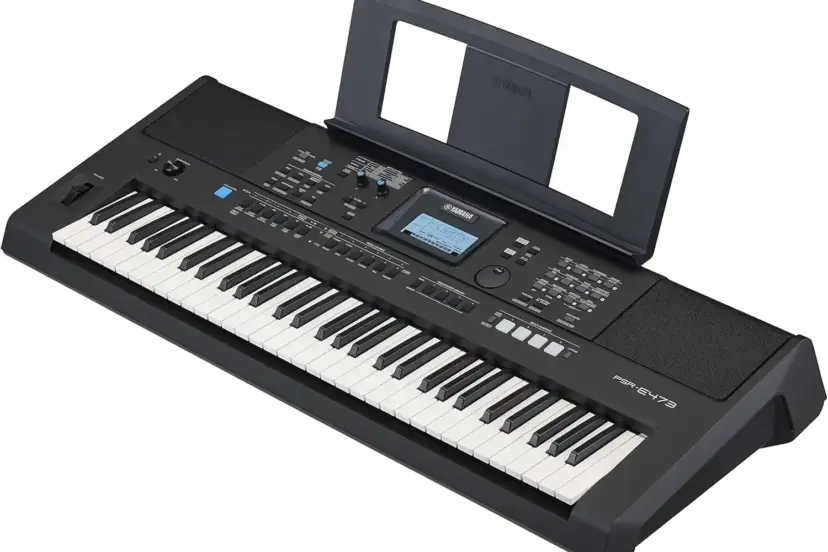
2. Yamaha PSR-E473 — Best for Creative Players
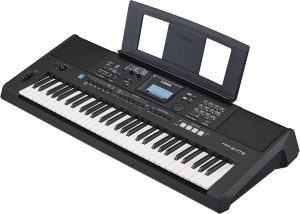
The PSR-E473 is for someone who looks at a beginner keyboard and thinks:
“I want to do more than just practice piano.”
It is designed for creativity.
The PSR-E473 combines traditional portable-keyboard functions with features aimed at:
- Performance
- Beat making
- Songwriting
- Sampling
- Groove creation
That makes it a logical step up from Yamaha’s entry-level PSR models.
More Than a Beginner Keyboard
The PSR-E473 offers a large collection of voices and accompaniment styles along with creative tools such as:
- Groove Creator
- Quick Sampling
- Motion Effect
- Assignable controls
- Pitch bend
- DSP effects
These features allow you to manipulate music rather than simply select a sound and play.
Groove Creator
Groove Creator is particularly useful for musicians interested in contemporary styles.
It lets you work with rhythmic patterns and build performances in a more DJ- or production-oriented way.
That makes the PSR-E473 appealing for:
- Electronic music
- Pop
- Dance
- Hip-hop
- Contemporary songwriting
Quick Sampling
Sampling allows you to capture sounds and incorporate them into your performance.
That’s not something most absolute beginners need.
But for a creative teenager, songwriter or aspiring producer, it can make the keyboard far more interesting.
Who Should Buy the PSR-E473?
Choose it if:
- You already know basic keyboard skills.
- You want more creative control.
- You’re interested in songwriting.
- You enjoy beats and grooves.
- You want sampling.
- You want something more sophisticated than an entry-level keyboard.
If your goal is purely traditional piano study, however, I’d put the same money toward an 88-key weighted digital piano.
[Check Yamaha PSR-E473 Price on Amazon →]
3. Yamaha CK61 — Best for Live Musicians
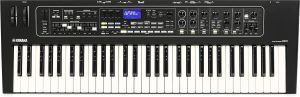
The CK61 is where this comparison changes direction completely.
This isn’t primarily a beginner keyboard.
It’s a compact stage keyboard designed for musicians who need immediate access to useful sounds and controls during performance.
The CK61 has:
- 61 FSB keys with initial touch
- 363 voices
- 128-note polyphony
- Piano sounds
- Electric pianos
- Organs
- Synths
- Effects
- Hands-on controls
- Built-in speakers
- Professional connectivity
And despite its capabilities, it remains remarkably portable.
Why the CK61 Is Different
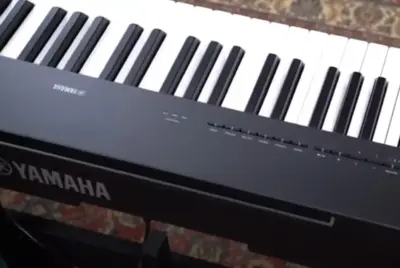
Look at its front panel and the difference becomes obvious.
The CK61 is built around real-time control.
Instead of spending a performance navigating layers of menus, the player gets dedicated controls for manipulating:
- Organ
- Synth
- Effects
- Filters
- Sound combinations
That matters on stage.
If you need to change a sound during a song, you want the adjustment to be immediate.
FSB Keyboard Action
The CK61 uses Yamaha’s 61-key FSB action.
It isn’t designed to imitate an 88-key hammer-action piano.
Instead, the action suits keyboard, organ and synth playing.
That makes sense because a professional keyboardist may switch during one performance among:
- Acoustic piano
- Electric piano
- Hammond-style organ
- Synth lead
- Pad
- Strings
A heavy piano action isn’t always ideal for all of those sounds.
Organ Controls
This is another major advantage over ordinary portable keyboards.
Organ players need a different kind of real-time control than pianists.
The CK61 gives performers dedicated access to organ-oriented functions, making it much more appropriate for stage use than a basic PSR keyboard.
Built-In Speakers on a Stage Keyboard
Interestingly, the CK61 includes built-in speakers.
That’s useful because many professional stage keyboards don’t.
For a major concert, you’ll still connect to a professional sound system.
But built-in speakers make the CK61 convenient for:
- Rehearsals
- Practice
- Small sessions
- Backstage preparation
- Casual playing
You can simply switch it on and play.
Who Should Buy the CK61?
Choose it if:
- You perform live.
- You’re a keyboardist rather than exclusively a pianist.
- You use organs and synths.
- You want real-time controls.
- Portability matters.
- You want professional flexibility.
For an absolute beginner, it’s probably unnecessary.
For a gigging musician, it may be the most interesting keyboard in this entire comparison.
[Check Yamaha CK61 Price on Amazon →]
Yamaha 61-Key Keyboards Compared
| Feature | PSR-E383 | PSR-E473 | CK61 | |
|---|---|---|---|---|
| Keys | 61 | 61 | 61 | |
| Touch Sensitive | Yes | Yes | Yes | |
| Weighted Hammer Action | No | No | No | |
| Best Use | Learning | Creativity | Live Stage | |
| Built-In Speakers | Yes | Yes | Yes | |
| Accompaniment | Yes | Yes | Limited stage focus | |
| Sampling | No major focus | Yes | No major focus | |
Which Yamaha 61-Key Keyboard Is Best for Beginners?
For most beginners:
Yamaha PSR-E383
It gives you the features that matter most at the beginning:
- Touch sensitivity
- Learning functions
- Plenty of sounds
- Accompaniment
- Built-in speakers
- Portability
without paying for advanced capabilities you may never use.
Which Is Best for Kids?
Again, I’d choose the PSR-E383 for most children.
It’s compact enough to fit easily into a bedroom or practice area, and the variety of sounds and accompaniment can help keep younger players engaged.
However, if a child is beginning formal classical piano lessons, ask the teacher whether an 88-key weighted digital piano would be preferable.
Which Is Best for Songwriting?
I’d choose between:
PSR-E473
For affordable creativity, beats and sampling.
PSR-SX600
For more sophisticated arranging and complete accompaniment.
They approach songwriting from different directions.
Which Is Best for Live Performance?
CK61.
That’s what it was designed to do.
Its combination of:
- Compact dimensions
- Stage-oriented sounds
- Organ controls
- Synth controls
- Effects
- Real-time interface
- Professional connections
makes it much more appropriate for regular live performance than a beginner PSR keyboard.
Which Is Best for Piano?
This requires a more nuanced answer.
If you specifically want a 61-key keyboard, any of these can provide useful piano sounds.
But if your main goal is learning traditional piano technique, I’d recommend leaving the 61-key category entirely and considering an 88-key weighted Yamaha such as the P-225.
Why?
Because piano study benefits from:
- 88 keys
- Hammer action
- Graded weighting
- Full piano range
[Internal link: Best Yamaha 88-Key Weighted Keyboards]
61 Keys vs 88 Keys
This is probably the most important decision before choosing any of these instruments.
Choose 61 Keys If:
- Portability matters.
- Space is limited.
- You play pop, rock or contemporary music.
- You want many sounds.
- You’re interested in songwriting.
- You’re a keyboardist rather than exclusively a pianist.
- You need a compact stage instrument.
Choose 88 Keys If:
- You’re studying classical piano.
- You want realistic piano technique.
- Hammer-weighted action matters.
- You play repertoire requiring the full piano range.
- Your main goal is becoming a pianist.
Neither format is universally superior.
They serve different musicians.
Is 61 Keys Enough to Learn Piano?
Yes, initially.
A beginner can learn an enormous amount on 61 keys.
But as repertoire advances, the missing upper and lower octaves can become limiting.
More importantly, many 61-key keyboards don’t have hammer-weighted action.
For casual playing, songwriting and keyboard skills, that’s perfectly acceptable.
For serious piano training, an 88-key hammer-action instrument is usually the better long-term investment.
What Features Should Beginners Look For?
If you’re buying a first 61-key keyboard, prioritize:
Touch Sensitivity
Essential for developing musical expression.
Built-In Speakers
Convenient for immediate practice.
Headphone Output
Very useful for quiet practice.
Sustain Pedal Input
Important as playing progresses.
USB Connectivity
Useful for learning apps and computers.
Metronome
Helpful for rhythm and timing.
Learning Functions
Useful, although they shouldn’t determine your entire purchase.
What Features Should Experienced Players Look For?
More experienced keyboardists may care about:
- Pitch bend
- Modulation
- Assignable controls
- Layering
- Splitting
- Effects
- Organ controls
- Synth editing
- Professional outputs
- MIDI
- Audio connectivity
- Registration memories
This is why the CK61 can make far more sense to a professional than a beginner keyboard with a larger number of preset sounds.
Don’t Buy Based on the Number of Voices
This is worth repeating.
One keyboard may advertise 650 sounds.
Another may have fewer.
That doesn’t automatically tell you which is better.
A beginner may use:
- Piano
- Electric piano
- Organ
- Strings
for most of the first year.
A professional may care much more about the quality and controllability of 20 useful sounds than having hundreds they never select.
Ask:
Are the sounds I actually need good?
That’s more important than the headline number.
Frequently Asked Questions
What is the best Yamaha 61-key keyboard for beginners?
The PSR-E383 is our first choice for most beginners because it combines 61 touch-sensitive keys, built-in learning functions, hundreds of sounds, accompaniment and strong portability.
Are Yamaha 61-key keyboards weighted?
Most Yamaha 61-key portable and stage keyboards are not hammer-weighted like an acoustic piano.
They may be touch-sensitive, but touch sensitivity and weighting are different things.
Is 61 keys enough for a beginner?
Yes, for many beginners.
It is particularly suitable for pop, contemporary music, songwriting and general keyboard learning.
For serious classical piano study, consider 88 weighted keys.
Can I play classical music on 61 keys?
You can play many beginner and intermediate pieces, but more advanced repertoire may require notes outside the 61-key range.
Which Yamaha 61-key keyboard is best for professional use?
The CK61 is the strongest stage-oriented choice in this comparison.
Which Yamaha is best for accompaniment?
The PSR-SX600 is designed specifically around sophisticated arranger and accompaniment functionality.
Which is better: PSR-E383 or PSR-E473?
Choose the PSR-E383 for straightforward beginner learning.
Choose the PSR-E473 if you want additional creative and performance-oriented features.
Should I buy 61 or 88 keys?
If you want a portable, versatile keyboard for contemporary music, 61 may be enough.
If your goal is serious piano study, 88 weighted keys are usually the better choice.
Final Verdict: Which Yamaha 61-Key Keyboard Should You Buy?
There’s no single winner because these four instruments serve very different musicians.
Best for Beginners — Yamaha PSR-E383
Affordable, touch-sensitive, portable and packed with useful learning features.
Best for Creativity — Yamaha PSR-E473
A strong step up for players interested in sampling, grooves, beats and songwriting.
Best for Live Performance — Yamaha CK61
The professional choice for keyboardists who want stage-ready sounds and immediate real-time control.
The most important decision isn’t actually which Yamaha model has the longest specification list.
It’s deciding what kind of musician you want the keyboard to help you become.
If you’re learning your first chords, start simple.
If you want to make beats and songs, prioritize creative features.
If you’re performing on stage, prioritize control and portability.
If you want sophisticated automatic accompaniment, consider an arranger.
And if your real goal is serious traditional piano study, don’t be afraid to skip 61 keys entirely and move to an 88-key weighted digital piano.
The best keyboard is the one designed for the kind of music you actually want to make. Finally, if price is one of your main considerations, see our Best Cheap Keyboards in 2026: 5 Budget Picks That Are Actually Worth Buying for affordable alternatives from Yamaha, Casio, Alesis, Donner and Roland. If you’ve encountered the older PSR-E373 while shopping, see our Yamaha PSR-E373 vs PSR-E383: Should You Still Buy the Older Keyboard in 2026? for a detailed look at what changed and which model makes more sense today.Related articles:
Eager to play the piano? SIMPLY PIANO app adapts to your skill level with a learning journey suited just for you.