Best Yamaha Digital Pianos for Intermediate Players in 2026
Reaching the intermediate stage of piano playing is exciting—but it can also expose the limitations of the instrument you started with.
A beginner digital piano may have been perfectly adequate for learning scales, basic chords, simple classical pieces and fundamental technique. But as your playing develops, you may begin to notice things that didn’t matter nearly as much during your first year or two.
Perhaps the keyboard action feels too light.
Maybe repeated notes don’t respond as naturally as you would like.
You may be working on more sophisticated pedaling, wider dynamic contrasts or repertoire that demands greater control.
Or perhaps you simply want a piano with better sound, stronger speakers and enough capability to serve you for many more years.
This is where choosing the right intermediate Yamaha digital piano becomes important.
Yamaha offers several excellent instruments at different price levels, from the compact and portable P-225, through the furniture-style YDP-166 Arius, to the premium portable P-525.
Which one is right for you?
In this guide, we’ll compare these models and explain what an intermediate pianist should prioritize when upgrading from a beginner instrument.
Disclosure: Some links on Pianos-Galore are affiliate links. If you purchase through these links, we may receive a small commission at no additional cost to you.
Our Top Yamaha Picks for Intermediate Players
| Model | Best For | Keyboard | Piano Sound |
|---|---|---|---|
| Yamaha P-225 | Best Value / Portable | GHC | Yamaha CFX |
| Yamaha YDP-166 | Best Home Piano | GrandTouch-E | Yamaha CFX |
| Yamaha P-525 | Best Premium Choice | GrandTouch-S | CFX + Bösendorfer Imperial |
These three models represent very different approaches.
The P-225 prioritizes portability and value.
The YDP-166 provides a traditional home-piano setup.
The P-525 provides the most sophisticated keyboard and sound system of the three for a pianist ready to move toward a premium instrument.
What Is an Intermediate Piano Player?
There is no universally agreed definition, because pianists progress at different rates.
But an intermediate player typically has moved beyond basic note reading and elementary technique.
You may already be comfortable with:
- Major and minor scales
- Arpeggios
- Chord inversions
- Independent hand movement
- Basic pedaling
- Dynamic markings
- Sight-reading simpler pieces
- Playing in several keys
- Intermediate classical repertoire
- Pop, jazz or worship arrangements using fuller harmony
At this stage, your instrument begins to influence your development more noticeably.
A very basic keyboard may still produce the correct notes, but that doesn’t mean it gives you the control required to refine technique.
That’s why upgrading at the intermediate stage can be worthwhile.
What Should an Intermediate Pianist Look for?
1. A Better Keyboard Action
This should usually be your first priority.
A beginning pianist can learn basic concepts on many different keyboards.
As you progress, however, the details of the action become increasingly important.
You begin working on:
- Very soft playing
- Strong accents
- Repetition
- Legato control
- Voicing chords
- Balance between melody and accompaniment
- Fast scales
- Dynamic contrasts
A more responsive action gives your fingers greater control over these nuances.
For traditional piano study, I would strongly favor 88 weighted keys with graded hammer action.
2. Full 88-Key Range
Intermediate repertoire increasingly uses more of the keyboard.
If you started on 61 or 76 keys, this is an excellent time to move to the standard 88-key piano range.
That is especially important for classical repertoire.
All three Yamaha models recommended in this guide provide 88 weighted keys.
If you’re unsure how much keyboard action matters as your technique develops, our guide to weighted keyboard keys explains hammer action, graded weighting and realistic piano feel in greater detail.
3. More Realistic Dynamic Response
Intermediate playing is no longer simply about hitting the correct notes.
You need to shape musical phrases.
That means controlling:
pianissimo → piano → mezzo piano → mezzo forte → forte → fortissimo
and everything in between.
A good intermediate digital piano should translate small differences in your touch into meaningful changes in sound.
4. Better Pedal Capability
The sustain pedal becomes increasingly sophisticated as repertoire advances.
A simple on/off footswitch may have been enough when you started.
Intermediate pianists should look for half-pedal support and, ideally, compatibility with a proper three-pedal system.
The three traditional pedals are:
- Damper
- Sostenuto
- Soft
You may not use all three constantly, but a proper pedal setup becomes increasingly relevant for serious classical study.
5. Better Piano Sound
At the intermediate level, you may become more sensitive to:
- Sustain
- Resonance
- Bass character
- Treble clarity
- Dynamic tonal changes
- Pedal resonance
- Note decay
Yamaha’s current intermediate and premium models increasingly use its CFX concert-grand sound and resonance technologies.
6. An Instrument You Won’t Quickly Outgrow
This is important economically.
The cheapest upgrade isn’t always the best value.
If you buy a slightly better instrument and replace it again in two years, you may ultimately spend more than if you had purchased a stronger long-term piano now.
Think about where you expect your playing to be in:
three years, five years, perhaps ten years.
1. Yamaha P-225 — Best Value for Intermediate Players
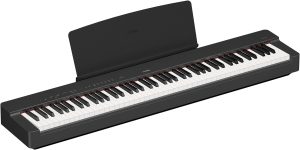
The Yamaha P-225 is my strongest recommendation for intermediate pianists who want an instrument that combines good piano fundamentals with portability and a relatively accessible price.
It uses Yamaha’s Graded Hammer Compact (GHC) 88-key keyboard.
The action provides heavier resistance in the lower register and progressively lighter weighting toward the treble, while keeping the instrument physically compact.
The P-225 also uses Yamaha’s CFX concert-grand piano sound, VRM Lite, key-off samples and 192-note polyphony.
Why the P-225 Works Well for Intermediate Players
An intermediate pianist usually doesn’t need hundreds of novelty sounds.
The priorities are more fundamental.
The P-225 gives you:
- 88 weighted GHC keys
- Yamaha CFX piano tone
- 192-note polyphony
- VRM Lite
- 24 onboard voices
- Split and layer functions
- Two-track MIDI recording
- USB audio/MIDI
- Dedicated AUX outputs
- Built-in speakers
- Three-pedal compatibility
Its USB audio interface supports 44.1 kHz, 24-bit stereo audio, which also makes the P-225 useful for home recording.
Portability
The P-225 weighs approximately 11.5 kg / 25 lb 6 oz.
That’s relatively light for an 88-key weighted digital piano.
This is particularly useful if you:
- Attend rehearsals
- Perform occasionally
- Live in an apartment
- Move frequently
- Need to store the piano
- Want one instrument for both home and outside use
Three-Pedal Upgrade
The P-225 supports Yamaha’s optional pedal systems.
This is worth considering for intermediate classical students because it allows the portable instrument to become a more complete home practice setup.
You can combine:
P-225 + dedicated stand + three-pedal system
and create something much closer to a console-style digital piano while still retaining the option of removing the keyboard for transport.
Who Should Buy the P-225?
Choose the P-225 if:
- You are moving beyond a beginner instrument.
- Portability matters.
- You want Yamaha CFX piano sound.
- Space is limited.
- You want recording/computer connectivity.
- You don’t yet need a premium wooden-key action.
If the P-225 is high on your shortlist, our detailed Yamaha P-225 review takes a closer look at its strengths, limitations and ideal users.
Best for: Intermediate pianists wanting excellent value and portability.
Check out the price of Yamaha P-225 at Amazon
2. Yamaha YDP-166 — Best Yamaha Home Piano for Intermediate Players
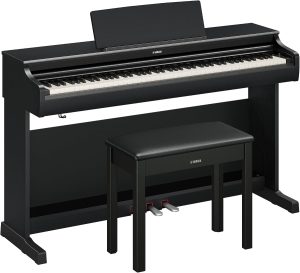
If portability isn’t important and you want a more traditional piano setup, the Yamaha Arius YDP-166 deserves serious consideration.
This is particularly timely because the YDP-166 is part of Yamaha’s new-generation 2026 Arius lineup.
Yamaha specifically describes the YDP-166 as suitable for beginners and intermediate players.
Most importantly, it introduces Yamaha’s GrandTouch-E keyboard.
GrandTouch-E Keyboard
The YDP-166 uses an 88-key GrandTouch-E action with:
- Synthetic ebony and ivory keytops
- Escapement
- Adjustable touch sensitivity
This gives the YDP-166 a more piano-oriented home experience than simply putting a portable keyboard on a stand.
For an intermediate player working on increasingly subtle technique, the keyboard is one of the biggest reasons to consider this model.
Yamaha CFX Piano Sound
Like the P-225, the YDP-166 uses Yamaha’s CFX piano sound.
It also incorporates VRM Lite to reproduce some of the resonances that occur when strings, dampers and other components interact inside an acoustic piano.
Maximum polyphony is 192 notes.
Traditional Three-Pedal System
The YDP-166 includes:
- Damper pedal with half-pedal function
- Sostenuto
- Soft pedal
That is particularly valuable for intermediate classical students.
Rather than adding an optional pedal unit later, you already have a complete traditional pedal setup integrated into the instrument.
Stronger Home-Piano Presentation
The YDP-166 incorporates:
- Furniture-style cabinet
- Sliding key cover
- Music rest
- Three pedals
- 20W × 2 amplification
- Two 12 cm speakers with diffuser grilles
- Two headphone connections
It therefore feels more like a permanent piano installation than a portable slab instrument.
Bluetooth and Smart Features
Yamaha also provides Bluetooth Audio/MIDI in supported markets and Smart Pianist app compatibility.
These features are useful, but they shouldn’t be your main reason for buying it.
The YDP-166’s real appeal is:
GrandTouch-E action + CFX sound + proper pedals + permanent home-piano format.
Who Should Buy the YDP-166?
Choose it if:
- The piano will remain at home.
- You’re serious about continuing lessons.
- Classical study is important.
- You want an integrated pedal system.
- You prefer a traditional cabinet.
- Keyboard feel matters more than portability.
Players who prefer a permanent cabinet and integrated pedals can also compare other furniture-style options in our guide to digital upright pianos for the home.
Best for: Intermediate students wanting a dedicated Yamaha home digital piano.
Check out the price of Yamaha YDP-166 at Amazon
3. Yamaha P-525 — Best Premium Yamaha for Intermediate and Advanced Players
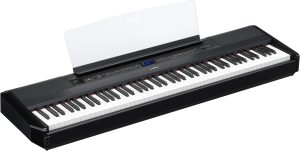
The Yamaha P-525 is in a different class from the P-225.
It is the model I would consider if you’re an intermediate pianist who wants an instrument capable of remaining useful well into advanced playing.
Its most significant advantages are:
GrandTouch-S keyboard + wooden white keys + CFX and Bösendorfer Imperial piano sounds + more advanced resonance and expression technology.
GrandTouch-S Keyboard
The P-525 uses Yamaha’s GrandTouch-S keyboard.
It incorporates:
- 88 graded weighted keys
- Wooden white keys
- Synthetic ebony and ivory keytops
- Escapement
This is a substantial step upward from the compact GHC action used in the P-225.
For a pianist becoming increasingly sensitive to touch, that difference can be meaningful.
Two Premium Concert-Grand Sounds
The P-525 includes both:
Yamaha CFX
and
Bösendorfer Imperial.
This gives you two very different acoustic-grand personalities.
You may prefer one for classical repertoire and another for jazz or ballads.
The advantage is that you can choose according to the music rather than being locked into a single tonal character.
Virtual Resonance Modeling
The P-525 uses Yamaha’s fuller Virtual Resonance Modeling system rather than VRM Lite.
It also adds Grand Expression Modeling, designed to reproduce variations resulting from differences in the pianist’s touch.
These technologies become increasingly meaningful at the intermediate and advanced levels because you’re using a broader dynamic and expressive range.
256-Note Polyphony
The P-525 provides 256-note maximum polyphony.
Again, don’t buy it simply because 256 is larger than 192.
But the additional capacity is useful for:
- Complex repertoire
- Heavy pedaling
- Layered sounds
- Recording
- Advanced arrangements
Recording Capability
The P-525 is particularly strong for musicians who record their playing.
It provides:
- 16-track MIDI recording
- Audio recording to USB
- USB audio interface
- MIDI In/Out
- AUX outputs
- USB-to-device
- USB-to-host
This gives it substantially greater recording capability than many simpler digital pianos.
Internal link: Link home recording to your refreshed Best Digital Pianos for Home Recording article.
Speaker System
The P-525 uses a multi-speaker arrangement powered by:
(20W + 6W) × 2
This gives the instrument substantially more onboard amplification than the P-225.
The Trade-Off: Weight
Premium action and speakers increase weight.
The P-525 weighs approximately 22 kg / 48 lb 8 oz.
So although Yamaha classifies it as a portable piano, it isn’t something most players will casually carry under one arm.
Think of it as:
transportable rather than lightweight.
Who Should Buy the P-525?
Choose the P-525 if:
- You’re an established intermediate pianist.
- You expect to progress toward advanced repertoire.
- Keyboard feel is increasingly important.
- You want CFX and Bösendorfer sounds.
- You record or perform.
- You want a long-term premium instrument.
- Your budget allows the upgrade.
If recording is an important part of your playing, compare the P-525 with other suitable instruments in our guide to digital pianos for recording music at home.
Best for: Serious intermediate players wanting an instrument capable of carrying them well into advanced playing.
Check out the price of Yamaha P-525 at Amazon
Yamaha P-225 vs YDP-166: Which Is Better?
These two instruments are aimed at slightly different buyers.
Choose the P-225 if you prioritize:
- Portability
- Lower weight
- Smaller physical footprint
- USB recording/connectivity
- Flexible placement
- Lower overall cost
Choose the YDP-166 if you prioritize:
- Permanent home setup
- GrandTouch-E keyboard
- Traditional cabinet
- Integrated three pedals
- More piano-like playing environment
An intermediate student living in an apartment and moving frequently may prefer the P-225.
A student living permanently at home and practicing classical repertoire daily may prefer the YDP-166.
Neither is universally better.
Yamaha P-225 vs P-525: Is the Upgrade Worth It?
This is a more straightforward comparison.
The P-525 is the more sophisticated instrument.
P-225
- GHC action
- CFX piano sound
- VRM Lite
- 192-note polyphony
- Lightweight at 11.5 kg
- Excellent value
P-525
- GrandTouch-S action
- Wooden white keys
- CFX + Bösendorfer Imperial
- Full VRM
- Grand Expression Modeling
- 256-note polyphony
- Stronger speakers
- Much greater recording capability
- 22 kg
The question is whether you are ready to benefit from those improvements.
For a newly intermediate player, the P-225 may be entirely sufficient.
For an experienced intermediate pianist who already notices the limitations of an entry-level action, the P-525 becomes much more attractive.
YDP-166 vs P-525
This is essentially:
premium home piano vs premium portable piano.
The YDP-166 gives you:
- Permanent cabinet
- Integrated three pedals
- GrandTouch-E action
- Home-oriented speaker system
The P-525 gives you:
- GrandTouch-S action
- Wooden white keys
- CFX + Bösendorfer
- Full VRM
- Advanced recording
- Greater sound selection
- Transportability
Choose according to how you use the instrument.
Should an Intermediate Pianist Upgrade From a Beginner Piano?
Not automatically.
If your existing piano has:
- 88 weighted keys
- Good touch response
- Appropriate pedal support
- Reliable speakers
- Good dynamic control
you may not need to upgrade immediately.
Upgrade when the instrument itself begins limiting you.
Signs can include:
- Key action feels too light or crude.
- Fast repetition is difficult.
- Dynamics feel difficult to control.
- Pedaling is too basic.
- You have outgrown a 61- or 76-key range.
- The speaker system no longer satisfies you.
- Recording/connectivity limitations matter.
- Your teacher recommends a better action.
Don’t replace an instrument solely because you’ve reached a particular grade or number of years of playing.
How Important Is Keyboard Action at the Intermediate Level?
Very important.
Intermediate playing increasingly requires you to make one hand or even one finger stand out while others remain softer.
For example, you may need to play:
melody strongly in the right-hand fifth finger
while keeping:
inner harmony considerably softer.
That demands finger independence and keyboard control.
A better action doesn’t magically create technique.
But it gives you a better physical platform on which to develop that technique.
Do Intermediate Players Need 88 Keys?
Yes, I strongly recommend them.
By the intermediate level, the limitations of shorter keyboards become increasingly noticeable.
This is especially true for:
- Classical repertoire
- Jazz
- Complex arrangements
- Advanced accompaniment
- Four-hand music
All three models recommended here provide the standard 88-key range.
Internal link: Link 88 weighted keys to your 88 Keyboard Keys pillar page.
Do Intermediate Players Need Three Pedals?
Not necessarily every day—but classical students increasingly benefit from access to them.
The damper pedal remains by far the most frequently used.
But advanced repertoire may also call for:
- Sostenuto
- Soft pedal
The YDP-166 integrates all three.
The P-225 and P-525 support compatible external pedal systems.
Which Yamaha Is Best for Classical Music?
For intermediate classical students, I would narrow the choices this way.
Best Value
Yamaha P-225
Good 88-key weighted action, CFX sound and portability.
Best Traditional Practice Setup
Yamaha YDP-166
GrandTouch-E action and a permanent three-pedal home-piano configuration.
Best Long-Term Premium Choice
Yamaha P-525
GrandTouch-S action, wooden white keys, advanced sound modeling and greater expressive capabilities.
Internal link: Link digital piano for classical music to your refreshed classical-piano article.
Which Yamaha Is Best for Pop, Jazz and Contemporary Music?
The P-225 and P-525 are particularly flexible because they’re portable and provide multiple voices, split/layer functions and external connectivity.
The P-525 offers a much wider palette and more advanced control.
However, if you’re mainly a performer who needs stage-oriented controls rather than a home/portable piano, you may eventually want to investigate Yamaha’s dedicated stage-keyboard families separately.
Which Yamaha Is Best for Home Recording?
The P-225 already offers excellent recording value because it includes USB audio/MIDI.
The P-525 goes considerably further, with multi-track MIDI recording, WAV audio recording and broader connectivity.
For a pianist who also composes or produces music, that can justify moving upward.
Should an Intermediate Player Buy an Acoustic Piano Instead?
Possibly.
Digital pianos offer major practical benefits:
- Headphones
- No tuning
- Adjustable volume
- Recording
- USB/MIDI
- Lower maintenance
- Easier relocation
An acoustic piano provides:
- Genuine mechanical action
- Physical string vibration
- Natural soundboard resonance
- Traditional acoustic projection
If your musical goal is advanced classical piano, regular access to a good acoustic instrument can become increasingly valuable.
But a high-quality digital piano remains an excellent practice instrument, particularly where volume, maintenance or space make acoustic ownership difficult.
Intermediate players are only one part of Yamaha’s range; see our complete Yamaha digital-piano lineup guide for beginner, home and advanced options as well.
Frequently Asked Questions
What is the best Yamaha digital piano for an intermediate player?
For most buyers, the Yamaha P-225 provides an excellent balance of price, CFX sound, 88 weighted keys and portability.
For serious home practice, consider the YDP-166.
For a premium long-term instrument, the P-525 is the strongest choice of the three.
Is the Yamaha P-225 good for intermediate players?
Yes.
It provides an 88-key GHC weighted keyboard, Yamaha CFX piano sound, VRM Lite, 192-note polyphony and useful recording/connectivity features.
Is the Yamaha YDP-166 good for intermediate piano?
Yes.
Yamaha specifically positions the new YDP-166 for beginner and intermediate players. Its GrandTouch-E keyboard, CFX sound and integrated three-pedal system make it particularly appropriate for home study.
Is the Yamaha P-525 too advanced for an intermediate player?
No.
An intermediate pianist can absolutely benefit from it.
The question is whether the higher price is justified by your playing level, budget and long-term plans.
Should I upgrade from a Yamaha P-125?
If your P-125 still serves your needs, there is no urgent reason to replace it.
But if you want better sound technology, a newer compact action and modern connectivity, the P-225 is the current-generation option to investigate.
If you want a more significant upgrade in touch, compare the P-525.
How many keys should an intermediate pianist have?
I strongly recommend 88 keys.
Do intermediate players need weighted keys?
Yes, if traditional piano development is the objective.
At this level, weighted action becomes increasingly important for dynamic control and technical development.
Is Yamaha better than Roland or Kawai for intermediate players?
Not universally.
Yamaha, Roland and Kawai all make excellent instruments.
Play comparable models whenever possible and choose according to keyboard feel, sound, features and budget.
Can intermediate players use headphones for practice?
Absolutely.
Headphone practice is one of the major advantages of digital pianos.
However, regularly practicing through the speakers is also useful because it helps you judge projection and balance differently.
Final Verdict
An intermediate pianist shouldn’t upgrade merely to obtain more features.
The most valuable improvements are usually:
better key action + better dynamic control + better piano sound + proper pedal support + enough capability to support future progress.
For most intermediate players, the Yamaha P-225 is an excellent value choice. It combines Yamaha CFX sound, 88 weighted GHC keys, portability and useful recording connectivity.
For students who want a permanent home piano, the Yamaha YDP-166 is particularly attractive. Yamaha’s new GrandTouch-E action, integrated three-pedal system and traditional cabinet create a more complete piano-learning environment.
And for serious intermediate players who want an instrument capable of remaining useful well into advanced playing, the Yamaha P-525 is the standout premium choice.
Its GrandTouch-S action, wooden white keys, CFX and Bösendorfer Imperial piano sounds, full VRM and Grand Expression Modeling represent a substantial step beyond entry-level digital pianos.
But specifications should only create your shortlist.
Whenever possible:
play the instruments yourself.
Play scales softly.
Play loud chords.
Try fast repeated notes.
Use the damper pedal.
Play music you know well.
The right intermediate piano should not merely accommodate the music you can play today.
It should give you room to become the pianist you want to be tomorrow.
For a broader view of how piano requirements change as your technique develops, see our digital piano recommendations by skill level, from beginner through advanced.
Intermediate players comparing Yamaha with another piano-focused brand may also find our Yamaha vs Kawai digital piano comparison useful.
If you’re not specifically shopping for an intermediate-level instrument, our broader Yamaha digital piano guide compares Yamaha choices for several different types of players.