Best Stylish Digital Pianos for Modern Homes in 2026: 7 Beautiful Picks
A digital piano does not have to look like a piece of electronic equipment sitting in the corner of your living room.
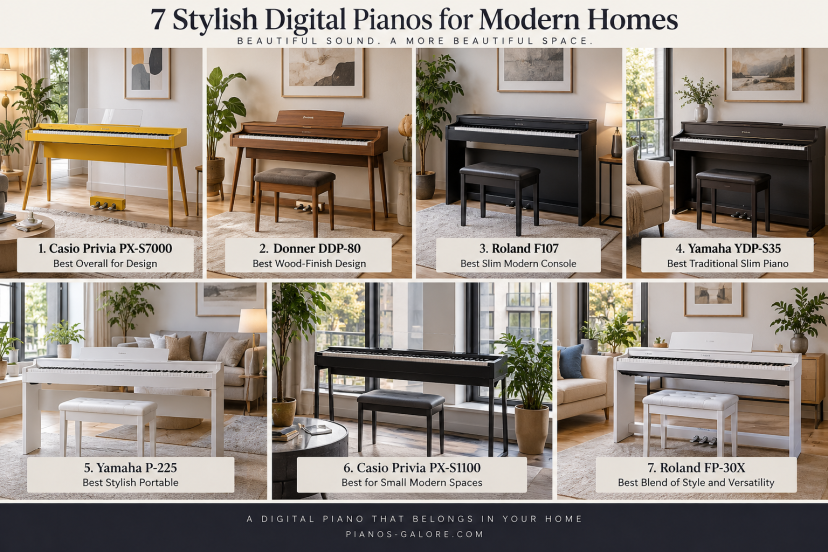
Today’s best stylish digital pianos combine realistic weighted keys and convincing piano sound with designs that can complement modern interiors. Some resemble elegant furniture. Others use slim cabinets, wood finishes, clean lines, hidden controls, or minimalist stands that make them much easier to integrate into a living room, bedroom, studio, or apartment.
For many buyers, this matters.
A piano may remain in the same room for years. Unlike headphones, laptops, or other music accessories that can be stored away, a piano often becomes part of the furniture. That means appearance, size, finish, and visual footprint can be almost as important as sound and keyboard action.
In this guide, we compare seven digital pianos that stand out not simply because they play well, but because they can also look good in your home.
Quick recommendations
| Digital Piano | Best For | Design Style | Keyboard |
|---|---|---|---|
| Casio PX-S7000 | Best Overall for Design | Premium contemporary | 88 weighted keys |
| Donner DDP-80 | Best Wood-Finish Design | Scandinavian/minimalist | 88 weighted keys |
| Roland F107 | Best Slim Console | Modern minimalist | 88 weighted keys |
| Yamaha YDP-S35 | Best Traditional Slim Piano | Contemporary classic | 88 weighted keys |
| Yamaha P-225 | Best Stylish Portable | Clean, understated | 88 weighted keys |
| Casio PX-S1100 | Best for Small Modern Spaces | Ultra-minimalist | 88 weighted keys |
| Roland FP-30X | Best Blend of Style and Versatility | Modern portable | 88 weighted keys |
Some links on Pianos-Galore are affiliate links. If you purchase through these links, we may receive a small commission at no additional cost to you.
1. Casio Privia PX-S7000 — Best Overall Stylish Digital Piano
Best for: Buyers who want a digital piano that looks deliberately designed as part of a modern interior.
The Casio Privia PX-S7000 is one of the clearest examples of how digital-piano design has changed.
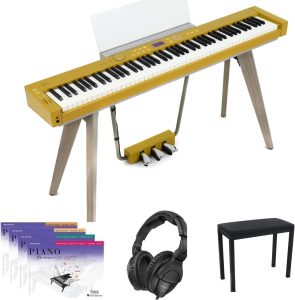
Instead of looking like a keyboard placed on a generic stand, the PX-S7000 integrates the instrument, stand, pedals, speaker fabric, and controls into one visually coordinated design.
Casio offers it in black, white, and a distinctive Harmonious Mustard finish. The wooden stand and matching pedal structure give the piano a furniture-like appearance, while the transparent acrylic music rest helps preserve the clean visual profile.
Its front-to-back depth is only about 242 mm, which is remarkably slim for an 88-key piano with an integrated stand and pedals.
That makes it especially appealing in:
- contemporary living rooms
- apartments
- minimalist interiors
- open-plan homes
- rooms where the piano will remain permanently visible
The visual design does not come at the expense of playability. The PX-S7000 uses Casio’s Multi-Dimensional Morphing AiR sound system and an 88-key weighted keyboard designed to reproduce a more piano-like response.
Why it stands out aesthetically
The biggest difference is that the PX-S7000 looks finished from virtually every angle.
Traditional console digital pianos are usually designed to sit against a wall. The PX-S7000 can look convincing even in a more open area of a room.
Its touch controls also reduce the number of visible buttons, contributing to a cleaner appearance.
Key strengths
- exceptionally attractive integrated design
- very slim depth
- coordinated stand and pedals
- multiple distinctive finishes
- 88 weighted keys
- sophisticated modern appearance
Possible drawback
You are paying partly for design. Buyers interested primarily in maximum piano performance per dollar may find less expensive alternatives.
Design verdict: ★★★★★
For buyers who regard a piano as both a musical instrument and an interior-design feature, the PX-S7000 is our top choice.
[Check Casio PX-S7000 Price on Amazon →]
2. Donner DDP-80 — Best Wood-Finish Digital Piano
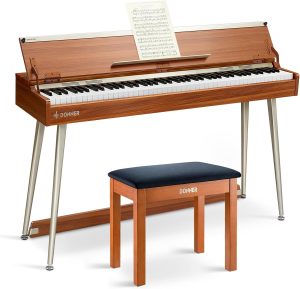
Best for: Buyers who want a warm, furniture-like piano without the visual appearance of conventional electronic keyboards.
The Donner DDP-80 takes a very different approach from most digital pianos.
Rather than emphasizing buttons, screens, control panels, or glossy black plastic, Donner gives the DDP-80 a warm wood-finish cabinet supported by four simple legs.
The result looks almost like a cross between a piano and a piece of Scandinavian-style furniture.
Donner itself describes the design as a combination of modern home aesthetics and classic piano quality. The cabinet houses an 88-key fully weighted keyboard, three-pedal unit, USB-MIDI connectivity, headphone output, and stereo speakers.
For buyers furnishing a room with wood, neutral colors, plants, light walls, or minimalist décor, the DDP-80 can blend into the space unusually well.
Why it stands out aesthetically
Most affordable digital pianos look unmistakably electronic.
The DDP-80 doesn’t.
Its controls are visually restrained, and its wooden legs create an open appearance rather than the heavier cabinet style of traditional console pianos.
It can therefore work particularly well in:
- Scandinavian-inspired interiors
- mid-century-modern rooms
- neutral or earth-tone décor
- apartments
- home offices
- minimalist living rooms
Key strengths
- unusually attractive wood finish
- 88 fully weighted keys
- 128-note polyphony
- three-pedal unit
- 2 × 20-watt speaker system
- USB-MIDI
- furniture-oriented design
Possible drawback
The DDP-80 is intentionally piano-focused and does not provide the broad feature set of some multipurpose digital pianos.
That may actually be a positive for buyers who prefer simplicity.
Design verdict: ★★★★★
Among relatively affordable home digital pianos, few make as strong a visual statement as the DDP-80.
[Check Donner DDP-80 Price on Amazon →]
3. Roland F107 — Best Slim Modern Console Piano
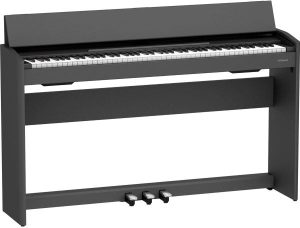
Best for: Modern apartments and homes where buyers want a proper console-style piano without a bulky cabinet.
The Roland F107 is designed specifically around the idea of fitting a serious digital piano into a contemporary living space.
Its cabinet is slim, simple, and understated. Instead of trying to imitate a large traditional upright piano, Roland keeps the proportions compact and modern.
That makes the F107 especially attractive for buyers who want a piano that looks permanent and substantial without dominating the room.
Inside, the F107 uses Roland’s PHA-4 Standard 88-key keyboard and SuperNATURAL piano technology.
This is important because the F107 isn’t simply decorative furniture. It provides the type of weighted action students and recreational pianists can use for genuine piano practice.
Why it stands out aesthetically
The F107 has fewer visual distractions than many console pianos.
The cabinet lines are clean, controls are discreet, and the instrument is designed to sit neatly against a wall.
It works particularly well with:
- contemporary furniture
- monochrome interiors
- compact apartments
- clean architectural spaces
- modern home offices
Roland says its styling draws from the higher-end F701, a design that received a Red Dot design award.
Key strengths
- slim console cabinet
- 88-key PHA-4 Standard action
- Roland SuperNATURAL piano technology
- Bluetooth connectivity
- integrated pedals
- understated modern appearance
Possible drawback
It is less portable than a slab-style piano such as the Yamaha P-225 or Roland FP-30X.
Design verdict: ★★★★½
For someone who wants a permanent home piano with contemporary styling, the F107 is an excellent balance of aesthetics and serious piano functionality.
[Check Roland F107 Price on Amazon →]
4. Yamaha Arius YDP-S35 — Best Slim Piano with Traditional Character
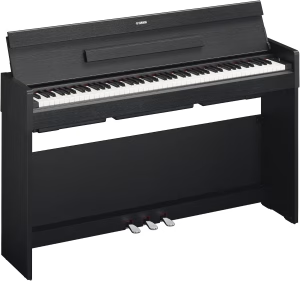
Best for: Buyers who like the appearance of a traditional home piano but need something substantially slimmer.
The Yamaha YDP-S35 occupies an interesting middle ground.
It looks more recognizably like a piano than the highly minimalist Casio or Donner designs, yet its cabinet is significantly slimmer than many conventional console digital pianos.
That gives it a refined appearance without making the room feel crowded.
The keyboard lid is particularly useful from a design standpoint. When closed, it creates a flat, relatively unobtrusive top surface and conceals the keys.
Yamaha describes the YDP-S35 as a slim and stylish Arius model designed to fit neatly into a room.
Musically, it offers:
- Yamaha CFX concert-grand piano sound
- 88-key Graded Hammer Standard keyboard
- Virtual Resonance Modeling Lite
- three-pedal console configuration
- Smart Pianist compatibility
The result is suitable for students, adult learners, and recreational pianists who want a conventional piano experience without installing a large acoustic upright.
Why it stands out aesthetically
The YDP-S35 works particularly well in rooms where an ultra-modern keyboard might look out of place.
It is a good match for:
- traditional interiors
- transitional décor
- smaller living rooms
- bedrooms
- formal spaces
- homes where the piano should resemble furniture
Key strengths
- elegant slim cabinet
- key-cover lid
- Yamaha CFX piano voice
- 88 GHS weighted keys
- three-pedal layout
- understated traditional styling
Possible drawback
If your décor is extremely minimalist, the Casio PX-S7000, PX-S1100, or Donner DDP-80 may appear more contemporary.
Design verdict: ★★★★½
The YDP-S35 is one of the strongest choices for buyers who want a real home-piano appearance without the bulk of a conventional upright.
[Check Yamaha YDP-S35 Price on Amazon →]
5. Yamaha P-225 — Best Stylish Portable Digital Piano
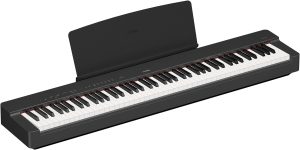
Best for: Buyers who want an attractive piano that can still be moved, stored, or taken to another location.
Not everyone wants a permanent furniture-style piano.
For those buyers, the Yamaha P-225 is one of the most attractive portable alternatives.
Yamaha redesigned the P-Series chassis to make the P-225 shorter and thinner than its predecessor. The company specifically describes the instrument as stylish enough to blend into a room and offers it in black and white.
Unlike many portable keyboards, the P-225 also looks much more substantial when paired with Yamaha’s matching furniture-style stand and three-pedal unit.
That gives owners two options:
Portable setup: place it on a conventional keyboard stand and move it when necessary.
Home setup: combine it with the matching stand and pedals so it resembles a slim digital console.
The keyboard uses Yamaha’s 88-key Graded Hammer Compact action, while its main piano sound is derived from Yamaha’s CFX concert grand.
Why it stands out aesthetically
The P-225 is a good example of restrained industrial design.
It doesn’t try to become the centerpiece of a room. Instead, its clean horizontal profile allows it to blend into the environment.
That makes it particularly appropriate for:
- apartments
- bedrooms
- multipurpose rooms
- home studios
- players who relocate frequently
- musicians who occasionally perform outside the home
Key strengths
- slim, attractive body
- available in black or white
- 88 weighted keys
- Yamaha CFX-based piano sound
- optional matching furniture stand
- portable enough for flexible use
Possible drawback
Without the matching stand, a portable piano may still look more like musical equipment than furniture.
Design verdict: ★★★★½
If you want both aesthetics and portability, the P-225 is one of the best compromises.
[Check Yamaha P-225 Price on Amazon →]
6. Casio Privia PX-S1100 — Best for Small Modern Spaces

Best for: Apartments, bedrooms, studios, and other rooms where every inch of space matters.
The Casio Privia PX-S1100 is built around extreme slimness.
Casio lists a front-to-back depth of approximately 232 mm, making it one of the shallowest full-size digital pianos in its class.
That slim profile can make an enormous difference in small rooms.
A conventional console piano may extend much farther into a walkway or living area. The PX-S1100 can sit much closer to the wall while still providing 88 weighted keys.
The design is deliberately minimalist. Touch-sensitive controls keep the top surface uncluttered, while black, white, red, and selected limited-edition finishes can suit different interiors.
Why it stands out aesthetically
Its strongest visual feature is actually what is absent.
There are very few physical buttons, knobs, sliders, or visible controls.
When switched off, the piano can look almost like a simple horizontal design object rather than a complicated electronic keyboard.
Pair it with Casio’s matching stand and pedal unit and it becomes substantially more furniture-like.
Key strengths
- extremely slim body
- minimalist control surface
- multiple color choices
- full 88-key weighted keyboard
- excellent for limited floor space
- portable enough to move when necessary
Possible drawback
Players wanting the appearance of a traditional piano cabinet may prefer the Yamaha YDP-S35 or Roland F107.
Design verdict: ★★★★½
For contemporary apartments and compact rooms, the PX-S1100 is difficult to beat.
[Check Casio PX-S1100 Price on Amazon →]
7. Roland FP-30X — Best Blend of Style, Performance and Flexibility
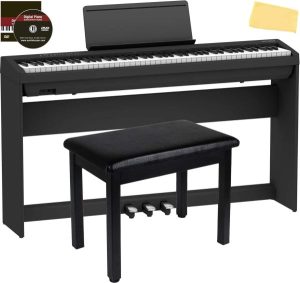
Best for: Buyers who want one piano for home practice, lessons, recording, and occasional performances.
The Roland FP-30X may not be the most visually dramatic piano in this list, but it deserves inclusion because of its versatility.
Its cabinet is slim and relatively understated, and it is available in black or white. Like the Yamaha P-225, it can be used as a portable piano or combined with a matching stand and pedal system to create a much more polished home installation.
Roland equips the FP-30X with its 88-note PHA-4 Standard keyboard and SuperNATURAL piano technology.
It also has Bluetooth connectivity and stronger onboard speakers than the entry-level FP-10.
This makes it particularly attractive for buyers who don’t want to choose between:
- a home piano
- a learning piano
- a portable instrument
- a piano for occasional performance
Why it stands out aesthetically
With the matching furniture stand and pedals, the FP-30X becomes a clean modern home piano.
Remove it from the stand, and it remains portable enough for other uses.
Few furniture-style pianos provide that flexibility.
Key strengths
- clean contemporary design
- black and white finishes
- PHA-4 Standard weighted keyboard
- SuperNATURAL piano sound
- Bluetooth audio and MIDI
- optional furniture-style stand and pedals
- strong long-term versatility
Possible drawback
Its appearance is conservative compared with the more design-led PX-S7000 or DDP-80.
Design verdict: ★★★★☆
For buyers who care about appearance but put versatility first, the FP-30X remains an excellent choice.
[Check Roland FP-30X Price on Amazon →]
Which Stylish Digital Piano Should You Choose?
There is no single design that will look best in every home.
The right choice depends heavily on your interior, available space, playing requirements, and whether you want the piano to stand out or disappear into the room.
Choose the Casio PX-S7000 if…
You want the piano itself to become a design feature.
Its integrated stand, coordinated pedals, premium finish options, and unusually clean proportions make it our strongest recommendation for design-conscious buyers.
Choose the Donner DDP-80 if…
You prefer natural wood and minimalist furniture styling.
It is particularly attractive in Scandinavian, contemporary, or earth-tone interiors.
Choose the Roland F107 if…
You want a slim permanent console piano that looks modern without attracting too much attention.
Choose the Yamaha YDP-S35 if…
You prefer a traditional piano appearance but don’t have room for a full-depth console or acoustic upright.
Choose the Yamaha P-225 if…
You need portability as well as attractive styling.
Choose the Casio PX-S1100 if…
Your priority is minimal floor space and a clean modern look.
Choose the Roland FP-30X if…
You want a piano that can handle home use, serious practice, technology, and occasional performance.
What Makes a Digital Piano Look Good in a Home?
Appearance is subjective, but there are several practical design factors worth considering.
1. Cabinet Depth
One of the most important measurements is often not width but depth.
Nearly all full-size digital pianos must accommodate 88 keys, so their width is relatively similar.
Depth varies much more.
A slim piano can project several inches less into a room, which can make a surprisingly large difference in an apartment, bedroom, hallway, or multipurpose living space.
Before ordering, measure:
- available wall width
- maximum acceptable depth
- bench space
- walking clearance
- clearance for opening doors or cabinets
2. Portable Piano vs Furniture-Style Piano
Portable digital pianos offer maximum flexibility.
You can move them, put them away, take them to another room, or transport them to performances.
But a conventional X-style keyboard stand rarely looks elegant in a living room.
If appearance matters, look for a portable piano with an optional matching furniture stand and three-pedal unit.
The Yamaha P-225, Casio PX-S1100, and Roland FP-30X are good examples.
A console model such as the Roland F107 or Yamaha YDP-S35 is less portable, but generally looks more finished.
3. Finish and Color
Black remains the most common digital-piano finish because it works in almost any room.
White can be especially effective in:
- Scandinavian interiors
- light-colored apartments
- minimalist rooms
- children’s rooms
- modern spaces with pale walls
Wood finishes create a warmer appearance and often integrate better with conventional home furniture.
More unusual colors, such as Casio’s Harmonious Mustard PX-S7000, can turn the piano into an intentional design accent.
4. Visible Controls
Older digital pianos often have large arrays of buttons, screens, labels, and sliders.
That can be useful functionally but makes the instrument look more like studio equipment.
For home décor, simpler control panels tend to look better.
Casio’s Privia designs are especially notable for touch controls that almost disappear when the instrument is not being operated.
5. Stand and Pedal Design
Don’t evaluate only the keyboard.
The stand contributes significantly to the finished appearance.
Compare:
- leg shape
- pedal assembly
- cross supports
- visible cables
- wood or metal finishes
- whether the stand matches the keyboard
A well-designed stand can transform an ordinary slab digital piano into something that looks like intentional furniture.
Stylish Doesn’t Mean You Should Ignore the Keyboard
A piano can look beautiful and still be the wrong instrument.
For genuine piano learning, we generally recommend 88 weighted keys.
Weighted keyboard actions better approximate the resistance of an acoustic piano and allow students to develop finger control, dynamics, and technique.
This is especially important for:
- classical piano lessons
- serious adult learners
- children receiving structured instruction
- players planning eventually to use an acoustic piano
If you are unsure about keyboard actions, see our guide to 88 weighted keys and whether you really need them on a digital piano.
Don’t Choose Appearance Over Sound
A piano is still primarily a musical instrument.
After narrowing your shortlist based on design, compare:
- piano tone
- keyboard action
- speaker quality
- polyphony
- pedal support
- headphone performance
- app compatibility
- Bluetooth
- recording features
- long-term suitability
An attractive piano that discourages you from playing because the keys or sound are unsatisfying is not a good purchase.
Ideally, the best digital piano should make you want to look at it and want to play it.
Stylish Digital Piano vs Acoustic Upright Piano
Acoustic upright pianos remain beautiful pieces of furniture, but digital pianos offer several practical advantages for modern homes.
They generally require:
- less floor depth
- less maintenance
- no regular tuning
- easier relocation
- lower overall cost
- no concern about temperature-related tuning changes
- headphone-compatible quiet practice
Digital pianos also give designers much greater freedom over cabinet shape.
That is why some of today’s most visually interesting pianos look nothing like traditional acoustic uprights.
If you prefer a more conventional furniture-style instrument, our Best Digital Upright Pianos for Home Use guide explores that category in greater detail.
Frequently Asked Questions
What is the most stylish digital piano?
For a premium contemporary interior, the Casio PX-S7000 is our top choice because its stand, pedals, cabinet and finishes are designed as one coordinated visual system.
For a natural wood look, the Donner DDP-80 is especially distinctive.
What digital piano looks most like furniture?
The Donner DDP-80, Casio PX-S7000, Roland F107 and Yamaha YDP-S35 all work particularly well as permanent pieces of home furniture.
What is the best stylish digital piano for a small apartment?
The Casio PX-S1100 is one of the strongest choices because of its unusually shallow cabinet.
The Yamaha P-225 is another excellent compact option.
What is the best stylish piano for a modern living room?
For a high-end contemporary room, consider the Casio PX-S7000.
For a more understated aesthetic, the Roland F107 is an excellent alternative.
Do white digital pianos get dirty easily?
White finishes can show some marks but may conceal dust better than glossy black surfaces. Routine wiping with a soft cloth is generally sufficient.
Always follow the manufacturer’s cleaning recommendations.
Are furniture-style digital pianos better than portable ones?
Not necessarily.
Furniture-style pianos generally look more integrated into a home and often provide fixed pedals and a more stable playing setup.
Portable digital pianos provide much greater flexibility.
The best choice depends on how often you expect to move the instrument.
Should a beginner buy a stylish piano?
There is nothing wrong with choosing a piano partly because you like its appearance.
In fact, an attractive instrument that remains accessible in your home may encourage more frequent practice.
The important point is to make sure it also has an appropriate keyboard action and sound for learning.
Final Verdict
The best digital piano is not necessarily the one with the longest specification list.
For a piano that lives permanently in your home, design matters.
Our top choices for 2026 are:
Best overall design: Casio PX-S7000 Best wood-finish design: Donner DDP-80 Best modern slim console: Roland F107 Best traditional slim design: Yamaha YDP-S35 Best stylish portable: Yamaha P-225 Best for small modern spaces: Casio PX-S1100 Best style-and-versatility combination: Roland FP-30X
The strongest choice ultimately depends on whether you want your piano to blend into the room, complement the furniture, or become a visual centerpiece.
A good digital piano should feel inviting every time you pass it—and sound even better when you sit down to play.Related Articles
Best Compact Digital Pianos for Small Spaces in 2026 Best Digital Upright Pianos for Home Use: 2026 Buying Guide Digital Pianos in 2026: The Complete Guide Before You Buy 88 Weighted Keys: Do You Really Need Them on a Digital Piano? Yamaha P-225 Review: Is It Worth Buying in 2026?
Want to learn or master the piano? Check out SIMPLY PIANO and play the music you enjoy.
- Tutorials are available for beginners, and advanced players can find more challenging courses.
- Learn at your own pace with lessons suited to your skill level, and receive real-time feedback.
- Play an array of music, from classical masterpieces to popular hits and Disney songs. Hone your skills with warm-ups, personalized exercises, and sheet music.