Best Roland Digital Pianos for Beginners in 2026: 5 Models Compared
If you’ve decided that you want a Roland digital piano, the next question is more difficult:
Which Roland is best for a beginner?
Roland makes everything from lightweight keyboards to sophisticated home digital pianos and professional stage instruments. A beginner doesn’t necessarily need the model with the most sounds, the highest polyphony or the longest feature list.
What matters more is finding an instrument that helps you learn proper piano technique, sounds good enough to encourage regular practice, fits your home and budget, and ideally gives you some room to grow.
For most beginners, we’d start with five Roland models:
| Model | Best For | Keys | Main Advantage |
|---|---|---|---|
| Roland FP-10 | Best Overall for Beginners | 88 weighted | Excellent piano fundamentals |
| Roland FP-30X | Best for Long-Term Growth | 88 weighted | More powerful complete package |
| Roland GO | Best Lightweight Choice | 88 | Portability and simplicity |
| Roland RP701 | Best Home/Console Piano | 88 weighted | Complete home-piano setup |
| Roland FP-E50 | Best for Extra Sounds & Features | 88 weighted | Piano + accompaniment + creative features |
For a beginner who wants to learn traditional piano properly, our first recommendation is the Roland FP-10.
If your budget allows more and you expect to continue playing for years, the FP-30X may be the better long-term purchase.
But the other three models serve very different beginners, as we’ll explain below.
Affiliate Disclosure
Some links on Pianos-Galore are affiliate links. If you purchase through these links, we may receive a small commission at no additional cost to you.
What Should a Beginner Look for in a Roland Digital Piano?
Before comparing models, it’s worth identifying the features that actually matter.
A beginner learning traditional piano should generally prioritize:
- Appropriate keyboard action
- 88 keys where budget and space allow
- Touch sensitivity
- Convincing acoustic-piano sound
- Sustain-pedal support
- Headphone practice
- Reliable construction
- Simple enough operation
- Enough capability to avoid an immediate upgrade
Features such as hundreds of sounds, accompaniment styles and advanced performance controls can be useful.
But they’re secondary if your main goal is learning piano.
That’s why our rankings aren’t based on which Roland has the longest specification sheet.
If you’re still learning what specifications such as weighted keys, polyphony, speakers and MIDI actually mean, our guide on how to choose a good keyboard piano explains the most important buying criteria.
1. Roland FP-10 — Best Overall Roland Digital Piano for Beginners
For most people who tell us:
“I want to learn piano properly, but I don’t want to spend more than necessary,”
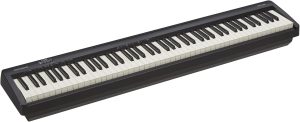
the Roland FP-10 is where we’d start.
Its biggest attraction isn’t a huge sound library.
It’s the keyboard.
PHA-4 Standard Keyboard
The FP-10 has an 88-key PHA-4 Standard keyboard with escapement and Ivory Feel key surfaces.
That’s unusually important for a beginner.
A student developing piano technique needs to learn to control:
- Soft and loud playing
- Finger pressure
- Dynamics
- Repeated notes
- Chords
- Scales
- Different articulations
A hammer-action keyboard provides a much more appropriate environment for that than a lightweight keyboard designed primarily for casual playing.
SuperNATURAL Piano Sound
Roland uses its SuperNATURAL Piano technology in the FP-10.
The objective isn’t simply to produce a recording of a piano note.
The sound should respond dynamically as your playing changes.
For a beginner, this matters because musical expression is part of learning piano—not something that begins only after you’ve mastered the notes.
96-Note Polyphony
The FP-10 provides 96-note maximum polyphony.
More expensive digital pianos offer considerably higher numbers, but 96 notes are sufficient for most beginner practice.
Don’t make the mistake of choosing a beginner piano based primarily on the largest polyphony figure.
Keyboard action, sound, pedals and usability generally matter more.
Twin Piano
Twin Piano is particularly useful for lessons.
It divides the keyboard into two similar pitch ranges so a teacher and student can sit side by side and play notes in the same register.
That’s a genuinely useful educational feature rather than a specification added merely to make the product list longer.
Headphone Practice
Headphones allow a beginner to practice without disturbing other people.
This can make a surprisingly large difference to how often someone practices—especially in apartments or homes where several people share the same space.
Where Does the FP-10 Compromise?
Its speakers and overall feature set are more modest than those of the FP-30X.
That’s part of the reason it costs less.
But those compromises don’t undermine the things a serious beginner needs most.
Best For
- First-time piano students
- Adult beginners
- Children taking formal lessons
- Budget-conscious families
- Classical beginners
- Anyone prioritizing piano fundamentals over extra features
Pros
- 88 weighted keys
- PHA-4 Standard action
- Escapement
- Ivory Feel key surfaces
- SuperNATURAL Piano sound
- Twin Piano
- Headphone practice
- Bluetooth MIDI
- Compact design
- Excellent foundation for traditional lessons
Cons
- More modest speakers than FP-30X
- Fewer features than higher Roland models
- Players who progress significantly may eventually want a more complete setup
[Check Roland FP-10 Price on Amazon →]
2. Roland FP-30X — Best Roland for Beginners Who Want Room to Grow
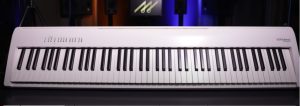
The Roland FP-30X is our preferred step-up choice.
Interestingly, you don’t move from the FP-10 to the FP-30X primarily to get a fundamentally different keyboard action.
Both use Roland’s PHA-4 Standard keyboard with escapement and Ivory Feel.
Instead, the FP-30X builds a more capable instrument around that strong foundation.
256-Note Polyphony
The FP-30X increases maximum polyphony substantially to 256 notes.
For a new beginner, that shouldn’t be the main reason to spend more.
But the additional headroom becomes useful as your playing becomes more sophisticated, particularly when using sustain and richer sounds.
Stronger Speakers
The FP-30X has a more powerful built-in speaker system than the FP-10.
This becomes increasingly valuable if the piano is used:
- In a larger room
- For playing to family or friends
- For lessons
- For small performances
- Without headphones much of the time
More Sounds and Connectivity
The FP-30X also expands the instrument’s overall capabilities.
This makes it more versatile as the student moves beyond basic lessons.
Rather than thinking of it as simply “a better FP-10,” think of it as:
the same strong beginner keyboard foundation inside a more capable long-term instrument.
Who Should Spend More for the FP-30X?
I’d consider it particularly worthwhile if:
- You’re confident you’ll continue playing
- You don’t want to upgrade soon
- You want stronger speakers
- You want greater connectivity
- You expect to play beyond the beginner stage
- Several members of the family may use the piano
Best For
Serious beginners who can afford to spend more now in exchange for greater long-term usefulness.
Pros
- PHA-4 Standard action
- 88 weighted keys
- SuperNATURAL Piano
- 256-note polyphony
- Stronger speakers
- Expanded sound selection
- Bluetooth Audio and MIDI
- Good long-term potential
- Suitable beyond beginner level
Cons
- Costs more than FP-10
- Beginners may not initially use many of its additional capabilities
[Check Roland FP-30X Price on Amazon →]
Roland FP-10 vs FP-30X: Which Should a Beginner Buy?
This is probably the most important comparison in this article.
Both are excellent beginner instruments.
And because both use the PHA-4 Standard action, you aren’t choosing between a “bad” keyboard and a “good” one.
You’re deciding how much instrument you need around that keyboard.
Buy the FP-10 If:
- Budget matters most
- You’re just starting
- Traditional piano learning is your priority
- Modest speakers are sufficient
- You don’t need extensive extra features
- You’re uncertain how long you’ll continue lessons
Buy the FP-30X If:
- Your budget comfortably allows it
- You expect to play for several years
- You want stronger speakers
- You want more connectivity
- You want greater polyphony
- You don’t want to upgrade quickly
Our Verdict
Best pure beginner value: FP-10
Best long-term beginner investment: FP-30X
There’s no need to stretch your budget for the FP-30X if doing so creates financial discomfort.
The FP-10 already gives a serious beginner the most important ingredient: a proper 88-key hammer-action keyboard.
3. Roland GO — Best Lightweight Roland for Casual Beginners
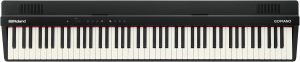
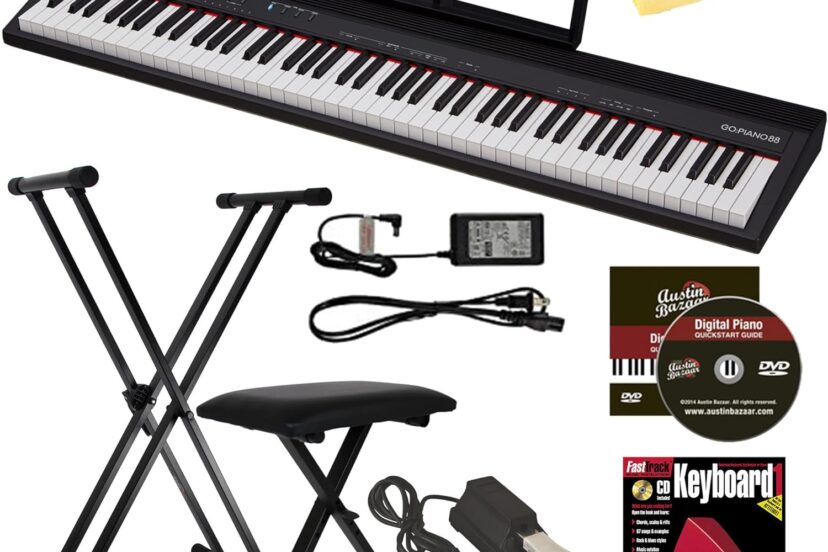
The GO serves a different type of beginner.
This distinction is important.
We would not automatically recommend it over the FP-10 simply because both have 88 keys.
The reason to consider GO is portability and simplicity rather than traditional hammer-action piano feel.
Who Is GO For?
Imagine someone who wants to:
- Start learning basic piano
- Play chords
- Learn songs
- Experiment with music
- Move the keyboard frequently
- Store it when not in use
- Avoid buying a heavier digital piano
That’s where GO becomes attractive.
Why 88 Keys Still Matter
Even on a lightweight beginner keyboard, having 88 keys gives you access to the full standard piano range.
That means you aren’t immediately restricted when learning music that extends into lower bass or higher treble registers.
But here’s the crucial point:
88 keys alone don’t make a keyboard equivalent to an 88-key hammer-action digital piano.
Keyboard action matters.
If you’re taking traditional piano lessons and expect to progress seriously, I’d prefer the FP-10.
If convenience and portability are more important, GO may suit you better.
Best For
- Casual beginners
- Adults exploring piano
- Players with limited space
- People who need to move/store the keyboard frequently
- Beginners who value portability more than hammer action
Pros
- Full 88-key range
- Lightweight design
- Easy to move
- Simple approach
- Suitable for casual learning
- Useful for space-conscious buyers
Cons
- Not the same piano-like action as FP-10/FP-30X
- Less appropriate for developing traditional acoustic-piano technique
- Serious students may outgrow it sooner
[Check Roland GO Price on Amazon →]
GO vs FP-10: Which Is Better for a Beginner?
This is another comparison where the answer depends on what “beginner” means.
Choose GO If:
- Portability is extremely important
- You need to store the instrument frequently
- You mainly want casual playing
- You’re still exploring whether piano is for you
Choose FP-10 If:
- You want formal piano lessons
- You want to develop traditional technique
- Weighted hammer action matters
- You expect to play acoustic pianos eventually
- You’re serious about progressing
If someone asks:
“Which one will better prepare me to play a real acoustic piano?”
I’d choose the FP-10.
4. Roland RP701 — Best Roland Home Piano for Beginners
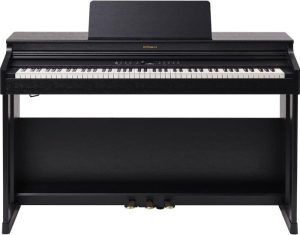
Not every beginner needs a portable piano.
Some families want an instrument that looks and functions more like a permanent home piano.
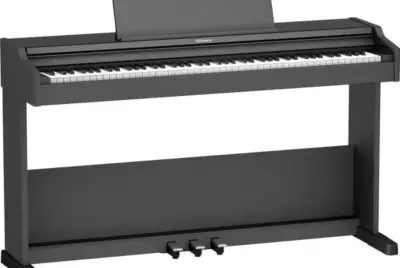
That’s where the Roland RP701 makes sense.
It combines beginner-friendly Roland technology with:
- A furniture-style cabinet
- Integrated stand
- Three-pedal system
- Music rest
- More substantial speaker system
- Traditional home-piano appearance
PHA-4 Standard Keyboard
The RP701 also uses Roland’s PHA-4 Standard keyboard with escapement and Ivory Feel.
That means the beginner gets a familiar action family shared with the FP-10 and FP-30X.
But instead of putting it in a portable slab-style chassis, Roland builds it into a complete home-piano setup.
Three Integrated Pedals
This is an important long-term advantage.
Beginners may initially use mainly the sustain pedal.
As their repertoire develops, however, a complete pedal system becomes more useful.
The RP701 provides:
- Damper
- Soft
- Sostenuto
The damper supports continuous detection, providing more nuanced pedal control than a basic on/off sustain switch.
256-Note Polyphony
Like the FP-30X, the RP701 provides up to 256-note polyphony.
Again, that’s more than a beginner strictly needs, but it provides substantial room for more advanced playing.
A Better Choice for a Permanent Music Room
The RP701 makes particular sense when:
- The piano will stay in one place
- You don’t need portability
- Furniture appearance matters
- You want integrated pedals
- Several family members may play
- You want a more traditional home-piano experience
The trade-off is obvious.
You aren’t going to put an RP701 under your arm and take it to rehearsal.
It is a home instrument.
Best For
- Families
- Children taking regular lessons
- Adult beginners with dedicated piano space
- Buyers wanting a traditional-looking instrument
- Students expected to continue for years
Pros
- PHA-4 Standard action
- 88 weighted keys
- SuperNATURAL Piano
- 256-note polyphony
- Three integrated pedals
- Stronger home-piano presentation
- Bluetooth Audio/MIDI
- Headphones 3D Ambience
- Good long-term instrument
Cons
- Not portable
- Requires more floor space
- Higher investment than FP-10
- Unnecessary if you specifically need a portable instrument
[Check Roland RP701 Price on Amazon →]
5. Roland FP-E50 — Best for Beginners Who Want More Than Piano
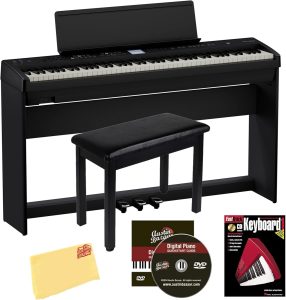
The FP-E50 is the most unusual recommendation in this list.
It’s also the one that needs the most explanation.
If your only goal is:
“I want to learn traditional piano.”
you don’t need an FP-E50.
The FP-10 or FP-30X is the more straightforward choice.
But some beginners aren’t interested only in piano.
They also want to:
- Sing
- Write songs
- Create arrangements
- Play with automatic accompaniment
- Explore synthesizer sounds
- Perform
- Record
- Experiment with different musical styles
For that person, the FP-E50 becomes much more interesting.
PHA-4 Standard Action
Importantly, Roland hasn’t sacrificed the piano foundation.
The FP-E50 still provides:
- 88 keys
- PHA-4 Standard action
- Escapement
- Ivory Feel
So it remains a genuine weighted-key digital piano.
SuperNATURAL Piano + ZEN-Core
The FP-E50 combines Roland’s SuperNATURAL Piano technology with its ZEN-Core sound engine.
That opens up a much broader sound palette.
You can explore:
- Pianos
- Electric pianos
- Strings
- Organs
- Pads
- Synths
- Other instruments
For a creative beginner, this can make the instrument much more engaging.
Automatic Accompaniment
The FP-E50 can generate accompaniment based on the chords you play.
That can be useful for:
- Songwriting
- Practicing with a backing arrangement
- Solo performance
- Exploring different musical styles
Again, none of this is necessary to learn scales or Beethoven.
But it can be enormously enjoyable for a different kind of musician.
Microphone Features
The FP-E50 also supports microphone-related performance features.
That makes it particularly attractive to singers who want one instrument serving as both:
digital piano + creative performance keyboard.
Best For
- Singer-songwriters
- Creative beginners
- Aspiring performers
- Players interested in arranging
- Beginners who want many sounds
- Musicians who want piano plus broader keyboard capabilities
Pros
- 88 PHA-4 Standard keys
- SuperNATURAL Piano
- ZEN-Core sound engine
- Extensive sound selection
- Automatic accompaniment
- Microphone capabilities
- Bluetooth
- USB audio/MIDI
- Considerable room for creative growth
Cons
- More expensive and complicated than necessary for basic piano lessons
- Large feature set can distract a beginner focused solely on traditional piano
- FP-10 or FP-30X offers a simpler path for piano-only learning
[Check Roland FP-E50 Price on Amazon →]
Do Beginners Really Need 88 Keys?
Strictly speaking, no.
A new beginner may spend months playing music that uses only a fraction of an 88-key keyboard.
So why recommend 88 keys?
Because beginners don’t remain beginners forever.
As your playing develops, you’ll encounter music requiring:
- Lower bass notes
- Higher treble notes
- Wider two-hand arrangements
- More advanced classical repertoire
Buying 88 keys from the beginning means the keyboard itself doesn’t impose an artificial range limit later.
If you’re uncertain whether the additional size is worthwhile, our guide on whether you really need 88 weighted keys examines the issue in greater detail.
Do Beginners Need Weighted Keys?
This question is more important than the number of sounds.
If your goal is specifically learning piano, weighted or hammer-action keys are highly desirable.
They help you develop control over:
- Dynamics
- Finger strength
- Key velocity
- Articulation
- Musical expression
They also make the transition to an acoustic piano easier.
That’s why the FP-10, FP-30X, RP701 and FP-E50 occupy such important positions in this guide.
GO is included for a different reason: portability and accessibility.
Which Roland Is Best for Classical Beginners?
I’d narrow the list immediately to:
FP-10
FP-30X
RP701
The FP-10 is the best budget choice.
The FP-30X gives you more room to grow while remaining portable.
The RP701 provides the most complete traditional home-piano setup of these three.
Classical students should prioritize:
- Keyboard action
- 88 keys
- Piano tone
- Pedal control
- Dynamic response
over enormous sound libraries.
For comparisons beyond Roland, see our guide to the best digital pianos for classical music practice.
Which Roland Is Best for an Adult Beginner?
For most adult beginners:
Choose FP-10 if:
You want an affordable, serious starting point.
Choose FP-30X if:
You expect piano to become a long-term hobby.
Choose GO if:
You value light weight and casual accessibility.
Choose RP701 if:
You want a permanent piano in your living room or music room.
Choose FP-E50 if:
You want to sing, compose, arrange and explore sounds as well as learn piano.
Which Roland Is Best for a Child Taking Lessons?
For a child taking conventional piano lessons, my first two choices would be:
FP-10 or FP-30X.
Both provide an appropriate 88-key hammer-action foundation.
If the family wants a permanent furniture-style instrument and the budget allows it, the RP701 becomes very attractive.
GO is easier to move, but I’d favor hammer action if traditional piano technique is the goal.
Portable Roland or Console Roland?
This decision is easier than it sounds.
Choose Portable If:
- Space is limited
- You may move house
- The keyboard needs to be stored
- You might perform outside the home
- You want a lower initial investment
The FP-10 and FP-30X are obvious choices.
Choose Console If:
- The piano will remain in one place
- Furniture appearance matters
- You want integrated pedals
- You want a traditional home-piano setup
That’s where the RP701 fits.
If portability is particularly important, our guide to the best portable digital pianos for beginners compares Roland with alternatives from Yamaha, Kawai, Casio and Alesis.
How Much Should a Beginner Spend?
There’s no magic amount.
Instead, think about how certain you are that you’ll continue playing.
If You’re Unsure
The FP-10 makes sense.
You get the important piano fundamentals without paying for capabilities you may never use.
If You’re Committed
The FP-30X is easier to justify.
The extra investment buys greater capability and reduces the likelihood that you’ll feel the need to upgrade soon.
If You Want a Permanent Home Piano
Consider RP701.
If Your Musical Interests Go Beyond Piano
Consider FP-E50.
The most expensive model isn’t automatically the smartest purchase.
The best value is the instrument whose features match what you’ll actually use.
Should You Buy a Beginner Piano You Can Grow Into?
Usually, yes—but within reason.
There’s little advantage in buying an extremely advanced professional instrument for someone who has never played before.
But buying the absolute minimum can also create false economy if you need to replace it after a year.
A good beginner instrument should ideally carry you into intermediate playing.
That’s one reason the FP-30X is so appealing.
Our best digital pianos by skill level guide explores how requirements change as players move from beginner through intermediate and advanced stages.
Roland vs Other Beginner Digital Piano Brands
Roland isn’t your only option.
Beginner-friendly digital pianos are also available from manufacturers such as:
- Yamaha
- Kawai
- Casio
- Alesis
- Donner
Each approaches keyboard action, piano sound, speakers and features somewhat differently.
Roland’s particular strength in this beginner comparison is that several models give you access to its PHA-4 Standard action at different price and feature levels.
But brand loyalty shouldn’t come before finding the instrument that feels right to you.
If possible, try several competing models before purchasing.
Our Best Digital Pianos for Beginners in 2026 guide compares Roland models directly with current alternatives from other manufacturers.
Frequently Asked Questions
What is the best Roland digital piano for a beginner?
For most beginners, we recommend the Roland FP-10 because it combines 88 weighted PHA-4 Standard keys, SuperNATURAL Piano sound and useful learning features without requiring the investment of a more advanced model.
Is Roland FP-10 good enough for a serious beginner?
Yes. Its 88-key PHA-4 Standard hammer action makes it particularly suitable for beginners who want to develop traditional piano technique.
Is FP-30X worth the extra money over FP-10?
It can be if you expect to continue playing for several years. The FP-30X offers stronger speakers, 256-note polyphony, more sounds and expanded connectivity while retaining the same PHA-4 Standard keyboard family.
Should a beginner buy FP-10 or FP-30X?
Choose FP-10 for maximum beginner value. Choose FP-30X if your budget allows it and you want greater long-term capability.
Is GO better than FP-10?
Not for traditional piano study. GO’s advantage is portability. FP-10 is the stronger choice when hammer-action piano feel and technique development are priorities.
Is RP701 suitable for a beginner?
Yes. It’s particularly appropriate for a beginner who wants a permanent furniture-style home piano with 88 weighted keys and an integrated three-pedal system.
Is FP-E50 too advanced for a beginner?
Not necessarily, but many beginners don’t need its extensive features. It’s most suitable for beginners who also want accompaniment, many sounds, songwriting and performance capabilities.
Does a beginner need 256-note polyphony?
No. Higher polyphony can become useful as playing grows more sophisticated, but it shouldn’t be the main criterion for choosing your first piano.
Are Roland digital pianos good for lessons?
Yes. Models such as FP-10, FP-30X and RP701 provide 88-key hammer actions and features well suited to traditional piano learning.
Can I learn classical piano on a Roland FP-10?
Yes. It’s a particularly attractive budget option for classical beginners because it provides 88 PHA-4 Standard hammer-action keys.
Final Verdict: Which Roland Should a Beginner Buy?
The five Roland instruments in this guide aren’t simply ranked from worst to best.
They’re designed for different beginners.
Best Overall for Beginners — Roland FP-10
Choose the FP-10 if you want the essential tools for serious piano learning at an accessible level.
Its PHA-4 Standard action is the main reason we rank it first.
[Check Roland FP-10 Price on Amazon →]
Best for Long-Term Growth — Roland FP-30X
Choose the FP-30X if you can spend more and want an instrument you’re less likely to outgrow.
[Check Roland FP-30X Price on Amazon →]
Best Lightweight Choice — Roland GO
Choose GO if portability and convenience matter more than traditional hammer action.
[Check Roland GO Price on Amazon →]
Best Home Piano — Roland RP701
Choose the RP701 if you want a permanent furniture-style piano with integrated pedals and a more traditional home setup.
[Check Roland RP701 Price on Amazon →]
Best for Creative Beginners — Roland FP-E50
Choose the FP-E50 if you want to explore accompaniment, songwriting, singing and a large sound palette in addition to piano.
[Check Roland FP-E50 Price on Amazon →]
For most traditional beginners, however, the decision comes down to two instruments:
FP-10 if you want the best value.
FP-30X if you want more room to grow.
That’s a much more useful way to choose than simply buying the Roland with the longest feature list.
If you’re not committed to Roland, our cross-brand beginner comparison includes alternatives from Yamaha, Kawai, Casio, Alesis and Donner.
Beginners mainly need to compare the FP-10, FP-30X and other entry-level choices, but players who want to understand the full product range can explore our complete guide to Roland digital pianos.
Related Articles
- Best Digital Pianos for Beginners in 2026: 7 Top Picks for Learning Piano
- Best 88-Key Weighted Keyboards for Beginners in 2026: 7 Top Picks
- Best Portable Digital Pianos for Beginners in 2026: 5 Lightweight Picks
- Digital Pianos in 2026: The Complete Guide Before You Buy
- Best Digital Pianos by Skill Level in 2026: Beginner to Advanced
Ready to learn piano? Simply Piano is the app for you.

• Beginner-friendly lessons and advanced courses are available for all levels.
• Learn at your own pace with instant feedback to keep you motivated.
• Play classical masterpieces, pop hits, and Disney favorites.
• Start your piano journey today with SIMPLY PIANO!