Best 88-Key Keyboards and Digital Pianos in 2026: Complete Buying Guide

If you’re serious about learning piano, one specification appears again and again:
88 keys.
What Exactly Is an 88-Key Keyboard?
A standard modern piano has:
52 white keys + 36 black keys = 88 keys.
The range extends from A0 at the bass end to C8 at the treble end—approximately 7¼ octaves.
This has become the standard keyboard range for modern acoustic pianos and piano-oriented digital instruments.
The white keys represent the natural notes:
A, B, C, D, E, F and G
while the black keys represent sharps and flats.
For beginners, however, the important issue isn’t memorizing the number of black and white keys.
It’s understanding why the full range matters as your playing develops.
A standard modern acoustic piano has 88 keys, giving pianists a range of more than seven octaves. That’s why most digital pianos designed for traditional piano playing also use an 88-key keyboard.
But there’s an important catch:
Not all 88-key keyboards are created equal.
Some have fully weighted hammer-action keys designed to reproduce the resistance and response of an acoustic piano. Others use lighter actions that may be better suited to synthesizer playing, music production or portability.
Sound quality, speakers, pedals, connectivity and portability also vary considerably.
So the real question isn’t simply:
“Should I buy an 88-key keyboard?”
It’s:
“Which 88-key keyboard or digital piano is right for me?”
In this guide, we’ll explain what to look for in an 88-key instrument and compare seven excellent choices for different types of players and budgets.
Disclosure: The products featured below were selected based on their features, suitability for different types of pianists, and current availability. Some links on Pianos-Galore are affiliate links. If you purchase through these links, we may receive a small commission at no additional cost to you.
Our Top 88-Key Keyboard Picks for 2026
| Model | Best For | Keyboard |
|---|---|---|
| Roland FP-30X | Best Overall | PHA-4 Standard |
| Roland FP-10 | Best for Beginners | PHA-4 Standard |
| Yamaha P-225 | Best Yamaha Choice | GHC |
| Kawai ES120 | Best Entry-Level Kawai | RHC |
| Kawai ES920 | Best Premium Portable | RHIII |
| Casio Privia PX-S1100 | Best Slim/Compact Choice | Smart Scaled Hammer Action |
| Donner DEP-20 | Best Budget Alternative | 88 weighted keys |
Now let’s look at why each one deserves consideration.
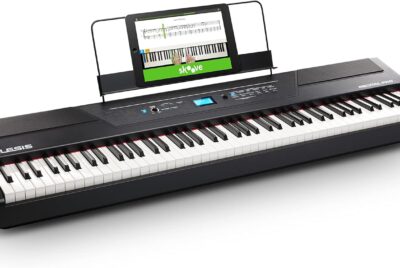
1. Roland FP-30X — Best Overall 88-Key Digital Piano
Check out the price of Roland FP-30X at Amazon
For buyers looking for an 88-key digital piano that can serve them beyond the beginner stage, the Roland FP-30X is one of the strongest all-around choices.
It combines Roland’s PHA-4 Standard keyboard with its SuperNATURAL Piano sound engine, 256-note maximum polyphony and an onboard stereo speaker system.
The PHA-4 Standard keyboard is particularly important.
It provides 88 weighted keys with escapement and Ivory Feel surfaces. Roland uses the same basic PHA-4 Standard action in the less expensive FP-10, which helps make both instruments attractive to piano students.
Why We Like the FP-30X
A beginner can certainly use the FP-30X, but it also offers enough capability for an intermediate player.
Its strengths include:
- 88 weighted PHA-4 Standard keys
- SuperNATURAL Piano sound engine
- 256-note polyphony
- Built-in stereo speakers
- Bluetooth audio and MIDI
- USB connectivity
- Headphone practice
- Optional three-pedal support
The combination of keyboard action, sound, speakers and connectivity makes the FP-30X particularly versatile.
It’s equally comfortable as:
a student’s practice piano, an adult’s home instrument, a compact recording keyboard, or a portable piano for occasional performance.
Who Should Buy It?
Consider the Roland FP-30X if you’re a serious beginner or intermediate player who wants an instrument you won’t quickly outgrow.
Best for: Most buyers seeking an excellent balance of keyboard feel, sound, features and price.
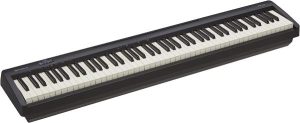
2. Roland FP-10 — Best 88-Key Piano for Beginners
Check out the price of Roland FP-10 at Amazon
The Roland FP-10 is an especially interesting beginner instrument because Roland gives it the same PHA-4 Standard keyboard family used in the FP-30X.
That means you get a genuine 88-key hammer-action keyboard with escapement and Ivory Feel key surfaces in a more affordable instrument.
The compromises appear elsewhere.
The FP-10 has a more basic speaker system, fewer sounds and fewer features than the FP-30X.
But that’s not necessarily a problem.
A beginner primarily needs:
a good keyboard action + a convincing piano sound + 88 keys + a sustain pedal + headphone capability.
The FP-10 covers those fundamentals well.
Why We Like the FP-10
Instead of loading the instrument with hundreds of features a beginning pianist may never use, Roland concentrates on the essentials.
That makes it particularly suitable for:
- Children beginning piano lessons
- Adult beginners
- Students practicing at home
- Apartment dwellers
- Buyers prioritizing key feel over extra features
FP-10 or FP-30X?
If your budget is tight, choose the FP-10.
If you can afford the FP-30X and expect to continue playing for years, the additional polyphony, speakers, connectivity and features make the FP-30X a stronger long-term instrument.
But from the standpoint of basic piano technique, the FP-10 provides an unusually strong foundation for its category.
The FP-10 is only one of several Roland options for new players; our Roland beginner piano comparison explains when stepping up to the FP-30X, FP-E50 or a console model makes sense.
Best for: Beginners who want a good weighted piano action without paying for features they may not need.
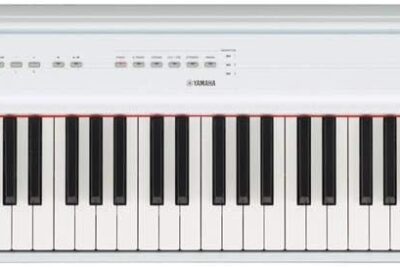
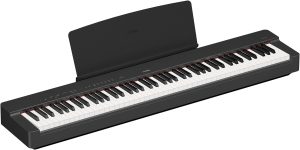
3. Yamaha P-225 — Best Yamaha 88-Key Digital Piano
Check out the price of Yamaha P-225 at Amazon
The Yamaha P-225 is an excellent alternative for buyers who prefer Yamaha’s piano sound and design philosophy.
It uses Yamaha’s Graded Hammer Compact (GHC) keyboard and a piano voice based on the company’s flagship CFX concert grand.
Yamaha also incorporates Virtual Resonance Modeling Lite (VRM Lite) to reproduce some of the resonance characteristics associated with an acoustic piano. The P-225 provides 192-note polyphony and 24 instrument voices.
Compact but Full-Sized
One of the P-225’s attractions is that Yamaha has fitted a full 88-key weighted keyboard into a relatively compact instrument.
The piano weighs approximately 11.5 kg / 25 lb 6 oz, making it easier to move than many furniture-style digital pianos.
That makes it suitable for:
- Apartments
- Bedrooms
- Small studios
- Students
- Musicians who occasionally transport their piano
Yamaha CFX Sound
The P-225’s CFX-based piano voice is an important selling point.
The CFX is Yamaha’s flagship concert grand, and Yamaha uses its tonal character throughout a number of its current digital-piano products.
Of course, a compact digital piano isn’t acoustically identical to sitting in front of a full concert grand.
But having a high-quality CFX-derived piano voice gives the P-225 a strong foundation for traditional piano playing.
Who Should Buy It?
The P-225 is particularly attractive for buyers wanting:
Yamaha piano sound + 88 weighted keys + compact dimensions + portability.
If the P-225 is on your shortlist, our in-depth Yamaha P-225 review examines its keyboard, sound, portability and suitability for different players in greater detail.
The P-225 is one strong Yamaha choice, but buyers interested in the brand should also compare the wider Yamaha digital-piano range.
Best for: Yamaha fans and buyers wanting a compact but capable 88-key digital piano.
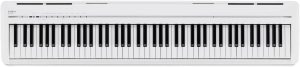
4. Kawai ES120 — Best Entry-Level Kawai 88-Key Piano
Check out the price of Kawai ES120 at Amazon
Kawai has a particularly strong reputation among pianists who care about keyboard feel.
The Kawai ES120 is one of the most accessible ways to enter the company’s digital-piano range.
It uses Kawai’s Responsive Hammer Compact (RHC) action with 88 grade-weighted keys.
The ES120 also uses Kawai’s Harmonic Imaging piano technology with 88-key stereo sampling and 192-note polyphony.
Its piano sounds include recordings associated with the Shigeru Kawai SK-EX concert grand, Kawai EX and Kawai K-60.
Why Consider Kawai?
Different manufacturers have different philosophies about keyboard action.
There’s no universal rule saying one brand’s action will feel best to every pianist.
But Kawai has devoted considerable attention to recreating acoustic-piano-style touch throughout its digital-piano range.
The ES120 gives beginners access to that approach without moving immediately into Kawai’s more expensive instruments.
Modern Connectivity
The ES120 also provides Bluetooth MIDI and Bluetooth Audio, making it easier to integrate compatible mobile devices and music applications.
Who Should Buy It?
Consider the ES120 if you’re:
- A beginner
- An adult returning to piano
- A student
- A Kawai fan
- Looking for a portable practice instrument
- Particularly interested in piano-oriented keyboard feel
Choosing between these two depends heavily on experience and keyboard-action expectations; our Kawai ES-series comparison puts them in the context of Kawai’s broader digital-piano range.
Best for: Beginners and home pianists who want Kawai’s piano-focused design philosophy at an accessible level.
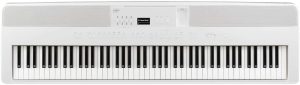
5. Kawai ES920 — Best Premium Portable 88-Key Digital Piano
Check out the price of Kawai ES920 at Amazon
The Kawai ES920 moves considerably beyond entry-level territory.
Its biggest attraction is Kawai’s Responsive Hammer III (RHIII) keyboard action.
RHIII provides:
- 88 grade-weighted keys
- Triple-sensor key detection
- Counterweights
- Let-off simulation
- Ivory Touch white-key surfaces
The ES920 also uses Kawai’s more advanced Harmonic Imaging XL (HI-XL) piano technology and offers 256-note maximum polyphony.
Why This Matters
As players become more experienced, subtle differences in keyboard response become increasingly noticeable.
A beginner may be primarily concerned with learning which notes to play.
An experienced pianist may notice:
- Key resistance
- Repetition
- Dynamic response
- Let-off sensation
- Control at very soft dynamics
This is where a higher-level action such as RHIII becomes more relevant.
Acoustic Rendering
The ES920 also incorporates Kawai’s Acoustic Rendering technology to reproduce resonant characteristics associated with acoustic pianos.
That contributes to a more sophisticated piano experience than simply triggering isolated recorded notes.
Who Should Buy It?
The ES920 makes particular sense for:
- Intermediate students
- Advanced students
- Classical pianists
- Piano teachers
- Experienced home musicians
- Performers who still need portability
A complete beginner certainly can buy an ES920, but its additional cost makes more sense when the player can appreciate its more sophisticated action and sound system.
Best for: Experienced pianists wanting premium touch and sound without moving to a large furniture-style digital piano.
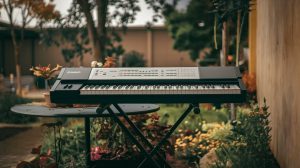
6. Casio Privia PX-S1100 — Best Slim and Compact 88-Key Piano
Check out the price of Casio Privia PX-S1100 at Amazon
Not everyone has room for a large digital piano.
That’s where the Casio Privia PX-S1100 becomes particularly interesting.
Casio designed the PX-S series around an unusually slim form factor while retaining a full 88-key weighted keyboard.
The PX-S1100 uses Casio’s Smart Scaled Hammer Action Keyboard and provides 192-note maximum polyphony.
Why Compact Size Matters
An 88-key keyboard is naturally wide.
You can’t make the actual playing range dramatically narrower without changing the dimensions of the keys.
Manufacturers can, however, reduce the depth and bulk of the cabinet.
That’s where the PX-S1100 shines.
It can make sense for:
- Apartments
- Condominiums
- Bedrooms
- Small home studios
- Musicians with limited space
- Players who frequently move their instrument
Bluetooth and Wireless Features
The PX-S1100 supports wireless functionality through Casio’s included/compatible adapter system, allowing integration with Bluetooth audio and MIDI applications depending on setup.
Who Should Buy It?
Choose the PX-S1100 if physical size and appearance matter almost as much as having a full 88-key weighted keyboard.
Its exceptionally slim cabinet also makes the PX-S1100 attractive for design-conscious homes; see how it compares with other pianos selected for modern interiors.
Best for: Buyers wanting a particularly slim, stylish 88-key piano for smaller spaces.
7. Donner DEP-20 — Best Budget 88-Key Alternative
Check out the price of Donner DEP-20 at Amazon
Not every beginner is ready to spend heavily on a first digital piano.
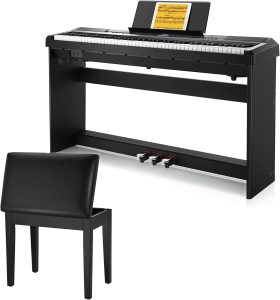
The Donner DEP-20 targets the budget-conscious buyer who nevertheless wants a full 88-key weighted keyboard.
It offers a broad collection of sounds and functions at a price that can make 88-key piano ownership more accessible.
Where the DEP-20 Fits
I wouldn’t position the DEP-20 as a direct replacement for a Kawai ES920 or other premium digital piano.
That’s not its purpose.
Its appeal is value.
For someone deciding between:
an inexpensive unweighted keyboard
and
an affordable 88-key weighted instrument,
the DEP-20 may provide a useful stepping stone into traditional piano playing.
Who Should Buy It?
Consider it for:
- Budget-conscious beginners
- Casual home players
- Families uncertain about a child’s long-term commitment
- Buyers wanting 88 weighted keys at a lower entry price
If your budget permits moving to a Roland, Yamaha or Kawai model, compare the actions personally before deciding.
But for buyers operating under a strict budget, Donner deserves consideration.
Budget buyers considering the DEP-20 can explore how Donner’s current piano range compares before deciding whether this is the right model.
Best for: Buyers seeking an affordable entry into 88-key weighted-keyboard playing.
Which 88-Key Piano Should You Buy?
Here’s the simplest way to narrow the choices.
If you’re a complete beginner:
Start with the Roland FP-10 or Kawai ES120.
Both provide genuine weighted 88-key actions without requiring you to move immediately into premium pricing.
If you want the best all-around choice:
Consider the Roland FP-30X.
It provides a particularly good balance of keyboard action, sound, speakers, connectivity and room for musical growth.
If you prefer Yamaha:
Choose the Yamaha P-225.
Its compact GHC keyboard and CFX-based sound make it a strong general-purpose digital piano.
If you’re an experienced pianist:
Consider the Kawai ES920.
Its RHIII action is the most sophisticated Kawai action among the models compared here.
If space is limited:
Look closely at the Casio PX-S1100.
Its slim design is a significant practical advantage.
If price is your main concern:
Consider the Donner DEP-20, while understanding that you’re buying primarily for affordability rather than premium action and piano reproduction.
Do Beginners Really Need 88 Keys?
Not immediately.
A complete beginner uses only a relatively small portion of the keyboard.
Many first-year exercises and simple pieces can comfortably fit on a 61-key instrument.
But if your objective is genuinely to learn piano, I generally recommend buying an 88-key instrument from the beginning if your budget and space permit.
Why?
Because you won’t have to replace the keyboard simply because your repertoire has outgrown its range.
This becomes increasingly relevant for:
- Classical music
- Advanced piano arrangements
- Jazz
- Romantic repertoire
- Four-hand music
- Music using extended bass and treble registers
Think of 88 keys as providing room to grow.
Buyers committed to learning piano may want to compare our 88-key recommendations specifically for beginning players before choosing a model.
88 Keys vs Weighted Keys: What’s the Difference?
This is one of the most important concepts for a first-time buyer.
88 keys describes the number of keys.
Weighted describes how those keys physically feel.
They aren’t the same thing.
You can encounter an 88-key keyboard with relatively light action.
For traditional piano study, I recommend looking for:
88 keys + weighted hammer action + touch sensitivity.
Why Weighted Keys Matter
On an acoustic piano, pressing a key activates a mechanical action that ultimately causes a hammer to strike strings.
This produces physical resistance beneath the fingers.
Digital-piano manufacturers use weighted hammer mechanisms to imitate aspects of that experience.
This helps students develop:
- Finger strength
- Dynamic control
- Articulation
- Consistency
- More transferable piano technique
What Is Graded Hammer Action?
On an acoustic piano, the bass and treble sections don’t feel exactly identical.
Digital-piano manufacturers therefore often use graded weighting.
In simplified terms:
Lower keys feel heavier → higher keys progressively lighter.
Different companies have their own systems.
For example:
- Yamaha — GHC and other graded actions
- Roland — PHA keyboard systems
- Kawai — Responsive Hammer actions
- Casio — Smart Scaled Hammer Action
The marketing names aren’t as important as the actual experience beneath your fingers.
Whenever possible, play the instrument before purchasing it.
88-Key vs 61-Key Keyboard
Should a beginner buy 61 or 88 keys?
It depends on the objective.
| Feature | 88-Key Keyboard | 61-Key Keyboard |
|---|---|---|
| Piano range | Full | Reduced |
| Classical study | Excellent | Eventually limiting |
| Portability | Larger | Better |
| Piano technique | Excellent if weighted | Depends on action |
| Synth playing | Good | Often excellent |
| Space required | More | Less |
| Typical price | Higher | Lower |
| Long-term piano study | Preferred | May be outgrown |
Choose 88 keys if:
Your objective is traditional piano playing.
Choose 61 keys if:
You primarily want:
- Synthesizer sounds
- Arranger functions
- Portable music-making
- Chord accompaniment
- Casual playing
A 61-key keyboard isn’t “inferior.”
It’s simply designed around somewhat different priorities.
Players who prioritize portability, accompaniment and lighter weight may instead want to explore when a 61-key keyboard makes more sense.
What About 76 Keys?
A 76-key keyboard provides a useful compromise.
It gives you substantially more range than 61 keys without occupying quite as much space as a full 88-key instrument.
Some performing musicians prefer 73- or 76-key instruments because they’re easier to transport.
For traditional piano students, however, I’d still favor 88 weighted keys whenever practical.
Fully Weighted vs Semi-Weighted Keys
Another common misconception is that heavier keys are automatically better.
Not necessarily.
Fully Weighted Hammer Action
Usually preferable for:
- Classical pianists
- Traditional piano students
- Jazz pianists
- Acoustic-piano players
- Serious home practice
Semi-Weighted Action
Can be preferable for:
- Synth players
- Organists
- Music producers
- Players performing many different keyboard parts
- Musicians prioritizing lighter weight
The correct action depends on what you intend to play.
What Is Touch Sensitivity?
Touch sensitivity—or velocity sensitivity—allows the instrument to respond to how you play.
Press a key gently and you hear a softer note.
Strike it forcefully and the sound becomes louder and often changes tonal character.
This is essential for expressive piano playing.
Therefore, when shopping for an inexpensive keyboard, ask three separate questions:
Does it have 88 keys?
Are the keys weighted?
Are the keys touch-sensitive?
Don’t assume that one automatically guarantees the others.
How Much Polyphony Do You Need?
Polyphony refers to the number of notes or sound elements a digital piano can reproduce simultaneously.
This sometimes confuses beginners.
You may think:
“I have only ten fingers. Why do I need 192 or 256 notes?”
Because notes continue sounding when you use the sustain pedal.
Layering two sounds can also consume additional polyphony.
Complex accompaniment and recording features may require still more.
Among our recommendations, for example, the Kawai ES920 and Roland FP-30X provide up to 256-note polyphony, while models such as the Yamaha P-225, Kawai ES120 and Casio PX-S1100 provide 192-note polyphony.
But don’t choose a piano based on this number alone.
For ordinary playing, keyboard action, sound quality, speakers and pedals may matter much more.
Why Built-In Speakers Matter
Digital-piano sound quality isn’t determined solely by the sound engine.
The speakers matter too.
A sophisticated piano sample played through weak speakers may be less convincing than expected.
Consider:
- Speaker size
- Amplifier power
- Number of speakers
- Speaker positioning
- Cabinet design
This is one reason headphones can sometimes reveal details that aren’t as obvious through a compact instrument’s built-in speakers.
If you’re comparing two models in a store, test them both:
through the speakers and through good headphones.
Don’t Forget the Pedals
The sustain pedal becomes increasingly important as your piano playing develops.
More advanced players may eventually want the traditional three-pedal arrangement:
Damper — Sostenuto — Soft
Portable digital pianos often include or support a basic damper pedal and offer an optional three-pedal accessory.
If you’re buying a portable piano for long-term classical study, check whether a compatible three-pedal system is available.
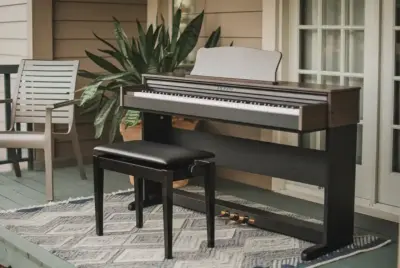
Portable or Furniture-Style Digital Piano?
Most of our recommendations in this article are portable/slab-style instruments.
That has several advantages.
Choose a portable digital piano if:
- Space is limited.
- You may move house.
- You perform outside the home.
- You need flexible placement.
- You don’t want a large piece of furniture.
Choose a console digital piano if:
- The instrument will remain permanently at home.
- You want integrated pedals.
- Appearance matters.
- You want a traditional piano setup.
- Portability isn’t important.
A portable piano isn’t necessarily a beginner instrument.
The Kawai ES920, for example, is portable in format while being designed for considerably more demanding players.
If you prefer integrated pedals and a permanent cabinet, compare our furniture-style digital pianos for home use.
Are 88-Key Keyboards Good for Classical Music?
Yes.
In fact, classical study is one of the strongest reasons to choose a full-size weighted keyboard.
Classical technique places considerable demands on:
- Dynamic control
- Finger independence
- Articulation
- Repetition
- Pedaling
- Keyboard range
A beginner won’t use all 88 keys immediately.
But as repertoire progresses, having the full acoustic-piano range becomes increasingly valuable.
For serious classical study, I’d prioritize keyboard action over extras such as hundreds of instrument voices or accompaniment rhythms.
Is an 88-Key Keyboard Too Big for a Child?
No.
This is a surprisingly common misconception.
An 88-key keyboard is physically wide, but the child isn’t expected to reach from one end to the other.
The individual keys are still normal piano-sized keys.
More important considerations include:
- Correct bench height
- Proper posture
- Comfortable keyboard height
- Appropriate key resistance
- Good instruction
For a very young child simply experimenting with music, a smaller keyboard can be perfectly reasonable.
But if a child is beginning serious piano lessons, an 88-key weighted instrument provides plenty of room for future development.
Players pursuing classical repertoire should also compare digital pianos selected specifically for classical practice.
Can You Learn Piano on a Cheap 88-Key Keyboard?
Yes—but there are limits.
An inexpensive keyboard can teach:
- Note recognition
- Chords
- Rhythm
- Basic songs
- Music theory
But if the action is extremely light or unrealistic, it may not prepare your fingers as effectively for playing an acoustic piano.
That’s why I would rather see a serious student buy a simpler instrument with a good weighted action than a flashy keyboard with hundreds of sounds but poor piano feel.
Which Brand Makes the Best 88-Key Digital Piano?
There is no universal winner.
Each manufacturer has strengths.
Roland
Worth considering for its PHA keyboard actions and SuperNATURAL piano technology.
Yamaha
Offers extensive acoustic-piano experience and characteristic Yamaha concert-grand sounds.
Kawai
Particularly interesting to pianists who prioritize piano-oriented keyboard action and acoustic-piano heritage.
Casio
Often combines compact dimensions, attractive design and competitive features.
Donner
Targets more budget-conscious buyers and can provide an affordable entry point into 88-key weighted instruments.
The better question is:
Which model at my budget feels and sounds best to me?
For a broader manufacturer comparison, see how Yamaha, Roland, Kawai, Casio, Donner and Nord differ in action, sound, design and target player.
Roland FP-30X vs Yamaha P-225
This will be a common comparison for readers.
Both are excellent compact 88-key digital pianos.
Choose the Roland FP-30X if you particularly like:
- PHA-4 Standard action
- 256-note polyphony
- Roland SuperNATURAL piano sound
- Its overall combination of features and speakers
Choose the Yamaha P-225 if you particularly like:
- Yamaha CFX-based piano tone
- GHC keyboard action
- Compact dimensions
- Yamaha’s overall piano ecosystem
Neither is objectively better for every pianist.
If possible, play them side by side.
Your fingers and ears may make the decision faster than a specification table.
Kawai ES120 vs Roland FP-10
Both make sense for beginners, but they offer different experiences.
The FP-10 provides Roland’s PHA-4 Standard keyboard and SuperNATURAL piano sound.
The ES120 provides Kawai’s RHC action, Harmonic Imaging sound technology and SK-EX-derived piano character.
For this comparison, keyboard feel should be one of your deciding factors.
Try both if possible.
Kawai ES920 vs Roland FP-30X
These aren’t quite direct competitors because the ES920 occupies a more premium position.
The ES920’s RHIII action incorporates features such as counterweights, let-off simulation and triple-sensor detection.
If you’re an experienced pianist and keyboard feel is one of your highest priorities, the additional cost may be justified.
If you’re a beginner or intermediate player looking for a strong all-around instrument at a lower price, the FP-30X may provide better value.
Frequently Asked Questions
How many keys does a full-size piano have?
A standard modern piano has 88 keys: 52 white and 36 black, extending from A0 to C8.
Is 88 keys necessary for a beginner?
Not for the earliest lessons, but 88 keys are strongly recommended for long-term traditional piano study if budget and space permit.
Is 61 keys enough to learn piano?
Yes, initially. You can learn notes, chords, scales and many beginner pieces on 61 keys. More advanced piano repertoire eventually benefits from the full 88-key range.
Should an 88-key keyboard have weighted keys?
For traditional piano learning, preferably yes. Weighted hammer action provides resistance that more closely approximates an acoustic piano.
What’s the difference between weighted and touch-sensitive keys?
Weighted refers to physical resistance.
Touch-sensitive refers to the instrument responding differently according to how forcefully you strike the key.
A good digital piano normally provides both.
Is an 88-key keyboard harder to play?
Not because it has more keys.
The action itself determines how physically demanding the instrument feels. An 88-key hammer-action digital piano may feel heavier than a 61-key synth-action keyboard, but that’s because of the action—not because there are 27 additional keys.
Do I need 88 keys for classical music?
For long-term classical study, yes, I strongly recommend them.
Which 88-key piano is best for beginners?
Among our recommendations, the Roland FP-10 and Kawai ES120 are particularly attractive starting points.
Which is the best 88-key digital piano overall?
For the broadest range of buyers, our overall pick is the Roland FP-30X because of its combination of PHA-4 Standard action, sound, speakers, connectivity and room for progression.
Which is best for an experienced pianist?
Among the seven models here, the Kawai ES920 is particularly attractive because of its more sophisticated RHIII action and premium piano-oriented design.
Which is best if I have very little space?
Consider the Casio Privia PX-S1100, which combines 88 weighted keys with an unusually slim cabinet.
Do digital pianos need tuning?
No.
Unlike acoustic pianos, digital pianos don’t have strings that gradually drift out of tune.
Can I use headphones?
Yes. Headphone practice is one of the major advantages of digital pianos, especially for apartments and shared households.
Final Verdict: Which 88-Key Keyboard Should You Buy?
There isn’t one perfect 88-key keyboard for everybody.
For most buyers, I would narrow the seven choices this way:
Best Overall — Roland FP-30X
A particularly strong combination of weighted action, sound, speakers and features.
Best for Beginners — Roland FP-10
An excellent way to get a quality weighted action without immediately moving into a higher price category.
Best Yamaha — Yamaha P-225
A compact, versatile choice featuring Yamaha CFX-based piano sound.
Best Entry-Level Kawai — Kawai ES120
A strong option for beginners who particularly value Kawai’s piano-oriented approach.
Best Premium Portable — Kawai ES920
Our choice for more experienced pianists who place greater emphasis on keyboard action and acoustic-piano realism.
Best Compact Choice — Casio Privia PX-S1100
Ideal when you want 88 weighted keys but physical space is at a premium.
Best Budget Alternative — Donner DEP-20
Worth considering when affordability is the overriding priority.
Whichever instrument you choose, remember that 88 keys alone don’t make a good digital piano.
For serious piano learning, look for the combination of:
88 full-size keys + weighted hammer action + touch sensitivity + convincing piano sound + proper pedal support.
And don’t become too distracted by enormous sound libraries.
For a piano student, an instrument with 700 voices and mediocre keyboard action may be less useful than a digital piano with 20 voices and a keyboard that responds naturally beneath the fingers.
If possible, play your shortlisted instruments before buying.
Try soft passages.
Try loud chords.
Play repeated notes.
Use the sustain pedal.
Listen through both speakers and headphones.
The specification sheet can help you create a shortlist.
Your fingers and ears should make the final decision.
Yamaha is particularly strong in this category. If realistic piano touch is important to you, see our guide to Yamaha 88-key weighted keyboards for a closer look at Yamaha’s graded hammer actions and full-size digital piano options.
Brand reputation can also help narrow your choices. Our comparison of leading digital piano brands explains the different strengths of Yamaha, Roland, Kawai, Casio, Donner and Nord.
Yamaha is especially strong in the full-size weighted-key category. For a closer look at how its key actions differ, see our guide to Yamaha 88-key weighted keyboards.
If you prefer Casio, our guide to Casio 88-key weighted keyboards compares several models designed to give players a more acoustic-piano-like feel.
Advanced players who need more than a conventional 88-key digital piano may want to explore the Roland RD-2000 for live and studio performance, which combines premium weighted action with extensive controller capabilities.
An 88-key digital piano can be a good long-term choice for formal lessons, but it is not automatically the right starting point for every child. Our guide to finding a suitable piano for an autistic child looks at when a lighter or smaller keyboard may be the more comfortable option.
Buyers who want the full 88-key range without moving into premium prices may also want to see our comparison of good-sounding digital pianos at affordable prices.
Students planning to focus on classical repertoire may also want to compare our best digital pianos for classical music study, where keyboard action, dynamic control and long-term suitability are given particular importance.
Musicians building a home studio may also want to compare our best piano keyboards for home recording, where MIDI connectivity, sound quality and DAW integration are given particular importance.
Players who particularly value authentic piano tone may also want to compare our best Yamaha digital pianos for acoustic-style sound, including portable and home models built around Yamaha’s concert-grand voices.
Not all weighted actions feel the same, and Kawai’s RHC, RHCII and RHIII systems illustrate those differences clearly in our guide to choosing among Kawai keyboards.
Most major manufacturers offer several full-size models, but differences in action can be substantial; our comparison of 88-key pianos from leading brands helps put those choices into perspective.
For students who have decided on a full-size instrument, we’ve also compared beginner-friendly models that combine 88 keys with proper piano action.
Pianists who have already developed basic technique may be ready to consider more capable Yamaha instruments for advancing skills.
Related articles:
If you’re serious about learning piano, one specification appears again and again:
88 keys.
What Exactly Is an 88-Key Keyboard?
A standard modern piano has:
52 white keys + 36 black keys = 88 keys.
The range extends from A0 at the bass end to C8 at the treble end—approximately 7¼ octaves.
This has become the standard keyboard range for modern acoustic pianos and piano-oriented digital instruments.
The white keys represent the natural notes:
A, B, C, D, E, F and G
while the black keys represent sharps and flats.
For beginners, however, the important issue isn’t memorizing the number of black and white keys.
It’s understanding why the full range matters as your playing develops.
A standard modern acoustic piano has 88 keys, giving pianists a range of more than seven octaves. That’s why most digital pianos designed for traditional piano playing also use an 88-key keyboard.
But there’s an important catch:
Not all 88-key keyboards are created equal.
Some have fully weighted hammer-action keys designed to reproduce the resistance and response of an acoustic piano. Others use lighter actions that may be better suited to synthesizer playing, music production or portability.
Sound quality, speakers, pedals, connectivity and portability also vary considerably.
So the real question isn’t simply:
“Should I buy an 88-key keyboard?”
It’s:
“Which 88-key keyboard or digital piano is right for me?”
In this guide, we’ll explain what to look for in an 88-key instrument and compare seven excellent choices for different types of players and budgets.
Disclosure: The products featured below were selected based on their features, suitability for different types of pianists, and current availability. Some links on Pianos-Galore are affiliate links. If you purchase through these links, we may receive a small commission at no additional cost to you.
Our Top 88-Key Keyboard Picks for 2026
| Model | Best For | Keyboard |
|---|---|---|
| Roland FP-30X | Best Overall | PHA-4 Standard |
| Roland FP-10 | Best for Beginners | PHA-4 Standard |
| Yamaha P-225 | Best Yamaha Choice | GHC |
| Kawai ES120 | Best Entry-Level Kawai | RHC |
| Kawai ES920 | Best Premium Portable | RHIII |
| Casio Privia PX-S1100 | Best Slim/Compact Choice | Smart Scaled Hammer Action |
| Donner DEP-20 | Best Budget Alternative | 88 weighted keys |
Now let’s look at why each one deserves consideration.
1. Roland FP-30X — Best Overall 88-Key Digital Piano
Check out the price of Roland FP-30X at Amazon
For buyers looking for an 88-key digital piano that can serve them beyond the beginner stage, the Roland FP-30X is one of the strongest all-around choices.
It combines Roland’s PHA-4 Standard keyboard with its SuperNATURAL Piano sound engine, 256-note maximum polyphony and an onboard stereo speaker system.
The PHA-4 Standard keyboard is particularly important.
It provides 88 weighted keys with escapement and Ivory Feel surfaces. Roland uses the same basic PHA-4 Standard action in the less expensive FP-10, which helps make both instruments attractive to piano students.
Why We Like the FP-30X
A beginner can certainly use the FP-30X, but it also offers enough capability for an intermediate player.
Its strengths include:
- 88 weighted PHA-4 Standard keys
- SuperNATURAL Piano sound engine
- 256-note polyphony
- Built-in stereo speakers
- Bluetooth audio and MIDI
- USB connectivity
- Headphone practice
- Optional three-pedal support
The combination of keyboard action, sound, speakers and connectivity makes the FP-30X particularly versatile.
It’s equally comfortable as:
a student’s practice piano, an adult’s home instrument, a compact recording keyboard, or a portable piano for occasional performance.
Who Should Buy It?
Consider the Roland FP-30X if you’re a serious beginner or intermediate player who wants an instrument you won’t quickly outgrow.
Best for: Most buyers seeking an excellent balance of keyboard feel, sound, features and price.
2. Roland FP-10 — Best 88-Key Piano for Beginners
Check out the price of Roland FP-10 at Amazon
The Roland FP-10 is an especially interesting beginner instrument because Roland gives it the same PHA-4 Standard keyboard family used in the FP-30X.
That means you get a genuine 88-key hammer-action keyboard with escapement and Ivory Feel key surfaces in a more affordable instrument.
The compromises appear elsewhere.
The FP-10 has a more basic speaker system, fewer sounds and fewer features than the FP-30X.
But that’s not necessarily a problem.
A beginner primarily needs:
a good keyboard action + a convincing piano sound + 88 keys + a sustain pedal + headphone capability.
The FP-10 covers those fundamentals well.
Why We Like the FP-10
Instead of loading the instrument with hundreds of features a beginning pianist may never use, Roland concentrates on the essentials.
That makes it particularly suitable for:
- Children beginning piano lessons
- Adult beginners
- Students practicing at home
- Apartment dwellers
- Buyers prioritizing key feel over extra features
FP-10 or FP-30X?
If your budget is tight, choose the FP-10.
If you can afford the FP-30X and expect to continue playing for years, the additional polyphony, speakers, connectivity and features make the FP-30X a stronger long-term instrument.
But from the standpoint of basic piano technique, the FP-10 provides an unusually strong foundation for its category.
The FP-10 is only one of several Roland options for new players; our Roland beginner piano comparison explains when stepping up to the FP-30X, FP-E50 or a console model makes sense.
Best for: Beginners who want a good weighted piano action without paying for features they may not need.
3. Yamaha P-225 — Best Yamaha 88-Key Digital Piano
Check out the price of Yamaha P-225 at Amazon
The Yamaha P-225 is an excellent alternative for buyers who prefer Yamaha’s piano sound and design philosophy.
It uses Yamaha’s Graded Hammer Compact (GHC) keyboard and a piano voice based on the company’s flagship CFX concert grand.
Yamaha also incorporates Virtual Resonance Modeling Lite (VRM Lite) to reproduce some of the resonance characteristics associated with an acoustic piano. The P-225 provides 192-note polyphony and 24 instrument voices.
Compact but Full-Sized
One of the P-225’s attractions is that Yamaha has fitted a full 88-key weighted keyboard into a relatively compact instrument.
The piano weighs approximately 11.5 kg / 25 lb 6 oz, making it easier to move than many furniture-style digital pianos.
That makes it suitable for:
- Apartments
- Bedrooms
- Small studios
- Students
- Musicians who occasionally transport their piano
Yamaha CFX Sound
The P-225’s CFX-based piano voice is an important selling point.
The CFX is Yamaha’s flagship concert grand, and Yamaha uses its tonal character throughout a number of its current digital-piano products.
Of course, a compact digital piano isn’t acoustically identical to sitting in front of a full concert grand.
But having a high-quality CFX-derived piano voice gives the P-225 a strong foundation for traditional piano playing.
Who Should Buy It?
The P-225 is particularly attractive for buyers wanting:
Yamaha piano sound + 88 weighted keys + compact dimensions + portability.
If the P-225 is on your shortlist, our in-depth Yamaha P-225 review examines its keyboard, sound, portability and suitability for different players in greater detail.
The P-225 is one strong Yamaha choice, but buyers interested in the brand should also compare the wider Yamaha digital-piano range.
Best for: Yamaha fans and buyers wanting a compact but capable 88-key digital piano.
4. Kawai ES120 — Best Entry-Level Kawai 88-Key Piano
Check out the price of Kawai ES120 at Amazon
Kawai has a particularly strong reputation among pianists who care about keyboard feel.
The Kawai ES120 is one of the most accessible ways to enter the company’s digital-piano range.
It uses Kawai’s Responsive Hammer Compact (RHC) action with 88 grade-weighted keys.
The ES120 also uses Kawai’s Harmonic Imaging piano technology with 88-key stereo sampling and 192-note polyphony.
Its piano sounds include recordings associated with the Shigeru Kawai SK-EX concert grand, Kawai EX and Kawai K-60.
Why Consider Kawai?
Different manufacturers have different philosophies about keyboard action.
There’s no universal rule saying one brand’s action will feel best to every pianist.
But Kawai has devoted considerable attention to recreating acoustic-piano-style touch throughout its digital-piano range.
The ES120 gives beginners access to that approach without moving immediately into Kawai’s more expensive instruments.
Modern Connectivity
The ES120 also provides Bluetooth MIDI and Bluetooth Audio, making it easier to integrate compatible mobile devices and music applications.
Who Should Buy It?
Consider the ES120 if you’re:
- A beginner
- An adult returning to piano
- A student
- A Kawai fan
- Looking for a portable practice instrument
- Particularly interested in piano-oriented keyboard feel
Choosing between these two depends heavily on experience and keyboard-action expectations; our Kawai ES-series comparison puts them in the context of Kawai’s broader digital-piano range.
Best for: Beginners and home pianists who want Kawai’s piano-focused design philosophy at an accessible level.
5. Kawai ES920 — Best Premium Portable 88-Key Digital Piano
Check out the price of Kawai ES920 at Amazon
The Kawai ES920 moves considerably beyond entry-level territory.
Its biggest attraction is Kawai’s Responsive Hammer III (RHIII) keyboard action.
RHIII provides:
- 88 grade-weighted keys
- Triple-sensor key detection
- Counterweights
- Let-off simulation
- Ivory Touch white-key surfaces
The ES920 also uses Kawai’s more advanced Harmonic Imaging XL (HI-XL) piano technology and offers 256-note maximum polyphony.
Why This Matters
As players become more experienced, subtle differences in keyboard response become increasingly noticeable.
A beginner may be primarily concerned with learning which notes to play.
An experienced pianist may notice:
- Key resistance
- Repetition
- Dynamic response
- Let-off sensation
- Control at very soft dynamics
This is where a higher-level action such as RHIII becomes more relevant.
Acoustic Rendering
The ES920 also incorporates Kawai’s Acoustic Rendering technology to reproduce resonant characteristics associated with acoustic pianos.
That contributes to a more sophisticated piano experience than simply triggering isolated recorded notes.
Who Should Buy It?
The ES920 makes particular sense for:
- Intermediate students
- Advanced students
- Classical pianists
- Piano teachers
- Experienced home musicians
- Performers who still need portability
A complete beginner certainly can buy an ES920, but its additional cost makes more sense when the player can appreciate its more sophisticated action and sound system.
Best for: Experienced pianists wanting premium touch and sound without moving to a large furniture-style digital piano.
6. Casio Privia PX-S1100 — Best Slim and Compact 88-Key Piano
Check out the price of Casio Privia PX-S1100 at Amazon
Not everyone has room for a large digital piano.
That’s where the Casio Privia PX-S1100 becomes particularly interesting.
Casio designed the PX-S series around an unusually slim form factor while retaining a full 88-key weighted keyboard.
The PX-S1100 uses Casio’s Smart Scaled Hammer Action Keyboard and provides 192-note maximum polyphony.
Why Compact Size Matters
An 88-key keyboard is naturally wide.
You can’t make the actual playing range dramatically narrower without changing the dimensions of the keys.
Manufacturers can, however, reduce the depth and bulk of the cabinet.
That’s where the PX-S1100 shines.
It can make sense for:
- Apartments
- Condominiums
- Bedrooms
- Small home studios
- Musicians with limited space
- Players who frequently move their instrument
Bluetooth and Wireless Features
The PX-S1100 supports wireless functionality through Casio’s included/compatible adapter system, allowing integration with Bluetooth audio and MIDI applications depending on setup.
Who Should Buy It?
Choose the PX-S1100 if physical size and appearance matter almost as much as having a full 88-key weighted keyboard.
Its exceptionally slim cabinet also makes the PX-S1100 attractive for design-conscious homes; see how it compares with other pianos selected for modern interiors.
Best for: Buyers wanting a particularly slim, stylish 88-key piano for smaller spaces.
7. Donner DEP-20 — Best Budget 88-Key Alternative
Check out the price of Donner DEP-20 at Amazon
Not every beginner is ready to spend heavily on a first digital piano.
The Donner DEP-20 targets the budget-conscious buyer who nevertheless wants a full 88-key weighted keyboard.
It offers a broad collection of sounds and functions at a price that can make 88-key piano ownership more accessible.
Where the DEP-20 Fits
I wouldn’t position the DEP-20 as a direct replacement for a Kawai ES920 or other premium digital piano.
That’s not its purpose.
Its appeal is value.
For someone deciding between:
an inexpensive unweighted keyboard
and
an affordable 88-key weighted instrument,
the DEP-20 may provide a useful stepping stone into traditional piano playing.
Who Should Buy It?
Consider it for:
- Budget-conscious beginners
- Casual home players
- Families uncertain about a child’s long-term commitment
- Buyers wanting 88 weighted keys at a lower entry price
If your budget permits moving to a Roland, Yamaha or Kawai model, compare the actions personally before deciding.
But for buyers operating under a strict budget, Donner deserves consideration.
Budget buyers considering the DEP-20 can explore how Donner’s current piano range compares before deciding whether this is the right model.
Best for: Buyers seeking an affordable entry into 88-key weighted-keyboard playing.
Which 88-Key Piano Should You Buy?
Here’s the simplest way to narrow the choices.
If you’re a complete beginner:
Start with the Roland FP-10 or Kawai ES120.
Both provide genuine weighted 88-key actions without requiring you to move immediately into premium pricing.
If you want the best all-around choice:
Consider the Roland FP-30X.
It provides a particularly good balance of keyboard action, sound, speakers, connectivity and room for musical growth.
If you prefer Yamaha:
Choose the Yamaha P-225.
Its compact GHC keyboard and CFX-based sound make it a strong general-purpose digital piano.
If you’re an experienced pianist:
Consider the Kawai ES920.
Its RHIII action is the most sophisticated Kawai action among the models compared here.
If space is limited:
Look closely at the Casio PX-S1100.
Its slim design is a significant practical advantage.
If price is your main concern:
Consider the Donner DEP-20, while understanding that you’re buying primarily for affordability rather than premium action and piano reproduction.
Do Beginners Really Need 88 Keys?
Not immediately.
A complete beginner uses only a relatively small portion of the keyboard.
Many first-year exercises and simple pieces can comfortably fit on a 61-key instrument.
But if your objective is genuinely to learn piano, I generally recommend buying an 88-key instrument from the beginning if your budget and space permit.
Why?
Because you won’t have to replace the keyboard simply because your repertoire has outgrown its range.
This becomes increasingly relevant for:
- Classical music
- Advanced piano arrangements
- Jazz
- Romantic repertoire
- Four-hand music
- Music using extended bass and treble registers
Think of 88 keys as providing room to grow.
Buyers committed to learning piano may want to compare our 88-key recommendations specifically for beginning players before choosing a model.
88 Keys vs Weighted Keys: What’s the Difference?
This is one of the most important concepts for a first-time buyer.
88 keys describes the number of keys.
Weighted describes how those keys physically feel.
They aren’t the same thing.
You can encounter an 88-key keyboard with relatively light action.
For traditional piano study, I recommend looking for:
88 keys + weighted hammer action + touch sensitivity.
Why Weighted Keys Matter
On an acoustic piano, pressing a key activates a mechanical action that ultimately causes a hammer to strike strings.
This produces physical resistance beneath the fingers.
Digital-piano manufacturers use weighted hammer mechanisms to imitate aspects of that experience.
This helps students develop:
- Finger strength
- Dynamic control
- Articulation
- Consistency
- More transferable piano technique
What Is Graded Hammer Action?
On an acoustic piano, the bass and treble sections don’t feel exactly identical.
Digital-piano manufacturers therefore often use graded weighting.
In simplified terms:
Lower keys feel heavier → higher keys progressively lighter.
Different companies have their own systems.
For example:
- Yamaha — GHC and other graded actions
- Roland — PHA keyboard systems
- Kawai — Responsive Hammer actions
- Casio — Smart Scaled Hammer Action
The marketing names aren’t as important as the actual experience beneath your fingers.
Whenever possible, play the instrument before purchasing it.
88-Key vs 61-Key Keyboard
Should a beginner buy 61 or 88 keys?
It depends on the objective.
| Feature | 88-Key Keyboard | 61-Key Keyboard |
|---|---|---|
| Piano range | Full | Reduced |
| Classical study | Excellent | Eventually limiting |
| Portability | Larger | Better |
| Piano technique | Excellent if weighted | Depends on action |
| Synth playing | Good | Often excellent |
| Space required | More | Less |
| Typical price | Higher | Lower |
| Long-term piano study | Preferred | May be outgrown |
Choose 88 keys if:
Your objective is traditional piano playing.
Choose 61 keys if:
You primarily want:
- Synthesizer sounds
- Arranger functions
- Portable music-making
- Chord accompaniment
- Casual playing
A 61-key keyboard isn’t “inferior.”
It’s simply designed around somewhat different priorities.
Players who prioritize portability, accompaniment and lighter weight may instead want to explore when a 61-key keyboard makes more sense.
What About 76 Keys?
A 76-key keyboard provides a useful compromise.
It gives you substantially more range than 61 keys without occupying quite as much space as a full 88-key instrument.
Some performing musicians prefer 73- or 76-key instruments because they’re easier to transport.
For traditional piano students, however, I’d still favor 88 weighted keys whenever practical.
Fully Weighted vs Semi-Weighted Keys
Another common misconception is that heavier keys are automatically better.
Not necessarily.
Fully Weighted Hammer Action
Usually preferable for:
- Classical pianists
- Traditional piano students
- Jazz pianists
- Acoustic-piano players
- Serious home practice
Semi-Weighted Action
Can be preferable for:
- Synth players
- Organists
- Music producers
- Players performing many different keyboard parts
- Musicians prioritizing lighter weight
The correct action depends on what you intend to play.
What Is Touch Sensitivity?
Touch sensitivity—or velocity sensitivity—allows the instrument to respond to how you play.
Press a key gently and you hear a softer note.
Strike it forcefully and the sound becomes louder and often changes tonal character.
This is essential for expressive piano playing.
Therefore, when shopping for an inexpensive keyboard, ask three separate questions:
Does it have 88 keys?
Are the keys weighted?
Are the keys touch-sensitive?
Don’t assume that one automatically guarantees the others.
How Much Polyphony Do You Need?
Polyphony refers to the number of notes or sound elements a digital piano can reproduce simultaneously.
This sometimes confuses beginners.
You may think:
“I have only ten fingers. Why do I need 192 or 256 notes?”
Because notes continue sounding when you use the sustain pedal.
Layering two sounds can also consume additional polyphony.
Complex accompaniment and recording features may require still more.
Among our recommendations, for example, the Kawai ES920 and Roland FP-30X provide up to 256-note polyphony, while models such as the Yamaha P-225, Kawai ES120 and Casio PX-S1100 provide 192-note polyphony.
But don’t choose a piano based on this number alone.
For ordinary playing, keyboard action, sound quality, speakers and pedals may matter much more.
Why Built-In Speakers Matter
Digital-piano sound quality isn’t determined solely by the sound engine.
The speakers matter too.
A sophisticated piano sample played through weak speakers may be less convincing than expected.
Consider:
- Speaker size
- Amplifier power
- Number of speakers
- Speaker positioning
- Cabinet design
This is one reason headphones can sometimes reveal details that aren’t as obvious through a compact instrument’s built-in speakers.
If you’re comparing two models in a store, test them both:
through the speakers and through good headphones.
Don’t Forget the Pedals
The sustain pedal becomes increasingly important as your piano playing develops.
More advanced players may eventually want the traditional three-pedal arrangement:
Damper — Sostenuto — Soft
Portable digital pianos often include or support a basic damper pedal and offer an optional three-pedal accessory.
If you’re buying a portable piano for long-term classical study, check whether a compatible three-pedal system is available.
Portable or Furniture-Style Digital Piano?
Most of our recommendations in this article are portable/slab-style instruments.
That has several advantages.
Choose a portable digital piano if:
- Space is limited.
- You may move house.
- You perform outside the home.
- You need flexible placement.
- You don’t want a large piece of furniture.
Choose a console digital piano if:
- The instrument will remain permanently at home.
- You want integrated pedals.
- Appearance matters.
- You want a traditional piano setup.
- Portability isn’t important.
A portable piano isn’t necessarily a beginner instrument.
The Kawai ES920, for example, is portable in format while being designed for considerably more demanding players.
If you prefer integrated pedals and a permanent cabinet, compare our furniture-style digital pianos for home use.
Are 88-Key Keyboards Good for Classical Music?
Yes.
In fact, classical study is one of the strongest reasons to choose a full-size weighted keyboard.
Classical technique places considerable demands on:
- Dynamic control
- Finger independence
- Articulation
- Repetition
- Pedaling
- Keyboard range
A beginner won’t use all 88 keys immediately.
But as repertoire progresses, having the full acoustic-piano range becomes increasingly valuable.
For serious classical study, I’d prioritize keyboard action over extras such as hundreds of instrument voices or accompaniment rhythms.
Is an 88-Key Keyboard Too Big for a Child?
No.
This is a surprisingly common misconception.
An 88-key keyboard is physically wide, but the child isn’t expected to reach from one end to the other.
The individual keys are still normal piano-sized keys.
More important considerations include:
- Correct bench height
- Proper posture
- Comfortable keyboard height
- Appropriate key resistance
- Good instruction
For a very young child simply experimenting with music, a smaller keyboard can be perfectly reasonable.
But if a child is beginning serious piano lessons, an 88-key weighted instrument provides plenty of room for future development.
Players pursuing classical repertoire should also compare digital pianos selected specifically for classical practice.
Can You Learn Piano on a Cheap 88-Key Keyboard?
Yes—but there are limits.
An inexpensive keyboard can teach:
- Note recognition
- Chords
- Rhythm
- Basic songs
- Music theory
But if the action is extremely light or unrealistic, it may not prepare your fingers as effectively for playing an acoustic piano.
That’s why I would rather see a serious student buy a simpler instrument with a good weighted action than a flashy keyboard with hundreds of sounds but poor piano feel.
Which Brand Makes the Best 88-Key Digital Piano?
There is no universal winner.
Each manufacturer has strengths.
Roland
Worth considering for its PHA keyboard actions and SuperNATURAL piano technology.
Yamaha
Offers extensive acoustic-piano experience and characteristic Yamaha concert-grand sounds.
Kawai
Particularly interesting to pianists who prioritize piano-oriented keyboard action and acoustic-piano heritage.
Casio
Often combines compact dimensions, attractive design and competitive features.
Donner
Targets more budget-conscious buyers and can provide an affordable entry point into 88-key weighted instruments.
The better question is:
Which model at my budget feels and sounds best to me?
For a broader manufacturer comparison, see how Yamaha, Roland, Kawai, Casio, Donner and Nord differ in action, sound, design and target player.
Roland FP-30X vs Yamaha P-225
This will be a common comparison for readers.
Both are excellent compact 88-key digital pianos.
Choose the Roland FP-30X if you particularly like:
- PHA-4 Standard action
- 256-note polyphony
- Roland SuperNATURAL piano sound
- Its overall combination of features and speakers
Choose the Yamaha P-225 if you particularly like:
- Yamaha CFX-based piano tone
- GHC keyboard action
- Compact dimensions
- Yamaha’s overall piano ecosystem
Neither is objectively better for every pianist.
If possible, play them side by side.
Your fingers and ears may make the decision faster than a specification table.
Kawai ES120 vs Roland FP-10
Both make sense for beginners, but they offer different experiences.
The FP-10 provides Roland’s PHA-4 Standard keyboard and SuperNATURAL piano sound.
The ES120 provides Kawai’s RHC action, Harmonic Imaging sound technology and SK-EX-derived piano character.
For this comparison, keyboard feel should be one of your deciding factors.
Try both if possible.
Kawai ES920 vs Roland FP-30X
These aren’t quite direct competitors because the ES920 occupies a more premium position.
The ES920’s RHIII action incorporates features such as counterweights, let-off simulation and triple-sensor detection.
If you’re an experienced pianist and keyboard feel is one of your highest priorities, the additional cost may be justified.
If you’re a beginner or intermediate player looking for a strong all-around instrument at a lower price, the FP-30X may provide better value.
Frequently Asked Questions
How many keys does a full-size piano have?
A standard modern piano has 88 keys: 52 white and 36 black, extending from A0 to C8.
Is 88 keys necessary for a beginner?
Not for the earliest lessons, but 88 keys are strongly recommended for long-term traditional piano study if budget and space permit.
Is 61 keys enough to learn piano?
Yes, initially. You can learn notes, chords, scales and many beginner pieces on 61 keys. More advanced piano repertoire eventually benefits from the full 88-key range.
Should an 88-key keyboard have weighted keys?
For traditional piano learning, preferably yes. Weighted hammer action provides resistance that more closely approximates an acoustic piano.
What’s the difference between weighted and touch-sensitive keys?
Weighted refers to physical resistance.
Touch-sensitive refers to the instrument responding differently according to how forcefully you strike the key.
A good digital piano normally provides both.
Is an 88-key keyboard harder to play?
Not because it has more keys.
The action itself determines how physically demanding the instrument feels. An 88-key hammer-action digital piano may feel heavier than a 61-key synth-action keyboard, but that’s because of the action—not because there are 27 additional keys.
Do I need 88 keys for classical music?
For long-term classical study, yes, I strongly recommend them.
Which 88-key piano is best for beginners?
Among our recommendations, the Roland FP-10 and Kawai ES120 are particularly attractive starting points.
Which is the best 88-key digital piano overall?
For the broadest range of buyers, our overall pick is the Roland FP-30X because of its combination of PHA-4 Standard action, sound, speakers, connectivity and room for progression.
Which is best for an experienced pianist?
Among the seven models here, the Kawai ES920 is particularly attractive because of its more sophisticated RHIII action and premium piano-oriented design.
Which is best if I have very little space?
Consider the Casio Privia PX-S1100, which combines 88 weighted keys with an unusually slim cabinet.
Do digital pianos need tuning?
No.
Unlike acoustic pianos, digital pianos don’t have strings that gradually drift out of tune.
Can I use headphones?
Yes. Headphone practice is one of the major advantages of digital pianos, especially for apartments and shared households.
Final Verdict: Which 88-Key Keyboard Should You Buy?
There isn’t one perfect 88-key keyboard for everybody.
For most buyers, I would narrow the seven choices this way:
Best Overall — Roland FP-30X
A particularly strong combination of weighted action, sound, speakers and features.
Best for Beginners — Roland FP-10
An excellent way to get a quality weighted action without immediately moving into a higher price category.
Best Yamaha — Yamaha P-225
A compact, versatile choice featuring Yamaha CFX-based piano sound.
Best Entry-Level Kawai — Kawai ES120
A strong option for beginners who particularly value Kawai’s piano-oriented approach.
Best Premium Portable — Kawai ES920
Our choice for more experienced pianists who place greater emphasis on keyboard action and acoustic-piano realism.
Best Compact Choice — Casio Privia PX-S1100
Ideal when you want 88 weighted keys but physical space is at a premium.
Best Budget Alternative — Donner DEP-20
Worth considering when affordability is the overriding priority.
Whichever instrument you choose, remember that 88 keys alone don’t make a good digital piano.
For serious piano learning, look for the combination of:
88 full-size keys + weighted hammer action + touch sensitivity + convincing piano sound + proper pedal support.
And don’t become too distracted by enormous sound libraries.
For a piano student, an instrument with 700 voices and mediocre keyboard action may be less useful than a digital piano with 20 voices and a keyboard that responds naturally beneath the fingers.
If possible, play your shortlisted instruments before buying.
Try soft passages.
Try loud chords.
Play repeated notes.
Use the sustain pedal.
Listen through both speakers and headphones.
The specification sheet can help you create a shortlist.
Your fingers and ears should make the final decision.
Yamaha is particularly strong in this category. If realistic piano touch is important to you, see our guide to Yamaha 88-key weighted keyboards for a closer look at Yamaha’s graded hammer actions and full-size digital piano options.
Brand reputation can also help narrow your choices. Our comparison of leading digital piano brands explains the different strengths of Yamaha, Roland, Kawai, Casio, Donner and Nord.
Yamaha is especially strong in the full-size weighted-key category. For a closer look at how its key actions differ, see our guide to Yamaha 88-key weighted keyboards.
If you prefer Casio, our guide to Casio 88-key weighted keyboards compares several models designed to give players a more acoustic-piano-like feel.
Advanced players who need more than a conventional 88-key digital piano may want to explore the Roland RD-2000 for live and studio performance, which combines premium weighted action with extensive controller capabilities.
An 88-key digital piano can be a good long-term choice for formal lessons, but it is not automatically the right starting point for every child. Our guide to finding a suitable piano for an autistic child looks at when a lighter or smaller keyboard may be the more comfortable option.
Buyers who want the full 88-key range without moving into premium prices may also want to see our comparison of good-sounding digital pianos at affordable prices.
Students planning to focus on classical repertoire may also want to compare our best digital pianos for classical music study, where keyboard action, dynamic control and long-term suitability are given particular importance.
Musicians building a home studio may also want to compare our best piano keyboards for home recording, where MIDI connectivity, sound quality and DAW integration are given particular importance.
Players who particularly value authentic piano tone may also want to compare our best Yamaha digital pianos for acoustic-style sound, including portable and home models built around Yamaha’s concert-grand voices.
Not all weighted actions feel the same, and Kawai’s RHC, RHCII and RHIII systems illustrate those differences clearly in our guide to choosing among Kawai keyboards.
Most major manufacturers offer several full-size models, but differences in action can be substantial; our comparison of 88-key pianos from leading brands helps put those choices into perspective.
For students who have decided on a full-size instrument, we’ve also compared beginner-friendly models that combine 88 keys with proper piano action.
Pianists who have already developed basic technique may be ready to consider more capable Yamaha instruments for advancing skills.