Best Portable Digital Pianos for Beginners in 2026: 5 Lightweight Picks
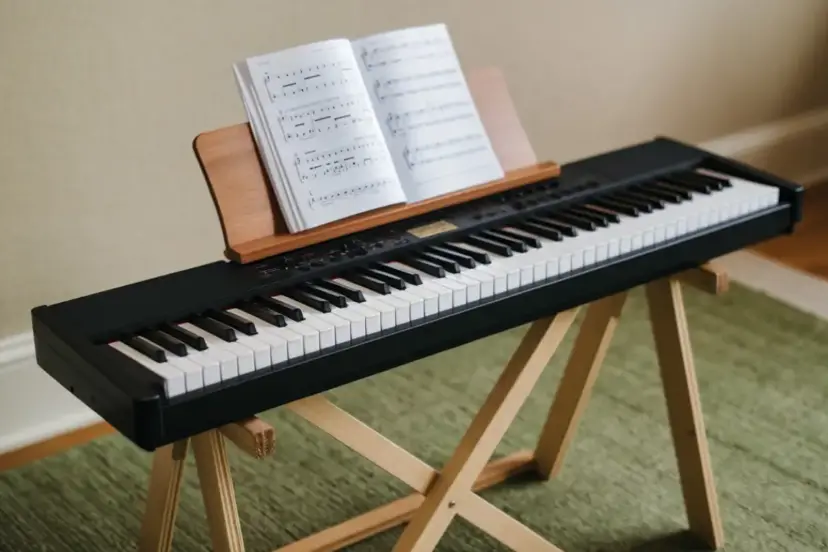
Learning piano doesn’t necessarily mean finding permanent space for a large instrument.
Today’s portable digital pianos can give beginners 88 weighted keys, realistic piano sounds, headphone practice and modern connectivity in instruments weighing around 25 pounds.
That makes them particularly attractive if you:
- Live in an apartment or condominium
- Have limited space
- Need to move the piano between rooms
- Take your instrument to lessons
- Don’t want a permanent furniture-style piano
- Need to store the piano when it isn’t being used
But portability shouldn’t come at the expense of learning proper piano technique.
That’s why the five instruments in this guide aren’t simply lightweight keyboards. They’re 88-key digital pianos with weighted or hammer-action keyboards suitable for beginners who want a more authentic piano-playing experience.
Our five top choices for 2026 are:
- Casio PX-S1100 — Best Overall for Portability
- Yamaha P-225 — Best Balance of Portability and Piano Quality
- Roland FP-10 — Best Budget Portable Piano Feel
- Kawai ES120 — Best Portable Piano for Serious Practice
- Alesis Recital Pro — Best Affordable Portable Alternative
Let’s compare them.
Disclosure: Some links on Pianos-Galore are affiliate links. If you purchase through these links, we may receive a small commission at no additional cost to you.
Best Portable Digital Pianos for Beginners: Quick Comparison
| Model | Keys/Action | Weight | Polyphony | Best For |
|---|---|---|---|---|
| Casio PX-S1100 | 88 Smart Scaled Hammer Action | 24.7 lb / 11.2 kg | 192 | Best Overall for Portability |
| Yamaha P-225 | 88 GHC weighted keys | 25.4 lb / 11.5 kg | 192 | Best Balance |
| Roland FP-10 | 88 PHA-4 Standard | Approx. 27 lb / 12.3 kg | 96 | Best Budget Piano Feel |
| Kawai ES120 | 88 Responsive Hammer Compact | 26.5 lb / 12 kg | 192 | Serious Piano Practice |
| Alesis Recital Pro | 88 Hammer-Action Keys | Approx. 26 lb / 11.8 kg | 128 | Affordable Alternative |
Our Quick Recommendation
If portability is your number-one priority, our first choice is the Casio PX-S1100.
It combines 88 hammer-action keys with an exceptionally slim cabinet, weighs only about 24.7 pounds and can even operate on batteries.
The Yamaha P-225 is our choice for beginners who want an especially strong balance between portability and traditional piano qualities.
Choose the Roland FP-10 if keyboard feel is more important than having lots of features.
The Kawai ES120 is particularly attractive for students who want a portable instrument but intend to take piano study seriously.
And the Alesis Recital Pro gives budget-conscious beginners another way to get 88 hammer-action keys.
What Makes a Digital Piano Truly Portable?
“Portable” is an overused word in the keyboard industry.
Technically, almost any slab-style digital piano can be moved.
But there’s a big difference between an instrument you can comfortably carry yourself and one that requires two people every time you move it.
For this guide, we looked particularly closely at:
- Weight
- Cabinet depth
- Overall dimensions
- Ability to use portable stands
- Battery operation
- Ease of storage
- Suitability for lessons
- Weighted keyboard action
- Beginner-friendly features
We also deliberately avoided large console-style digital pianos.
They’re excellent instruments, but they’re designed primarily to remain in one place.
[Internal link: Digital Pianos in 2026: The Complete Guide Before You Buy]
Can an 88-Key Weighted Piano Really Be Portable?
Yes—with one qualification.
The 88 keys themselves establish a minimum width.
You can’t shrink an 88-key piano down to the dimensions of a 61-key portable keyboard because the keys still have to be physically large enough to play.
Most instruments in this guide are therefore around four feet wide.
Where manufacturers save space is primarily in:
- Depth
- Height
- Cabinet design
- Internal components
- Speaker design
Weight matters even more.
A digital piano weighing around 25 pounds is quite different from one weighing 40, 50 or 70 pounds.
If you intend to move your piano regularly, those extra pounds become noticeable very quickly.
[Internal link: 88 Keyboard Keys]
1. Casio PX-S1100 — Best Overall Portable Digital Piano for Beginners
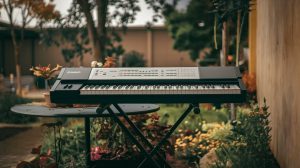
Best for:
Beginners who want the smallest and lightest practical 88-key weighted digital piano without giving up serious piano features.
The Casio PX-S1100 is particularly impressive because of how much Casio fits into such a slim instrument.
It provides:
- 88 Smart Scaled Hammer Action keys
- Five touch-response levels plus off
- Multi-Dimensional Morphing AiR sound source
- 192-note polyphony
- 18 tones
- 60 built-in songs
- MIDI recording
- Audio recording
- 8W + 8W amplification
- Two headphone jacks
- USB connectivity
- Wireless MIDI/audio adapter
- Optional three-pedal support
- Battery operation
- Approximately 24.7 lb / 11.2 kg weight
And it does all this in a cabinet only about 9.1 inches deep.
That’s why it takes our number-one position when portability itself is the main buying criterion.
Why the PX-S1100 Is So Easy to Live With
The PX-S1100 measures approximately:
52.1 inches wide × 9.1 inches deep × 4 inches high
without the music stand.
That shallow depth is especially valuable in:
- Apartments
- Condominiums
- Bedrooms
- Dorm rooms
- Small studios
- Multipurpose rooms
You can place it on a portable X-style or Z-style stand when you want to play and potentially store it when necessary.
Battery Operation
The PX-S1100 can run on six AA alkaline batteries for approximately four hours under specified conditions.
This doesn’t mean most beginners should practice on batteries every day.
An AC adapter is far more practical for normal home use.
But battery operation gives the PX-S1100 an extra degree of portability that most traditional digital pianos don’t provide.
You could use it:
- In a room without a convenient outlet
- At rehearsals
- At informal performances
- Outdoors under suitable conditions
- During temporary power interruptions
Smart Scaled Hammer Action
Portability wouldn’t mean much for serious piano learning if Casio had achieved it by using lightweight synthesizer-style keys.
Instead, the PX-S1100 uses an 88-key Smart Scaled Hammer Action Keyboard.
The action provides a weighted, piano-oriented playing experience while keeping the instrument unusually compact.
For a beginner, that’s a compelling combination.
192-Note Polyphony
The PX-S1100 provides 192-note maximum polyphony.
That’s more than enough for beginner playing and gives the instrument considerable room for more advanced music later.
Who Should Buy the Casio PX-S1100?
Choose it if:
- Portability is your top priority.
- You live in a small space.
- You want 88 weighted keys.
- You may need to store the piano.
- You want battery operation.
- You appreciate wireless connectivity.
- You want a clean, modern design.
For the beginner asking, “What’s the easiest full-size weighted piano to fit into my life?”, the PX-S1100 is our top recommendation.
[Check Casio PX-S1100 Price on Amazon →]
2. Yamaha P-225 — Best Balance of Portability and Piano Quality
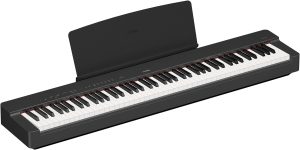
Best for:
Beginners who want a compact portable piano but place traditional piano sound and playing experience very high on their priority list.
The Yamaha P-225 weighs only about 25.4 pounds, putting it remarkably close to the Casio PX-S1100.
It provides:
- 88-key Graded Hammer Compact action
- Yamaha CFX piano sound
- VRM Lite
- 192-note polyphony
- 24 voices
- Dual mode
- Split mode
- Duo mode
- 20 rhythms
- MIDI recording
- USB audio/MIDI
- Optional three-pedal setup
- Approximately 25.4 lb / 11.5 kg weight
Its cabinet is approximately 10.7 inches deep.
Graded Hammer Compact Action
Yamaha’s GHC, or Graded Hammer Compact, action is designed partly to solve the problem this article is about.
How do you provide a proper 88-key weighted experience without making the digital piano unnecessarily bulky?
The action is graded, meaning lower-register keys feel heavier while higher-register keys become lighter.
That’s an important characteristic for beginners intending to develop traditional piano technique.
Yamaha CFX Piano Sound
The P-225 uses a piano sound based on Yamaha’s flagship CFX concert grand.
It also incorporates Virtual Resonance Modeling Lite, which helps reproduce some of the resonance behavior associated with acoustic pianos.
This is one reason I particularly like the P-225 for someone who says:
“Yes, I need portability—but I’m primarily buying this to learn piano.”
P-225 vs PX-S1100 for Portability
This is probably the most important comparison in this article.
Choose Casio PX-S1100 if:
- Minimum cabinet depth is extremely important.
- You want battery operation.
- You particularly value a very slim design.
- You want wireless MIDI/audio through the included adapter.
Choose Yamaha P-225 if:
- Yamaha’s piano sound appeals to you.
- You want GHC action.
- You want Yamaha CFX sound.
- USB audio/MIDI is useful to you.
- You want a particularly strong balance between portability and traditional piano characteristics.
The difference in weight is tiny.
For most people, either one is genuinely portable.
Who Should Buy the Yamaha P-225?
Choose it if:
- You’re serious about learning piano.
- You need an instrument you can move.
- You want 88 graded weighted keys.
- You value Yamaha’s CFX piano sound.
- You want an instrument you aren’t likely to outgrow quickly.
[Check Yamaha P-225 Price on Amazon →]
3. Roland FP-10 — Best Budget Portable Piano Feel
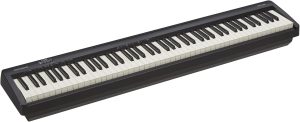
Best for:
Beginners who care more about keyboard feel than getting the lightest possible instrument.
The Roland FP-10 isn’t our lightest recommendation.
But at roughly 27 pounds, it’s still manageable for many adults.
What makes it particularly interesting is its keyboard.
The FP-10 provides:
- 88 PHA-4 Standard keys
- Hammer action
- Escapement
- Ivory Feel surfaces
- Five touch settings plus fixed
- Roland SuperNATURAL piano sound
- 96-note polyphony
- Twin Piano mode
- USB connectivity
- Bluetooth MIDI in supported configurations
- Half-pedal capability with an optional compatible pedal
PHA-4 Standard Action
This is the FP-10’s biggest attraction.
Roland’s PHA-4 Standard keyboard includes hammer action, escapement and textured Ivory Feel surfaces.
The weighting also changes across the keyboard to create a more piano-like experience.
For a beginner trying to develop piano technique, keyboard action matters enormously.
You interact with it every single time you practice.
Portability vs Keyboard Feel
The FP-10 demonstrates an important lesson:
The lightest piano isn’t automatically the best portable piano for you.
Suppose:
- Piano A weighs 24.7 pounds.
- Piano B weighs 27 pounds.
If you move your instrument twice a year, that difference may be almost irrelevant.
Keyboard feel may matter much more.
But if you’re carrying your piano to lessons twice a week, even a few pounds can become significant.
Choose according to how often you’re actually going to move it.
96-Note Polyphony
The FP-10 has 96-note maximum polyphony.
That’s lower than the 192 notes offered by several competitors here.
But for beginner and much intermediate piano playing, 96 notes are generally sufficient.
Don’t reject a digital piano simply because another model has a bigger polyphony number.
Action, sound and your overall playing experience matter more.
Who Should Buy the Roland FP-10?
Choose it if:
- Piano feel is your priority.
- You’re working with a tighter budget.
- You want 88 hammer-action keys.
- You don’t mind carrying a couple of extra pounds.
- You don’t need hundreds of instrument sounds.
[Check Roland FP-10 Price on Amazon →]
4. Kawai ES120 — Best Portable Piano for Serious Practice
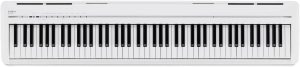
Best for:
Beginners who want portability but expect piano to become a serious long-term pursuit.
Kawai is known for both acoustic and digital pianos, and the ES120 reflects that piano-first philosophy.
It provides:
- 88-key Responsive Hammer Compact action
- Grade-weighted hammers
- Matte key surfaces
- Harmonic Imaging sound technology
- 88-key stereo sampling
- 192-note polyphony
- 25 sounds
- Damper resonance
- String resonance
- Virtual Technician
- Bluetooth MIDI
- Bluetooth audio
- USB MIDI
- 20-watt speaker system
- Approximately 26.5 lb / 12 kg weight
That’s still remarkably manageable for a full-size digital piano.
Responsive Hammer Compact Action
Kawai uses its Responsive Hammer Compact, or RHC, action in the ES120.
The action includes grade-weighted hammers.
Again, that’s important because our goal isn’t merely finding something easy to carry.
We’re looking for portable instruments that can support genuine piano learning.
88-Key Piano Sampling
The ES120 uses Kawai’s Harmonic Imaging technology with individual 88-key stereo sampling.
Its piano sounds include recordings associated with Kawai’s:
- SK-EX
- EX
- K-60
pianos.
The instrument also models aspects such as damper and string resonance.
A complete beginner may not initially appreciate every subtle detail.
But these qualities can become more important as your ear and technique develop.
Virtual Technician
Kawai’s Virtual Technician system allows various piano characteristics to be adjusted.
You probably shouldn’t spend your first week changing every parameter.
Learn to play first.
But later, the ability to adjust characteristics such as touch, voicing and resonance can help you personalize the instrument.
Who Should Buy the Kawai ES120?
Choose it if:
- You’re serious about piano study.
- Portability still matters.
- You want a piano-oriented instrument.
- You value Kawai’s acoustic-piano background.
- You want 192-note polyphony.
- You want Bluetooth audio and MIDI.
[Check Kawai ES120 Price on Amazon →]
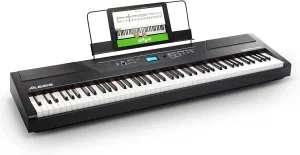
5. Alesis Recital Pro — Best Affordable Portable Alternative
Best for:
Budget-conscious beginners who want 88 hammer-action keys in a movable digital piano.
One important warning:
Don’t confuse the Alesis Recital Pro with the standard Alesis Recital.
The standard Recital uses semi-weighted keys.
The Recital Pro uses 88 full-size hammer-action keys.
That’s why we’re recommending the Pro here.
Its features include:
- 88 hammer-action keys
- Adjustable touch response
- 128-note polyphony
- 12 built-in voices
- Layer mode
- Split mode
- Lesson mode
- Recording
- Metronome
- Reverb
- Chorus
- Modulation effects
- 20-watt speakers
- USB MIDI
- Headphone output
- Battery operation
Battery Power
Like the Casio, the Recital Pro offers battery operation.
It can run from six D-cell batteries.
That’s potentially useful for:
- Lessons
- Rehearsals
- Temporary setups
- Locations without convenient electrical outlets
D-cell batteries obviously add weight, so AC power remains the sensible choice for normal home practice.
Lesson Mode
The Recital Pro’s Lesson Mode divides the keyboard into two identical zones with the same pitch and voice.
That means a teacher and student can sit beside each other and play equivalent notes without constantly changing positions.
For a beginner taking lessons, this can be genuinely useful.
Who Should Buy the Alesis Recital Pro?
Choose it if:
- Budget is a major consideration.
- You want hammer-action keys.
- You need a portable slab-style instrument.
- You want 128-note polyphony.
- Lesson Mode appeals to you.
- Battery operation would be useful.
[Check Alesis Recital Pro Price on Amazon
Which Is the Lightest Portable Digital Piano Here?
Among our five recommendations, the Casio PX-S1100 is the lightest at approximately 24.7 pounds.
The differences aren’t huge, though.
The Yamaha P-225 is approximately 25.4 pounds.
The Kawai ES120 is approximately 26.5 pounds.
The Roland FP-10 is around 27 pounds.
The Alesis Recital Pro is also in this general weight range.
This illustrates how competitive portable digital pianos have become.
You can now get a full 88-key hammer-action instrument weighing roughly the same as a packed suitcase.
How Heavy Is Too Heavy for a Portable Digital Piano?
There’s no universal cutoff.
I’d think of portability roughly this way:
Under 25 pounds
Highly portable for an 88-key weighted instrument.
25–30 pounds
Still genuinely portable for many adults.
30–40 pounds
Movable, but less pleasant to carry frequently.
Over 40 pounds
I’d start thinking of the instrument as transportable rather than truly portable.
There’s an important distinction.
A 45-pound piano may be easy to move twice a year.
It may be miserable to carry to lessons every week.
Can One Person Carry an 88-Key Digital Piano?
Usually, yes, for the models in this guide.
But weight isn’t the only issue.
An 88-key piano is long.
Even a 25-pound instrument can be awkward because of its width.
A good carrying case with strong handles can make a significant difference.
If you have back, shoulder or mobility limitations, don’t assume that a 25-pound specification automatically means you’ll find it comfortable to carry.
61 Keys vs 88 Keys for Portability
If portability is your absolute priority, a 61-key keyboard has an obvious advantage.
It’s:
- Shorter
- Usually lighter
- Easier to carry
- Easier to store
- Often less expensive
So why are all our recommendations 88-key instruments?
Because this article is aimed at people who want to learn piano, not merely own the smallest keyboard possible.
For serious piano learning, 88 weighted keys provide a better long-term foundation.
But if you’re unsure whether piano will become a long-term hobby, a 61-key touch-sensitive keyboard can still be a perfectly sensible starting point.
Portable Digital Piano vs Portable Keyboard
These terms are often used interchangeably online, but they aren’t quite the same thing.
Portable Keyboard
Typically emphasizes:
- Low weight
- Many sounds
- Rhythms
- Accompaniment
- 61 or 76 keys
- Synth-style action
- Entertainment features
Portable Digital Piano
Typically emphasizes:
- 88 keys
- Weighted or hammer action
- Acoustic-piano sound
- Sustain pedal use
- Piano technique
- Headphone practice
Neither category is inherently better.
They serve different purposes.
If you want to learn traditional piano, I’d favor the second.
[Internal link: Digital Piano vs Keyboard: Which Should You Buy in 2026?]
Do Beginners Need Weighted Keys?
Not necessarily.
You can learn notes, chords, rhythm and songs on lightweight keys.
But if your goal is piano technique, weighted keys become much more important.
They train your fingers to control resistance and dynamics in a way that lightweight keyboard actions don’t reproduce as effectively.
That’s why all five models in this guide use hammer-action or weighted piano-oriented keyboards.
Best Casio Digital Pianos with Weighted Keys in 2026: 5 Models ComparedDo You Need 88 Keys as a Beginner?
Not immediately.
Your first pieces won’t use the entire keyboard.
But buying 88 keys gives you room to progress without replacing your instrument simply because you’ve outgrown its range.
If you’re confident that you want to learn piano seriously, starting with 88 keys makes sense.
[Internal link: Best 88-Key Weighted Keyboards for Beginners in 2026: 7 Top Picks]
Best Portable Piano for an Apartment
My first choice would be the Casio PX-S1100.
Why?
Its unusually shallow cabinet makes it easier to fit against a wall or into a small room.
Headphone practice means you can play without disturbing neighbors.
And because the instrument weighs only about 24.7 pounds, moving or storing it is relatively easy.
The Yamaha P-225 would be my other leading choice.
Best Portable Piano for Taking to Lessons
Again, the PX-S1100 and P-225 stand out because they’re among the lightest.
But don’t overlook the FP-10.
If you particularly like Roland’s PHA-4 Standard action, carrying an extra pound or two may be a perfectly reasonable compromise.
The best instrument for lessons isn’t necessarily the lightest one.
It’s the lightest one whose action and sound you actually enjoy practicing on.
Best Portable Piano for Serious Study
I’d put the Kawai ES120, Yamaha P-225 and Roland FP-10 high on the list.
All three have strong piano-oriented identities.
The choice then becomes personal.
Do you prefer:
- Kawai’s RHC action and piano character?
- Yamaha’s GHC action and CFX sound?
- Roland’s PHA-4 Standard action and SuperNATURAL piano sound?
If possible, try them before buying.
Keyboard feel is one specification that a chart cannot fully communicate.
Portable Stand vs Furniture Stand
One advantage of these slab-style pianos is flexibility.
Portable Stand
Choose an X-style or Z-style stand if:
- You move the piano regularly.
- You need to store it.
- You take it to lessons or rehearsals.
- Space is limited.
Furniture-Style Stand
Choose a matching manufacturer stand if:
- The piano usually stays in one room.
- Appearance matters.
- You want a more stable home setup.
- You plan to add a three-pedal unit.
Some players begin with a portable stand and later convert their piano into a more permanent home setup.
That’s one of the advantages of this category.
Does Battery Operation Matter?
Probably less than you think.
Most beginners will practice at home near an electrical outlet.
So don’t reject an otherwise excellent digital piano just because it can’t run on batteries.
Battery operation is genuinely useful if you:
- Travel with the instrument
- Play outdoors
- Move between rooms frequently
- Perform in unusual locations
- Experience frequent power interruptions
Otherwise, consider it a bonus rather than an essential feature.
Can Portable Digital Pianos Use Headphones?
Yes, and this is one of their greatest advantages over acoustic pianos.
Headphones allow you to practice:
- Early in the morning
- Late at night
- In apartments
- While family members are watching television
- Without other people hearing your mistakes
For beginners, this can remove a surprising amount of self-consciousness.
Can You Use These Pianos with Learning Apps?
Yes.
Modern digital pianos can connect to phones, tablets or computers using technologies such as USB MIDI or Bluetooth MIDI, depending on the model.
Learning apps can provide:
- Structured lessons
- Note recognition
- Songs
- Exercises
- Progress tracking
They’re especially useful for self-directed beginners.
[Internal link: Simply Piano Review 2026: Is It Good for Beginners?]
What Should a Beginner Prioritize?
When comparing portable digital pianos, I’d prioritize:
1. Keyboard Action
You’re going to touch the keys every time you practice.
2. Weight
If portability genuinely matters, don’t ignore this number.
3. Dimensions
A slim piano can be easier to live with than a merely lightweight one.
4. Piano Sound
You should enjoy hearing your instrument.
5. Headphone Capability
Extremely useful for home practice.
6. Sustain Pedal Support
Important as your playing progresses.
7. Connectivity
USB/MIDI and Bluetooth can be useful for apps and recording.
8. Speakers
More important if you frequently play without headphones.
9. Battery Operation
Useful for some players, irrelevant for others.
8 Mistakes to Avoid When Buying a Portable Digital Piano
1. Looking Only at Weight
Dimensions matter too.
2. Assuming “Portable” Means Lightweight
Manufacturers use the term loosely.
Check the actual specifications.
3. Buying Non-Weighted Keys Just to Save Weight
That’s fine for general keyboard playing but less ideal for serious piano study.
4. Forgetting the Carrying Case
A good case can dramatically improve real-world portability.
5. Buying a Heavy Stand
A 25-pound piano isn’t especially portable if it’s attached to a 40-pound furniture stand.
6. Forgetting the Pedal
Check what comes with the piano and what is optional.
7. Choosing Hundreds of Sounds Over Piano Quality
For piano study, keyboard action and piano sound matter more.
8. Buying Too Cheap and Upgrading Immediately
If you’re already committed to piano, spending slightly more initially may save money later.
Frequently Asked Questions
What is the best portable digital piano for beginners?
Our overall portability choice is the Casio PX-S1100 because it combines 88 hammer-action keys, 192-note polyphony, an exceptionally slim cabinet, approximately 24.7-pound weight and battery capability.
What is the lightest digital piano on this list?
The Casio PX-S1100, at approximately 24.7 pounds without batteries.
Is the Yamaha P-225 portable?
Yes. It weighs approximately 25.4 pounds and is only about 10.7 inches deep.
Is the Roland FP-10 portable?
Yes. At roughly 27 pounds, it’s manageable for many adults, although it’s slightly heavier than the Casio and Yamaha models in this guide.
Are portable digital pianos good for beginners?
Yes, provided you choose an instrument with an appropriate keyboard action. A portable 88-key hammer-action piano can be an excellent first instrument.
Can I learn piano on 61 keys?
Yes, especially at the beginning.
However, serious piano students will eventually benefit from the complete 88-key range.
Do portable digital pianos have weighted keys?
Some do and some don’t.
Always check the actual keyboard-action specification rather than relying on the word “portable.”
Is the Alesis Recital Pro weighted?
Yes. The Recital Pro has hammer-action keys. Don’t confuse it with the standard Alesis Recital, which uses semi-weighted keys.
Do I need Bluetooth?
No.
It’s convenient for apps and audio, but it’s not essential for learning piano.
Which portable digital piano is best for classical music?
Among these five, I’d particularly consider the Kawai ES120, Yamaha P-225 and Roland FP-10 because of their emphasis on piano sound and action.
Final Verdict: Which Portable Digital Piano Should a Beginner Buy?
Portability no longer means settling for a toy-like keyboard.
All five instruments in this guide provide the full 88-key range and piano-oriented weighted or hammer-action keyboards while remaining manageable enough for many people to move themselves.
Best Overall for Portability — Casio PX-S1100
Our first choice if low weight, minimal depth and easy storage are your biggest priorities.
Best Balance — Yamaha P-225
An excellent choice if you want portability without making it the only consideration. Yamaha’s CFX sound, GHC action and 192-note polyphony make it a strong long-term beginner instrument.
Best Budget Piano Feel — Roland FP-10
A particularly attractive choice if you value Roland’s PHA-4 Standard keyboard action more than having the absolute lightest instrument.
Best for Serious Practice — Kawai ES120
A piano-focused portable instrument with Kawai’s RHC action, Harmonic Imaging sound and 192-note polyphony.
Best Affordable Alternative — Alesis Recital Pro
A useful budget-oriented option with 88 hammer-action keys, 128-note polyphony, Lesson Mode and battery capability.
Still undecided?
Use this shortcut:
Small apartment / maximum portability → Casio PX-S1100
Best balance of piano + portability → Yamaha P-225
Piano feel on a tighter budget → Roland FP-10
Serious long-term piano study → Kawai ES120
Affordable hammer-action alternative → Alesis Recital Pro
The most important question isn’t simply:
“Which piano is the lightest?”
It’s:
“Which piano is portable enough for my situation while still being good enough that I’ll want to practice on it?”
Get that balance right, and your first portable digital piano could remain useful long after you’re no longer a beginner.
Portability often involves compromises in size and weight, so see 88 Weighted Keys: Do You Really Need Them on a Digital Piano? if you’re unsure whether you need the full piano keyboard. If portability isn’t your only priority and your budget extends to $1,000, compare a broader selection in Best Digital Pianos Under $1,000 in 2026: 7 Top Picks. If you don’t need to move or store your instrument regularly, consider a console-style model instead; our Best Digital Upright Pianos for Home Use: 2026 Buying Guide explains the advantages of digital uprights for permanent home use. The Kawai ES120 is only one part of Kawai’s digital-piano lineup; see Best Kawai Digital Pianos 2026: Which Model Is Right for You? to compare its portable, home and premium digital-piano families. Yamaha, Roland, Kawai and Casio are among the strongest names in portable digital pianos, although each has its own strengths. Our Best Piano Brands in 2026: 10 Top Names Compared provides a broader comparison of these and other leading manufacturers. If your priority is saving floor space rather than carrying the instrument frequently, see our Best Compact Digital Pianos for Small Spaces in 2026: 6 Top Picks for apartment- and small-room-friendly options. If this model is on your shortlist, take a closer look at the Yamaha P-225 to see how its compact dimensions, weighted action and connectivity work together. Players who have moved beyond home practice and now perform regularly should see our guide to the best portable keyboards for gigging musicians, where weight, outputs, stage controls and live connectivity become much more important. The FP-10 and FP-30X are both strong portable choices, but they suit slightly different buyers. See which Roland is better for a beginner before deciding between them. Portability doesn’t necessarily mean sacrificing the standard piano range; several portable models with a full 88-key keyboard remain compact enough for students and smaller homes. Portability is only one consideration for a new player; our broader comparison of first digital pianos also considers keyboard action, sound, budget and long-term growth. If portability is your main concern, remember that a lightweight keyboard and a portable digital piano serve different purposes; our keyboard-or-digital-piano decision guide explains the trade-offs.Related Articles
- Best 88-Key Weighted Keyboards for Beginners in 2026: 7 Top Picks
- Best Digital Pianos for Beginners in 2026: 7 Top Picks for Learning Piano
- Best Cheap Keyboards in 2026: 5 Budget Picks That Are Actually Worth Buying
- Digital Piano vs Keyboard: Which Should You Buy in 2026?
- Simply Piano Review 2026: Is It Good for Beginners?