Best Digital Pianos for Every Budget in 2026: Beginner to Pro

Buying a digital piano can be confusing.
You can find 88-key instruments costing only a few hundred dollars—and premium digital pianos costing several times as much.
They may all look broadly similar.
They may all have 88 black and white keys.
So what exactly are you getting when you spend more?
And perhaps more importantly:
How much digital piano do you actually need?
A beginner learning basic scales doesn’t necessarily need the same instrument as an advanced classical pianist. Likewise, spending as little as possible isn’t always economical if you outgrow the piano after a year.
For 2026, we’ve selected eight digital pianos covering a wide range of budgets and playing levels:
Donner DEP-20 — Best Budget 88-Key Choice
Alesis Recital Pro — Best Affordable Hammer-Action Piano
Roland FP-10 — Best for Serious Beginners
Yamaha P-225 — Best Overall
Roland FP-30X — Best for Piano Practice
Kawai ES920 — Best Premium Step-Up
Yamaha P-525 — Best for Advanced Pianists
Roland FP-90X — Best Premium Roland / Performance Choice
The goal isn’t simply to identify the most expensive piano.
It’s to help you find the sweet spot where price, playing level and features meet.
Disclosure: Some links on Pianos-Galore are affiliate links. If you purchase through these links, we may receive a small commission at no additional cost to you.
Best Digital Pianos for Every Budget at a Glance
| Digital Piano | Best For | Keys/Action | Polyphony |
|---|---|---|---|
| Donner DEP-20 | Budget Buyers | 88 Weighted | 128 |
| Alesis Recital Pro | Affordable Hammer Action | 88 Hammer Action | 128 |
| Roland FP-10 | Serious Beginners | PHA-4 Standard | 96 |
| Yamaha P-225 | Best Overall | GHC | 192 |
| Roland FP-30X | Serious Piano Practice | PHA-4 Standard | 256 |
| Kawai ES920 | Premium Step-Up | RHIII | 256 |
| Yamaha P-525 | Advanced Pianists | GrandTouch-S | 256 |
| Roland FP-90X | Premium/Performance | PHA-50 Hybrid | 256 |
One important point before we compare them:
Don’t choose a digital piano by polyphony alone.
Keyboard action, piano sound, speakers, pedals, connectivity and how the instrument responds to your playing are usually more important.
How Much Should You Spend on a Digital Piano?
There isn’t a single correct amount.
Think about your purchase in broad tiers.
Budget Tier
Best for:
- First-time players
- Families testing a child’s interest
- Recreational musicians
- Buyers with strict budgets
The priority should be getting 88 keys, touch sensitivity and preferably weighted or hammer action without paying for features you don’t need.
Beginner / Lower Midrange
This is where serious piano learning becomes more interesting.
You begin to find better hammer actions, stronger piano sounds and instruments capable of serving a student for several years.
Midrange
For many people, this is the digital-piano sweet spot.
You get much of what matters for serious practice without paying premium prices.
Upper Midrange
This is where experienced players start receiving meaningful improvements in:
- Keyboard action
- Piano modeling/sampling
- Amplification
- Connectivity
- Recording
- Pedal response
- Expressive control
Premium
Premium digital pianos are aimed at advanced pianists, performers and serious enthusiasts.
Here you’re paying less for “more features” and increasingly for better touch, sound and expression.
1. Donner DEP-20 — Best Budget 88-Key Choice
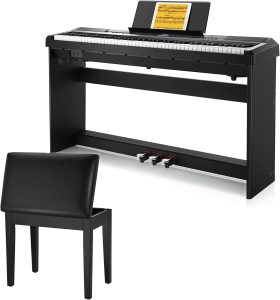
The Donner DEP-20 proves that buying an 88-key weighted digital piano doesn’t necessarily require a large investment.
It combines:
- 88 weighted keys
- 128-note polyphony
- 238 tones
- Dual 25W speakers
- USB-MIDI
- Dual headphone connections
- Audio input/output
- Split functionality
- Pedal support
Its biggest attraction is straightforward:
You get a lot of instrument for the money.
Who Is It For?
The DEP-20 makes particular sense for:
- Adult beginners
- Teenagers
- Families
- Casual home players
- Budget-conscious students
Its 238 tones also make it more versatile than many piano-focused instruments.
You can experiment with:
- Piano
- Electric piano
- Organ
- Strings
- Bass
- Synth sounds
and many other voices.
Where Does It Compromise?
Budget instruments have to save money somewhere.
Players who become serious about classical piano may eventually want a more refined action and more sophisticated acoustic-piano sound.
That’s why I regard the DEP-20 as a strong entry point rather than a lifetime instrument for an advanced pianist.
Pros
- 88 weighted keys
- 128-note polyphony
- 238 tones
- Strong speaker specification
- USB-MIDI
- Excellent feature-to-price ratio
Consider Before Buying
If serious classical study is already your goal, compare the DEP-20 with the Roland FP-10 before deciding.
Best for:
Buyers wanting the maximum amount of 88-key weighted-piano functionality on a limited budget.
[Check Donner DEP-20 Price on Amazon →]
2. Alesis Recital Pro — Best Affordable Hammer-Action Piano
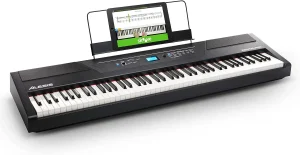
The Alesis Recital Pro is an interesting next step because it offers a proper 88-key hammer-action keyboard while remaining relatively affordable.
Key features include:
- 88 full-size hammer-action keys
- Adjustable touch response
- 128-note polyphony
- 12 built-in voices
- 20W speaker system
- Split and Layer modes
- Lesson Mode
- Record Mode
- USB-MIDI
- Headphone output
- Sustain-pedal input
Why Choose It Over a Basic Keyboard?
The key distinction is hammer action.
Many inexpensive electronic keyboards use light synth-style or semi-weighted actions.
That’s perfectly acceptable for casual keyboard playing, but students learning traditional piano technique benefit from resistance that more closely resembles an acoustic piano.
The Recital Pro gives budget-conscious buyers access to that experience without immediately moving into more expensive territory.
Lesson Mode
Alesis also includes a useful learning feature that divides the keyboard into two identical pitch ranges.
Teacher and student can therefore sit together and play the same notes without constantly changing seats or octaves.
Pros
- 88 hammer-action keys
- 128-note polyphony
- Affordable
- Lesson Mode
- Recording
- USB-MIDI
- Good beginner feature set
Consider Before Buying
If your budget stretches further, the Roland FP-10 provides a more piano-focused proposition and is worth comparing.
Best for:
Beginners wanting an affordable introduction to 88-key hammer-action piano playing.
[Check Alesis Recital Pro Price on Amazon →]
3. Roland FP-10 — Best for Serious Beginners
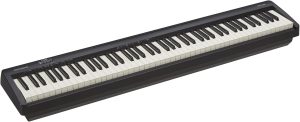
The Roland FP-10 is where our recommendations move firmly into serious piano-learning territory.
Roland equips it with the PHA-4 Standard keyboard.
This is particularly significant because the same basic action family appears in the more expensive FP-30X.
The FP-10 provides:
- 88 PHA-4 Standard keys
- Hammer action
- Escapement
- Ivory Feel key surfaces
- SuperNATURAL Piano sound
- 96-note polyphony
- Twin Piano mode
- Bluetooth MIDI
- USB connectivity
- Built-in speakers
Why the FP-10 Stands Out
Many beginners focus heavily on the number of sounds.
For serious piano learning, I would prioritize something else:
keyboard action.
The FP-10’s PHA-4 Standard action gives a beginner a strong foundation for developing:
- Finger control
- Dynamics
- Articulation
- Repetition
- Expression
Roland also incorporates escapement and textured key surfaces.
Is 96-Note Polyphony Enough?
For beginner and much intermediate piano playing, yes.
It’s easy to assume that 256 is automatically “better” than 96.
But maximum polyphony isn’t a measure of overall piano quality.
A beginner playing Beethoven’s early sonatas isn’t likely to reject an FP-10 because it has 96-note rather than 256-note polyphony.
Pros
- Excellent action for its class
- PHA-4 Standard keyboard
- SuperNATURAL Piano
- Escapement
- Ivory Feel
- Bluetooth MIDI
- Strong long-term beginner instrument
Consider Before Buying
Its built-in amplification and features are more modest than those of the FP-30X.
Best for:
Beginners who already know they’re serious about learning piano.
[Check Roland FP-10 Price on Amazon →]
4. Yamaha P-225 — Best Overall Digital Piano
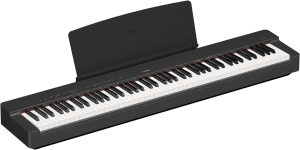
For the broadest range of buyers, the Yamaha P-225 remains our Best Overall recommendation.
It provides:
- 88-key Graded Hammer Compact (GHC) action
- Yamaha CFX concert-grand sound
- VRM Lite
- 192-note polyphony
- 24 voices
- Split, Dual and Duo
- 20 rhythms
- USB audio/MIDI
- Optional three-pedal system
The P-225 is also impressively compact at approximately 11.5 kg (25 lb 6 oz) and only around 272 mm deep without the music rest.
Why It’s the Sweet Spot
The P-225 doesn’t have the most advanced keyboard in this article.
It doesn’t have the highest polyphony.
And it isn’t the cheapest.
That’s exactly why it’s our overall choice.
It achieves an excellent balance among:
price + action + sound + portability + long-term usefulness.
A beginner can start on it.
An intermediate pianist can continue enjoying it.
An experienced player can use it as a convenient secondary instrument.
Yamaha CFX Sound
The P-225 draws on the sound of Yamaha’s CFX concert grand.
VRM Lite adds modeled resonance behavior to create a more complex piano character than a simple static sample.
GHC Keyboard
Graded Hammer Compact action is designed to provide weighted piano response while keeping the physical instrument compact.
That makes the P-225 particularly attractive for:
- Apartments
- Bedrooms
- Studios
- Smaller homes
Pros
- 88 GHC weighted keys
- Yamaha CFX sound
- VRM Lite
- 192-note polyphony
- Compact
- Relatively lightweight
- USB audio/MIDI
- Excellent balance of features
Consider Before Buying
Advanced pianists may eventually want the substantially more sophisticated GrandTouch-S action of the P-525.
Best for:
The largest range of beginner and intermediate players wanting one digital piano that does almost everything well.
[Check Yamaha P-225 Price on Amazon →]
5. Roland FP-30X — Best for Serious Piano Practice
If the P-225 is our all-rounder, the Roland FP-30X is especially compelling as a dedicated practice instrument.
It offers:
- 88 PHA-4 Standard keys
- Escapement
- Ivory Feel
- SuperNATURAL Piano
- 256-note polyphony
- Strong built-in amplification
- Bluetooth Audio
- Bluetooth MIDI
- USB audio/MIDI
- Optional three-pedal system
FP-10 vs FP-30X
This is an important comparison.
Both use Roland’s PHA-4 Standard action.
So why pay more for the FP-30X?
You gain improvements including:
- More polyphony
- Stronger speakers
- More sounds
- Better connectivity
- Bluetooth Audio
- Greater overall flexibility
If you’re a beginner on a tight budget, the FP-10 makes excellent sense.
If you’re able to spend more and expect to keep the piano for years, the FP-30X becomes easier to justify.
256-Note Polyphony
The FP-30X provides substantial headroom for sustained passages and layered sounds.
Combined with the PHA-4 action, it makes the instrument particularly attractive to students progressing toward intermediate and advanced repertoire.
Pros
- PHA-4 Standard
- Escapement
- Ivory Feel
- 256-note polyphony
- Strong speakers
- Bluetooth Audio/MIDI
- USB audio/MIDI
- Excellent practice instrument
Consider Before Buying
It weighs more than some competitors, so frequent transportation isn’t its strongest advantage.
Best for:
Serious students and home pianists who prioritize piano practice over maximum portability.
[Check Roland FP-30X Price on Amazon →]
6. Kawai ES920 — Best Premium Step-Up Digital Piano
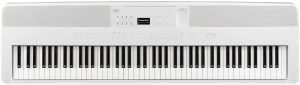
The Kawai ES920 represents a substantial step upward.
This isn’t merely a beginner piano with more sounds.
It introduces meaningful upgrades in keyboard action, piano sampling, amplification and expressive control.
The ES920 features:
- 88-key Responsive Hammer III (RHIII) action
- Grade-weighted hammers
- Triple-sensor key detection
- Let-off simulation
- Counterweights
- Ivory Touch key surfaces
- Harmonic Imaging XL sound engine
- 88-key stereo piano sampling
- SK-EX, SK-5 and EX grand-piano sounds
- 256-note polyphony
- 38 voices
- 40W speaker system
- Bluetooth MIDI and Audio
- USB recording
- Virtual Technician adjustments
Responsive Hammer III Action
The RHIII action is one of the biggest reasons to step up to the ES920.
Compared with entry-level actions, it adds refinements such as:
- Triple sensors
- Counterweights
- Let-off simulation
- Grade-weighted hammers
- Ivory Touch surfaces
These characteristics become increasingly meaningful as your technique develops.
Shigeru Kawai SK-EX Sound
The ES920 incorporates sampled sounds from Kawai concert grands including the Shigeru Kawai SK-EX.
Its HI-XL sound engine uses 88-key stereo sampling to capture individual notes across the keyboard.
256-Note Polyphony
The ES920 provides enough polyphonic headroom for demanding repertoire, extensive pedal use and layered playing.
40W Speaker System
Its 20W x 2 amplification system gives it substantially more acoustic presence than many entry-level portable pianos.
Virtual Technician
More experienced pianists can adjust characteristics such as:
- Voicing
- Touch
- Resonance
- Damper behavior
- Hammer noise
- Tuning
- Temperament
This is precisely the kind of capability beginners may barely notice but experienced players can appreciate.
Pros
- Excellent RHIII action
- Triple sensors
- Counterweights
- SK-EX piano sound
- 256-note polyphony
- 40W speakers
- Bluetooth Audio/MIDI
- Extensive piano customization
Consider Before Buying
At approximately 17 kg without the music rest, it’s portable but considerably less convenient to move than an entry-level slab piano.
Best for:
Intermediate and advanced players ready to move beyond entry-level digital-piano action and sound.
[Check Kawai ES920 Price on Amazon →]
7. Yamaha P-525 — Best for Advanced Pianists
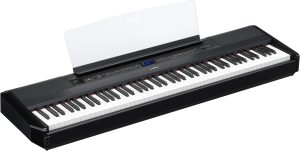
The Yamaha P-525 takes another major step toward premium digital-piano territory.
Its features include:
- 88-key GrandTouch-S keyboard
- Wooden white keys
- Synthetic ebony and ivory keytops
- Escapement
- Yamaha CFX concert-grand sound
- Bösendorfer Imperial grand sound
- Virtual Resonance Modeling
- Grand Expression Modeling
- 256-note polyphony
- 16-track MIDI recording
- USB audio recording
- Advanced speaker system
Where Does the Extra Money Go?
This is exactly the question this article should answer.
Compared with a P-225, you’re not primarily paying for a longer list of gimmicks.
You’re paying for upgrades to the core piano experience.
Keyboard
The GrandTouch-S action incorporates wooden white keys and escapement.
Piano Sounds
You get both Yamaha CFX and Bösendorfer Imperial grand-piano characters.
Resonance
The P-525 uses Yamaha’s fuller Virtual Resonance Modeling rather than the lighter VRM implementation of less expensive models.
Expression
Grand Expression Modeling adds further tonal variation based on how the pianist interacts with the keyboard.
These differences matter much more to an experienced pianist than someone playing their first five-note exercise.
Pros
- GrandTouch-S action
- Wooden white keys
- CFX and Bösendorfer sounds
- Full VRM
- Grand Expression Modeling
- 256-note polyphony
- Advanced recording
- Premium piano experience
Consider Before Buying
At roughly 22 kg, “portable” is relative.
And most beginners simply don’t need to spend this much.
Best for:
Advanced pianists and serious enthusiasts who prioritize sophisticated touch and acoustic-piano expression.
[Check Yamaha P-525 Price on Amazon →]
8. Roland FP-90X — Best Premium Roland / Performance Choice
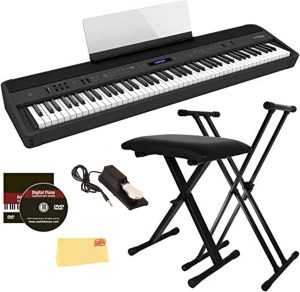
At the top of our Roland recommendations sits the FP-90X.
This is Roland’s flagship FP-X portable piano.
Its defining features include:
- 88-key PHA-50 hybrid keyboard
- Wood/plastic hybrid construction
- Escapement
- Ivory Feel
- PureAcoustic Piano Modeling
- 256-note piano polyphony
- Powerful four-speaker system
- Bluetooth Audio/MIDI
- USB audio/MIDI
- Extensive onboard sounds and effects
- Professional connectivity
PHA-50 Keyboard
The PHA-50 is a substantial step beyond the PHA-4 Standard action used in the FP-10 and FP-30X.
Its hybrid construction combines wooden elements with modern composite materials.
The goal is to provide a more premium, responsive playing experience without the maintenance requirements of an acoustic-piano mechanism.
PureAcoustic Piano Modeling
Instead of relying purely on conventional sample playback, the FP-90X uses Roland’s PureAcoustic Piano Modeling technology.
This allows the instrument to reproduce and manipulate complex aspects of piano tone and resonance.
Four-Speaker System
The FP-90X is also designed to produce considerably more substantial room-filling sound than typical portable digital pianos.
This makes it particularly attractive for:
- Performers
- Rehearsals
- Serious home players
- Musicians who don’t always want external amplification
Who Needs an FP-90X?
Not every pianist.
If you’re just starting, an FP-10 or P-225 is much more sensible.
The FP-90X makes sense when you’ve developed enough technique and experience to appreciate what its keyboard, sound engine, amplification and performance features provide.
Pros
- PHA-50 hybrid action
- PureAcoustic Piano Modeling
- 256-note piano polyphony
- Powerful four-speaker system
- Professional connectivity
- Bluetooth
- Excellent performance capabilities
Consider Before Buying
It’s large, heavy and significantly more expensive than what most beginners need.
Best for:
Advanced pianists, performers and serious Roland enthusiasts wanting the flagship FP-X experience.
[Check Roland FP-90X Price on Amazon →]
Budget vs Premium Digital Piano: What Are You Actually Paying For?
This is perhaps the most important question in this guide.
Suppose one 88-key piano costs several times more than another.
Where does the money go?
1. Better Keyboard Action
This is often the biggest improvement.
You may progress from:
Basic weighted action
to
Hammer action
to
Graded hammer action with triple sensors
to
Premium hybrid or wooden-key actions.
Advanced actions can improve repetition, dynamic control and subtle expression.
2. Better Piano Sound
Entry-level instruments may use relatively straightforward sampling.
Premium instruments can add:
- Multiple concert grands
- More sample layers
- Physical modeling
- Detailed resonance
- Damper modeling
- String interaction
- Advanced expression systems
3. Better Speakers
A 10W or 20W system can be perfectly adequate for practice.
Premium models may use much more powerful multi-speaker systems capable of producing a fuller, more room-filling sound.
4. Better Pedaling
Advanced repertoire increasingly demands nuanced pedal control.
Premium instruments and optional three-pedal units may provide more sophisticated half-pedaling and pedal response.
5. Better Connectivity
As price increases, you may gain:
- Bluetooth Audio
- Bluetooth MIDI
- USB audio
- Dedicated line outputs
- Traditional MIDI
- Microphone inputs
- Multiple pedal connections
depending on the instrument.
6. Better Recording
Higher-end models may offer multi-track MIDI recording, WAV recording and more sophisticated performance features.
What You DON’T Necessarily Need to Pay More For
Beginners often get distracted by:
500 sounds!
300 rhythms!
Huge effects libraries!
Those features can be fun.
But if your goal is learning piano, I’d rather have:
10 excellent sounds + a good keyboard
than
500 sounds + poor key action.
Spend your money first on:
- Keyboard action
- Piano sound
- Pedal support
- Speakers
- Build quality
Then worry about extras.
Best Digital Piano for a Complete Beginner
If budget allows:
Roland FP-10
or
Yamaha P-225
The FP-10 is especially compelling if you want a serious hammer-action learning instrument at a relatively accessible price.
The P-225 costs more but offers a broader all-round package and greater long-term flexibility.
For tighter budgets, consider the Alesis Recital Pro or Donner DEP-20.
Best Digital Piano for an Intermediate Player
My shortlist would be:
Yamaha P-225
Roland FP-30X
and, if budget allows,
Kawai ES920
The ES920 is where the benefits of paying more become particularly noticeable in keyboard sophistication and piano-focused features.
Best Digital Piano for an Advanced Player
I’d compare:
Kawai ES920
Yamaha P-525
Roland FP-90X
At this level, don’t buy purely from specification tables.
Try the instruments if possible.
The differences in keyboard feel and piano tone become increasingly subjective.
Best Digital Piano for Classical Music
For serious classical study, prioritize:
- 88 weighted keys
- Graded hammer action
- Dynamic control
- Good pedal support
- Realistic piano tone
- Sufficient polyphony
For beginners, the Roland FP-10 or Yamaha P-225 can provide an excellent foundation.
Intermediate and advanced players should consider the Kawai ES920, Yamaha P-525 and Roland FP-90X.
Best Digital Piano for Apartments
If you’re short on space, I’d lean toward the Yamaha P-225.
It combines a full 88-key GHC action with an unusually shallow cabinet.
The FP-10 is another good option.
And remember one enormous advantage digital pianos have over acoustics:
headphones.
You can practice late at night without disturbing your neighbors.
Best Digital Piano for Performing
The decision changes for performers.
Consider:
- Weight
- Dedicated audio outputs
- Amplification
- Connectivity
- Sound selection
- Keyboard feel
- Reliability
The Roland FP-90X is particularly strong here because it’s explicitly designed as a premium portable/performance instrument.
The Kawai ES920 is another compelling choice, especially for piano-focused performers.
When Should You Upgrade Your Digital Piano?
Don’t upgrade simply because a newer model exists.
Upgrade when your current piano is limiting your playing.
Possible signs include:
- You need a more responsive keyboard.
- Repetition feels limiting.
- Pedal behavior is inadequate.
- Speakers no longer satisfy you.
- You need professional outputs.
- You need better recording/connectivity.
- Your repertoire exposes weaknesses in the action.
- You’re regularly playing acoustic grands and find your digital piano frustrating.
If none of those apply, keep practicing.
A better pianist on a modest digital piano is still a better pianist.
Should a Beginner Buy an Expensive Digital Piano?
Sometimes.
If you’re an adult beginner who is absolutely committed to learning and can comfortably afford a premium instrument, there’s nothing wrong with buying something like the Kawai ES920 or even Yamaha P-525.
You won’t “damage” your learning by having a better piano.
But don’t assume the expensive instrument will make you learn faster.
Practice still matters far more than price.
For most beginners, the FP-10, P-225 or FP-30X represents a more rational starting point.
Should You Buy the Cheapest Piano First and Upgrade Later?
Not necessarily.
Suppose you buy a very cheap keyboard today and replace it with a proper weighted digital piano six months later.
You may end up spending more overall.
If you’re reasonably confident you’ll continue learning, buying an instrument with:
- 88 keys
- Hammer action
- Touch sensitivity
- Sustain-pedal support
from the beginning can make better financial sense.
Digital Piano vs Acoustic Piano: Where Should Your Budget Go?
Once your budget reaches premium digital-piano territory, another question emerges:
Should I buy an acoustic piano instead?
That’s worth considering.
An acoustic piano offers real strings, hammers, a soundboard and physical resonance.
A digital piano gives you:
- Headphones
- Volume control
- Recording
- MIDI
- Bluetooth
- Easier moving
- No regular tuning
- Smaller size
Neither is universally better.
The right choice depends on your home, playing goals and priorities.
Internal link: Digital Pianos Are Outselling Acoustics—Here’s Why
Frequently Asked Questions
How much should a beginner spend on a digital piano?
There isn’t a fixed amount.
Instead of targeting a particular price, look for an instrument with 88 full-size keys, good hammer action, touch sensitivity, sustain-pedal support and a convincing piano sound.
What is the best digital piano for most people?
Our overall recommendation is the Yamaha P-225 because it balances action, sound, portability and capability extremely well.
Is the Roland FP-10 good enough for a beginner?
Yes.
In fact, its PHA-4 Standard action makes it one of our preferred choices for a serious beginner.
Is the FP-30X worth paying more than the FP-10?
For many players, yes.
You gain stronger amplification, more polyphony, additional sounds and connectivity while retaining the PHA-4 Standard action.
Is the Kawai ES920 worth the extra money?
For intermediate and advanced players who appreciate its RHIII action, triple sensors, counterweights, HI-XL piano sound, 256-note polyphony and extensive piano customization, it can be.
A complete beginner may not appreciate all of those advantages immediately.
Is the Yamaha P-525 suitable for beginners?
Absolutely—but it’s more piano than most beginners require.
It makes greater financial sense for committed players who expect to benefit from its GrandTouch-S action and premium piano technologies.
Is the Roland FP-90X a professional digital piano?
It is Roland’s flagship FP-X portable digital piano and is designed for advanced home playing and performance applications.
Does a more expensive digital piano make you a better pianist?
No.
A better instrument can provide better feedback, greater expressive control and a more enjoyable practice experience.
But progress still depends primarily on good instruction and consistent practice.
Final Recommendations by Budget and Skill Level
If you’re still undecided, use this shortcut.
Lowest Budget — Donner DEP-20
Choose it if your priority is getting 88 weighted keys and lots of features for as little money as practical.
[Check Donner DEP-20 Price on Amazon →]
Affordable Hammer Action — Alesis Recital Pro
Choose it if you want an inexpensive entry into 88-key hammer-action piano playing.
[Check Alesis Recital Pro Price on Amazon →]
Serious Beginner — Roland FP-10
Choose it if you’re starting piano but already know that keyboard feel and proper technique matter.
[Check Roland FP-10 Price on Amazon →]
Best Overall — Yamaha P-225
For the largest number of buyers, this is our sweet-spot recommendation.
[Check Yamaha P-225 Price on Amazon →]
Serious Home Practice — Roland FP-30X
Choose it if you’re prepared to spend more for stronger speakers, 256-note polyphony and additional connectivity while retaining Roland’s PHA-4 Standard action.
[Check Roland FP-30X Price on Amazon →]
Premium Step-Up — Kawai ES920
Choose it when you’ve progressed enough to appreciate RHIII action, triple sensors, counterweights, SK-EX piano sounds and more sophisticated piano customization.
[Check Kawai ES920 Price on Amazon →]
Advanced Pianist — Yamaha P-525
Choose it if GrandTouch-S action, wooden white keys, CFX/Bösendorfer sounds and advanced acoustic-piano modeling are worth the additional investment.
[Check Yamaha P-525 Price on Amazon →]
Premium Roland / Performer — Roland FP-90X
Choose it for Roland’s PHA-50 hybrid action, PureAcoustic Piano Modeling, powerful amplification and performance-oriented capabilities.
[Check Roland FP-90X Price on Amazon →]
Final Verdict
The best digital piano isn’t necessarily the most expensive one you can afford.
It’s the instrument that matches where you are as a pianist today while giving you enough room to grow tomorrow.
For someone simply exploring piano, the Donner DEP-20 or Alesis Recital Pro can lower the financial barrier to getting started.
For a serious beginner, the Roland FP-10 offers an unusually strong piano-focused foundation.
For most buyers, the Yamaha P-225 hits the sweet spot.
As your playing develops, the Roland FP-30X and Kawai ES920 offer increasingly sophisticated experiences.
And for advanced players prepared to invest substantially more, the Yamaha P-525 and Roland FP-90X demonstrate just how close modern portable digital pianos have come to providing a genuinely premium piano experience.
Whatever your budget, prioritize the fundamentals:
Good keyboard action.
Convincing piano sound.
Proper pedal support.
An instrument you enjoy playing.
Because ultimately, the best-value piano isn’t the cheapest one.
It’s the one you keep playing for years. If your maximum budget is around $1,000, see our Best Digital Pianos Under $1,000 in 2026: 7 Top Picks for a more detailed comparison within this price range. If your digital piano will remain permanently at home, our Best Digital Upright Pianos for Home Use: 2026 Buying Guide explores furniture-style models with integrated stands, pedals and speakers. If you’d rather choose according to your playing needs than price alone, see our Best Digital Pianos in 2026: 7 Top-Rated Picks for Different Players. Before deciding how much to spend, new buyers may want to read our Piano Essentials: A Beginner’s Guide to Buying and Playing Piano for an overview of the factors that matter when choosing and learning an instrument. Price isn’t the only consideration when choosing a piano—the strengths and design priorities of different manufacturers also matter. Read our Best Piano Brands in 2026: 10 Top Names Compared for an overview of the leading names in the piano industry. Buyers who consider computer connectivity an important part of their purchase should also compare our recommended MIDI-capable 88-key digital pianos. Price tells only part of the story. Before deciding how much to spend, consider what makes a keyboard good for your particular needs and which features you’ll actually use. If Roland’s combination of weighted actions, modeling technology and modern connectivity appeals to you, see our closer look at Roland’s current digital-piano range.Relevant reading materials:
Looking to learn piano or improve your playing ability ? Simply Piano is your go-to app for mastering the songs you love.

- Follow beginner-friendly tutorials or take advanced courses to level up.
- Learn at your pace and get personalized feedback.
- Play classical, pop, and Disney tunes with customized warm-ups and exercises.