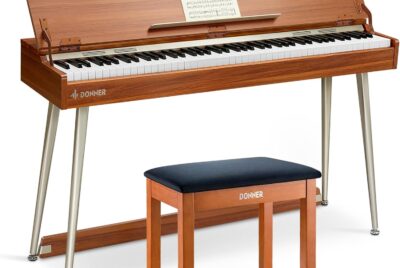
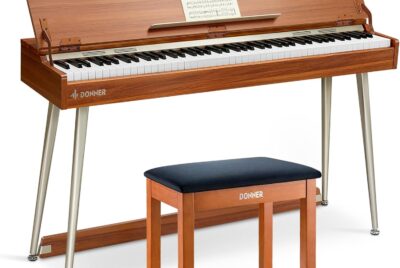
Best Donner Digital Pianos in 2026: 6 Models for Beginners and Home Players
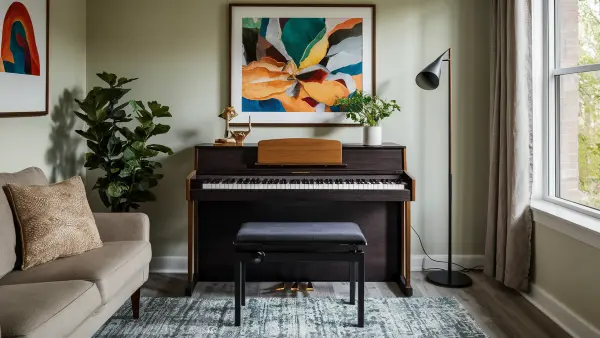
But Donner’s digital-piano range is now broad enough to create another problem:
Which Donner piano should you actually buy?
Some Donner models emphasize affordability and lots of sounds. Others concentrate on realistic piano playing. Some are designed to look like attractive pieces of home furniture, while newer models add more sophisticated features and connectivity.
For 2026, six models deserve particular consideration:
Donner DEP-20, DDP-60, DDP-80, DDP-90, DDP-100S, and DDP-300.
They don’t all serve the same type of pianist.
In this guide, we’ll explain their differences and help you decide which Donner digital piano makes the most sense for your playing level, home, and budget.
Disclosure: Some links on Pianos-Galore are affiliate links. If you purchase through these links, we may receive a small commission at no additional cost to you.
Best Donner Digital Pianos at a Glance
| Model | Best For | Keyboard Approach |
|---|---|---|
| Donner DEP-20 | Best Overall Value | 88 fully weighted keys |
| Donner DDP-60 | Casual Beginners | 88 semi-weighted keys |
| Donner DDP-80 | Best for Piano-Focused Home Practice | Graded hammer action |
| Donner DDP-90 | Compact Home Piano | Weighted home-piano design |
| Donner DDP-100S | Best Feature-Rich Home Piano | Progressive weighted hammer action |
| Donner DDP-300 | Premium Donner Option | Fully weighted hammer action |
There is one particularly important point for beginners:
Not every 88-key keyboard is fully weighted.
The DDP-60, for example, gives you the full 88-key range but uses a semi-weighted action. Donner’s own comparison information identifies the DDP-60 as semi-weighted, while the DDP-80 uses its Graded Hammer-Action II system.
That distinction matters if you’re studying traditional piano technique.
What Should Beginners Look for in a Digital Piano?
Before comparing individual models, it helps to understand which features actually matter.
Beginners can easily be distracted by specifications such as:
200 sounds! 100 rhythms! Bluetooth! Recording!
Those features can be useful.
But if your goal is actually to learn piano, I would prioritize these characteristics first.
1. 88 Keys
An acoustic piano has 88 keys.
A smaller keyboard can certainly be used during the earliest stages of learning, but a full-size keyboard prevents you from eventually outgrowing the available range.
All six Donner models discussed here provide 88 keys.
2. Weighted Action
This is more important than having hundreds of sounds.
An acoustic piano requires physical force to move its hammer mechanism. Digital pianos imitate this resistance through weighted keyboard actions.
Weighted keys help developing pianists work on:
- Finger strength
- Dynamic control
- Hand coordination
- Soft versus loud playing
- Traditional piano technique
For serious piano study, I generally prefer a fully weighted hammer-action keyboard over a semi-weighted one.
3. Touch Sensitivity
Your digital piano should respond to how you play.
Press softly and the note should sound softer.
Strike more firmly and it should become louder and more assertive.
This is fundamental to musical expression.
4. Sustain Pedal
Even beginners eventually need to learn pedaling.
A three-pedal unit becomes increasingly valuable as a student progresses, particularly for classical piano.
5. Headphones
This is one of the biggest advantages of digital pianos.
Headphone practice allows you to play early in the morning or late at night without disturbing other people.
6. USB/MIDI Connectivity
USB-MIDI can allow the piano to communicate with computers, tablets, learning software, and music-production applications.
It isn’t essential for learning scales and chords, but it can significantly expand what you can do with the instrument.
1. Donner DEP-20 — Best Overall Value
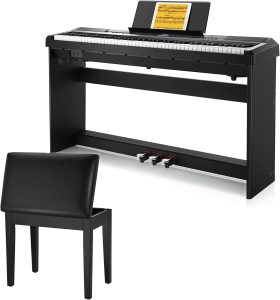
For many buyers, the Donner DEP-20 is probably the most versatile model in this group.
Unlike some Donner home pianos that concentrate almost entirely on acoustic-piano playing, the DEP-20 combines an 88-key weighted keyboard with a large selection of sounds, rhythms, recording features, and connectivity.
Donner currently specifies:
- 88 full-size weighted keys
- Adjustable touch response
- 238 tones
- 128-note polyphony
- 200 rhythms
- 100 demonstration songs
- Dual-tone capability
- MIDI recording
- MP3 playback
- LCD display
- 25W × 2 amplification
- USB-MIDI
- Headphone connection
Why the DEP-20 Stands Out
The DEP-20 isn’t simply trying to imitate an acoustic piano.
It’s also designed as a multipurpose keyboard.
That makes it particularly attractive to someone interested in:
- Piano lessons
- Pop music
- Arranging
- Songwriting
- Experimenting with different sounds
- Basic recording
- Playing with rhythms
Its 238 tones provide considerably more variety than a piano-focused instrument such as the DDP-80.
128-Note Polyphony
The DEP-20 provides 128-note maximum polyphony.
That’s sufficient for normal piano practice and also gives reasonable capacity when using layered sounds and sustain.
Strong Speakers
Donner specifies dual amplifiers rated at 25W × 2.
That is substantial on paper for an affordable home digital piano.
Three-Pedal Configuration
Current DEP-20 packages can include a furniture stand and three-pedal unit, depending on the bundle. Donner’s current listing includes the stand and three-pedal unit.
Always check the exact Amazon package before purchasing because accessories can differ between listings.
Who Should Buy the DEP-20?
Choose it if:
- You want fully weighted keys.
- You’re learning traditional piano.
- You also enjoy experimenting with different sounds.
- Recording and rhythms appeal to you.
- You want strong value for money.
Best for:
Beginners and home musicians wanting the most versatile Donner package.
[Check Donner DEP-20 Price on Amazon →]
2. Donner DDP-60 — Best for Casual Beginners
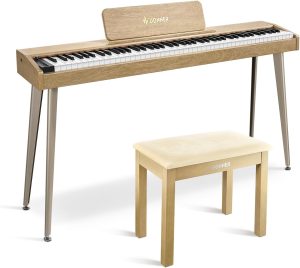
The DDP-60 needs to be understood correctly.
It has 88 keys, but Donner identifies its keyboard as semi-weighted, rather than fully weighted hammer action.
That’s not necessarily bad.
It simply makes the DDP-60 appropriate for a somewhat different buyer.
Donner’s comparison information lists:
- 88 semi-weighted keys
- 128 sounds
- 128-note polyphony
- 83 rhythms
- 47 demo songs
- 15W × 2 speakers
- USB-MIDI
- MIDI In/Out
- Split function
Who Might Prefer Semi-Weighted Keys?
Semi-weighted actions usually feel lighter than hammer-action piano keyboards.
That can appeal to:
- Casual players
- Younger beginners
- Keyboard players
- People who dislike heavy actions
- Musicians moving between piano and synth-style playing
However, if your main objective is traditional classical piano technique, I would generally favor the DEP-20, DDP-80, or another fully weighted Donner.
128 Sounds
The DDP-60 takes a different approach from the minimalist DDP-80.
You get a broad sound selection plus rhythms and practice features.
That can make learning more entertaining for beginners who enjoy exploring beyond conventional acoustic piano sounds.
Best for:
Casual beginners wanting 88 keys and a lighter touch rather than traditional hammer action.
[Check Donner DDP-60 Price on Amazon →]
3. Donner DDP-80 — Best for Piano-Focused Home Practice
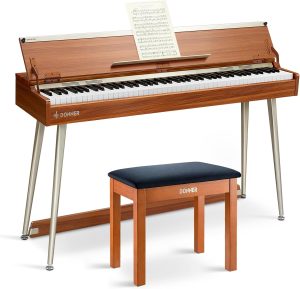
The Donner DDP-80 takes almost the opposite approach from the DEP-20.
Rather than loading the instrument with hundreds of sounds and controls, Donner designed it around a more focused piano experience.
Donner specifies:
- 88 keys
- Graded Hammer-Action II
- 128-note polyphony
- 20W × 2 speakers
- Three pedals
- USB-MIDI
- MIDI connectivity
- Headphone connection
- Furniture-style wooden cabinet
Minimalist Design
One of the DDP-80’s most distinctive characteristics is its appearance.
Rather than looking like a conventional electronic keyboard with numerous buttons, screens, and labels, it uses a minimalist furniture-style design.
That can make it attractive in:
- Living rooms
- Bedrooms
- Studios
- Modern apartments
It looks more like a permanent home instrument.
Graded Hammer Action
This is probably more important than the cabinet.
Donner identifies the DDP-80’s keyboard as Graded Hammer-Action II.
The idea is to provide a more acoustic-piano-oriented response than a lightweight or semi-weighted keyboard.
Only One Main Piano Sound?
This may initially seem like a disadvantage.
But it reflects the DDP-80’s philosophy.
It isn’t trying to be an arranger keyboard.
It’s trying to provide a straightforward:
sit down → switch on → play piano
experience.
For someone who wants 200 instrument sounds, this is the wrong Donner.
For someone who primarily wants to practice piano, the simplicity can actually be appealing.
Best for:
Beginners and home pianists who prioritize piano playing, hammer action, and attractive furniture styling over hundreds of extra sounds.
[Check Donner DDP-80 Price on Amazon →]
DEP-20 vs DDP-80: Which Is Better?
This is one of the most useful comparisons in the Donner range.
Choose the DEP-20 if you want:
- 238 tones
- Rhythms
- Recording
- LCD screen
- Greater versatility
- Piano plus general keyboard features
Choose the DDP-80 if you want:
- A more minimalist experience
- Graded hammer action
- Furniture styling
- Fewer distractions
- Primarily acoustic-piano practice
Neither is automatically better.
The DEP-20 is the more versatile keyboard.
The DDP-80 is the more focused home piano.
4. Donner DDP-90 — Best Compact Home Piano
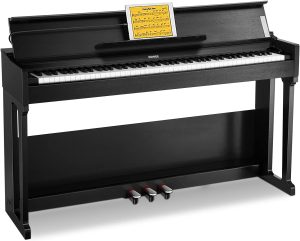
The DDP-90 is another model aimed at home players who want an 88-key digital piano integrated into a furniture-style cabinet.
Its appeal is less about having hundreds of sounds and more about providing a dedicated home-practice setup.
This makes it particularly interesting for:
- Apartments
- Bedrooms
- Small music rooms
- Families wanting a permanent piano setup
- Students who don’t need portability
The main reason to consider a cabinet-style instrument rather than a portable piano is convenience.
Once assembled, you have:
keyboard + stand + pedals + music rest
ready whenever you want to practice.
There’s no need to unfold a stand or connect a separate pedal system every time.
Who Should Buy the DDP-90?
Choose it if:
- Your piano will remain in one location.
- You prefer furniture styling.
- You want weighted keys.
- You want an integrated pedal setup.
- Space efficiency matters.
Best for:
Home learners wanting a compact dedicated piano rather than a portable keyboard.
[Check Donner DDP-90 Price on Amazon →]
5. Donner DDP-100S — Best Feature-Rich Home Piano
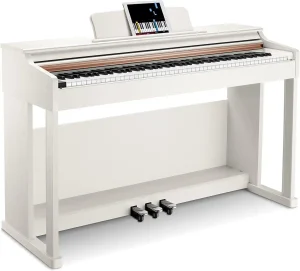
The DDP-100s is especially interesting because it expands considerably on the simpler home-piano concept.
Donner currently specifies:
- 88-key progressive weighted keyboard with hammer touch
- 200 sounds
- 200 rhythms
- 100 demo songs
- Three touch-response curves
- AWM dynamic sampling
- DREAM sound engine
- Three-pedal system
- MIDI In/Out
- USB-MIDI
- Dual headphone connections
- Audio input/output
- Metronome
- Transposition
- Dual keyboard functionality
That makes the DDP-100S significantly more versatile than the minimalist DDP-80.
Progressive Weighted Keyboard
For piano students, the keyboard is the important part.
Donner describes the DDP-100S as using a progressive weighted hammer-touch keyboard designed to reproduce the heavier-to-lighter behavior associated with acoustic piano keyboards.
200 Sounds and 200 Rhythms
Unlike the DDP-80, the DDP-100S gives players a large collection of sounds and accompaniment possibilities.
This makes it suitable not only for traditional practice but also for:
- Pop playing
- Songwriting
- Arranging
- Experimentation
- Recreational music making
Connectivity
MIDI In/Out plus USB connectivity gives the DDP-100S useful integration possibilities with computers and other music equipment.
Best for:
Home players wanting hammer-style weighted keys plus a much broader feature set than a minimalist digital piano.
[Check Donner DDP-100S Price on Amazon →]
6. Donner DDP-300 — Best Premium Donner Choice
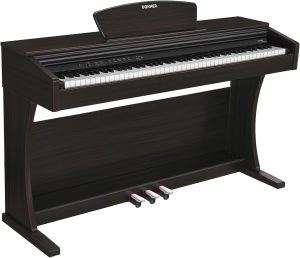
The DDP-300 sits toward the higher end of the Donner models we’re considering.
Current Donner comparison listings identify it as an 88-key fully weighted hammer-action digital piano with Bluetooth.
That positions it differently from entry-level models such as the DDP-60.
The DDP-300 makes the most sense for someone who already knows that:
- Piano playing is a long-term interest.
- Fully weighted hammer action matters.
- A permanent home instrument is preferred.
- More advanced connectivity is useful.
- Spending more now may prevent an early upgrade later.
Best for:
Committed beginners and developing home pianists wanting to move higher in Donner’s range.
[Check Donner DDP-300 Price on Amazon →]
Which Donner Digital Piano Is Best for Beginners?
For most beginners, I would narrow the six choices to three.
Best Overall Beginner Choice: Donner DEP-20
The combination of fully weighted keys, 238 tones, 128-note polyphony, strong speakers, recording, and three-pedal bundle availability makes it an excellent all-around choice.
Best Piano-Focused Choice: Donner DDP-80
Choose this if you’re primarily interested in learning piano and prefer a minimalist furniture-style instrument.
Best Casual Choice: Donner DDP-60
Choose this if you prefer lighter semi-weighted keys and aren’t specifically pursuing traditional acoustic-piano technique.
Which Donner Is Best for Classical Music?
For classical study, prioritize:
88 keys + weighted hammer action + touch sensitivity + proper pedals.
That means I would not put the DDP-60 first for serious classical study because of its semi-weighted keyboard.
Instead, consider models such as:
DEP-20 → affordable and versatile
DDP-80 → focused piano experience
DDP-100S → weighted action plus broader features
DDP-300 → higher-end Donner option
Internal link: Link classical music practice to your Best Digital Pianos for Classical Music article.
Which Donner Is Best for Kids?
That depends on the child’s goals.
For a child simply exploring music, the DDP-60’s lighter action and numerous sounds may be enjoyable.
For a child receiving traditional piano lessons, I’d lean toward a fully weighted model such as the DEP-20.
A good teacher may also have a preference based on the student’s technique and repertoire.
Which Donner Is Best for Adults Learning Piano?
The DEP-20 is probably the safest all-round recommendation.
Adults often appreciate having:
- Weighted keys
- Headphones
- Recording
- Different sounds
- USB/MIDI
- Three pedals
- Strong speakers
The DDP-80 becomes particularly attractive if appearance matters and the piano will stay permanently in a living room.
Which Donner Is Best for Small Apartments?
The answer isn’t necessarily the smallest instrument on paper.
Consider whether you want the piano to be:
portable or permanent.
A compact furniture-style model can actually be very convenient because everything stays assembled.
Headphone capability is also particularly valuable for apartment living.
Donner vs Yamaha, Roland and Kawai
This is where expectations need to be realistic.
Donner competes aggressively on features and price.
Yamaha, Roland, and Kawai have much longer histories in acoustic/electronic piano development and extensive proprietary keyboard and sound technologies.
For example, a beginner might compare a Donner with instruments such as:
- Yamaha P-225
- Roland FP-10
- Roland FP-30X
- Kawai ES120
The Donner may provide more bundled features or furniture styling for the money.
The established brands may justify their higher prices through differences in keyboard action, sound technology, long-term support, resale value, or overall refinement.
The correct question isn’t:
“Is Donner better than Yamaha?”
It’s:
“Which instrument gives me the playing experience and features I need at the price I can afford?”
Is Donner a Good Piano Brand for Beginners?
Donner can be an attractive choice for beginners, particularly when budget is limited.
Its strongest appeal is value.
Several models combine:
- 88 keys
- Weighted actions
- Built-in speakers
- Pedals
- Furniture stands
- USB/MIDI
- Headphone capability
at competitive prices.
But buyers should pay close attention to the type of keyboard action.
“88 keys” does not automatically mean “fully weighted hammer action.”
The DDP-60 is a perfect example: it has 88 keys but uses a semi-weighted action.
Frequently Asked Questions
What is the best Donner digital piano for beginners?
For most beginners, the DEP-20 provides an excellent combination of 88 weighted keys, 238 sounds, 128-note polyphony, strong speakers, recording features, and useful connectivity.
Does the Donner DEP-20 have weighted keys?
Yes. Donner describes the DEP-20 as having 88 full-size weighted hammer-action keys with adjustable touch response.
Is the Donner DDP-60 fully weighted?
No. Donner’s comparison information identifies the DDP-60 as semi-weighted.
This is an important distinction for students seeking traditional piano technique.
Does the Donner DDP-80 have weighted keys?
Yes. Donner lists it with Graded Hammer-Action II.
Does the DDP-80 have three pedals?
Yes. Donner lists damper, soft, and sostenuto pedals.
Does the DDP-100S have weighted keys?
Yes. Donner describes it as having an 88-key progressive weighted keyboard with hammer touch.
Can Donner digital pianos connect to computers?
Several models support USB-MIDI. Exact connectivity varies by model, so check the specifications for the instrument you’re considering.
Do Donner digital pianos require tuning?
No.
Like other digital pianos, they generate sound electronically and don’t have acoustic strings that require periodic tuning.
Are Donner digital pianos good for classical music?
Some are.
For traditional classical study, prioritize Donner models with fully weighted hammer-action keys rather than semi-weighted keyboards.
Is the DEP-20 better than the DDP-80?
Not universally.
Choose the DEP-20 if you want versatility, numerous sounds, rhythms, recording, and a display.
Choose the DDP-80 if you primarily want a straightforward home piano with graded hammer action and minimalist furniture styling.
Final Verdict: Which Donner Digital Piano Should You Buy?
Donner’s lineup makes much more sense when you stop looking for one universally “best” model and instead match the instrument to the player.
Best Overall Value — Donner DEP-20
The strongest all-round choice for many beginners because it combines fully weighted keys with 238 tones, 128-note polyphony, powerful speakers, recording features, and extensive versatility.
Best Casual Beginner Piano — Donner DDP-60
A good option for players who prefer a lighter semi-weighted touch and want numerous sounds and rhythms.
Best Piano-Focused Home Model — Donner DDP-80
Ideal for someone who wants a more traditional piano-playing experience, graded hammer action, three pedals, and attractive minimalist styling.
Best Compact Home Choice — Donner DDP-90
Worth considering when you want an integrated home-piano setup in a relatively space-conscious format.
Best Feature-Rich Home Piano — Donner DDP-100S
Its progressive weighted action, 200 sounds, 200 rhythms, MIDI connectivity, and practice functions make it particularly versatile.
Best Premium Donner Option — Donner DDP-300
The choice to investigate if you’re prepared to move higher in Donner’s range for fully weighted hammer action and additional modern features.
For a typical beginner, however, I’d start the comparison with:
DEP-20 vs DDP-80.
Choose the DEP-20 if you want versatility.
Choose the DDP-80 if you want simplicity and a more piano-focused home instrument.
And whichever model you’re considering, don’t judge it solely by the number of sounds or features.
For anyone serious about learning piano, the most important question remains:
How does the keyboard feel under your fingers?
If possible, play the instrument before buying—or purchase from a retailer with a reasonable return policy.
Before choosing a budget Donner model, you may also want to compare it with other affordable options in our Best Cheap Keyboards in 2026: 5 Budget Picks That Are Actually Worth Buying.
Related articles
But Donner’s digital-piano range is now broad enough to create another problem:
Which Donner piano should you actually buy?
Some Donner models emphasize affordability and lots of sounds. Others concentrate on realistic piano playing. Some are designed to look like attractive pieces of home furniture, while newer models add more sophisticated features and connectivity.
For 2026, six models deserve particular consideration:
Donner DEP-20, DDP-60, DDP-80, DDP-90, DDP-100S, and DDP-300.
They don’t all serve the same type of pianist.
In this guide, we’ll explain their differences and help you decide which Donner digital piano makes the most sense for your playing level, home, and budget.
Disclosure: Some links on Pianos-Galore are affiliate links. If you purchase through these links, we may receive a small commission at no additional cost to you.
Best Donner Digital Pianos at a Glance
| Model | Best For | Keyboard Approach |
|---|---|---|
| Donner DEP-20 | Best Overall Value | 88 fully weighted keys |
| Donner DDP-60 | Casual Beginners | 88 semi-weighted keys |
| Donner DDP-80 | Best for Piano-Focused Home Practice | Graded hammer action |
| Donner DDP-90 | Compact Home Piano | Weighted home-piano design |
| Donner DDP-100S | Best Feature-Rich Home Piano | Progressive weighted hammer action |
| Donner DDP-300 | Premium Donner Option | Fully weighted hammer action |
There is one particularly important point for beginners:
Not every 88-key keyboard is fully weighted.
The DDP-60, for example, gives you the full 88-key range but uses a semi-weighted action. Donner’s own comparison information identifies the DDP-60 as semi-weighted, while the DDP-80 uses its Graded Hammer-Action II system.
That distinction matters if you’re studying traditional piano technique.
What Should Beginners Look for in a Digital Piano?
Before comparing individual models, it helps to understand which features actually matter.
Beginners can easily be distracted by specifications such as:
200 sounds! 100 rhythms! Bluetooth! Recording!
Those features can be useful.
But if your goal is actually to learn piano, I would prioritize these characteristics first.
1. 88 Keys
An acoustic piano has 88 keys.
A smaller keyboard can certainly be used during the earliest stages of learning, but a full-size keyboard prevents you from eventually outgrowing the available range.
All six Donner models discussed here provide 88 keys.
2. Weighted Action
This is more important than having hundreds of sounds.
An acoustic piano requires physical force to move its hammer mechanism. Digital pianos imitate this resistance through weighted keyboard actions.
Weighted keys help developing pianists work on:
- Finger strength
- Dynamic control
- Hand coordination
- Soft versus loud playing
- Traditional piano technique
For serious piano study, I generally prefer a fully weighted hammer-action keyboard over a semi-weighted one.
3. Touch Sensitivity
Your digital piano should respond to how you play.
Press softly and the note should sound softer.
Strike more firmly and it should become louder and more assertive.
This is fundamental to musical expression.
4. Sustain Pedal
Even beginners eventually need to learn pedaling.
A three-pedal unit becomes increasingly valuable as a student progresses, particularly for classical piano.
5. Headphones
This is one of the biggest advantages of digital pianos.
Headphone practice allows you to play early in the morning or late at night without disturbing other people.
6. USB/MIDI Connectivity
USB-MIDI can allow the piano to communicate with computers, tablets, learning software, and music-production applications.
It isn’t essential for learning scales and chords, but it can significantly expand what you can do with the instrument.
1. Donner DEP-20 — Best Overall Value
For many buyers, the Donner DEP-20 is probably the most versatile model in this group.
Unlike some Donner home pianos that concentrate almost entirely on acoustic-piano playing, the DEP-20 combines an 88-key weighted keyboard with a large selection of sounds, rhythms, recording features, and connectivity.
Donner currently specifies:
- 88 full-size weighted keys
- Adjustable touch response
- 238 tones
- 128-note polyphony
- 200 rhythms
- 100 demonstration songs
- Dual-tone capability
- MIDI recording
- MP3 playback
- LCD display
- 25W × 2 amplification
- USB-MIDI
- Headphone connection
Why the DEP-20 Stands Out
The DEP-20 isn’t simply trying to imitate an acoustic piano.
It’s also designed as a multipurpose keyboard.
That makes it particularly attractive to someone interested in:
- Piano lessons
- Pop music
- Arranging
- Songwriting
- Experimenting with different sounds
- Basic recording
- Playing with rhythms
Its 238 tones provide considerably more variety than a piano-focused instrument such as the DDP-80.
128-Note Polyphony
The DEP-20 provides 128-note maximum polyphony.
That’s sufficient for normal piano practice and also gives reasonable capacity when using layered sounds and sustain.
Strong Speakers
Donner specifies dual amplifiers rated at 25W × 2.
That is substantial on paper for an affordable home digital piano.
Three-Pedal Configuration
Current DEP-20 packages can include a furniture stand and three-pedal unit, depending on the bundle. Donner’s current listing includes the stand and three-pedal unit.
Always check the exact Amazon package before purchasing because accessories can differ between listings.
Who Should Buy the DEP-20?
Choose it if:
- You want fully weighted keys.
- You’re learning traditional piano.
- You also enjoy experimenting with different sounds.
- Recording and rhythms appeal to you.
- You want strong value for money.
Best for:
Beginners and home musicians wanting the most versatile Donner package.
[Check Donner DEP-20 Price on Amazon →]
2. Donner DDP-60 — Best for Casual Beginners
The DDP-60 needs to be understood correctly.
It has 88 keys, but Donner identifies its keyboard as semi-weighted, rather than fully weighted hammer action.
That’s not necessarily bad.
It simply makes the DDP-60 appropriate for a somewhat different buyer.
Donner’s comparison information lists:
- 88 semi-weighted keys
- 128 sounds
- 128-note polyphony
- 83 rhythms
- 47 demo songs
- 15W × 2 speakers
- USB-MIDI
- MIDI In/Out
- Split function
Who Might Prefer Semi-Weighted Keys?
Semi-weighted actions usually feel lighter than hammer-action piano keyboards.
That can appeal to:
- Casual players
- Younger beginners
- Keyboard players
- People who dislike heavy actions
- Musicians moving between piano and synth-style playing
However, if your main objective is traditional classical piano technique, I would generally favor the DEP-20, DDP-80, or another fully weighted Donner.
128 Sounds
The DDP-60 takes a different approach from the minimalist DDP-80.
You get a broad sound selection plus rhythms and practice features.
That can make learning more entertaining for beginners who enjoy exploring beyond conventional acoustic piano sounds.
Best for:
Casual beginners wanting 88 keys and a lighter touch rather than traditional hammer action.
[Check Donner DDP-60 Price on Amazon →]
3. Donner DDP-80 — Best for Piano-Focused Home Practice
The Donner DDP-80 takes almost the opposite approach from the DEP-20.
Rather than loading the instrument with hundreds of sounds and controls, Donner designed it around a more focused piano experience.
Donner specifies:
- 88 keys
- Graded Hammer-Action II
- 128-note polyphony
- 20W × 2 speakers
- Three pedals
- USB-MIDI
- MIDI connectivity
- Headphone connection
- Furniture-style wooden cabinet
Minimalist Design
One of the DDP-80’s most distinctive characteristics is its appearance.
Rather than looking like a conventional electronic keyboard with numerous buttons, screens, and labels, it uses a minimalist furniture-style design.
That can make it attractive in:
- Living rooms
- Bedrooms
- Studios
- Modern apartments
It looks more like a permanent home instrument.
Graded Hammer Action
This is probably more important than the cabinet.
Donner identifies the DDP-80’s keyboard as Graded Hammer-Action II.
The idea is to provide a more acoustic-piano-oriented response than a lightweight or semi-weighted keyboard.
Only One Main Piano Sound?
This may initially seem like a disadvantage.
But it reflects the DDP-80’s philosophy.
It isn’t trying to be an arranger keyboard.
It’s trying to provide a straightforward:
sit down → switch on → play piano
experience.
For someone who wants 200 instrument sounds, this is the wrong Donner.
For someone who primarily wants to practice piano, the simplicity can actually be appealing.
Best for:
Beginners and home pianists who prioritize piano playing, hammer action, and attractive furniture styling over hundreds of extra sounds.
[Check Donner DDP-80 Price on Amazon →]
DEP-20 vs DDP-80: Which Is Better?
This is one of the most useful comparisons in the Donner range.
Choose the DEP-20 if you want:
- 238 tones
- Rhythms
- Recording
- LCD screen
- Greater versatility
- Piano plus general keyboard features
Choose the DDP-80 if you want:
- A more minimalist experience
- Graded hammer action
- Furniture styling
- Fewer distractions
- Primarily acoustic-piano practice
Neither is automatically better.
The DEP-20 is the more versatile keyboard.
The DDP-80 is the more focused home piano.
4. Donner DDP-90 — Best Compact Home Piano
The DDP-90 is another model aimed at home players who want an 88-key digital piano integrated into a furniture-style cabinet.
Its appeal is less about having hundreds of sounds and more about providing a dedicated home-practice setup.
This makes it particularly interesting for:
- Apartments
- Bedrooms
- Small music rooms
- Families wanting a permanent piano setup
- Students who don’t need portability
The main reason to consider a cabinet-style instrument rather than a portable piano is convenience.
Once assembled, you have:
keyboard + stand + pedals + music rest
ready whenever you want to practice.
There’s no need to unfold a stand or connect a separate pedal system every time.
Who Should Buy the DDP-90?
Choose it if:
- Your piano will remain in one location.
- You prefer furniture styling.
- You want weighted keys.
- You want an integrated pedal setup.
- Space efficiency matters.
Best for:
Home learners wanting a compact dedicated piano rather than a portable keyboard.
[Check Donner DDP-90 Price on Amazon →]
5. Donner DDP-100S — Best Feature-Rich Home Piano
The DDP-100s is especially interesting because it expands considerably on the simpler home-piano concept.
Donner currently specifies:
- 88-key progressive weighted keyboard with hammer touch
- 200 sounds
- 200 rhythms
- 100 demo songs
- Three touch-response curves
- AWM dynamic sampling
- DREAM sound engine
- Three-pedal system
- MIDI In/Out
- USB-MIDI
- Dual headphone connections
- Audio input/output
- Metronome
- Transposition
- Dual keyboard functionality
That makes the DDP-100S significantly more versatile than the minimalist DDP-80.
Progressive Weighted Keyboard
For piano students, the keyboard is the important part.
Donner describes the DDP-100S as using a progressive weighted hammer-touch keyboard designed to reproduce the heavier-to-lighter behavior associated with acoustic piano keyboards.
200 Sounds and 200 Rhythms
Unlike the DDP-80, the DDP-100S gives players a large collection of sounds and accompaniment possibilities.
This makes it suitable not only for traditional practice but also for:
- Pop playing
- Songwriting
- Arranging
- Experimentation
- Recreational music making
Connectivity
MIDI In/Out plus USB connectivity gives the DDP-100S useful integration possibilities with computers and other music equipment.
Best for:
Home players wanting hammer-style weighted keys plus a much broader feature set than a minimalist digital piano.
[Check Donner DDP-100S Price on Amazon →]
6. Donner DDP-300 — Best Premium Donner Choice
The DDP-300 sits toward the higher end of the Donner models we’re considering.
Current Donner comparison listings identify it as an 88-key fully weighted hammer-action digital piano with Bluetooth.
That positions it differently from entry-level models such as the DDP-60.
The DDP-300 makes the most sense for someone who already knows that:
- Piano playing is a long-term interest.
- Fully weighted hammer action matters.
- A permanent home instrument is preferred.
- More advanced connectivity is useful.
- Spending more now may prevent an early upgrade later.
Best for:
Committed beginners and developing home pianists wanting to move higher in Donner’s range.
[Check Donner DDP-300 Price on Amazon →]
Which Donner Digital Piano Is Best for Beginners?
For most beginners, I would narrow the six choices to three.
Best Overall Beginner Choice: Donner DEP-20
The combination of fully weighted keys, 238 tones, 128-note polyphony, strong speakers, recording, and three-pedal bundle availability makes it an excellent all-around choice.
Best Piano-Focused Choice: Donner DDP-80
Choose this if you’re primarily interested in learning piano and prefer a minimalist furniture-style instrument.
Best Casual Choice: Donner DDP-60
Choose this if you prefer lighter semi-weighted keys and aren’t specifically pursuing traditional acoustic-piano technique.
Which Donner Is Best for Classical Music?
For classical study, prioritize:
88 keys + weighted hammer action + touch sensitivity + proper pedals.
That means I would not put the DDP-60 first for serious classical study because of its semi-weighted keyboard.
Instead, consider models such as:
DEP-20 → affordable and versatile
DDP-80 → focused piano experience
DDP-100S → weighted action plus broader features
DDP-300 → higher-end Donner option
Internal link: Link classical music practice to your Best Digital Pianos for Classical Music article.
Which Donner Is Best for Kids?
That depends on the child’s goals.
For a child simply exploring music, the DDP-60’s lighter action and numerous sounds may be enjoyable.
For a child receiving traditional piano lessons, I’d lean toward a fully weighted model such as the DEP-20.
A good teacher may also have a preference based on the student’s technique and repertoire.
Which Donner Is Best for Adults Learning Piano?
The DEP-20 is probably the safest all-round recommendation.
Adults often appreciate having:
- Weighted keys
- Headphones
- Recording
- Different sounds
- USB/MIDI
- Three pedals
- Strong speakers
The DDP-80 becomes particularly attractive if appearance matters and the piano will stay permanently in a living room.
Which Donner Is Best for Small Apartments?
The answer isn’t necessarily the smallest instrument on paper.
Consider whether you want the piano to be:
portable or permanent.
A compact furniture-style model can actually be very convenient because everything stays assembled.
Headphone capability is also particularly valuable for apartment living.
Donner vs Yamaha, Roland and Kawai
This is where expectations need to be realistic.
Donner competes aggressively on features and price.
Yamaha, Roland, and Kawai have much longer histories in acoustic/electronic piano development and extensive proprietary keyboard and sound technologies.
For example, a beginner might compare a Donner with instruments such as:
- Yamaha P-225
- Roland FP-10
- Roland FP-30X
- Kawai ES120
The Donner may provide more bundled features or furniture styling for the money.
The established brands may justify their higher prices through differences in keyboard action, sound technology, long-term support, resale value, or overall refinement.
The correct question isn’t:
“Is Donner better than Yamaha?”
It’s:
“Which instrument gives me the playing experience and features I need at the price I can afford?”
Is Donner a Good Piano Brand for Beginners?
Donner can be an attractive choice for beginners, particularly when budget is limited.
Its strongest appeal is value.
Several models combine:
- 88 keys
- Weighted actions
- Built-in speakers
- Pedals
- Furniture stands
- USB/MIDI
- Headphone capability
at competitive prices.
But buyers should pay close attention to the type of keyboard action.
“88 keys” does not automatically mean “fully weighted hammer action.”
The DDP-60 is a perfect example: it has 88 keys but uses a semi-weighted action.
Frequently Asked Questions
What is the best Donner digital piano for beginners?
For most beginners, the DEP-20 provides an excellent combination of 88 weighted keys, 238 sounds, 128-note polyphony, strong speakers, recording features, and useful connectivity.
Does the Donner DEP-20 have weighted keys?
Yes. Donner describes the DEP-20 as having 88 full-size weighted hammer-action keys with adjustable touch response.
Is the Donner DDP-60 fully weighted?
No. Donner’s comparison information identifies the DDP-60 as semi-weighted.
This is an important distinction for students seeking traditional piano technique.
Does the Donner DDP-80 have weighted keys?
Yes. Donner lists it with Graded Hammer-Action II.
Does the DDP-80 have three pedals?
Yes. Donner lists damper, soft, and sostenuto pedals.
Does the DDP-100S have weighted keys?
Yes. Donner describes it as having an 88-key progressive weighted keyboard with hammer touch.
Can Donner digital pianos connect to computers?
Several models support USB-MIDI. Exact connectivity varies by model, so check the specifications for the instrument you’re considering.
Do Donner digital pianos require tuning?
No.
Like other digital pianos, they generate sound electronically and don’t have acoustic strings that require periodic tuning.
Are Donner digital pianos good for classical music?
Some are.
For traditional classical study, prioritize Donner models with fully weighted hammer-action keys rather than semi-weighted keyboards.
Is the DEP-20 better than the DDP-80?
Not universally.
Choose the DEP-20 if you want versatility, numerous sounds, rhythms, recording, and a display.
Choose the DDP-80 if you primarily want a straightforward home piano with graded hammer action and minimalist furniture styling.
Final Verdict: Which Donner Digital Piano Should You Buy?
Donner’s lineup makes much more sense when you stop looking for one universally “best” model and instead match the instrument to the player.
Best Overall Value — Donner DEP-20
The strongest all-round choice for many beginners because it combines fully weighted keys with 238 tones, 128-note polyphony, powerful speakers, recording features, and extensive versatility.
Best Casual Beginner Piano — Donner DDP-60
A good option for players who prefer a lighter semi-weighted touch and want numerous sounds and rhythms.
Best Piano-Focused Home Model — Donner DDP-80
Ideal for someone who wants a more traditional piano-playing experience, graded hammer action, three pedals, and attractive minimalist styling.
Best Compact Home Choice — Donner DDP-90
Worth considering when you want an integrated home-piano setup in a relatively space-conscious format.
Best Feature-Rich Home Piano — Donner DDP-100S
Its progressive weighted action, 200 sounds, 200 rhythms, MIDI connectivity, and practice functions make it particularly versatile.
Best Premium Donner Option — Donner DDP-300
The choice to investigate if you’re prepared to move higher in Donner’s range for fully weighted hammer action and additional modern features.
For a typical beginner, however, I’d start the comparison with:
DEP-20 vs DDP-80.
Choose the DEP-20 if you want versatility.
Choose the DDP-80 if you want simplicity and a more piano-focused home instrument.
And whichever model you’re considering, don’t judge it solely by the number of sounds or features.
For anyone serious about learning piano, the most important question remains:
How does the keyboard feel under your fingers?
If possible, play the instrument before buying—or purchase from a retailer with a reasonable return policy.
Before choosing a budget Donner model, you may also want to compare it with other affordable options in our Best Cheap Keyboards in 2026: 5 Budget Picks That Are Actually Worth Buying.
Related articles