Best Alesis Digital Pianos & Keyboards in 2026: 4 Top Picks Compared
Buying an affordable digital piano can be confusing. Many instruments advertise 88 full-size keys, hundreds of sounds, powerful speakers, and learning features—but those specifications don’t necessarily tell you how suitable a keyboard is for actually learning piano.
Alesis has become particularly popular among beginners and budget-conscious musicians because it offers several full-size 88-key instruments at prices that can be considerably lower than many traditional piano brands.
But there’s an important distinction:
Not all 88-key Alesis keyboards have the same type of key action.
The Alesis Recital Play uses non-weighted keys. The Alesis Recital uses semi-weighted keys. Move up to the Recital Pro, and you get hammer-action keys. At the top of the four models we’re comparing, the Prestige Artist provides graded hammer-action keys.
That difference can matter enormously—particularly if your goal is to develop traditional piano technique.
For 2026, these are four Alesis models worth considering:
- Alesis Prestige Artist — Best Overall
- Alesis Recital Pro — Best Value for Piano Learning
- Alesis Recital — Best Budget 88-Key Choice
- Alesis Recital Play — Best for Kids and Musical Exploration
Let’s look at which one makes the most sense for you.
Disclosure: Some links on Pianos-Galore are affiliate links. If you purchase through these links, we may receive a small commission at no additional cost to you.
Best Alesis Digital Pianos at a Glance
| Model | Best For | Key Action | Sounds | Polyphony |
|---|---|---|---|---|
| Alesis Prestige Artist | Best Overall | Graded hammer action | 30 | 256 |
| Alesis Recital Pro | Piano Learning | Hammer action | 12 | 128 |
| Alesis Recital | Budget Buyers | Semi-weighted | 5 | 128 |
| Alesis Recital Play | Kids & Recreation | Non-weighted | 480 | — |
Alesis’s current specifications confirm these important differences. The Prestige Artist has 88 graded hammer-action keys, while the Recital Pro uses hammer action, the Recital uses semi-weighted keys, and the Recital Play uses non-weighted keys.
That should be one of the first things you consider—not simply the number of sounds.
Why Consider an Alesis Digital Piano?
Alesis occupies an interesting position in the digital-piano market.
Brands such as Yamaha, Roland and Kawai have long histories in piano manufacturing and premium digital-piano technology. Alesis instead has strong roots in electronic musical instruments and recording equipment and has become particularly competitive in the entry-level and affordable digital-piano market.
Its appeal comes largely from value.
Depending on the model, Alesis gives buyers features such as:
- 88 full-size keys
- Adjustable touch response
- Built-in speakers
- Headphone practice
- USB-MIDI
- Split and Layer modes
- Lesson Mode
- Recording functions
- Battery operation on some models
- Learning-software support
The important question is therefore not simply:
“Is Alesis a good brand?”
A better question is:
“Which Alesis keyboard matches the way I intend to learn and play?”
Understanding Alesis Key Actions
Before reviewing the four instruments, let’s clarify one of the most important specifications.
Non-Weighted Keys
These provide relatively little resistance.
They’re easy to press and can be perfectly appropriate for:
- Casual keyboard playing
- Children exploring music
- Pop and electronic music
- Learning basic notes and chords
But they don’t closely imitate the physical resistance of an acoustic piano.
The Recital Play falls into this category.
Semi-Weighted Keys
Semi-weighted keyboards add resistance but still generally feel lighter than a hammer-action digital piano.
They can be a good compromise for:
- Beginners on a tight budget
- Recreational musicians
- Keyboard players
- Adults who prefer lighter actions
The standard Alesis Recital uses semi-weighted keys.
Hammer-Action Keys
Hammer-action digital pianos attempt to reproduce more of the resistance associated with an acoustic piano mechanism.
This can help students develop:
- Finger strength
- Dynamic control
- Better articulation
- More transferable piano technique
The Recital Pro uses hammer-action keys.
Graded Hammer Action
On an acoustic piano, the bass keys generally feel heavier than the treble keys because of differences in the hammer mechanism.
A graded digital-piano action attempts to recreate this heavier-to-lighter response across the keyboard.
The Prestige Artist provides graded hammer action, making it the most piano-oriented action among our four recommendations.
1. Alesis Prestige Artist — Best Overall
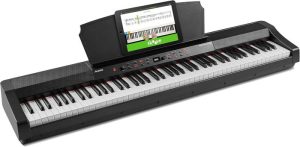
If piano playing is your priority and your budget allows it, the Alesis Prestige Artist is my top choice among these four.
It’s considerably more sophisticated than the basic Recital.
Alesis equips the Prestige Artist with:
- 88 full-size graded hammer-action keys
- Adjustable touch response
- 30 multi-sampled voices
- 256-note maximum polyphony
- 50W speaker system
- OLED display
- Lesson Mode
- Record Mode
- Split and Layer modes
- Five reverb types
- Arpeggiator
- USB-MIDI
- Stereo outputs
- Two headphone connections
- Auxiliary input
Graded Hammer Action
This is probably the most important reason to choose the Prestige Artist.
Having 88 keys is useful, but how those keys respond matters greatly for serious piano practice.
The Prestige Artist’s graded hammer-action keyboard is intended to provide a more acoustic-piano-like experience than the semi-weighted Recital.
For students progressing beyond basic lessons, that can make the Prestige Artist a more convincing long-term instrument.
30 Multi-Sampled Voices
Alesis uses multi-sampling for the Prestige Artist’s 30 built-in voices.
Rather than relying on a single recording played across a large range of the keyboard, multi-sampling can use multiple recordings to create a more detailed response.
You aren’t limited to acoustic piano either. The sound selection provides enough variety for musicians who occasionally want to explore other instruments.
256-Note Polyphony
The Prestige Artist provides 256-note maximum polyphony.
For ordinary piano practice, that’s more than enough.
High polyphony becomes particularly useful when:
- Playing dense passages
- Using the sustain pedal heavily
- Layering sounds
- Performing more complex arrangements
It also gives the instrument considerably more headroom than many inexpensive beginner keyboards.
Powerful 50W Speakers
Another major advantage is the built-in 50W micro-array speaker system, using two 25W amplifiers.
That’s significantly more powerful on paper than the speaker systems in the Recital and Recital Pro.
For someone who wants to play at home without immediately adding external amplification, that’s valuable.
OLED Display
A small OLED display helps with sound selection and settings.
This isn’t essential to piano playing, but it makes an instrument with multiple functions easier to navigate.
Lesson and Record Modes
Lesson Mode divides the keyboard into two identical pitch ranges.
That allows a teacher and student to sit together and play the same notes without continually reaching across the keyboard.
Record Mode lets students listen back to their performances—one of the simplest ways to hear timing or phrasing issues that aren’t always obvious while you’re actually playing.
Pros
- Graded hammer-action keyboard
- 256-note polyphony
- 30 multi-sampled sounds
- Powerful 50W speakers
- OLED display
- Recording function
- USB-MIDI
- Two headphone connections
- Strong long-term choice for developing pianists
Possible Drawbacks
The Prestige Artist costs more than Alesis’s entry-level models, and players who only want a casual keyboard may not need its more sophisticated action.
Best for:
Beginners, intermediate players and serious home pianists wanting the strongest piano-oriented Alesis option among these four.
[Check Alesis Prestige Artist Price on Amazon →]
2. Alesis Recital Pro — Best Value for Learning Piano
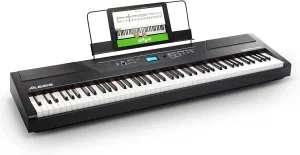
The Alesis Recital Pro occupies an especially attractive middle ground.
It’s considerably more piano-oriented than the standard Recital but typically aimed at buyers who don’t necessarily want to move into a premium instrument.
Alesis specifies:
- 88 full-size hammer-action keys
- Adjustable touch response
- 12 built-in voices
- 128-note polyphony
- Split and Layer modes
- Lesson Mode
- Record Mode
- Metronome
- Modulation, Chorus and Reverb effects
- USB-MIDI
- Stereo outputs
- Headphone output
- Sustain-pedal input
- Optional battery operation
Hammer-Action Keyboard
This is the main reason I would recommend the Recital Pro over the standard Recital for traditional piano lessons.
The standard Recital is semi-weighted.
The Recital Pro is hammer-action.
For students intending eventually to play an acoustic piano, that distinction matters.
12 Instrument Voices
The Recital Pro isn’t trying to compete with arranger keyboards offering hundreds of sounds.
Instead, its 12 voices include acoustic and electric pianos, organs, harpsichord, vibraphone, synth, strings and bass sounds.
That’s enough variety for most piano students without making the interface unnecessarily complicated.
128-Note Polyphony
Alesis gives the Recital Pro 128-note polyphony.
For beginner and intermediate piano repertoire, that should generally be sufficient.
Record Mode
The ability to record yourself is particularly useful for students.
Play a piece, listen back, and ask:
- Is my tempo consistent?
- Are the dynamics clear?
- Is my phrasing musical?
- Are some notes uneven?
- Am I rushing difficult passages?
This can turn a seemingly simple feature into a useful practice tool.
Battery Operation
The Recital Pro can also operate from six D-cell batteries as an alternative to the included power supply.
That doesn’t make it a lightweight portable keyboard, but it provides additional flexibility where a power outlet isn’t convenient.
Pros
- 88 hammer-action keys
- Adjustable touch response
- 128-note polyphony
- 12 useful sounds
- Lesson Mode
- Recording capability
- USB-MIDI
- Battery-power option
Possible Drawbacks
Its action isn’t graded like the Prestige Artist, and the Prestige Artist also provides more sounds, higher polyphony and substantially more powerful speakers.
Best for:
Beginners who are serious about learning traditional piano but want to keep the budget below the Prestige Artist.
[Check Alesis Recital Pro Price on Amazon →]
Recital Pro vs Prestige Artist: Which Is Better?
This is probably the most useful comparison for someone seriously learning piano.
| Feature | Recital Pro | Prestige Artist |
|---|---|---|
| Keys | 88 | 88 |
| Action | Hammer action | Graded hammer action |
| Voices | 12 | 30 |
| Polyphony | 128 | 256 |
| Speakers | 20W rated system | 50W |
| Display | Yes | OLED |
| Lesson Mode | Yes | Yes |
| Record Mode | Yes | Yes |
| USB-MIDI | Yes | Yes |
If you’re a complete beginner and price matters considerably, the Recital Pro may provide everything you actually need.
If you expect to play for years and can afford the upgrade, I’d choose the Prestige Artist.
Its graded action, greater polyphony and more substantial sound system give it more room for musical growth.
3. Alesis Recital — Best Budget 88-Key Choice
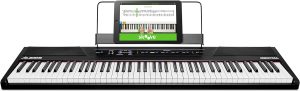
The standard Alesis Recital has been popular partly because it offers something many beginners specifically search for:
88 full-size keys at an affordable price.
But it’s important to describe the keyboard accurately.
These are semi-weighted, not hammer-action, keys.
Alesis specifies:
- 88 full-size semi-weighted keys
- Adjustable touch response
- 5 built-in voices
- 128-note polyphony
- 20W speakers
- Layer Mode
- Split Mode
- Lesson Mode
- Metronome
- Reverb and Chorus
- USB-MIDI
- Headphone output
- Sustain-pedal input
- Battery operation
Why Buy the Recital?
Price and simplicity.
A beginner doesn’t necessarily need:
- 500 sounds
- Advanced recording
- Huge color displays
- Complex accompaniment systems
The Recital gives you the full 88-key range, touch sensitivity, basic piano sounds and useful practice features.
For someone unsure whether piano will become a long-term hobby, that can make good financial sense.
Five Sounds
The Recital includes:
- Acoustic Piano
- Electric Piano
- Organ
- Synth
- Bass
You can combine two using Layer Mode or divide the keyboard using Split Mode.
Five sounds may appear unimpressive compared with keyboards advertising hundreds.
But if your main purpose is to learn piano, you don’t need 500 sounds.
One convincing piano sound can be more useful than hundreds of voices you rarely use.
Lesson Mode
Like the more expensive Alesis instruments, the Recital includes Lesson Mode.
This divides the keyboard into two areas with the same pitch and voice, allowing teacher and student to play alongside each other.
USB-MIDI
USB-MIDI lets you connect the Recital to a computer and use compatible educational software or virtual instruments.
This significantly expands what an inexpensive keyboard can do.
Battery Operation
The Recital can operate from six D-cell batteries.
That’s unusual enough to be useful for musicians who occasionally need to play away from a convenient outlet.
Pros
- Affordable
- Full 88-key range
- Semi-weighted touch
- Adjustable touch response
- 128-note polyphony
- Lesson Mode
- USB-MIDI
- Battery operation
- Straightforward interface
Possible Drawback
Semi-weighted keys do not reproduce acoustic-piano resistance as convincingly as hammer-action keys.
If traditional piano technique is your priority and your budget permits it, I’d step up to the Recital Pro.
Best for:
Budget-conscious beginners who want 88 full-size keys but aren’t ready to pay for hammer action.
[Check Alesis Recital Price on Amazon →]
4. Alesis Recital Play — Best for Kids and Musical Exploration
The Alesis Recital Play is fundamentally different from the other three.
It has 88 full-size keys—but they’re non-weighted.
At the same time, the Recital Play provides vastly more sounds and accompaniment features.
Alesis currently specifies:
- 88 full-size non-weighted keys
- Adjustable touch response
- 480 built-in sounds
- 160 accompaniment rhythms
- 140 demo songs
- Split and Layer capability
- Lesson Mode
- Record Mode
- Metronome
- USB-MIDI
- Headphone output
- Battery operation
The package also includes a stand, carrying case, music rest, sustain pedal, headphones and power adapter.
480 Sounds
That’s the obvious headline feature.
Compared with:
Recital — 5 sounds
Recital Pro — 12 sounds
Prestige Artist — 30 sounds
the Recital Play’s 480 sounds seems enormous.
But don’t conclude that this automatically makes it the best instrument.
The four keyboards serve different purposes.
The Prestige Artist concentrates much more heavily on the piano-playing experience.
The Recital Play concentrates on variety, entertainment and exploration.
160 Accompaniment Rhythms
The Recital Play also provides 160 rhythms, allowing beginners to play with automatic musical accompaniment.
This can be especially enjoyable for:
- Children
- Casual musicians
- Pop players
- Beginners learning chords
- People interested in songwriting
Excellent Starter Bundle
Another strength is the included accessory package.
You receive:
- Adjustable X-stand
- Carrying case
- Sustain pedal
- Headphones
- Music rest
- Power adapter
That can eliminate several additional purchases for a first-time player.
But What About the Non-Weighted Keys?
This is the key consideration.
For a child simply discovering music, non-weighted keys aren’t necessarily a problem.
For a student beginning formal classical piano lessons, however, I’d prefer the Recital Pro if the budget allows.
A hammer-action keyboard will generally provide better preparation for playing acoustic pianos.
Pros
- 88 full-size keys
- 480 sounds
- 160 accompaniment rhythms
- 140 demo songs
- Excellent accessory bundle
- Lesson and Record modes
- USB-MIDI
- Battery operation
- Fun for children and recreational players
Possible Drawback
The keys are non-weighted.
That’s the primary reason I don’t rank it above the Recital Pro for serious piano study.
Best for:
Children, families and recreational beginners who value sounds, rhythms and an all-in-one starter package more than acoustic-piano-style key resistance.
[Check Alesis Recital Play Price on Amazon →]
Alesis Recital vs Recital Play
The names are confusing, but the instruments have different priorities.
Choose the Recital if you want:
- Semi-weighted keys
- Simpler piano-focused operation
- 128-note polyphony
- Only a few essential sounds
Choose the Recital Play if you want:
- 480 sounds
- 160 rhythms
- Accessory bundle
- Musical experimentation
- Entertainment features
For piano-oriented playing, I’d favor the Recital.
For children and recreational music-making, I’d favor the Recital Play.
Which Alesis Is Best for Beginners?
It depends on what “beginner” means.
Serious piano beginner: Recital Pro
If you’re taking traditional lessons and hope eventually to play acoustic piano, the Recital Pro is my value recommendation because of its hammer-action keyboard.
Beginner with a larger budget: Prestige Artist
The graded hammer action, 256-note polyphony and stronger speakers make it the better long-term instrument.
Budget beginner: Recital
If cost is the overriding consideration, the Recital still gives you 88 semi-weighted keys and useful educational features.
Young/recreational beginner: Recital Play
If fun, sounds, rhythms and accessories matter more than authentic piano action, the Recital Play makes considerable sense.
Which Alesis Is Best for Classical Piano?
I’d narrow the selection immediately to:
Recital Pro
or
Prestige Artist
Classical piano places greater emphasis on:
- Dynamic control
- Finger strength
- Articulation
- Repeated notes
- Pedaling
- Expressive touch
Hammer action therefore becomes more important.
Between the two, I’d choose the Prestige Artist if budget permits because of its graded hammer action and higher polyphony.
Internal link suggestion: Link classical piano to your Piano Keyboards for Learning Classical Music article.
Which Alesis Is Best for Kids?
For children simply exploring music, I’d seriously consider the Recital Play.
The huge sound library, rhythms, demo songs and included accessories can make practice feel less intimidating and more entertaining.
For a child already enrolled in serious piano lessons, however, I’d favor the Recital Pro.
This is an important distinction:
Best keyboard for having fun learning music ≠ necessarily best keyboard for developing traditional piano technique.
Which Alesis Is Best for Adults Learning Piano?
For most adult beginners, I’d choose the Recital Pro.
Adults frequently start with the intention of learning recognizable songs but later become interested in more demanding repertoire.
Starting with hammer-action keys can reduce the likelihood of wanting an early upgrade simply because the keyboard feels too light.
If budget isn’t a major concern, move directly to the Prestige Artist.
Which Alesis Is Best for Apartment Living?
All four have headphone capability, which is one of the biggest advantages of choosing a digital instrument.
For serious piano practice in an apartment:
Recital Pro or Prestige Artist
For casual playing:
Recital or Recital Play
The ability to practice through headphones late at night without disturbing family members or neighbors is something an acoustic piano simply cannot offer without specialized silent-piano technology.
Alesis vs Yamaha, Roland and Kawai
This is where expectations should be realistic.
Alesis competes particularly aggressively on price and features.
Brands such as Yamaha, Roland and Kawai have extensive histories in piano development and proprietary digital-piano technologies.
For example, buyers might compare an Alesis instrument with models such as:
- Yamaha P-225
- Roland FP-10
- Roland FP-30X
- Kawai ES120
Alesis may appeal because of price, included features or bundled accessories.
The competing instruments may justify higher prices through differences in action, sound technology, speaker design, build quality, brand support or resale value.
There is no substitute for trying the keyboards yourself when possible.
Are Alesis Digital Pianos Good?
For the right buyer, yes.
Alesis is particularly compelling for:
- Beginners
- Budget-conscious buyers
- Home musicians
- Students
- Recreational players
But you need to choose the right model.
Someone seeking serious piano technique shouldn’t buy the Recital Play merely because 480 sounds sounds more impressive than the Prestige Artist’s 30.
Likewise, a child who mainly wants to explore sounds and rhythms may have far more fun with the Recital Play than with a more serious piano-focused model.
The specification that matters most depends on the musician.
Frequently Asked Questions
What is the best Alesis digital piano?
Among these four, my overall recommendation is the Alesis Prestige Artist.
Its combination of 88 graded hammer-action keys, 30 multi-sampled sounds, 256-note polyphony and a 50W speaker system gives it the strongest piano-oriented specification.
Is the Alesis Recital fully weighted?
No.
The Alesis Recital uses semi-weighted keys with adjustable touch response.
Does the Alesis Recital Pro have weighted keys?
Yes.
The Recital Pro uses 88 full-size hammer-action keys with adjustable touch response.
Does the Prestige Artist have weighted keys?
Yes.
The Prestige Artist uses 88 full-size graded hammer-action keys.
Does the Recital Play have weighted keys?
No.
Alesis specifies 88 full-size non-weighted keys with adjustable touch response.
Is Alesis Recital good for beginners?
Yes, particularly for budget-conscious beginners.
However, students focused on traditional piano technique should consider the hammer-action Recital Pro if their budget allows.
Is the Recital Pro good for classical music?
It’s a much better choice than the standard Recital or Recital Play for classical study because of its hammer-action keyboard.
More advanced students may prefer the Prestige Artist’s graded hammer action.
How many sounds does the Alesis Recital Play have?
It has 480 built-in sounds, along with 160 accompaniment rhythms and 140 demo songs.
How many sounds does the Prestige Artist have?
It provides 30 multi-sampled built-in voices.
Can Alesis digital pianos connect to a computer?
These four models support USB-MIDI connectivity, allowing compatible connections with educational software and virtual instruments.
Do Alesis digital pianos require tuning?
No.
Digital pianos generate their sounds electronically and don’t contain acoustic piano strings that require periodic tuning.
Final Verdict: Which Alesis Should You Buy?
The four instruments become relatively easy to understand once you focus on the type of player rather than simply comparing specifications.
Best Overall — Alesis Prestige Artist
Choose the Prestige Artist if piano playing is the priority and you can afford the step up.
Its graded hammer-action keys, 30 multi-sampled sounds, 256-note polyphony and powerful 50W speaker system make it the most sophisticated piano-oriented instrument among our four recommendations.
[Check Alesis Prestige Artist Price on Amazon →]
Best Value for Piano Learning — Alesis Recital Pro
For many beginners, this may actually be the sweet spot.
Its 88 hammer-action keys and 128-note polyphony provide a much more piano-oriented foundation than the cheaper Recital without necessarily requiring the investment of the Prestige Artist.
[Check Alesis Recital Pro Price on Amazon →]
Best Budget 88-Key Choice — Alesis Recital
Choose the standard Recital if affordability is paramount.
You still get 88 full-size semi-weighted keys, adjustable touch response, 128-note polyphony, built-in speakers and USB-MIDI.
[Check Alesis Recital Price on Amazon →]
Best for Kids & Musical Exploration — Alesis Recital Play
Choose the Recital Play if your priority is fun and versatility.
Its 480 sounds, 160 rhythms, 140 demo songs and extensive accessory bundle make it particularly appealing to younger players and recreational beginners.
[Check Alesis Recital Play Price on Amazon →]
In simple terms:
Prestige Artist → best overall piano experience
Recital Pro → best balance of piano learning and value
Recital → best budget 88-key option
Recital Play → best for kids, sounds and entertainment
And remember the most important distinction in this entire comparison:
88 keys does not automatically mean weighted piano action.
If you’re serious about learning traditional piano, the feel of those 88 keys should matter more than how many hundreds of sounds are built into the instrument.
If you’re comparing the Alesis Recital with other affordable instruments, see our Best Cheap Keyboards in 2026: 5 Budget Picks That Are Actually Worth Buying.
Related readings:|
Buying an affordable digital piano can be confusing. Many instruments advertise 88 full-size keys, hundreds of sounds, powerful speakers, and learning features—but those specifications don’t necessarily tell you how suitable a keyboard is for actually learning piano.
Alesis has become particularly popular among beginners and budget-conscious musicians because it offers several full-size 88-key instruments at prices that can be considerably lower than many traditional piano brands.
But there’s an important distinction:
Not all 88-key Alesis keyboards have the same type of key action.
The Alesis Recital Play uses non-weighted keys. The Alesis Recital uses semi-weighted keys. Move up to the Recital Pro, and you get hammer-action keys. At the top of the four models we’re comparing, the Prestige Artist provides graded hammer-action keys.
That difference can matter enormously—particularly if your goal is to develop traditional piano technique.
For 2026, these are four Alesis models worth considering:
- Alesis Prestige Artist — Best Overall
- Alesis Recital Pro — Best Value for Piano Learning
- Alesis Recital — Best Budget 88-Key Choice
- Alesis Recital Play — Best for Kids and Musical Exploration
Let’s look at which one makes the most sense for you.
Disclosure: Some links on Pianos-Galore are affiliate links. If you purchase through these links, we may receive a small commission at no additional cost to you.
Best Alesis Digital Pianos at a Glance
| Model | Best For | Key Action | Sounds | Polyphony |
|---|---|---|---|---|
| Alesis Prestige Artist | Best Overall | Graded hammer action | 30 | 256 |
| Alesis Recital Pro | Piano Learning | Hammer action | 12 | 128 |
| Alesis Recital | Budget Buyers | Semi-weighted | 5 | 128 |
| Alesis Recital Play | Kids & Recreation | Non-weighted | 480 | — |
Alesis’s current specifications confirm these important differences. The Prestige Artist has 88 graded hammer-action keys, while the Recital Pro uses hammer action, the Recital uses semi-weighted keys, and the Recital Play uses non-weighted keys.
That should be one of the first things you consider—not simply the number of sounds.
Why Consider an Alesis Digital Piano?
Alesis occupies an interesting position in the digital-piano market.
Brands such as Yamaha, Roland and Kawai have long histories in piano manufacturing and premium digital-piano technology. Alesis instead has strong roots in electronic musical instruments and recording equipment and has become particularly competitive in the entry-level and affordable digital-piano market.
Its appeal comes largely from value.
Depending on the model, Alesis gives buyers features such as:
- 88 full-size keys
- Adjustable touch response
- Built-in speakers
- Headphone practice
- USB-MIDI
- Split and Layer modes
- Lesson Mode
- Recording functions
- Battery operation on some models
- Learning-software support
The important question is therefore not simply:
“Is Alesis a good brand?”
A better question is:
“Which Alesis keyboard matches the way I intend to learn and play?”
Understanding Alesis Key Actions
Before reviewing the four instruments, let’s clarify one of the most important specifications.
Non-Weighted Keys
These provide relatively little resistance.
They’re easy to press and can be perfectly appropriate for:
- Casual keyboard playing
- Children exploring music
- Pop and electronic music
- Learning basic notes and chords
But they don’t closely imitate the physical resistance of an acoustic piano.
The Recital Play falls into this category.
Semi-Weighted Keys
Semi-weighted keyboards add resistance but still generally feel lighter than a hammer-action digital piano.
They can be a good compromise for:
- Beginners on a tight budget
- Recreational musicians
- Keyboard players
- Adults who prefer lighter actions
The standard Alesis Recital uses semi-weighted keys.
Hammer-Action Keys
Hammer-action digital pianos attempt to reproduce more of the resistance associated with an acoustic piano mechanism.
This can help students develop:
- Finger strength
- Dynamic control
- Better articulation
- More transferable piano technique
The Recital Pro uses hammer-action keys.
Graded Hammer Action
On an acoustic piano, the bass keys generally feel heavier than the treble keys because of differences in the hammer mechanism.
A graded digital-piano action attempts to recreate this heavier-to-lighter response across the keyboard.
The Prestige Artist provides graded hammer action, making it the most piano-oriented action among our four recommendations.
1. Alesis Prestige Artist — Best Overall
If piano playing is your priority and your budget allows it, the Alesis Prestige Artist is my top choice among these four.
It’s considerably more sophisticated than the basic Recital.
Alesis equips the Prestige Artist with:
- 88 full-size graded hammer-action keys
- Adjustable touch response
- 30 multi-sampled voices
- 256-note maximum polyphony
- 50W speaker system
- OLED display
- Lesson Mode
- Record Mode
- Split and Layer modes
- Five reverb types
- Arpeggiator
- USB-MIDI
- Stereo outputs
- Two headphone connections
- Auxiliary input
Graded Hammer Action
This is probably the most important reason to choose the Prestige Artist.
Having 88 keys is useful, but how those keys respond matters greatly for serious piano practice.
The Prestige Artist’s graded hammer-action keyboard is intended to provide a more acoustic-piano-like experience than the semi-weighted Recital.
For students progressing beyond basic lessons, that can make the Prestige Artist a more convincing long-term instrument.
30 Multi-Sampled Voices
Alesis uses multi-sampling for the Prestige Artist’s 30 built-in voices.
Rather than relying on a single recording played across a large range of the keyboard, multi-sampling can use multiple recordings to create a more detailed response.
You aren’t limited to acoustic piano either. The sound selection provides enough variety for musicians who occasionally want to explore other instruments.
256-Note Polyphony
The Prestige Artist provides 256-note maximum polyphony.
For ordinary piano practice, that’s more than enough.
High polyphony becomes particularly useful when:
- Playing dense passages
- Using the sustain pedal heavily
- Layering sounds
- Performing more complex arrangements
It also gives the instrument considerably more headroom than many inexpensive beginner keyboards.
Powerful 50W Speakers
Another major advantage is the built-in 50W micro-array speaker system, using two 25W amplifiers.
That’s significantly more powerful on paper than the speaker systems in the Recital and Recital Pro.
For someone who wants to play at home without immediately adding external amplification, that’s valuable.
OLED Display
A small OLED display helps with sound selection and settings.
This isn’t essential to piano playing, but it makes an instrument with multiple functions easier to navigate.
Lesson and Record Modes
Lesson Mode divides the keyboard into two identical pitch ranges.
That allows a teacher and student to sit together and play the same notes without continually reaching across the keyboard.
Record Mode lets students listen back to their performances—one of the simplest ways to hear timing or phrasing issues that aren’t always obvious while you’re actually playing.
Pros
- Graded hammer-action keyboard
- 256-note polyphony
- 30 multi-sampled sounds
- Powerful 50W speakers
- OLED display
- Recording function
- USB-MIDI
- Two headphone connections
- Strong long-term choice for developing pianists
Possible Drawbacks
The Prestige Artist costs more than Alesis’s entry-level models, and players who only want a casual keyboard may not need its more sophisticated action.
Best for:
Beginners, intermediate players and serious home pianists wanting the strongest piano-oriented Alesis option among these four.
[Check Alesis Prestige Artist Price on Amazon →]
2. Alesis Recital Pro — Best Value for Learning Piano
The Alesis Recital Pro occupies an especially attractive middle ground.
It’s considerably more piano-oriented than the standard Recital but typically aimed at buyers who don’t necessarily want to move into a premium instrument.
Alesis specifies:
- 88 full-size hammer-action keys
- Adjustable touch response
- 12 built-in voices
- 128-note polyphony
- Split and Layer modes
- Lesson Mode
- Record Mode
- Metronome
- Modulation, Chorus and Reverb effects
- USB-MIDI
- Stereo outputs
- Headphone output
- Sustain-pedal input
- Optional battery operation
Hammer-Action Keyboard
This is the main reason I would recommend the Recital Pro over the standard Recital for traditional piano lessons.
The standard Recital is semi-weighted.
The Recital Pro is hammer-action.
For students intending eventually to play an acoustic piano, that distinction matters.
12 Instrument Voices
The Recital Pro isn’t trying to compete with arranger keyboards offering hundreds of sounds.
Instead, its 12 voices include acoustic and electric pianos, organs, harpsichord, vibraphone, synth, strings and bass sounds.
That’s enough variety for most piano students without making the interface unnecessarily complicated.
128-Note Polyphony
Alesis gives the Recital Pro 128-note polyphony.
For beginner and intermediate piano repertoire, that should generally be sufficient.
Record Mode
The ability to record yourself is particularly useful for students.
Play a piece, listen back, and ask:
- Is my tempo consistent?
- Are the dynamics clear?
- Is my phrasing musical?
- Are some notes uneven?
- Am I rushing difficult passages?
This can turn a seemingly simple feature into a useful practice tool.
Battery Operation
The Recital Pro can also operate from six D-cell batteries as an alternative to the included power supply.
That doesn’t make it a lightweight portable keyboard, but it provides additional flexibility where a power outlet isn’t convenient.
Pros
- 88 hammer-action keys
- Adjustable touch response
- 128-note polyphony
- 12 useful sounds
- Lesson Mode
- Recording capability
- USB-MIDI
- Battery-power option
Possible Drawbacks
Its action isn’t graded like the Prestige Artist, and the Prestige Artist also provides more sounds, higher polyphony and substantially more powerful speakers.
Best for:
Beginners who are serious about learning traditional piano but want to keep the budget below the Prestige Artist.
[Check Alesis Recital Pro Price on Amazon →]
Recital Pro vs Prestige Artist: Which Is Better?
This is probably the most useful comparison for someone seriously learning piano.
| Feature | Recital Pro | Prestige Artist |
|---|---|---|
| Keys | 88 | 88 |
| Action | Hammer action | Graded hammer action |
| Voices | 12 | 30 |
| Polyphony | 128 | 256 |
| Speakers | 20W rated system | 50W |
| Display | Yes | OLED |
| Lesson Mode | Yes | Yes |
| Record Mode | Yes | Yes |
| USB-MIDI | Yes | Yes |
If you’re a complete beginner and price matters considerably, the Recital Pro may provide everything you actually need.
If you expect to play for years and can afford the upgrade, I’d choose the Prestige Artist.
Its graded action, greater polyphony and more substantial sound system give it more room for musical growth.
3. Alesis Recital — Best Budget 88-Key Choice
The standard Alesis Recital has been popular partly because it offers something many beginners specifically search for:
88 full-size keys at an affordable price.
But it’s important to describe the keyboard accurately.
These are semi-weighted, not hammer-action, keys.
Alesis specifies:
- 88 full-size semi-weighted keys
- Adjustable touch response
- 5 built-in voices
- 128-note polyphony
- 20W speakers
- Layer Mode
- Split Mode
- Lesson Mode
- Metronome
- Reverb and Chorus
- USB-MIDI
- Headphone output
- Sustain-pedal input
- Battery operation
Why Buy the Recital?
Price and simplicity.
A beginner doesn’t necessarily need:
- 500 sounds
- Advanced recording
- Huge color displays
- Complex accompaniment systems
The Recital gives you the full 88-key range, touch sensitivity, basic piano sounds and useful practice features.
For someone unsure whether piano will become a long-term hobby, that can make good financial sense.
Five Sounds
The Recital includes:
- Acoustic Piano
- Electric Piano
- Organ
- Synth
- Bass
You can combine two using Layer Mode or divide the keyboard using Split Mode.
Five sounds may appear unimpressive compared with keyboards advertising hundreds.
But if your main purpose is to learn piano, you don’t need 500 sounds.
One convincing piano sound can be more useful than hundreds of voices you rarely use.
Lesson Mode
Like the more expensive Alesis instruments, the Recital includes Lesson Mode.
This divides the keyboard into two areas with the same pitch and voice, allowing teacher and student to play alongside each other.
USB-MIDI
USB-MIDI lets you connect the Recital to a computer and use compatible educational software or virtual instruments.
This significantly expands what an inexpensive keyboard can do.
Battery Operation
The Recital can operate from six D-cell batteries.
That’s unusual enough to be useful for musicians who occasionally need to play away from a convenient outlet.
Pros
- Affordable
- Full 88-key range
- Semi-weighted touch
- Adjustable touch response
- 128-note polyphony
- Lesson Mode
- USB-MIDI
- Battery operation
- Straightforward interface
Possible Drawback
Semi-weighted keys do not reproduce acoustic-piano resistance as convincingly as hammer-action keys.
If traditional piano technique is your priority and your budget permits it, I’d step up to the Recital Pro.
Best for:
Budget-conscious beginners who want 88 full-size keys but aren’t ready to pay for hammer action.
[Check Alesis Recital Price on Amazon →]
4. Alesis Recital Play — Best for Kids and Musical Exploration
The Alesis Recital Play is fundamentally different from the other three.
It has 88 full-size keys—but they’re non-weighted.
At the same time, the Recital Play provides vastly more sounds and accompaniment features.
Alesis currently specifies:
- 88 full-size non-weighted keys
- Adjustable touch response
- 480 built-in sounds
- 160 accompaniment rhythms
- 140 demo songs
- Split and Layer capability
- Lesson Mode
- Record Mode
- Metronome
- USB-MIDI
- Headphone output
- Battery operation
The package also includes a stand, carrying case, music rest, sustain pedal, headphones and power adapter.
480 Sounds
That’s the obvious headline feature.
Compared with:
Recital — 5 sounds
Recital Pro — 12 sounds
Prestige Artist — 30 sounds
the Recital Play’s 480 sounds seems enormous.
But don’t conclude that this automatically makes it the best instrument.
The four keyboards serve different purposes.
The Prestige Artist concentrates much more heavily on the piano-playing experience.
The Recital Play concentrates on variety, entertainment and exploration.
160 Accompaniment Rhythms
The Recital Play also provides 160 rhythms, allowing beginners to play with automatic musical accompaniment.
This can be especially enjoyable for:
- Children
- Casual musicians
- Pop players
- Beginners learning chords
- People interested in songwriting
Excellent Starter Bundle
Another strength is the included accessory package.
You receive:
- Adjustable X-stand
- Carrying case
- Sustain pedal
- Headphones
- Music rest
- Power adapter
That can eliminate several additional purchases for a first-time player.
But What About the Non-Weighted Keys?
This is the key consideration.
For a child simply discovering music, non-weighted keys aren’t necessarily a problem.
For a student beginning formal classical piano lessons, however, I’d prefer the Recital Pro if the budget allows.
A hammer-action keyboard will generally provide better preparation for playing acoustic pianos.
Pros
- 88 full-size keys
- 480 sounds
- 160 accompaniment rhythms
- 140 demo songs
- Excellent accessory bundle
- Lesson and Record modes
- USB-MIDI
- Battery operation
- Fun for children and recreational players
Possible Drawback
The keys are non-weighted.
That’s the primary reason I don’t rank it above the Recital Pro for serious piano study.
Best for:
Children, families and recreational beginners who value sounds, rhythms and an all-in-one starter package more than acoustic-piano-style key resistance.
[Check Alesis Recital Play Price on Amazon →]
Alesis Recital vs Recital Play
The names are confusing, but the instruments have different priorities.
Choose the Recital if you want:
- Semi-weighted keys
- Simpler piano-focused operation
- 128-note polyphony
- Only a few essential sounds
Choose the Recital Play if you want:
- 480 sounds
- 160 rhythms
- Accessory bundle
- Musical experimentation
- Entertainment features
For piano-oriented playing, I’d favor the Recital.
For children and recreational music-making, I’d favor the Recital Play.
Which Alesis Is Best for Beginners?
It depends on what “beginner” means.
Serious piano beginner: Recital Pro
If you’re taking traditional lessons and hope eventually to play acoustic piano, the Recital Pro is my value recommendation because of its hammer-action keyboard.
Beginner with a larger budget: Prestige Artist
The graded hammer action, 256-note polyphony and stronger speakers make it the better long-term instrument.
Budget beginner: Recital
If cost is the overriding consideration, the Recital still gives you 88 semi-weighted keys and useful educational features.
Young/recreational beginner: Recital Play
If fun, sounds, rhythms and accessories matter more than authentic piano action, the Recital Play makes considerable sense.
Which Alesis Is Best for Classical Piano?
I’d narrow the selection immediately to:
Recital Pro
or
Prestige Artist
Classical piano places greater emphasis on:
- Dynamic control
- Finger strength
- Articulation
- Repeated notes
- Pedaling
- Expressive touch
Hammer action therefore becomes more important.
Between the two, I’d choose the Prestige Artist if budget permits because of its graded hammer action and higher polyphony.
Internal link suggestion: Link classical piano to your Piano Keyboards for Learning Classical Music article.
Which Alesis Is Best for Kids?
For children simply exploring music, I’d seriously consider the Recital Play.
The huge sound library, rhythms, demo songs and included accessories can make practice feel less intimidating and more entertaining.
For a child already enrolled in serious piano lessons, however, I’d favor the Recital Pro.
This is an important distinction:
Best keyboard for having fun learning music ≠ necessarily best keyboard for developing traditional piano technique.
Which Alesis Is Best for Adults Learning Piano?
For most adult beginners, I’d choose the Recital Pro.
Adults frequently start with the intention of learning recognizable songs but later become interested in more demanding repertoire.
Starting with hammer-action keys can reduce the likelihood of wanting an early upgrade simply because the keyboard feels too light.
If budget isn’t a major concern, move directly to the Prestige Artist.
Which Alesis Is Best for Apartment Living?
All four have headphone capability, which is one of the biggest advantages of choosing a digital instrument.
For serious piano practice in an apartment:
Recital Pro or Prestige Artist
For casual playing:
Recital or Recital Play
The ability to practice through headphones late at night without disturbing family members or neighbors is something an acoustic piano simply cannot offer without specialized silent-piano technology.
Alesis vs Yamaha, Roland and Kawai
This is where expectations should be realistic.
Alesis competes particularly aggressively on price and features.
Brands such as Yamaha, Roland and Kawai have extensive histories in piano development and proprietary digital-piano technologies.
For example, buyers might compare an Alesis instrument with models such as:
- Yamaha P-225
- Roland FP-10
- Roland FP-30X
- Kawai ES120
Alesis may appeal because of price, included features or bundled accessories.
The competing instruments may justify higher prices through differences in action, sound technology, speaker design, build quality, brand support or resale value.
There is no substitute for trying the keyboards yourself when possible.
Are Alesis Digital Pianos Good?
For the right buyer, yes.
Alesis is particularly compelling for:
- Beginners
- Budget-conscious buyers
- Home musicians
- Students
- Recreational players
But you need to choose the right model.
Someone seeking serious piano technique shouldn’t buy the Recital Play merely because 480 sounds sounds more impressive than the Prestige Artist’s 30.
Likewise, a child who mainly wants to explore sounds and rhythms may have far more fun with the Recital Play than with a more serious piano-focused model.
The specification that matters most depends on the musician.
Frequently Asked Questions
What is the best Alesis digital piano?
Among these four, my overall recommendation is the Alesis Prestige Artist.
Its combination of 88 graded hammer-action keys, 30 multi-sampled sounds, 256-note polyphony and a 50W speaker system gives it the strongest piano-oriented specification.
Is the Alesis Recital fully weighted?
No.
The Alesis Recital uses semi-weighted keys with adjustable touch response.
Does the Alesis Recital Pro have weighted keys?
Yes.
The Recital Pro uses 88 full-size hammer-action keys with adjustable touch response.
Does the Prestige Artist have weighted keys?
Yes.
The Prestige Artist uses 88 full-size graded hammer-action keys.
Does the Recital Play have weighted keys?
No.
Alesis specifies 88 full-size non-weighted keys with adjustable touch response.
Is Alesis Recital good for beginners?
Yes, particularly for budget-conscious beginners.
However, students focused on traditional piano technique should consider the hammer-action Recital Pro if their budget allows.
Is the Recital Pro good for classical music?
It’s a much better choice than the standard Recital or Recital Play for classical study because of its hammer-action keyboard.
More advanced students may prefer the Prestige Artist’s graded hammer action.
How many sounds does the Alesis Recital Play have?
It has 480 built-in sounds, along with 160 accompaniment rhythms and 140 demo songs.
How many sounds does the Prestige Artist have?
It provides 30 multi-sampled built-in voices.
Can Alesis digital pianos connect to a computer?
These four models support USB-MIDI connectivity, allowing compatible connections with educational software and virtual instruments.
Do Alesis digital pianos require tuning?
No.
Digital pianos generate their sounds electronically and don’t contain acoustic piano strings that require periodic tuning.
Final Verdict: Which Alesis Should You Buy?
The four instruments become relatively easy to understand once you focus on the type of player rather than simply comparing specifications.
Best Overall — Alesis Prestige Artist
Choose the Prestige Artist if piano playing is the priority and you can afford the step up.
Its graded hammer-action keys, 30 multi-sampled sounds, 256-note polyphony and powerful 50W speaker system make it the most sophisticated piano-oriented instrument among our four recommendations.
[Check Alesis Prestige Artist Price on Amazon →]
Best Value for Piano Learning — Alesis Recital Pro
For many beginners, this may actually be the sweet spot.
Its 88 hammer-action keys and 128-note polyphony provide a much more piano-oriented foundation than the cheaper Recital without necessarily requiring the investment of the Prestige Artist.
[Check Alesis Recital Pro Price on Amazon →]
Best Budget 88-Key Choice — Alesis Recital
Choose the standard Recital if affordability is paramount.
You still get 88 full-size semi-weighted keys, adjustable touch response, 128-note polyphony, built-in speakers and USB-MIDI.
[Check Alesis Recital Price on Amazon →]
Best for Kids & Musical Exploration — Alesis Recital Play
Choose the Recital Play if your priority is fun and versatility.
Its 480 sounds, 160 rhythms, 140 demo songs and extensive accessory bundle make it particularly appealing to younger players and recreational beginners.
[Check Alesis Recital Play Price on Amazon →]
In simple terms:
Prestige Artist → best overall piano experience
Recital Pro → best balance of piano learning and value
Recital → best budget 88-key option
Recital Play → best for kids, sounds and entertainment
And remember the most important distinction in this entire comparison:
88 keys does not automatically mean weighted piano action.
If you’re serious about learning traditional piano, the feel of those 88 keys should matter more than how many hundreds of sounds are built into the instrument.
If you’re comparing the Alesis Recital with other affordable instruments, see our Best Cheap Keyboards in 2026: 5 Budget Picks That Are Actually Worth Buying.