Best Yamaha Digital Pianos for Realistic Acoustic Piano Sound in 2026
For many people buying a digital piano, one question matters more than almost anything else:
How close does it sound to a real acoustic piano?
Digital pianos have improved dramatically. Modern instruments can reproduce not only the basic tone of an acoustic grand piano but also many of the subtle resonances and expressive changes that occur when a pianist varies touch, dynamics and pedaling.
Yamaha is particularly interesting in this area because it doesn’t merely manufacture digital instruments. It is also one of the world’s major acoustic-piano makers, producing everything from upright pianos to concert grands.
That experience feeds into Yamaha’s digital-piano technology.
But Yamaha offers many different models, and they don’t all use the same piano samples, sound processing, keyboard actions or speaker systems.
In this guide, we’ll look at some of the best Yamaha digital pianos for players who place a high priority on realistic acoustic-piano sound.
Disclosure: Some links on Pianos-Galore are affiliate links. If you purchase through these links, we may receive a small commission at no additional cost to you.
What Makes a Digital Piano Sound Like an Acoustic Piano?
A convincing digital piano involves much more than recording a single piano note and playing it back whenever you press a key.
Several technologies contribute to realism.
High-Quality Acoustic Piano Sampling
Digital-piano manufacturers record real acoustic pianos at different notes and dynamic levels.
Yamaha uses sounds based on some particularly prestigious instruments.
One is its own Yamaha CFX concert grand.
Higher-level Yamaha digital pianos may also include the sound of the Bösendorfer Imperial, giving players two distinctive concert-grand characters.
Dynamic Response
An acoustic piano changes character depending on how the pianist strikes the keys.
Play gently and the tone is soft and delicate.
Strike harder and the instrument becomes brighter and more powerful.
A good digital piano therefore needs to respond convincingly across a broad dynamic range rather than simply becoming louder.
Resonance
A real piano is an interconnected acoustic system.
Strings resonate with one another. The soundboard vibrates. Dampers influence the sound. Pedaling changes which strings are free to resonate.
Yamaha’s Virtual Resonance Modeling (VRM) technology is designed to reproduce some of these interactions electronically.
Entry and midrange instruments may use VRM Lite, while higher-level instruments employ more sophisticated implementations.
Speaker System
The sound engine isn’t the whole story.
A digital piano can have excellent samples but still sound less convincing if its speakers cannot reproduce them effectively.
This is one reason a premium console digital piano can provide a different experience from a slim portable instrument even when both use high-quality piano sounds.
Keyboard Action
Strictly speaking, key action doesn’t determine the quality of the piano sample.
But it affects the sound you produce because your fingers control velocity and dynamics through the keyboard.
That’s why sound quality and keyboard feel should be evaluated together.
Internal link: Link weighted keyboard action to your Weighted Keyboard Keys article.
Best Yamaha Digital Pianos for Acoustic Piano Sound
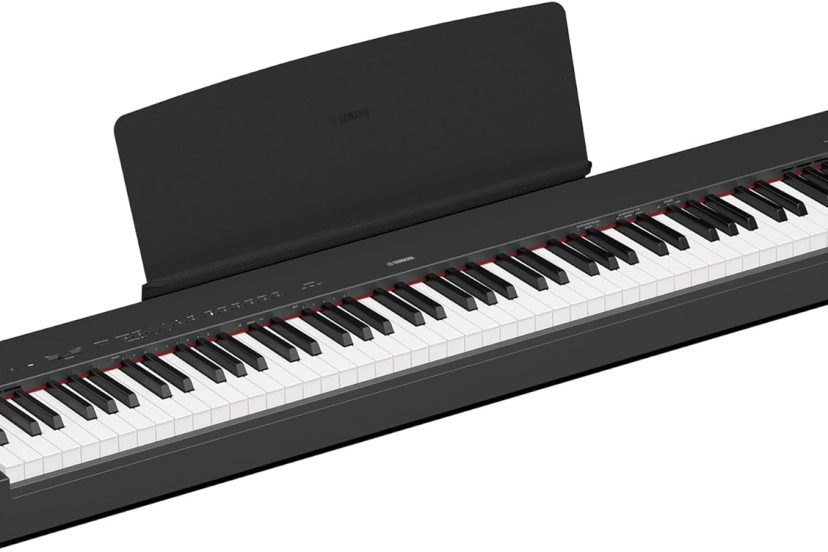
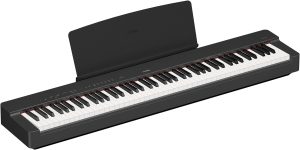
1. Yamaha P-225 — Best Value for Most Players
Check out the price of Yamaha P225 at Amazon
The Yamaha P-225 is an excellent starting point for someone who wants convincing Yamaha acoustic-piano sound without moving immediately into premium price territory.
It uses a piano sound based on Yamaha’s flagship CFX concert grand.
Yamaha combines this with Virtual Resonance Modeling Lite (VRM Lite) and key-off samples. The P-225 provides 192-note maximum polyphony and 24 instrument voices.
Why the CFX Sound Matters
The CFX is Yamaha’s flagship concert grand.
Rather than using the older CFIIIS-based sound found in previous generations such as the P-125, the P-225 gives buyers access to a newer CFX-based piano voice.
That makes the P-225 a much more appropriate recommendation for this updated guide.
Keyboard
The P-225 uses Yamaha’s Graded Hammer Compact (GHC) action.
It provides 88 weighted keys while allowing the instrument to remain relatively compact. The P-225 weighs about 11.5 kg / 25 lb 6 oz, making it particularly attractive when portability matters.
Who Should Buy It?
The P-225 is particularly suitable for:
- Beginners
- Intermediate students
- Home pianists
- Apartment dwellers
- Musicians needing portability
- Players wanting good acoustic-piano sound without buying a large console
Best for: Most buyers wanting a balance of Yamaha piano sound, portability and price.
2. Yamaha YDP-166 — Best Home Digital Piano for Serious Students
Check out the price of YDP-166 at Amazon
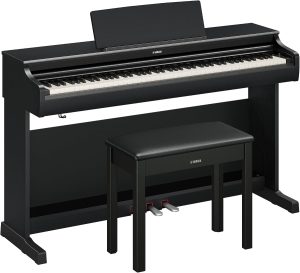
The Yamaha Arius YDP-166 is an especially attractive choice for pianists who want realistic acoustic-piano sound in a traditional furniture-style digital piano.
Introduced in 2026, the YDP-166 represents a newer generation of Yamaha’s popular Arius home digital pianos. It combines an 88-key GrandTouch-E keyboard with Yamaha’s CFX Grand Piano Voice, three pedals and an upgraded speaker system.
New GrandTouch-E Keyboard
One of the most important improvements is Yamaha’s newly developed GrandTouch-E keyboard.
Yamaha says it was designed to provide stable response across playing styles ranging from powerful passages to delicate expression and rapid repetition.
This makes the YDP-166 particularly appealing to students who intend to progress beyond basic piano lessons.
Yamaha CFX Grand Piano Sound
The YDP-166 features Yamaha’s CFX Grand Piano Voice, derived from the company’s flagship concert grand.
Its home-piano design also incorporates:
- 88 weighted keys
- GrandTouch-E action
- CFX Grand Piano Voice
- Three pedals: damper, sostenuto and soft
- 20W × 2 amplification
- 12 cm speakers with diffuser grilles
- 10 instrument voices
- 353 songs
- Headphone practice
- Bluetooth connectivity
Yamaha specifically redesigned the speaker system for this new Arius generation to produce clearer, richer and more expansive sound.
Who Should Buy It?
The YDP-166 is especially suitable for serious beginners, intermediate students, classical-piano learners and families looking for a permanent home instrument rather than a portable keyboard.
Best for: Serious students wanting Yamaha CFX piano sound, a traditional three-pedal cabinet and Yamaha’s newer GrandTouch-E keyboard.
3. Yamaha P-525 — Best Premium Portable Yamaha Piano
Check out the price of Yamaha P-525 at Amazon
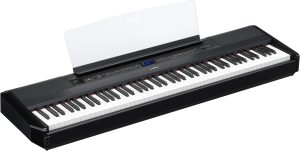
The Yamaha P-525 is where this comparison becomes especially interesting.
It’s portable in the sense that it isn’t built permanently into a furniture cabinet, but it moves considerably closer to premium digital-piano territory.
Yamaha gives the P-525 two major concert-grand voices:
Yamaha CFX and Bösendorfer Imperial.
That gives the pianist contrasting tonal personalities.
More Advanced Sound Technology
The P-525 includes:
- Virtual Resonance Modeling
- Grand Expression Modeling
- Binaural sampling for the CFX Grand voice
- 256-note polyphony
- 44 voices plus extensive additional sounds
Grand Expression Modeling is intended to reproduce tonal changes resulting from differences in how the pianist interacts with the keys.
GrandTouch-S Keyboard
The P-525 also represents a major step upward in keyboard action.
It uses Yamaha’s GrandTouch-S action with wooden white keys, synthetic ebony and ivory keytops, and escapement.
So you’re upgrading both sides of the piano experience:
sound + touch.
Who Should Buy It?
- Experienced pianists
- Classical musicians
- Advanced students
- Performing musicians
- Players wanting premium sound without a permanent console
- Pianists who want both CFX and Bösendorfer voices
Best for: Experienced players wanting premium Yamaha acoustic-piano sound in a transportable instrument.
Quick Comparison
| Model | Piano Sound | Keyboard | Best For |
|---|---|---|---|
| Yamaha P-225 | CFX | GHC | Value & portability |
| Yamaha YDP-166 | CFX Grand | GrandTouch-E | Serious students/home |
| Yamaha P-525 | CFX + Bösendorfer | GrandTouch-S | Premium portable |
Yamaha P-225 vs P-525: How Much Difference Does the Upgrade Make?
This is one of the most useful comparisons for buyers.
The P-225 already gives you:
- Yamaha CFX piano sound
- VRM Lite
- 192-note polyphony
- 88 weighted GHC keys
For many beginners and intermediate pianists, that is more than enough.
The P-525 moves considerably further.
It adds:
- CFX and Bösendorfer Imperial voices
- Full VRM
- Grand Expression Modeling
- Binaural CFX sampling
- 256-note polyphony
- GrandTouch-S action
- Wooden white keys
- Escapement
So the P-525 isn’t simply a P-225 with louder speakers and more sounds.
It represents a significant upgrade in both sound reproduction and keyboard action.
For a beginner, the extra expense may not be necessary.
For an experienced pianist, it can be meaningful.
CFX vs Bösendorfer: Which Sounds Better?
Neither is objectively “better.”
They have different tonal personalities.
Some pianists may prefer the clarity and power of Yamaha’s CFX character, while others may prefer the different tonal character associated with the Bösendorfer Imperial.
The advantage of a model such as the P-525 is that you don’t have to make that choice permanently—it provides both concert-grand voices.
That is one of the unique pleasures of digital piano ownership.
With an acoustic piano, you buy one instrument and its tonal character.
With a high-quality digital piano, you may have several different grand-piano personalities available from the same keyboard.
Does More Polyphony Mean Better Piano Sound?
Not necessarily.
Polyphony tells you how many notes or sound elements the instrument can reproduce simultaneously.
The P-225 offers 192-note polyphony, while the P-525 provides 256 notes.
Higher polyphony can be useful when:
- Using the sustain pedal heavily
- Layering voices
- Playing complex repertoire
- Using accompaniment features
But don’t buy a piano simply because one specification says “256” while another says “192.”
For acoustic-piano realism, sampling, modeling, speakers, keyboard response and pedal behavior can be much more meaningful.
Is Yamaha’s CFX Digital Sound the Same as a Real CFX Grand?
No—and this distinction is important for credibility.
A digital piano can reproduce the tonal character of a sampled or modeled acoustic grand with impressive realism.
But a real concert grand produces sound physically through:
- Strings
- Hammers
- Dampers
- Bridges
- Soundboard
- Cabinet
- Sympathetic resonance
- The surrounding room
A digital instrument reproduces this experience electronically.
Modern premium digital pianos can sound remarkably convincing, but describing them as identical to a real acoustic concert grand would be an overstatement.
This is especially relevant for advanced classical pianists.
Speakers vs Headphones: The Same Piano Can Sound Very Different
Another often-overlooked factor is how you listen to the instrument.
The same digital piano may sound different through:
- Built-in speakers
- High-quality headphones
- Studio monitors
- PA speakers
- An external amplifier
This is why evaluating digital-piano sound from an online video isn’t perfect.
You’re hearing:
piano → recording equipment → internet compression → your speakers/headphones
rather than the piano directly.
Whenever possible, listen to the instrument personally.
Are Yamaha Digital Pianos Good for Headphone Practice?
Yes, and this is one of the biggest advantages of choosing digital over acoustic.
Headphones allow you to practice:
- Early in the morning
- Late at night
- In apartments
- Without disturbing family members
Higher Yamaha models also incorporate technologies intended to make headphone listening more natural.
For example, the P-525 includes binaural sampling for its CFX Grand voice.
This can make private practice considerably more immersive than simply hearing a conventional stereo piano sample inside headphones.
Should You Buy an Acoustic or Digital Yamaha Piano?
Digital pianos have several major practical advantages.
They don’t require regular tuning.
You can use headphones.
They are generally easier to move.
Many offer USB and MIDI connectivity.
Some provide multiple concert-grand sounds.
And volume is adjustable.
An acoustic piano, however, provides a genuine mechanical and acoustic interaction that a digital instrument is trying to reproduce.
So the right choice depends on priorities.
Choose a digital piano if you value:
- Headphone practice
- Lower maintenance
- Recording
- Connectivity
- Multiple sounds
- Portability
- Volume control
Consider an acoustic piano if you primarily value:
- Genuine acoustic sound production
- Traditional mechanical action
- Natural soundboard resonance
- Acoustic performance experience
For many households, a quality digital piano offers the more practical compromise.
Which Yamaha Digital Piano Should a Beginner Buy?
For many beginners, the P-225 is the logical starting point.
You get:
- 88 weighted keys
- Yamaha CFX sound
- VRM Lite
- 192-note polyphony
- Compact dimensions
without immediately paying for premium technologies.
For a child or adult who is clearly committed to long-term piano lessons and doesn’t need portability, the YDP-166 becomes particularly attractive because of its furniture cabinet, GrandTouch-E action and integrated three-pedal system.
Which Yamaha Digital Piano Is Best for Classical Music?
For beginning and intermediate classical students, both the P-225 and YDP-165 can be appropriate.
If keyboard action is a major priority, I would lean toward the YDP-166 over the P-225 because of its GrandTouch-E action.
For more advanced players, the P-525 and Clavinova range become increasingly attractive.
The P-525 combines GrandTouch-S with CFX and Bösendorfer Imperial sounds, full VRM and Grand Expression Modeling.
Frequently Asked Questions
Which Yamaha digital piano sounds most like an acoustic piano?
Generally, acoustic-piano realism increases as you move into Yamaha’s premium P-Series and Clavinova instruments, although personal preference matters.
The P-525 is especially interesting among portable instruments because it combines Yamaha CFX and Bösendorfer Imperial voices with VRM and Grand Expression Modeling.
Is the Yamaha P-225 good enough for serious piano practice?
Yes, particularly for beginners and intermediate players.
It provides 88 weighted GHC keys, CFX piano sound, VRM Lite and 192-note polyphony.
What’s the difference between the Yamaha P-225 and YDP-166?
The P-225 emphasizes portability and compactness.
The YDP-165 is a furniture-style home piano with Yamaha’s GrandTouch-E action and an integrated three-pedal system.
What is Yamaha VRM?
VRM stands for Virtual Resonance Modeling.
It is Yamaha’s technology for electronically reproducing some of the complex resonances that occur inside an acoustic piano.
The P-225 uses VRM Lite, while the premium P-525 uses the fuller VRM system.
Does the Yamaha P-525 have wooden keys?
The P-525’s GrandTouch-S keyboard uses wooden white keys, while the black keys are not wooden. It also has synthetic ebony/ivory key surfaces and escapement.
Do I need a Clavinova to get realistic Yamaha piano sound?
No.
Models such as the P-225 already provide CFX-based sound and resonance technology.
Clavinova becomes attractive when you’re looking for a more sophisticated complete home-piano experience, including keyboard, pedal, speakers, cabinet and sound reproduction.
Is a digital piano better than an acoustic piano for beginners?
Neither is automatically better.
A good weighted digital piano can be an excellent learning instrument and offers practical advantages such as headphones and low maintenance.
The important thing is to avoid choosing a lightweight unweighted keyboard when the goal is traditional piano technique.
Sound realism is only one buying criterion, so you may also want to compare Yamaha models across different player needs and price levels.
Final Thoughts
Yamaha offers realistic acoustic-piano sound at several price levels, so there isn’t one model that’s right for everyone.
For most buyers looking for a combination of price, portability and convincing acoustic-piano sound, the Yamaha P-225 is an excellent place to begin.
For serious students wanting a permanent home instrument, the YDP-166 adds the stronger GrandTouch-E keyboard and traditional three-pedal configuration.
For experienced players who still want portability, the P-525 represents a major step upward with CFX and Bösendorfer Imperial concert-grand voices, GrandTouch-S action, VRM and Grand Expression Modeling.
When choosing a piano for acoustic realism, the most important question isn’t:
“Which Yamaha has the longest feature list?”
It’s:
“Which one makes me want to keep playing?”