Yamaha P-225 Review: Digital Piano with Advanced Features
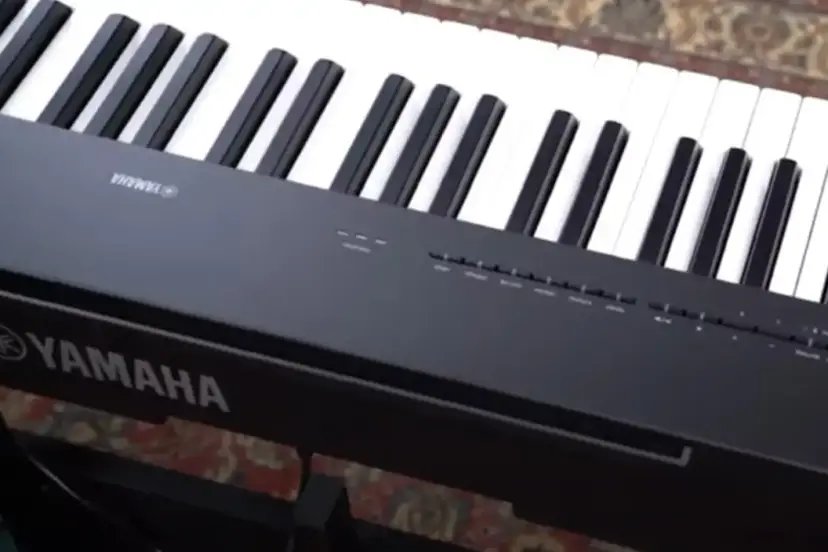
The Yamaha P-225 occupies an interesting position in today’s digital-piano market.
It isn’t Yamaha’s cheapest portable digital piano, nor is it designed to compete with the company’s premium instruments.
Instead, the P-225 aims for something that many buyers actually need:
A compact, relatively lightweight 88-key digital piano that feels sufficiently piano-like for serious practice without taking over the room.
That combination has made the P-225 particularly attractive to beginners, intermediate players, apartment dwellers and musicians who need an instrument that can be moved when necessary.
But is the Yamaha P-225 still worth buying in 2026?
For many players, we think the answer is yes—provided you understand both its strengths and its compromises.
Yamaha P-225 at a Glance
| Feature | Yamaha P-225 |
|---|---|
| Keys | 88 |
| Keyboard action | Graded Hammer Compact (GHC) |
| Piano sound | Yamaha CFX |
| Maximum polyphony | 192 notes |
| Voices | 24 |
| Rhythms | 20 |
| Piano resonance | VRM Lite |
| Speakers | Built-in stereo speaker system |
| Amplification | 7W × 2 |
| USB | USB TO HOST with audio/MIDI |
| Headphones | 2 standard stereo headphone jacks |
| Audio outputs | L/L+R and R AUX OUT |
| Pedals | Sustain input + optional three-pedal unit support |
| Weight | About 25.6 lb / 11.5 kg |
| Width | About 52.2 in / 132.6 cm |
| Depth | About 10.7 in / 27.2 cm |
| Best for | Beginners through intermediate players, home practice, apartments and portability |
Quick Verdict
The Yamaha P-225 is one of the better choices for someone who wants a genuine 88-key piano-oriented instrument without the bulk of a traditional console digital piano.
Its strongest points are:
- 88 weighted GHC keys
- Yamaha CFX piano sound
- 192-note polyphony
- Very slim cabinet
- Relatively low weight
- USB audio/MIDI
- Proper AUX outputs
- Built-in speakers
- Optional furniture stand and three-pedal setup
It isn’t the perfect digital piano for everyone.
Advanced players may eventually want a more sophisticated keyboard action, while buyers mainly interested in hundreds of sounds and arranger features should look elsewhere.
But as a compact piano for learning, practicing and everyday playing, the P-225 strikes a convincing balance.
[Check Yamaha P-225 Price on Amazon →]
Affiliate Disclosure
Some links on Pianos-Galore are affiliate links. If you purchase through these links, we may receive a small commission at no additional cost to you.
What Is the Yamaha P-225?
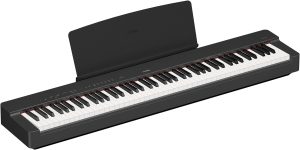
The P-225 belongs to Yamaha’s long-running P Series of portable digital pianos.
The basic philosophy of the P Series is straightforward:
Give players the essential characteristics of a piano—88 keys, weighted action and convincing acoustic-piano sound—without requiring the large cabinet of a traditional home digital piano.
The P-225 takes that concept further by emphasizing compactness.
Its cabinet measures only about 10.7 inches deep without the music rest.
That’s remarkably shallow for an 88-key instrument.
It makes the P-225 particularly suitable for:
- Apartments
- Bedrooms
- Condominiums
- Dorm rooms
- Home offices
- Small music rooms
- Multipurpose living spaces
And because it weighs about 25.6 pounds, moving it is considerably easier than moving a console digital piano.
Yamaha P-225 Keyboard: What Does GHC Feel Like?
One of the most important features of any digital piano is its keyboard action.
The P-225 uses Yamaha’s Graded Hammer Compact (GHC) action.
The word “graded” is important.
On an acoustic piano, bass keys generally feel heavier than treble keys because of differences in the underlying mechanism.
A graded digital-piano action attempts to reproduce this general characteristic.
The P-225 therefore gives beginners a much more piano-oriented playing experience than an inexpensive unweighted keyboard.
GHC vs. GHS
You may encounter older information online describing the P-225 as having Yamaha’s GHS action.
That’s incorrect.
The P-225 uses GHC—Graded Hammer Compact.
Yamaha developed GHC partly to maintain a weighted piano-style response while allowing the instrument itself to remain compact.
That’s central to the P-225’s identity.
Is GHC Good Enough for Learning Piano?
For most beginners, yes.
If your objective is to develop:
- Finger control
- Dynamic expression
- Two-handed technique
- Scales
- Chords
- Arpeggios
- Traditional piano repertoire
a weighted 88-key action such as GHC is much more appropriate than a typical lightweight keyboard action.
The P-225 also offers four touch-response settings:
- Hard
- Medium
- Soft
- Fixed
These change how the instrument responds to playing velocity.
Is It Like an Acoustic Grand?
No digital piano in this category should be described that way.
The GHC action is designed partly around compactness.
More expensive digital pianos can provide longer, more sophisticated actions and a playing experience closer to higher-end acoustic instruments.
That’s an important distinction for advanced pianists.
But the relevant question isn’t:
“Does the P-225 feel exactly like a concert grand?”
It’s:
“Does the P-225 provide a sufficiently piano-oriented weighted action for the type of player and price category it’s designed for?”
For many beginners and intermediate players, the answer is yes.
Yamaha CFX Piano Sound
The P-225’s primary piano sound is based on Yamaha’s CFX concert grand.
This is an important improvement in positioning compared with treating the P-225 simply as an inexpensive portable keyboard.
Yamaha’s CFX is the company’s flagship concert grand family, and the P-225 uses a CFX-based piano voice as its main acoustic-piano sound.
Of course, you’re not getting the same reproduction system or level of detail found in Yamaha’s premium digital pianos.
But the source gives the P-225 a convincing tonal foundation.
VRM Lite
The P-225 also includes Virtual Resonance Modeling Lite, or VRM Lite.
An acoustic piano isn’t simply a collection of independent strings.
Strings, the soundboard and the instrument’s physical structure interact with one another, producing complex resonances.
VRM Lite is designed to simulate aspects of those interactions digitally.
The result is intended to make the piano sound more natural and less like isolated samples being triggered one at a time.
Key-Off Samples
The P-225 also incorporates key-off samples.
These contribute to the subtle sonic behavior heard when notes are released.
These details aren’t as immediately marketable as “hundreds of sounds,” but they’re relevant to someone who primarily wants to play piano.
192-Note Polyphony: Is That Enough?
The P-225 provides a maximum polyphony of 192 notes.
Polyphony refers to how many notes the sound engine can reproduce simultaneously.
You might reasonably ask:
Why would I need 192 notes when a piano only has 88 keys?
Because notes can continue sounding after you’ve released the keys, particularly when using the sustain pedal. Layered sounds and other functions can also consume additional polyphony.
For ordinary piano practice—and even fairly demanding repertoire—192-note polyphony provides considerable headroom.
This is one specification most P-225 owners probably won’t need to worry about.
More Than Just a Piano Sound
Although the P-225 is piano-focused, it isn’t restricted to one acoustic-piano voice.
It provides 24 voices.
These allow you to explore sounds beyond the main concert grand, including other keyboard and instrument categories.
The P-225 also supports:
Dual
Layer two voices so they sound together.
For example, piano and strings can create a fuller texture.
Split
Assign different voices to the left and right sections of the keyboard.
Duo
Divide the keyboard into two similar pitch ranges.
This can be useful in teaching situations where student and teacher want to play comparable notes on opposite halves of the same keyboard.
20 Built-In Rhythms
The P-225 also includes 20 rhythm patterns.
This isn’t an arranger keyboard with hundreds of accompaniment styles.
Nor is it trying to be.
But rhythms can make practice more enjoyable and help develop timing.
They’re also useful for casual playing and songwriting.
If elaborate accompaniment is one of your main priorities, Yamaha’s DGX line would probably be a better direction.
If your main priority is piano, the P-225’s more focused approach makes sense.
Compact Design: One of the P-225’s Biggest Advantages
This is arguably where the P-225 becomes particularly compelling.
The instrument measures approximately:
52.2 inches wide × 10.7 inches deep × 5.1 inches high
without the music rest.
The width isn’t surprising.
An 88-key instrument can’t magically eliminate the physical space occupied by 88 full-size keys.
But the depth of only about 10.7 inches is impressive.
That makes it easier to position against a wall, in a bedroom or in a multipurpose living area.
Good for Apartments
For apartment dwellers, depth often matters more than people realize.
A traditional console digital piano may occupy permanent floor space.
The P-225 can instead sit on:
- A portable keyboard stand
- Yamaha’s optional dedicated stand
- Another suitable support
depending on how permanent you want the setup to be.
Weight
At approximately 25.6 pounds, the P-225 is also relatively easy to reposition.
That’s useful if you:
- Rearrange your room
- Move between home and lessons
- Rehearse elsewhere
- Occasionally perform
- Don’t want a permanently installed instrument
It isn’t something most people will casually carry under one arm, but it’s dramatically more manageable than an acoustic piano or console digital piano.
Built-In Speakers
The P-225 includes its own stereo speaker system powered by 7W × 2 amplification.
That means you don’t need:
- External monitors
- An amplifier
- A computer
- Headphones
just to sit down and practice.
Turn it on and play.
That’s one of the major advantages of choosing a digital piano instead of a dedicated MIDI controller.
Is It Loud Enough?
For normal home practice, the onboard speaker system should be adequate for many users.
For larger performance spaces, however, external amplification may be appropriate.
Fortunately, the P-225 provides dedicated AUX outputs.
Headphone Practice
The P-225 provides two standard stereo headphone jacks.
This is particularly useful for:
- Apartments
- Late-night practice
- Shared homes
- Dormitories
- Families
- Teacher/student practice
Two headphone connections can also be useful when two people want to listen privately.
Yamaha additionally provides its Stereophonic Optimizer, designed to make headphone piano sound feel more spacious rather than appearing to originate directly inside your ears.
USB Audio and MIDI: A Major Advantage
The P-225 is more useful than a purely standalone digital piano because it can integrate with computers and compatible devices.
Its USB TO HOST connection supports both MIDI and USB audio.
These are different technologies.
MIDI
MIDI transmits performance information such as:
- Which note you played
- When you played it
- How strongly you played it
- When you released it
This allows the P-225 to interact with compatible:
- DAWs
- Virtual instruments
- Notation software
- Piano-learning applications
USB Audio
USB audio deals with actual sound rather than note instructions.
The P-225 supports stereo USB audio at 44.1 kHz/24-bit.
For musicians interested in home recording, that’s a genuinely useful feature.
It means the P-225 isn’t limited to being a practice piano.
It can also become part of a modest digital-music setup.
Can You Use the Yamaha P-225 as a MIDI Controller?
Yes.
Because the P-225 can transmit MIDI through USB, it can control compatible virtual instruments and software.
For example:
P-225 → Computer → Virtual Grand Piano
You play the P-225’s physical keyboard, while the computer generates the sound of the software instrument.
This greatly expands your available sonic possibilities.
However, remember that the P-225 is primarily a digital piano, not a dedicated studio controller.
It doesn’t provide the extensive pads, knobs and sliders found on many production-oriented MIDI keyboards.
For pianists, that may actually be preferable.
Smart Pianist Compatibility
The P-225 works with Yamaha’s Smart Pianist app on compatible devices.
Smart Pianist can provide a more graphical way of accessing supported functions and settings than navigating everything through the piano’s physical controls.
This can be especially helpful because the P-225 deliberately keeps its control panel relatively clean.
Rather than covering the front panel with buttons and a large display, Yamaha allows compatible app integration to handle some of the deeper interaction.
If app functionality is important to you, check Yamaha’s current compatibility information for your specific phone or tablet and operating system.
Pedals: From Beginner Setup to Home Piano
The P-225 can be used with a basic sustain pedal for everyday playing.
But Yamaha also provides support for an optional three-pedal configuration.
That’s important for advancing pianists.
A traditional piano has:
- Damper/sustain pedal
- Sostenuto pedal
- Soft pedal
A three-pedal setup therefore makes the P-225 more suitable for serious repertoire and gives it a more complete home-piano configuration.
Combine the P-225 with Yamaha’s dedicated furniture-style stand and compatible pedal unit, and the instrument can look much more like a permanent home digital piano.
Yet you retain the option of removing the piano and using it portably.
That’s an advantage console digital pianos don’t offer.
Is the Yamaha P-225 Good for Beginners?
Yes—and beginners may actually be one of its strongest audiences.
A beginner doesn’t necessarily need an expensive piano.
But if you’re serious about learning traditional piano, certain fundamentals are valuable from the beginning:
- 88 keys
- Weighted action
- Touch sensitivity
- Sustain pedal support
- Appropriate piano sound
- Headphone practice
- Metronome
The P-225 provides those essentials.
More importantly, it offers enough capability that a beginner shouldn’t immediately outgrow it.
That’s one of the problems with buying the cheapest possible keyboard.
A 61-key unweighted keyboard can be excellent for exploring music, but a committed student may eventually want 88 weighted keys.
Starting with the P-225 avoids that particular upgrade.
The P-225 has enough capability to serve many developing players, but those already progressing beyond beginner repertoire should also compare Yamaha’s intermediate-level alternatives.
Is the P-225 Good for Intermediate Players?
This may be where the P-225 provides particularly strong value.
An intermediate pianist may want something better than an entry-level keyboard but still not be ready to invest in a premium home digital piano.
The P-225 offers:
- Full 88-key range
- Weighted action
- CFX-based sound
- 192-note polyphony
- Three-pedal capability
- USB audio/MIDI
- AUX outputs
- Portable design
That’s a useful combination for someone progressing beyond the earliest stages.
Eventually, an advanced player may want a more sophisticated action.
But the P-225 provides plenty of room between “first keyboard” and “premium digital piano.”
Is the Yamaha P-225 Good for Classical Music?
For beginner and intermediate classical practice, it can be a good choice.
The full 88-key range and weighted action are much better suited to traditional piano technique than lightweight keyboard actions.
Three-pedal capability also helps as repertoire becomes more demanding.
Advanced classical pianists, however, should compare the P-225 with higher-level digital pianos offering more sophisticated actions.
The better you become, the more subtle differences in keyboard action can matter.
Is the P-225 Good for Gigging?
It can be.
At roughly 25.6 pounds, the P-225 is considerably easier to transport than a console piano.
It also has dedicated AUX outputs, which are useful when connecting to external amplification.
For occasional gigs, rehearsals, churches or small performances, that’s appealing.
But professional stage musicians should also consider whether they need:
- More real-time controls
- More sounds
- Stage-oriented effects
- More sophisticated splitting/layering
- Professional stage-piano workflow
If those are priorities, a dedicated stage piano may be more appropriate.
The P-225’s strength is that it can move between home piano and occasional performance instrument reasonably well.
Yamaha P-225 for Small Spaces
If you live in an apartment or small home, this is one of the strongest reasons to consider the P-225.
The cabinet is only about 10.7 inches deep.
You still need roughly 52 inches of width because of the 88-key keyboard, but the shallow depth can make the instrument considerably easier to integrate into a room.
Add headphones and you solve another apartment problem:
noise.
You can practice without sending amplified piano sound through the walls late at night.
For buyers with limited living space, the combination of slim dimensions, headphones and 88 weighted keys is particularly attractive.
Yamaha P-225 vs. Roland FP-30X
The Roland FP-30X is one of the P-225’s most obvious competitors.
Both offer:
- 88 weighted keys
- Built-in speakers
- Portable design
- Computer connectivity
- Strong beginner-to-intermediate appeal
The decision may come down partly to keyboard feel and personal preference.
The Roland’s PHA-4 Standard action has its own character, while Yamaha’s GHC action emphasizes compactness.
If possible, play both before buying.
For many pianists, keyboard feel is too personal to decide entirely from specifications.
Yamaha P-225 vs. Kawai ES120
The Kawai ES120 is another strong piano-focused competitor.
Kawai places considerable emphasis on piano action and acoustic-piano heritage.
The ES120 therefore deserves serious consideration from buyers particularly focused on traditional piano practice.
The Yamaha counters with an excellent combination of compact dimensions, CFX-based sound and USB audio/MIDI functionality.
Again, there isn’t a universal winner.
The better question is:
Which compromises matter least to you?
Yamaha P-225 vs. Casio PX-S1100
The Casio PX-S1100 is particularly attractive if slim design and modern styling are major priorities.
Both instruments work well in apartments and smaller rooms.
The choice should therefore consider:
- Keyboard feel
- Piano sound preference
- Physical dimensions
- Connectivity
- Design
- Price
Don’t choose solely from a specification table.
If possible, try both keyboards.
What We Like About the Yamaha P-225
The P-225’s biggest strengths are:
Excellent size-to-capability ratio
You get 88 weighted keys in a very shallow cabinet.
Yamaha CFX-based piano sound
The primary piano voice gives the instrument a strong tonal foundation.
192-note polyphony
Plenty for normal piano practice and demanding passages.
USB audio and MIDI
Useful for recording, virtual instruments and music software.
Two headphone jacks
Excellent for private practice and shared listening.
AUX outputs
Useful for external amplification and performance.
Three-pedal upgrade path
Allows the instrument to grow with an advancing pianist.
Manageable weight
At around 25.6 pounds, it remains genuinely portable compared with console instruments.
What We Don’t Like
No digital piano is perfect.
GHC Is Still a Compact Action
The P-225’s keyboard is designed partly around keeping the instrument small.
Advanced players may prefer a more substantial premium action.
Limited Onboard Interface
The minimalist controls look clean but can make some functions less immediately accessible.
Smart Pianist can help, but some users prefer dedicated physical controls and displays.
Only 24 Voices
That’s perfectly adequate for a piano-focused instrument.
But buyers who want hundreds of sounds should consider a different category.
Built-In Speakers Have Limits
They’re convenient for home practice, but musicians performing in larger spaces may need external amplification.
Who Should Buy the Yamaha P-225?
The P-225 makes particular sense for:
- Serious beginners
- Intermediate pianists
- Adults returning to piano
- Apartment dwellers
- Students with limited space
- Players needing an easily movable home piano
- Pianists interested in apps and MIDI
- Home-recording beginners
- Occasional performers
Who Should Look Elsewhere?
Consider another instrument if:
- You’re an advanced pianist demanding a premium keyboard action.
- You want a traditional furniture-style console permanently installed at home.
- You need hundreds of accompaniment styles and voices.
- You need extensive stage-piano controls.
- You mainly produce electronic music and need pads, knobs and sliders.
The P-225 is versatile, but its core identity remains:
A compact piano-focused digital piano.
Frequently Asked Questions
Does the Yamaha P-225 have weighted keys?
Yes. It has 88 Yamaha Graded Hammer Compact (GHC) weighted keys.
Does the P-225 use GHS action?
No. The P-225 uses Yamaha’s newer GHC, or Graded Hammer Compact, keyboard action.
How much does the Yamaha P-225 weigh?
Approximately 25.6 pounds, or 11.5 kilograms.
How many sounds does the P-225 have?
It provides 24 preset voices.
What is the polyphony of the Yamaha P-225?
Maximum polyphony is 192 notes.
Does the Yamaha P-225 have MIDI?
Yes. It supports MIDI through its USB TO HOST connection.
Does the Yamaha P-225 support USB audio?
Yes. It includes USB audio functionality as well as MIDI connectivity.
Can I use headphones with the P-225?
Yes. The P-225 provides two standard stereo headphone jacks.
Can I add three pedals?
Yes. The P-225 supports a compatible optional three-pedal unit.
Is the P-225 suitable for classical piano?
It can be a very good instrument for beginner and intermediate classical practice. Advanced pianists may eventually prefer a higher-level keyboard action.
Is the Yamaha P-225 good for apartments?
Yes. Its shallow cabinet, relatively low weight and headphone capability make it particularly suitable for apartments and other smaller living spaces.
Is the Yamaha P-225 good for beginners?
Yes. Its 88 weighted keys, touch sensitivity, piano-focused sound and ability to grow with the player make it a strong first serious digital piano.
Yamaha P-225 Review: Final Verdict
The Yamaha P-225 succeeds because it doesn’t try to be everything.
It isn’t an arranger workstation.
It isn’t a premium console digital piano.
And it isn’t a professional stage workstation covered in controls.
Instead, Yamaha has concentrated on something many players need:
A good 88-key digital piano that is compact enough for modern living.
You get GHC weighted keys, a Yamaha CFX-based piano sound, VRM Lite, 192-note polyphony, built-in speakers, headphone practice, USB audio/MIDI, AUX outputs and the ability to add a furniture stand and three-pedal system.
For a serious beginner, there’s enough here to avoid an early upgrade.
For an intermediate player, there’s enough capability for substantial practice.
For an apartment dweller, the compact dimensions are a genuine advantage.
And for someone who occasionally needs to move the piano, its approximately 25.6-pound weight is far more manageable than a console instrument.
Its main limitation is also part of its design philosophy: the GHC action prioritizes compactness rather than trying to reproduce the more substantial feel of Yamaha’s premium keyboard actions.
That trade-off won’t suit every pianist.
But for the buyer asking:
“I want a proper 88-key Yamaha, but I don’t want a huge or extremely heavy piano.”
the P-225 remains one of the strongest models to consider in 2026.
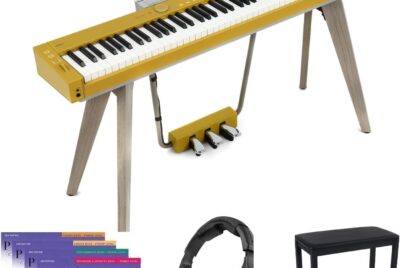
The P-225’s slim body and clean lines also make it a particularly attractive option for the living room; see how it compares with other stylish digital pianos.
[Check Yamaha P-225 Price on Amazon →]
Related Articles
- Best Yamaha 88-Key Weighted Keyboards in 2026: 5 Models Compared
- Best Digital Pianos for Beginners in 2026: 7 Top Picks for Learning Piano
- Best Portable Digital Pianos for Beginners in 2026: 5 Lightweight Picks
- Best Digital Pianos Under $1,000 in 2026: 7 Top Picks
- Best Compact Digital Pianos for Small Spaces in 2026: 6 Top Picks