Best Yamaha Digital Pianos in 2026: 5 Top Picks for Every Player

Yamaha is one of the most recognizable names in the piano world, with a history that spans both traditional acoustic pianos and modern digital instruments.
That experience gives Yamaha an unusual advantage. The company doesn’t simply manufacture electronic keyboards—it also builds concert grands, upright pianos, and professional instruments used by musicians around the world.
But Yamaha’s digital-piano selection can be confusing.
Should you buy the compact Yamaha P-225, the feature-packed DGX-670, or a furniture-style Arius such as the YDP-145 or YDP-165? And if you’re an experienced pianist, is it worth stepping up to the premium P-525?
The answer depends on how and where you intend to play.
In this guide, we’ll compare five Yamaha digital pianos that cover a wide range of players:
Yamaha P-225 — Best Overall
Yamaha DGX-670 — Best for Features and Entertainment
Yamaha YDP-145 — Best Affordable Home Piano
Yamaha YDP-165 — Best for Serious Home Practice
Yamaha P-525 — Best Premium Portable
Whether you’re buying your first weighted-key piano or looking for a more sophisticated instrument for advanced playing, one of these models may be the right fit.
Disclosure: Some links on Pianos-Galore are affiliate links. If you purchase through these links, we may receive a small commission at no additional cost to you.
Best Yamaha Digital Pianos at a Glance
| Model | Best For | Keyboard | Piano Sound | Polyphony |
|---|---|---|---|---|
| Yamaha P-225 | Best Overall | GHC | Yamaha CFX | 192 |
| Yamaha DGX-670 | Features & Entertainment | GHS | Yamaha CFX | 256 |
| Yamaha YDP-145 | Affordable Home Piano | GHS | Yamaha CFX | 192 |
| Yamaha YDP-165 | Serious Home Practice | GH3 | Yamaha CFX | 192 |
| Yamaha P-525 | Premium Portable | GrandTouch-S | CFX + Bösendorfer Imperial | 256 |
These instruments share the Yamaha name, but they are designed for very different users.
Understanding those differences is more important than simply buying the most expensive model.
Why Choose a Yamaha Digital Piano?
Yamaha has extensive experience with acoustic pianos, digital pianos, keyboards, synthesizers, recording equipment, and professional audio.
For the digital-piano buyer, several Yamaha technologies are particularly important.
Yamaha CFX Piano Sound
All five models in this guide incorporate the sound of Yamaha’s CFX concert grand in some form.
The CFX is Yamaha’s flagship concert grand, and its tonal character provides the foundation for many of Yamaha’s current digital pianos.
The implementation becomes increasingly sophisticated as you move up the range.
If realistic piano tone matters more than extra features, see our guide to Yamaha models with the most convincing acoustic-piano sound.
Weighted Keyboard Actions
Yamaha doesn’t use the same action across all of its digital pianos.
You’ll encounter:
GHC — Graded Hammer Compact
GHS — Graded Hammer Standard
GH3 — Graded Hammer 3
GrandTouch-S
Each is designed for a different price and performance level.
If keyboard feel is one of your main priorities, our comparison of Yamaha’s 88-key weighted models explains how GHC, GHS, GH3 and GrandTouch-S differ in practice.
Digital-Piano Convenience
Compared with an acoustic piano, Yamaha digital pianos offer practical advantages such as:
- Headphone practice
- Adjustable volume
- No traditional tuning
- Recording capabilities
- USB connectivity
- Multiple instrument voices
- Easier relocation
For many homes, particularly apartments and smaller spaces, these advantages can be significant.
1. Yamaha P-225 — Best Overall Yamaha Digital Piano
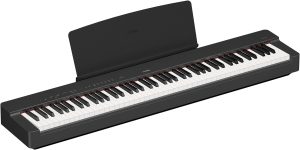
For the widest range of buyers, the Yamaha P-225 is my top recommendation.
It combines a full 88-key weighted keyboard, Yamaha CFX concert-grand sound, modern connectivity, 192-note polyphony, and a compact portable design.
Yamaha equips the P-225 with:
- 88-key Graded Hammer Compact (GHC) keyboard
- Yamaha CFX piano sound
- VRM Lite
- 192-note maximum polyphony
- 24 instrument voices
- Split, Dual, and Duo modes
- USB audio/MIDI
- Built-in speakers
- Optional three-pedal compatibility
The P-225 weighs approximately 11.5 kg / 25 lb 6 oz, making it substantially easier to move than most furniture-style digital pianos.
Graded Hammer Compact Keyboard
One of the P-225’s major improvements is Yamaha’s GHC keyboard.
The goal is to provide an acoustic-piano-style weighted response while allowing Yamaha to build a shallower, more compact instrument.
For:
- Home practice
- Lessons
- Small apartments
- Occasional performances
- Moving between locations
that compactness can be a major advantage.
Yamaha CFX Sound
The P-225 uses a Yamaha CFX concert-grand piano voice.
It also incorporates Virtual Resonance Modeling Lite (VRM Lite), which helps recreate some of the sympathetic resonance that occurs naturally inside an acoustic piano.
192-Note Polyphony
The P-225 provides 192-note maximum polyphony.
That’s ample for most traditional piano playing, including substantial use of the sustain pedal.
24 Voices
Although primarily a digital piano, the P-225 includes 24 voices.
This gives you enough variety for everyday music-making without turning the instrument into a complicated arranger keyboard.
Who Should Buy the P-225?
It’s particularly well suited to:
- Beginners
- Intermediate pianists
- Adults returning to piano
- Students
- Apartment dwellers
- Players who occasionally transport their instrument
- Home musicians
Pros
- Compact and relatively lightweight
- 88 weighted keys
- CFX piano sound
- VRM Lite
- 192-note polyphony
- Modern connectivity
- Suitable for beginners through intermediate players
Possible Drawback
Advanced pianists may eventually want a more sophisticated action such as the GrandTouch-S mechanism in the P-525.
Buyers considering Yamaha’s portable sweet spot can explore its strengths and limitations in our full Yamaha P-225 review.
Best for:
Most buyers wanting an excellent balance of price, portability, piano sound, and weighted-key performance.
[Check Yamaha P-225 Price on Amazon →]
2. Yamaha DGX-670 — Best for Features and Entertainment
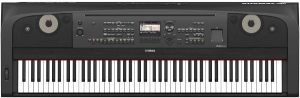
The Yamaha DGX-670 is the most feature-packed instrument in our selection.
Although it has an 88-key weighted keyboard and serious Yamaha piano sound, it goes far beyond traditional piano practice.
Yamaha equips the DGX-670 with:
- 88-key GHS weighted keyboard
- Yamaha CFX piano sound
- Virtual Resonance Modeling
- 256-note polyphony
- Hundreds of instrument sounds
- 263 accompaniment styles
- 4.3-inch color display
- 16-track MIDI recording
- USB audio recording
- Microphone input
- Bluetooth Audio
- Intelligent accompaniment features
Yamaha’s current specifications list 601 main voices plus 29 drum/SFX kits, while Yamaha’s consumer-facing description refers to 630 total instrument voices.
It’s More Than a Piano
This is what separates the DGX-670 from the P-225.
The P-225 is fundamentally:
a digital piano.
The DGX-670 is closer to:
digital piano + arranger + recording instrument + entertainment keyboard.
You can sit down and play a Yamaha CFX grand-piano sound—or create an entire arrangement with drums, bass, accompaniment, and additional instruments.
263 Accompaniment Styles
The DGX-670 provides 263 preset accompaniment styles covering musical genres such as pop, jazz, R&B and others.
Your left-hand chords can control a virtual backing band while you perform the melody.
For recreational players, songwriters, and entertainers, this can be tremendous fun.
Smart Chord
Smart Chord makes sophisticated accompaniment accessible even to less experienced musicians.
You can play relatively simple chord structures while the DGX-670 generates fuller accompaniment. Yamaha also provides Adaptive Style, which can change accompaniment intensity according to your playing.
4.3-Inch Color Display
The DGX-670 includes a 4.3-inch color display capable of displaying information including scores and lyrics.
That’s useful because this instrument has far more functionality to navigate than a conventional digital piano.
Recording
The DGX-670 supports 16-track MIDI recording as well as USB audio recording.
This makes it particularly attractive for:
- Songwriters
- Arrangers
- Home musicians
- Singers
- Composers
Microphone Capability
A microphone can be connected directly to the instrument.
That makes the DGX-670 an interesting all-in-one solution for someone who sings while playing.
One Important Consideration: Weight
At approximately 21.4 kg / 47 lb 3 oz, the DGX-670 is considerably heavier than the P-225.
Technically it can be moved, but I wouldn’t choose it primarily for frequent transportation.
Pros
- 88 weighted keys
- CFX piano sound
- 256-note polyphony
- Huge sound library
- 263 accompaniment styles
- Color display
- Powerful recording functions
- Microphone connectivity
- Excellent for entertainment and composition
Possible Drawback
If you only want to practice traditional piano, many of these features may be unnecessary.
Best for:
Home musicians, entertainers, songwriters, and families wanting far more than conventional piano practice.
[Check Yamaha DGX-670 Price on Amazon →]
P-225 vs DGX-670: Which Should You Buy?
This is an important comparison because both can appeal to home musicians.
Choose the P-225 if:
- Piano practice is your priority.
- You value portability.
- You want a simple interface.
- You don’t need hundreds of sounds.
- You want a relatively compact instrument.
Choose the DGX-670 if:
- You enjoy arranging music.
- You want accompaniment styles.
- You sing and play.
- Recording matters.
- You want hundreds of instrument sounds.
- Entertainment features are important.
The P-225 is the better straightforward digital piano for most people.
The DGX-670 is the better musical workstation/entertainment piano.
3. Yamaha YDP-145 — Best Affordable Home Piano
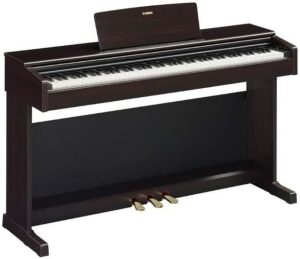
Not everyone wants a portable keyboard sitting on a stand.
Some buyers want their digital piano to feel like a permanent piece of furniture.
That’s where Yamaha’s Arius YDP-145 comes in.
It combines:
- 88-key GHS keyboard
- Yamaha CFX piano sound
- VRM Lite
- 192-note polyphony
- Three built-in pedals
- Sliding key cover
- Furniture-style cabinet
- Duo mode
- Headphone connectivity
Yamaha confirms that the YDP-145 uses GHS action, while providing the CFX piano voice, VRM Lite and 192-note polyphony.
Why Choose an Arius?
A portable digital piano has obvious advantages.
But a console piano offers something different.
The YDP-145 stays assembled and ready to play.
You get:
- Proper stand height
- Stable playing position
- Integrated pedals
- Music rest
- Key cover
- More traditional appearance
For a family with a child taking piano lessons, that can be extremely convenient.
Three-Pedal System
The YDP-145 includes:
- Damper
- Sostenuto
- Soft
and the damper supports half-pedaling.
This becomes increasingly important as students move into more advanced classical repertoire.
Who Should Buy It?
The YDP-145 makes particular sense for:
- Families
- Piano students
- Adult beginners
- Home practice
- Buyers who don’t need portability
- People wanting traditional piano furniture styling
Pros
- Permanent home-piano format
- CFX sound
- 88 weighted keys
- 192-note polyphony
- Three pedals
- Attractive furniture appearance
- Straightforward piano-focused operation
Possible Drawback
Its GHS action is not as sophisticated as the GH3 mechanism in the YDP-165.
Best for:
Families and beginners wanting an affordable, permanent Yamaha home piano.
[Check Yamaha YDP-145 Price on Amazon →]
4. Yamaha YDP-165 — Best Yamaha for Serious Home Practice
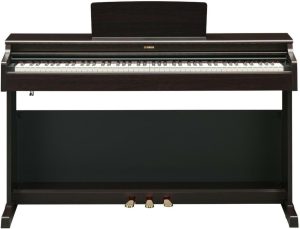
At first glance, the YDP-165 may look very similar to the YDP-145.
But there is one important difference:
the keyboard action.
The YDP-165 moves from GHS to Yamaha’s GH3 keyboard, with synthetic ebony and ivory keytops.
That makes the YDP-165 the model I’d favor for a more committed piano student.
It provides:
- 88-key GH3 action
- Synthetic ebony and ivory keytops
- Yamaha CFX piano sound
- VRM Lite
- 192-note polyphony
- Three pedals with half-pedal capability
- Integrated cabinet
- Sliding key cover
Why GH3 Matters
The keyboard is the part of a digital piano you physically interact with every second you’re playing.
As students progress, action becomes increasingly important.
GH3 is designed to provide improved repetition behavior compared with simpler entry-level actions, which can become relevant for:
- Faster passages
- Repeated notes
- Classical repertoire
- Dynamic control
- More advanced technique
YDP-145 vs YDP-165
For a casual beginner, the YDP-145 may be entirely sufficient.
For a student likely to continue seriously, the YDP-165 is the stronger long-term proposition.
| Feature | YDP-145 | YDP-165 |
|---|---|---|
| Keys | 88 | 88 |
| Action | GHS | GH3 |
| Piano | Yamaha CFX | Yamaha CFX |
| VRM Lite | Yes | Yes |
| Polyphony | 192 | 192 |
| Pedals | 3 | 3 |
| Best For | Beginner/home | Serious home study |
The key reason to spend more is therefore not more polyphony or a different flagship piano sample.
It’s primarily the improved keyboard experience.
Pros
- GH3 action
- CFX piano sound
- 192-note polyphony
- Three pedals
- Traditional home-piano format
- Stronger choice for serious students
Possible Drawback
It’s a permanent furniture-style instrument, so it’s not appropriate for musicians needing portability.
Best for:
Committed students and home pianists who want a better keyboard action without moving into premium digital-piano pricing.
[Check Yamaha YDP-165 Price on Amazon →]
5. Yamaha P-525 — Best Premium Portable Yamaha Digital Piano
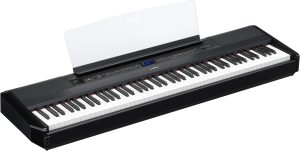
The Yamaha P-525 is in a different performance class from the P-225.
Yamaha positions it as the flagship of its P-Series portable digital pianos.
It provides:
- 88-key GrandTouch-S keyboard
- Wooden white keys
- Synthetic ebony and ivory keytops
- Escapement
- Yamaha CFX concert-grand sound
- Bösendorfer Imperial grand sound
- Virtual Resonance Modeling
- Grand Expression Modeling
- Binaural sampling
- 256-note polyphony
- Hundreds of additional voices
- MIDI and audio recording
GrandTouch-S Keyboard
The P-525’s keyboard is one of its biggest selling points.
The GrandTouch-S action incorporates wooden white keys, escapement, and textured key surfaces.
This is a considerable step up from the GHC action in the P-225.
Experienced pianists are more likely than beginners to appreciate differences in:
- Repetition
- Key resistance
- Dynamic control
- Key stability
- Fine tonal expression
Yamaha CFX + Bösendorfer Imperial
The P-525 doesn’t limit you to Yamaha’s CFX character.
It also provides a Bösendorfer Imperial grand-piano voice.
Bösendorfer is part of the Yamaha group but retains its distinctive piano-building heritage.
Having both piano personalities gives advanced players greater tonal choice.
Virtual Resonance Modeling
The P-525 uses Yamaha’s fuller VRM implementation rather than the VRM Lite found in lower models.
It also includes Grand Expression Modeling, which is intended to reproduce more of the tonal variation produced by differences in touch.
Binaural Sampling
For headphone practice, Yamaha provides binaural sampling with its CFX Grand voice.
This is designed to create a more spatial, natural headphone experience.
Recording Capability
The P-525 supports substantial recording functionality, including multi-track MIDI recording and USB audio recording.
That makes it useful not only for practice but also for:
- Composition
- Performance review
- Home recording
- Music production
Is the P-525 Really Portable?
Technically, yes.
But at approximately 22 kg / 48 lb 8 oz, it isn’t something most people will casually carry around every day.
Think of it as a premium digital piano that can be transported, rather than an ultra-light portable keyboard.
Pros
- Premium GrandTouch-S action
- Wooden white keys
- CFX and Bösendorfer piano sounds
- VRM
- Grand Expression Modeling
- 256-note polyphony
- Strong recording features
- Premium headphone experience
Possible Drawback
Its price and weight are difficult to justify for a complete beginner who doesn’t yet need the premium action.
Best for:
Advanced pianists and serious home players wanting a premium Yamaha piano without committing to a permanent console cabinet.
[Check Yamaha P-525 Price on Amazon →]
Yamaha P-225 vs P-525: Is the P-525 Worth It?
This comparison illustrates how Yamaha’s P-Series progresses.
P-225
- GHC keyboard
- CFX piano
- VRM Lite
- 192-note polyphony
- 24 voices
- Approximately 11.5 kg
P-525
- GrandTouch-S keyboard
- Wooden white keys
- CFX + Bösendorfer Imperial
- Full VRM
- Grand Expression Modeling
- 256-note polyphony
- Much broader sound library
- Approximately 22 kg
For most beginners, I’d choose the P-225.
For an experienced pianist who cares deeply about action and tonal control, I’d choose the P-525.
The additional money is buying genuine improvements—not merely additional instrument sounds.
Which Yamaha Digital Piano Is Best for Beginners?
For most beginners, my recommendation is the P-225.
It offers:
- 88 weighted keys
- CFX sound
- 192-note polyphony
- Compact size
- Relatively low weight
- Enough features to continue well beyond the first lessons
If the instrument will stay permanently in one room and furniture styling is important, consider the YDP-145 instead.
Which Yamaha Is Best for Intermediate Players?
The P-225 remains a strong choice.
But an intermediate pianist who increasingly cares about keyboard action should consider:
YDP-165 for permanent home use.
P-525 for premium performance with transportability.
Players who have progressed beyond beginner needs may want to narrow the choices with our Yamaha recommendations for intermediate pianists.
Which Yamaha Is Best for Classical Music?
For beginning classical students:
P-225 or YDP-145
For more committed students:
YDP-165
For advanced players:
P-525
Classical players should pay particular attention to keyboard action and pedals rather than choosing based on the number of voices.
Which Yamaha Is Best for Home Recording?
For straightforward recording, the P-225 provides useful USB connectivity.
For songwriting and arranging, the DGX-670 is particularly compelling because of its 16-track MIDI recording, accompaniment system and broad instrument library.
For advanced piano recording and performance, consider the P-525.
Which Yamaha Is Best for Families?
I’d consider either:
YDP-145 — if piano lessons are the priority.
DGX-670 — if the whole family wants to explore different instruments, accompaniment, singing and recreational music.
The DGX-670 can be particularly entertaining in a household where not everyone is pursuing formal piano study.
Which Yamaha Is Best for Small Spaces?
The P-225.
At approximately 132.6 cm wide, 27.2 cm deep and 11.5 kg, it provides a full 88-key weighted keyboard in a relatively compact package.
Apartment dwellers can also use headphones for quiet practice.
Yamaha Portable vs Console Digital Piano
One of the biggest decisions isn’t actually between individual models.
It’s between portable and furniture-style formats.
Choose a portable model such as the P-225 or P-525 if:
- You may move the piano.
- Space is limited.
- You perform outside the home.
- You want flexible stand options.
- You don’t want permanent furniture.
Choose an Arius such as the YDP-145 or YDP-165 if:
- The piano will remain at home.
- You want integrated pedals.
- You prefer traditional styling.
- You want a stable practice station.
- You have children taking regular lessons.
Neither format is inherently superior.
Buyers who prefer a permanent cabinet and integrated pedals can also compare digital upright pianos designed for home use.
Are Yamaha Digital Pianos Good for Beginners?
Yes.
Yamaha is particularly attractive for beginners because its range allows students to start at a relatively accessible level and progress to increasingly sophisticated instruments.
A beginner doesn’t necessarily need:
- Wooden keys
- Hundreds of voices
- Advanced recording
- Premium modeling
- Professional connectivity
What matters most initially is:
88 keys + weighted action + touch sensitivity + good piano sound + sustain pedal + consistent practice.
Yamaha vs Roland
A common beginner comparison is:
Yamaha P-225 vs Roland FP-30X
Both provide 88 weighted keys and are designed for serious home practice while remaining transportable.
Roland emphasizes its PHA keyboard technology and SuperNATURAL piano system, while Yamaha brings its own graded actions and CFX piano sound.
Neither specification sheet can tell you which action you’ll personally prefer.
If possible, play both.
Yamaha vs Kawai
Kawai is another strong competitor, particularly among piano-focused players.
A useful comparison might include:
Yamaha P-225 vs Kawai ES120
At a higher level, Yamaha’s P-525 can be compared with premium portable digital pianos from Kawai and Roland.
Again, keyboard feel becomes increasingly subjective as instruments improve.
If you are not committed to Yamaha, our Yamaha-versus-Kawai comparison explains where each brand tends to excel.
Frequently Asked Questions
What is the best Yamaha digital piano for most people?
The Yamaha P-225 is my overall recommendation because it combines an 88-key GHC weighted keyboard, CFX sound, VRM Lite, 192-note polyphony and compact dimensions.
What is the best Yamaha digital piano for beginners?
The P-225 is an excellent starting point.
For a permanent home instrument, the YDP-145 is another strong option.
Does the Yamaha P-225 have weighted keys?
Yes. It uses Yamaha’s 88-key Graded Hammer Compact (GHC) action.
Is the Yamaha YDP-165 better than the YDP-145?
For keyboard action, yes.
The YDP-165 uses GH3, while the YDP-145 uses GHS. Both provide Yamaha CFX sound, VRM Lite and 192-note polyphony.
For a committed piano student, I’d favor the YDP-165 if the price difference is manageable.
Does the DGX-670 have weighted keys?
Yes. It uses Yamaha’s 88-key Graded Hammer Standard (GHS) action.
How many sounds does the DGX-670 have?
Yamaha specifies 601 voices plus 29 drum/SFX kits, effectively giving players 630 instrument and percussion/SFX choices, alongside its extensive accompaniment capabilities.
Does the P-525 have wooden keys?
The P-525’s GrandTouch-S keyboard uses wooden white keys with synthetic ebony and ivory key surfaces.
Does the P-525 have Bösendorfer sound?
Yes. It includes both Yamaha CFX and Bösendorfer Imperial piano voices.
Do Yamaha digital pianos require tuning?
No.
Because digital pianos don’t use acoustic strings, they don’t require conventional piano tuning.
Can I practice a Yamaha digital piano with headphones?
Yes. These Yamaha digital pianos provide headphone-practice options, although the exact connections and headphone technologies differ between models.
Final Verdict: Which Yamaha Digital Piano Should You Buy?
The best Yamaha digital piano isn’t necessarily the most expensive one.
It depends on what kind of pianist you are.
Best Overall — Yamaha P-225
This is my recommendation for the widest range of players.
Its combination of GHC weighted action, Yamaha CFX sound, VRM Lite, 192-note polyphony and compact design makes it suitable for beginners, intermediate players and home musicians.
[Check Yamaha P-225 Price on Amazon →]
Best for Features & Entertainment — Yamaha DGX-670
Choose the DGX-670 if you want far more than conventional piano practice.
Its hundreds of sounds, accompaniment styles, recording system, color display and microphone capability make it ideal for songwriting, arranging, singing and family entertainment.
[Check Yamaha DGX-670 Price on Amazon →]
Best Affordable Home Piano — Yamaha YDP-145
Choose the YDP-145 if you want a permanent furniture-style Yamaha with CFX sound, 88 weighted keys, three pedals and a traditional home-piano setup.
[Check Yamaha YDP-145 Price on Amazon →]
Best for Serious Home Practice — Yamaha YDP-165
Choose the YDP-165 when piano development is the priority.
The move from GHS to GH3 keyboard action is the main reason I’d recommend it over the YDP-145 for committed students.
[Check Yamaha YDP-165 Price on Amazon →]
Best Premium Portable — Yamaha P-525
Choose the P-525 if you’re an experienced pianist who will appreciate GrandTouch-S action, wooden white keys, Yamaha CFX and Bösendorfer Imperial sounds, VRM and Grand Expression Modeling.
[Check Yamaha P-525 Price on Amazon →]
In simple terms:
P-225 → best choice for most people
DGX-670 → best for musical versatility
YDP-145 → best affordable home console
YDP-165 → best for serious home study
P-525 → best premium portable
Before making the final decision, try to play your top two choices if possible.
Specifications can tell you about polyphony, speakers, sounds and connectivity.
But they can’t tell you exactly how a keyboard will feel under your own fingers.
Related articles: