Yamaha vs Kawai Digital Pianos: Which Is Better in 2026?
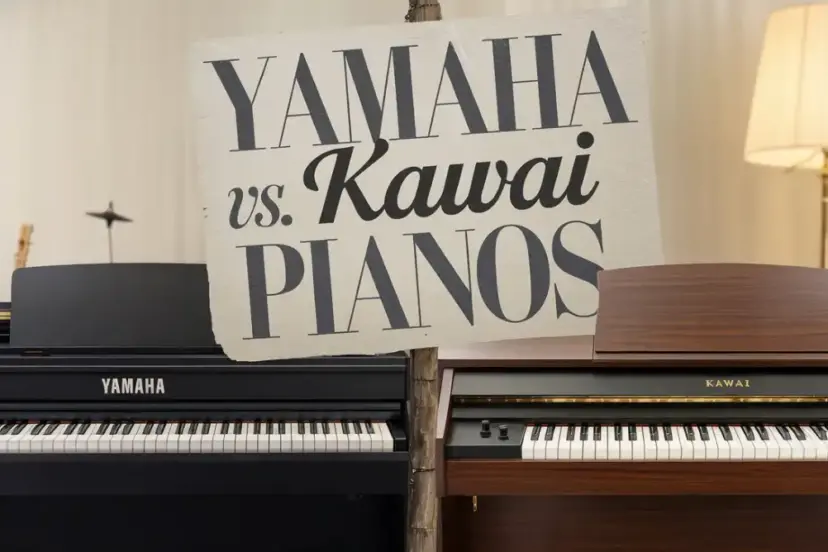
Yamaha and Kawai are two of the most respected names in the piano world.
Both companies manufacture acoustic grand and upright pianos. Both have decades of piano-building experience. And both offer digital instruments ranging from relatively affordable portable pianos to sophisticated home and hybrid models.
So which brand makes the better digital piano?
The short answer is:
Neither Yamaha nor Kawai is universally better.
Yamaha tends to offer an exceptionally broad product range, sophisticated digital technology and piano sounds derived from instruments such as the Yamaha CFX and, on selected premium models, the Bösendorfer Imperial.
Kawai has an especially strong piano-focused identity and is well known for keyboard actions and digital piano sounds derived from its Shigeru Kawai concert grands.
But those are broad tendencies—not rules.
The better question is:
Which Yamaha or Kawai digital piano is better for your playing style, skill level, budget and priorities?
In this 2026 comparison, we’ll look at:
- Keyboard action
- Piano sound
- Speakers
- Polyphony
- Portability
- Connectivity
- Apps and technology
- Beginner suitability
- Classical piano
- Advanced playing
- Value
- Representative Yamaha and Kawai models
By the end, you should have a much clearer idea which brand is right for you.
Disclosure: Some links on Pianos-Galore are affiliate links. If you purchase through these links, we may receive a small commission at no additional cost to you.
Yamaha vs Kawai: Quick Comparison
| Category | Yamaha | Kawai |
|---|---|---|
| Acoustic Piano Heritage | Excellent | Excellent |
| Portable Digital Pianos | Excellent | Excellent |
| Entry-Level Choice | Very Strong | Strong |
| Premium Digital Pianos | Excellent | Excellent |
| Keyboard Actions | Wide range, from compact to wooden-key premium actions | Strong piano-focused actions across ranges |
| Piano Sounds | Yamaha CFX; Bösendorfer on selected premium models | Shigeru Kawai SK-EX and other Kawai grands |
| Apps/Technology | Strong | Strong |
| Classical Practice | Excellent | Excellent |
| Portability | Strong P-Series choices | Strong ES-Series choices |
| Best Overall? | Depends on model/player | Depends on model/player |
The most important takeaway is that brand-level comparisons only go so far.
You should ultimately compare individual models at similar prices.
Yamaha and Kawai: Two Genuine Piano Manufacturers
One reason this comparison is more interesting than many digital-piano brand comparisons is that both Yamaha and Kawai build acoustic pianos.
That matters.
Yamaha
Yamaha was established in Japan in 1887 and has grown into one of the world’s largest musical-instrument manufacturers.
Its piano range includes:
- Acoustic uprights
- Acoustic grands
- Concert grands
- Portable digital pianos
- Console digital pianos
- Stage instruments
- Hybrid pianos
Important Yamaha digital families include:
P Series — portable digital pianos
Arius YDP Series — home console digital pianos
Clavinova CLP Series — premium home digital pianos
Clavinova CSP/CVP families — feature-rich home instruments
AvantGrand — hybrid digital/acoustic-action instruments
That enormous range is one of Yamaha’s biggest advantages.
Kawai
Kawai was founded in Japan in 1927.
Unlike Yamaha, whose business spans many different musical and non-musical categories, Kawai is especially closely associated with pianos.
Its digital-piano families include:
ES Series — portable digital pianos
KDP Series — home digital pianos
CN Series — midrange home digital pianos
CA Series — premium Concert Artist instruments
Novus — hybrid digital pianos
Kawai also manufactures acoustic uprights and grands, including its prestigious Shigeru Kawai instruments.
[Internal link: Kawai Pianos]
Yamaha vs Kawai Keyboard Action
For serious pianists, keyboard action may be the single most important part of this comparison.
And this is where overly broad statements such as “Kawai has better action” or “Yamaha actions are lighter” become misleading.
Both manufacturers use multiple actions at different price levels.
Yamaha Keyboard Actions
Yamaha’s actions vary considerably across its range.
For example, the portable Yamaha P-225 uses the company’s Graded Hammer Compact (GHC) keyboard.
Its purpose is partly contained in the name: Yamaha wanted to provide graded hammer response while keeping the instrument compact.
Move considerably higher to the Yamaha P-525, however, and you get a very different keyboard:
GrandTouch-S
with:
- Wooden white keys
- Synthetic ebony and ivory keytops
- Escapement
- Graded hammer response
So it’s inaccurate to talk about “the Yamaha action” as though every Yamaha digital piano feels the same.
They don’t.
Kawai Keyboard Actions
Kawai follows a similar progression.
The Kawai ES120 uses its Responsive Hammer Compact (RHC) action with:
- 88 keys
- Grade-weighted hammers
- Matte key surfaces
Move to the Kawai ES920, and you get Responsive Hammer III (RHIII) with:
- Grade-weighted hammers
- Triple-sensor key detection
- Let-off simulation
- Counterweights
- Ivory Touch white-key surfaces
Higher Kawai home digital pianos can use even more sophisticated wooden-key actions.
Again, there is no single “Kawai action.”
Which Brand Has Better Keyboard Action?
There is no universal winner.
At entry and midrange levels, some pianists prefer Kawai’s approach because its actions can feel particularly piano-focused.
Others prefer Yamaha’s response.
At premium levels, both companies offer sophisticated actions, including wooden-key designs.
For classical players especially, my advice is:
Try the actual models if possible.
Keyboard feel is too personal to determine solely from a specification table.
Keyboard Action Verdict:
Tie — but Kawai deserves particularly close consideration if action feel is your number-one priority.
Yamaha vs Kawai Piano Sound
This comparison is equally subjective.
Both companies have a major advantage over many electronics-only brands:
They have their own world-class acoustic grand pianos to draw from.
Yamaha Digital Piano Sound
Yamaha uses sounds derived from its acoustic grands.
The Yamaha P-225, for example, features the sound of Yamaha’s flagship CFX concert grand.
It also incorporates VRM Lite, a streamlined version of Yamaha’s Virtual Resonance Modeling technology.
Move to the premium P-525 and the sound system becomes considerably more sophisticated.
You get:
- Yamaha CFX
- Bösendorfer Imperial
- Virtual Resonance Modeling
- Grand Expression Modeling
- Binaural sampling for the CFX Grand voice
The Bösendorfer connection is especially interesting because Yamaha owns Bösendorfer, the historic Austrian piano manufacturer.
That gives higher-end Yamaha instruments access to two distinctly different grand-piano characters.
Kawai Digital Piano Sound
Kawai takes a similarly piano-focused approach.
The ES120 uses Harmonic Imaging technology with 88-key stereo sampling.
Its piano sounds are derived from:
- Shigeru Kawai SK-EX
- Kawai EX
- Kawai K-60
The more advanced ES920 moves to Harmonic Imaging XL (HI-XL) and includes SK-EX, SK-5, EX and K-60 recordings.
It also adds Kawai’s Acoustic Rendering resonance system.
Yamaha Sound vs Kawai Sound: Which Is Better?
This is where you’ll often encounter descriptions such as:
Yamaha = brighter and clearer
Kawai = warmer and mellower
There can be some truth to those impressions, but they shouldn’t be treated as fixed rules.
Different models, voices, speaker systems, headphones and user settings can change the character significantly.
More importantly, tone preference is personal.
One pianist may love the clarity of a Yamaha CFX-derived voice.
Another may prefer the character of Kawai’s SK-EX-derived sound.
Neither is objectively correct.
Sound Verdict:
Tie — choose according to your ears, not internet stereotypes.
Yamaha vs Kawai Polyphony
Polyphony is the maximum number of notes the instrument can reproduce simultaneously.
It matters because notes continue sounding when you use the sustain pedal, and layered sounds can consume multiple voices.
For example:
Yamaha P-225 — 192-note polyphony
Kawai ES120 — 192-note polyphony
At a higher level:
Yamaha P-525 — 256-note polyphony
Kawai ES920 — 256-note polyphony
So neither manufacturer has a meaningful universal advantage here.
And don’t choose a piano based on polyphony alone.
Keyboard action and sound are generally more important.
Polyphony Verdict:
Tie.
Yamaha vs Kawai for Beginners
This is one area where Yamaha’s enormous range can be an advantage.
Yamaha offers many instruments covering different entry points, including portable keyboards and digital pianos.
For serious piano learning, the Yamaha P-225 is one of our preferred all-round choices.
It gives beginners:
- 88 GHC weighted keys
- Yamaha CFX sound
- VRM Lite
- 192-note polyphony
- Compact dimensions
- USB audio/MIDI
- Optional three-pedal capability
But Kawai’s ES120 is an equally serious alternative.
It provides:
- 88 RHC grade-weighted keys
- SK-EX-derived piano sound
- 192-note polyphony
- Damper and string resonance
- Bluetooth MIDI/Audio
- Optional three-pedal capability
Which Would I Choose for a Beginner?
For the widest range of buyers:
Yamaha P-225 gets a slight edge for its excellent all-round balance.
For someone particularly focused on traditional piano feel and sound:
Kawai ES120 deserves very serious consideration.
Neither is a wrong choice.
Best Digital Pianos for Beginners in 2026: 7 Top Picks for Learning Piano
Yamaha P-225 vs Kawai ES120
This is one of the most useful real-world comparisons because these instruments target similar buyers.
| Feature | Yamaha P-225 | Kawai ES120 |
|---|---|---|
| Keys | 88 | 88 |
| Action | GHC | Responsive Hammer Compact |
| Main Piano | Yamaha CFX | Shigeru Kawai SK-EX-derived |
| Polyphony | 192 | 192 |
| Voices | 24 | 25 |
| Resonance | VRM Lite | Damper/String Resonance |
| Portable | Yes | Yes |
| Target Player | Beginner–Intermediate | Beginner–Intermediate |
The specifications demonstrate how closely matched they are.
The real decision comes down largely to:
keyboard feel + piano sound + features + personal preference.
Choose the Yamaha P-225 If:
- You prefer Yamaha’s CFX sound.
- Compactness is important.
- You want an excellent all-rounder.
- You already use Yamaha’s ecosystem.
Choose the Kawai ES120 If:
- You prefer Kawai’s action.
- You like the SK-EX-derived piano character.
- Piano-focused playing is your priority.
- Kawai’s Virtual Technician adjustments appeal to you.
[Check Yamaha P-225 Price on Amazon →]
[Check Kawai ES120 Price on Amazon →]
Yamaha P-525 vs Kawai ES920
This comparison moves us considerably higher.
Both are serious portable digital pianos, but they approach the premium experience differently.
Yamaha P-525
Highlights include:
- GrandTouch-S action
- Wooden white keys
- Synthetic ebony/ivory keytops
- Escapement
- Yamaha CFX
- Bösendorfer Imperial
- Full Virtual Resonance Modeling
- Grand Expression Modeling
- 256-note polyphony
- Extensive recording capabilities
Kawai ES920
Highlights include:
- Responsive Hammer III
- Triple sensors
- Let-off simulation
- Counterweights
- Ivory Touch key surfaces
- SK-EX, SK-5, EX and K-60 piano recordings
- HI-XL sound engine
- Acoustic Rendering
- 256-note polyphony
- Virtual Technician customization
These are both substantial instruments.
Choose the Yamaha P-525 If:
- Wooden white keys matter to you.
- You want both CFX and Bösendorfer grand sounds.
- You like Yamaha’s modeling technologies.
- Recording and broader functionality matter.
Choose the Kawai ES920 If:
- RHIII action appeals to you.
- You want triple sensors and counterweights.
- You prefer Kawai’s piano sound.
- Detailed piano customization matters.
- You want a somewhat lighter premium portable instrument.
[Check Yamaha P-525 Price on Amazon →]
[Check Kawai ES920 Price on Amazon →]
Yamaha vs Kawai for Classical Piano
Both brands are excellent choices for classical music.
That’s important because the old assumption that Kawai is automatically for classical music while Yamaha is better for pop is far too simplistic.
For classical practice, prioritize:
- 88 keys
- Graded hammer action
- Dynamic response
- Pedal capability
- Piano tone
- Resonance
- Sufficient polyphony
Both companies can provide all of these.
Beginner Classical Student
Consider:
Yamaha P-225
or
Kawai ES120
Intermediate/Advanced Pianist
Consider:
Yamaha P-525
or
Kawai ES920
Higher-end console and hybrid models from both companies take the comparison much further.
Classical Verdict:
Tie. Let touch and tone preference decide.
Yamaha vs Kawai for Jazz
Again, both are excellent.
Jazz pianists may particularly appreciate:
- Responsive actions
- Dynamic piano sounds
- Electric-piano voices
- Split/layer capabilities
- Strong amplification
- Connectivity
The decision is more likely to depend on the individual model than the manufacturer’s logo.
Yamaha vs Kawai for Pop and Contemporary Music
Yamaha’s broader ecosystem and feature sets can make it particularly attractive for musicians who move among different styles.
But don’t assume Kawai is limited to classical piano.
Models such as the ES920 include numerous non-piano sounds and useful performance features.
If you primarily want hundreds of sounds, rhythms and arranger functionality, however, you may want to investigate other Yamaha families rather than comparing only conventional digital pianos.
Yamaha vs Kawai Speakers
Speaker quality varies significantly by model.
You can’t meaningfully say:
“Yamaha speakers are better.”
or:
“Kawai speakers are better.”
You have to compare specific instruments.
For example, the ES920 uses a much more substantial amplification system than an entry-level portable digital piano.
Likewise, Yamaha’s premium instruments can offer far more sophisticated speaker arrangements than entry-level P-Series models.
When shopping, consider:
- Amplifier wattage
- Number of speakers
- Speaker size
- Placement
- Cabinet design
But ultimately:
listen to them.
Specifications don’t tell you everything about speaker quality.
Yamaha vs Kawai With Headphones
Both companies recognize that headphone practice is one of the biggest reasons people buy digital pianos.
Higher-end instruments may incorporate technologies designed to make headphone listening feel more spacious and natural.
This matters particularly if you:
- Live in an apartment
- Practice late at night
- Share your home
- Spend hours practicing with headphones
If headphones will be your primary listening method, bring your own headphones when testing pianos if possible.
Yamaha vs Kawai Connectivity
Modern digital pianos increasingly interact with:
- Smartphones
- Tablets
- Computers
- DAWs
- Learning apps
- Recording software
Depending on model, Yamaha instruments may offer:
- USB-MIDI
- USB audio
- Bluetooth-related functionality
- Smart Pianist integration
- Audio outputs
Kawai models may provide:
- USB-MIDI
- Bluetooth MIDI
- Bluetooth Audio
- PianoRemote
- Audio outputs
- Recording functions
Don’t assume every model includes every connection.
Always check the exact piano.
Yamaha Smart Pianist vs Kawai PianoRemote
Both companies offer apps that extend control beyond the physical piano.
Yamaha Smart Pianist
Depending on the compatible instrument, Smart Pianist can provide convenient access to:
- Voice selection
- Piano settings
- Songs
- Recording
- Various instrument controls
Kawai PianoRemote
Kawai’s PianoRemote ecosystem provides control of compatible digital-piano settings from a mobile device.
Kawai’s Virtual Technician functions can also allow detailed adjustment of piano characteristics on compatible instruments.
These can include parameters relating to:
- Touch
- Voicing
- Resonance
- Damper behavior
- Key-off characteristics
For technically inclined pianists who enjoy fine-tuning their instrument, this can be particularly appealing.
Yamaha vs Kawai for Small Spaces
Both companies make excellent portable instruments.
The Yamaha P Series is particularly strong if compactness is a priority.
The P-225, for example, manages to combine 88 weighted keys with a relatively compact body.
Kawai’s ES120 is also portable and easy to integrate into smaller living spaces.
If you’re living in an apartment, condominium or bedroom, either can work well.
Best Compact Digital Pianos for Small Spaces
Yamaha vs Kawai for Advanced Pianists
As playing ability increases, the comparison changes.
Beginners often focus on:
- Price
- Number of sounds
- Bluetooth
- Included accessories
Advanced pianists increasingly notice:
- Key pivot behavior
- Repetition
- Escapement/let-off simulation
- Key weighting
- Sensors
- Pedal response
- Resonance
- Dynamic tonal changes
This is why comparing premium models purely on specifications becomes increasingly unreliable.
At this level:
play them yourself.
The better instrument is the one that responds better to your hands and ears.
Yamaha vs Kawai for Home Use
For a home piano that won’t regularly be moved, don’t limit yourself to portable instruments.
Yamaha offers home-oriented families such as:
- Arius
- Clavinova
- AvantGrand
Kawai offers:
- KDP
- CN
- CA
- Novus
A console instrument can provide:
- Permanent stand
- Integrated pedals
- Larger speaker systems
- More traditional appearance
- More stable playing position
If portability isn’t important, these deserve consideration.
Yamaha vs Kawai Hybrid Pianos
At the top end of digital-piano technology, both manufacturers offer hybrid instruments.
These attempt to combine characteristics of genuine acoustic-piano mechanisms with the advantages of digital sound.
Yamaha’s AvantGrand family and Kawai’s Novus instruments are examples.
These are aimed at pianists who want:
- Highly sophisticated action
- Headphone capability
- Digital convenience
- No traditional tuning requirement
- A playing experience much closer to acoustic piano
Related articles:
Best Yamaha Digital Pianos in 2026: 5 Top Picks for Every Player Top 4 Kawai Pianos: Best Picks for Beginners and Professionals Best 88-Key Digital Pianos in 2026: 7 Top Picks for Every Pianist Best Piano Brands in 2026: 10 Top Names Compared
Want to perfect your piano skills? SIMPLY PIANO offers a personalized experience to suit your level, whether you’re new to piano or already skilled.