Best Compact Digital Pianos for Small Spaces in 2026: 6 Top Picks
You don’t need a large music room to own a good piano.
Today’s compact digital pianos can provide 88 keys, weighted or hammer-style actions, convincing piano sounds, headphone practice and modern connectivity while occupying surprisingly little space.
That makes them particularly attractive for:
- Apartments
- Condominiums
- Bedrooms
- Dorm rooms
- Small houses
- Home offices
- Studios
- Multipurpose living spaces
But “small piano” can mean different things to different people.
Some buyers want the smallest possible 88-key digital piano. Others are willing to sacrifice the full 88-key range for an ultra-compact 61-key keyboard. Still others want a furniture-style piano that looks permanent and attractive without occupying the space of a traditional acoustic upright.
We’ve selected six different instruments to cover those needs.
Quick Comparison: Best Small Pianos in 2026
| Model | Keys | Best For |
|---|---|---|
| Casio PX-S1100 | 88 weighted | Best Overall for Small Spaces |
| Yamaha P-225 | 88 weighted | Best Balance of Compact Size & Piano Experience |
| Roland FP-10 | 88 weighted | Best Budget Compact 88-Key Piano |
| Kawai ES120 | 88 weighted | Best for Serious Piano Practice in a Small Space |
| Casio CT-S300 | 61 touch-sensitive | Best Ultra-Compact Budget Keyboard |
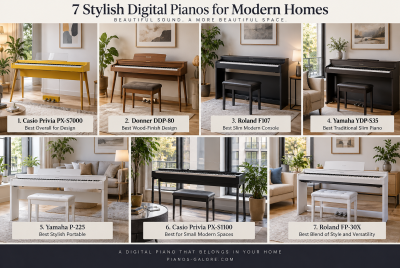
| Donner DDP-80 | 88 weighted | Best Compact Furniture-Style Piano |
Our Quick Recommendation
For most buyers who want a genuine piano-oriented instrument without giving up too much living space, the Casio PX-S1100 is our top choice.
If piano feel and long-term practice are more important than minimizing every inch of space, look closely at the Yamaha P-225 and Kawai ES120.
If space is extremely limited and 88 weighted keys aren’t essential, the Casio CT-S300 is considerably smaller.
And if you want something that looks more like permanent furniture than a portable keyboard on a stand, the Donner DDP-80 deserves consideration.
Affiliate Disclosure
Some links on Pianos-Galore are affiliate links. If you purchase through these links, we may receive a small commission at no additional cost to you.
What Makes a Good Piano for a Small Space?
A small piano isn’t simply a lightweight piano.
That’s an important distinction.
If you frequently transport your instrument to lessons, rehearsals or performances, weight is extremely important.
But if the piano will remain in your apartment or bedroom, its footprint may matter much more.
Consider these factors.
Width
An 88-key piano will inevitably be fairly wide because the keys themselves require physical space.
If width is your biggest constraint, a 61-key keyboard may be necessary.
Depth
This is where modern digital pianos can save a surprising amount of space.
A slim 88-key slab piano can sit relatively close to a wall and occupy far less floor area than a traditional upright acoustic piano.
Stand
Don’t evaluate the piano alone.
Think about the stand that will support it.
A portable piano on a folding X-stand may be easy to move but can occupy more usable floor area than expected.
A manufacturer’s dedicated stand may create a cleaner, more permanent setup.
Bench Space
Remember that the player also needs room.
Measure enough space for:
- The piano
- Stand
- Pedals
- Bench
- Your legs
- Comfortable movement
Headphones
In a small apartment, noise may be as important as physical dimensions.
A headphone output can allow you to practice without disturbing family members, roommates or neighbors.
1. Casio PX-S1100 — Best Overall Small Digital Piano
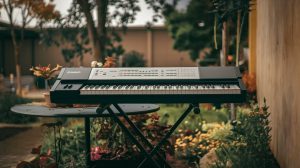
Best for: Apartment and condo owners who want 88 weighted keys in an unusually slim design
The Casio PX-S1100 is one of the first models we would consider when floor space is genuinely limited but you don’t want to compromise by dropping to 61 keys.
Casio’s Privia PX-S series emphasizes slim design, making the PX-S1100 particularly well suited to modern apartments and multipurpose rooms.
You still get a full 88-key weighted keyboard, so you’re not giving up the standard piano range merely to save space.
That’s important for beginners who expect to continue studying piano.
A very small 61-key keyboard may seem adequate during the first few months, but more advanced music can eventually require a wider range. Starting with 88 keys avoids that limitation.
Why We Like It for Small Spaces
The PX-S1100 offers a particularly attractive combination of:
- 88 weighted keys
- Slim cabinet
- Clean contemporary appearance
- Built-in speakers
- Headphone practice
- Portable slab-style construction
It can work particularly well in a bedroom, apartment living room or home office where the piano must coexist with other furniture.
Add a dedicated stand and it can look like a compact home piano.
Use a portable stand and it can be moved or stored when necessary.
Possible Drawback
Its emphasis on compactness means buyers who prioritize the most substantial possible keyboard action may prefer to compare it with models from Roland or Kawai.
But if space efficiency is your first priority without abandoning 88 weighted keys, the PX-S1100 is extremely compelling.
Verdict: Our best overall choice for buyers who want a real 88-key piano experience in a small footprint.
[Check Casio PX-S1100 Price on Amazon →]
2. Yamaha P-225 — Best Balance of Compact Size and Piano Experience
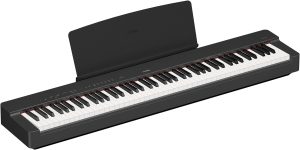
Best for: Beginners and intermediate players who want a compact Yamaha for long-term home practice
The Yamaha P-225 is an excellent example of how compact modern digital pianos have become.
Despite providing a full 88-key piano-oriented keyboard, its cabinet is only about 10.7 inches deep without the music rest.
That can make a meaningful difference in a small room.
The P-225 uses Yamaha’s Graded Hammer Compact (GHC) keyboard and features a Yamaha CFX-based piano sound.
It also offers 192-note polyphony, giving it plenty of capacity for normal piano playing, including sustained passages.
Why It Works in Small Rooms
The P-225 doesn’t look bulky.
Its slab-style cabinet can work:
- Against a bedroom wall
- In an apartment living area
- In a home office
- On a dedicated furniture stand
- On a portable stand when flexibility is important
This makes it a good choice for someone who doesn’t merely want a “small keyboard.”
You want a proper piano-oriented instrument that happens to be compact.
That’s a very different buying objective.
Who Should Choose It?
I’d particularly recommend the P-225 to a beginner who expects to progress.
Instead of buying a tiny inexpensive keyboard now and replacing it shortly afterward, the P-225 gives you an instrument with enough capability to remain useful as your technique develops.
Possible Drawback
At approximately 52 inches wide, it’s still an 88-key instrument.
No manufacturer can eliminate the physical width required by a full-size 88-key keyboard.
So if your available wall space is extremely narrow, a 61-key instrument may still be the practical answer.
Verdict: One of the best choices if you want to minimize depth without sacrificing a serious 88-key piano experience.
[Check Yamaha P-225 Price on Amazon →]
3. Roland FP-10 — Best Budget Compact 88-Key Piano
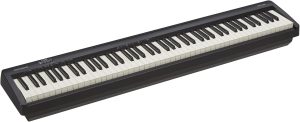
Best for: Budget-conscious beginners who care about piano feel
The Roland FP-10 has long been attractive to beginners because it concentrates on the fundamentals.
Rather than trying to impress buyers primarily with hundreds of sounds and entertainment features, the FP-10 provides a full 88-key keyboard and a piano-oriented playing experience in a relatively compact package.
Its PHA-4 Standard keyboard is one of its most important selling points.
For beginners who intend to develop traditional piano technique, keyboard action deserves considerable attention.
You can add extra sounds and software later.
Developing your technique on an appropriate keyboard from the beginning can be more valuable.
Why It Makes Sense for Small Homes
The FP-10 works particularly well when:
- You need 88 keys.
- Your budget is limited.
- You don’t have room for a console piano.
- You want headphone practice.
- Piano feel matters more than furniture styling.
Put it on a compact stand and you have a practical home-practice instrument without dedicating a large part of the room to a piano.
A Good First Serious Piano
There’s an important distinction between a first keyboard and a first piano.
A small 61-key keyboard can be excellent for casual music making.
But if your intention is traditional piano lessons, the FP-10 represents a more piano-focused starting point.
Possible Drawback
The FP-10 is deliberately straightforward.
Players who want more elaborate onboard features, stronger amplification or more sophisticated connectivity may eventually prefer a higher-level instrument.
But simplicity can also be an advantage when you’re just learning.
Verdict: A strong choice for beginners who need to control both their budget and their use of space without abandoning 88 weighted keys.
[Check Roland FP-10 Price on Amazon →]
4. Kawai ES120 — Best Small Piano for Serious Practice
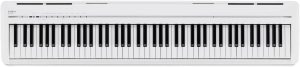
Best for: Players who prioritize piano practice and keyboard feel while still needing a relatively compact instrument
Kawai has a long association with acoustic pianos, and the ES120 is designed as a portable digital piano rather than a feature-heavy entertainment keyboard.
That makes it particularly interesting for people who say:
“My room is small, but I still want to take piano seriously.”
The ES120 measures approximately 51.3 inches wide and 11 inches deep without its music rest.
For an 88-key digital piano, that’s a very manageable depth.
It weighs about 26.5 pounds without the music rest, so although our focus here is space rather than portability, it remains far easier to reposition than an acoustic upright.
Piano-Focused Design
The ES120 uses Kawai’s Responsive Hammer Compact keyboard action and offers 88 weighted keys.
Its emphasis is clearly on giving home players a satisfying piano-oriented experience without requiring a large cabinet.
That’s useful for:
- Serious beginners
- Piano students
- Adults returning to piano
- Classical practice
- Small teaching spaces
Why Choose It Over a Smaller Keyboard?
If you’re studying piano seriously, saving another few inches by dropping to a 61-key unweighted keyboard may be the wrong compromise.
The ES120 illustrates an important principle:
A small room doesn’t necessarily require a small keyboard.
Modern 88-key slab digital pianos can give you the full keyboard range while keeping the instrument relatively shallow.
Possible Drawback
It’s not the least expensive option in this list.
If you’re simply experimenting with music and aren’t yet sure whether you’ll continue, a lower-cost model may make more sense.
But if you already know that piano is a serious interest, spending more for an instrument designed around piano practice can be worthwhile.
Verdict: Our preferred option for the small-space buyer who places piano practice above maximum portability or entertainment features.
[Check Kawai ES120 Price on Amazon →]
5. Casio CT-S300 — Best Ultra-Compact Budget Keyboard
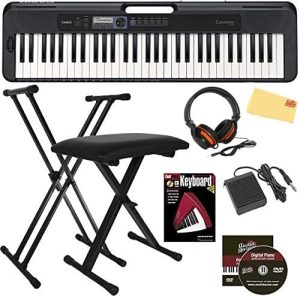
Best for: Extremely limited spaces, casual beginners, children and buyers who don’t require 88 weighted keys
Sometimes an 88-key piano simply won’t fit.
That’s where the Casio CT-S300 makes sense.
It has 61 touch-sensitive keys and measures approximately 36.6 inches wide, 10.1 inches deep and less than 3 inches high without its music stand.
It weighs only about 7.3 pounds.
That’s dramatically smaller than a full 88-key digital piano.
It can potentially be:
- Placed on a small desk
- Used in a bedroom
- Stored after practice
- Carried between rooms
- Taken to lessons
- Used where a permanent piano setup isn’t possible
It can also operate on batteries, which adds flexibility.
The Important Compromise
The CT-S300 is not an 88-key weighted digital piano.
Its keys are touch-sensitive, but that should not be confused with weighted hammer action.
This distinction matters.
If your goal is serious traditional piano study, we’d normally recommend an 88-key weighted instrument if space and budget permit.
But there are situations where practicality wins.
A 61-key keyboard that fits into your life and gets played regularly is more useful than an 88-key piano you have nowhere to put.
Who Is It Best For?
Consider the CT-S300 if:
- Your room is exceptionally small.
- You’re a complete beginner testing your interest.
- You’re buying for a child.
- Portability matters.
- Your budget is limited.
- You want lots of keyboard functionality rather than only piano practice.
Verdict: The best option in our list when physical size is the overriding consideration.
[Check Casio CT-S300 Price on Amazon →]
6. Donner DDP-80 — Best Compact Furniture-Style Piano
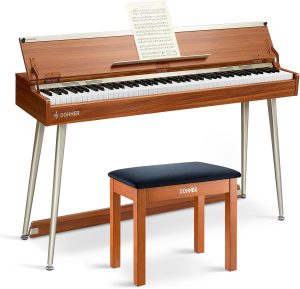
Best for: Small homes where appearance matters and the piano will remain permanently set up
Not everyone shopping for a small piano wants something that looks portable.
Maybe you don’t intend to move it at all.
You simply want a piano that:
- Fits into a relatively small living area
- Looks attractive
- Has 88 weighted keys
- Doesn’t dominate the room
That’s why the Donner DDP-80 earns a place here.
Its distinctive minimalist furniture design makes it different from the slab-style Casio, Yamaha, Roland and Kawai instruments above.
Instead of looking like a keyboard placed on a stand, the DDP-80 is designed to become part of the room.
Why This Matters
A piano is also a piece of furniture.
In a small apartment or condominium, every large object contributes to the appearance of the room.
Some people don’t want:
- Black X-stands
- Exposed cables
- Portable-looking keyboards
They want an instrument that can remain permanently set up and still complement their interior.
That’s where the DDP-80 is particularly appealing.
88 Keys Without the Traditional Upright Look
The DDP-80 gives you the full keyboard range while avoiding the bulky visual appearance of many traditional console digital pianos.
That makes it an interesting alternative for:
- Modern apartments
- Minimalist interiors
- Living rooms
- Bedrooms
- Small music corners
Possible Drawback
Unlike a slab-style digital piano, a furniture-oriented instrument isn’t the best choice if you expect to pack it away frequently.
If portability is important, choose one of the slab models instead.
Verdict: A particularly attractive choice for small-space buyers who want their digital piano to look like intentional furniture rather than portable equipment.
[Check Donner DDP-80 Price on Amazon →]
Small Piano vs. Portable Piano: What’s the Difference?
These terms overlap, but they’re not identical.
A portable piano emphasizes:
- Lower weight
- Easy transport
- Rehearsals
- Lessons
- Gigs
- Temporary setups
A small or compact piano emphasizes:
- Minimal floor space
- Shallow depth
- Apartment suitability
- Small-room placement
- Efficient furniture design
A piano can be both.
The Casio PX-S1100 is a good example.
But a furniture-style model such as the Donner DDP-80 may qualify as a good small-space piano even though portability isn’t its primary purpose.
This distinction is important when deciding what you actually need.
Best Portable Digital Pianos for Beginners in 2026: 5 Lightweight Picks
61 Keys vs. 88 Keys for Small Spaces
If you’re short on space, this is one of the most important decisions.
Choose 61 Keys If:
- Space is extremely limited.
- You need maximum portability.
- You’re learning casually.
- You’re primarily interested in chords or popular music.
- You need to store the keyboard after use.
- You’re not yet committed to long-term piano study.
Choose 88 Keys If:
- You’re taking traditional piano lessons.
- You want to play classical repertoire.
- You expect to progress beyond beginner level.
- You want the standard piano range.
- You don’t want to upgrade simply because you run out of keys.
If an 88-key instrument fits, we’d generally prefer it for serious piano study.
88 Weighted Keys: Do You Really Need Them on a Digital Piano?
Slab Piano or Furniture-Style Piano?
This decision is especially important in small rooms.
Slab-Style Piano
Examples include:
- Casio PX-S1100
- Yamaha P-225
- Roland FP-10
- Kawai ES120
Advantages:
- Flexible placement
- Easier to move
- Can use different stands
- Can sometimes be stored
- Generally lighter
Furniture-Style Piano
The Donner DDP-80 represents this approach in our list.
Advantages:
- More finished appearance
- Permanent setup
- Can blend better with home décor
- Doesn’t look like stage equipment
Your available space isn’t the only consideration.
Think about how you want the room to look.
If you want a compact piano that not only saves space but also complements your décor, see our guide to the best stylish digital pianos for modern homes.
Should You Buy a Small Acoustic Piano Instead?
Digital pianos aren’t your only option.
Compact acoustic uprights exist, and for some buyers they can be an excellent choice.
An acoustic upright provides:
- Real strings
- Mechanical action
- Natural acoustic resonance
- Traditional piano experience
But even a relatively small acoustic upright is generally much heavier and deeper than a slim digital piano.
It also requires periodic tuning and greater attention to environmental conditions.
If you specifically want an acoustic instrument, don’t dismiss a compact upright.
But if you’re choosing primarily because of limited living space, a digital piano is often much easier to accommodate.
Don’t Forget About Noise
A small apartment creates another problem:
Your neighbors may hear you.
This is an important reason digital pianos are so practical for compact living.
Headphones allow you to practice:
- Early in the morning
- Late at night
- While someone else is working
- While children are sleeping
- Without disturbing neighbors as much
Remember, however, that weighted keys themselves still make some mechanical noise.
Headphones eliminate the amplified piano sound, not every physical sound produced by the keyboard action.
How to Measure Your Space Before Buying
Don’t rely on product photographs.
Use a tape measure.
Step 1: Measure the Wall
Check the available width.
Remember that 88-key pianos are naturally wide.
Step 2: Measure Depth
Include:
- Piano
- Stand
- Music rest
- Pedals
- Bench
- Player
Step 3: Check Nearby Doors
Make sure the piano doesn’t interfere with doors, cabinets or walkways.
Step 4: Locate Electrical Outlets
Avoid creating a setup that requires awkward extension cords across walking areas.
Step 5: Mark the Floor
One useful trick is to mark the proposed footprint with painter’s tape.
You’ll immediately get a better sense of how much room the piano will actually occupy.
Which Small Piano Should You Buy?
Here’s the simplest way to decide.
Choose the Casio PX-S1100 if:
You want the best overall combination of 88 weighted keys and space-saving design.
Choose the Yamaha P-225 if:
You want a compact piano with strong long-term potential for learning and home practice.
Choose the Roland FP-10 if:
You’re on a tighter budget but still want 88 weighted keys and a piano-focused action.
Choose the Kawai ES120 if:
Piano practice and keyboard feel are your priorities, but you don’t have room for a large console instrument.
Choose the Casio CT-S300 if:
Your space is extremely limited and you’re willing to accept 61 non-weighted keys.
Choose the Donner DDP-80 if:
You want an 88-key piano that stays permanently set up and looks attractive in a small modern living space.
Frequently Asked Questions
What is the best small piano for an apartment?
For many apartment buyers, the Casio PX-S1100 is particularly attractive because it combines 88 weighted keys with a slim design. The Yamaha P-225 and Kawai ES120 are also excellent alternatives.
Can an 88-key piano fit in a small bedroom?
Often, yes. Modern slab digital pianos can be surprisingly shallow. Measure the available width and remember to include room for the stand, pedals, bench and player.
Is a 61-key keyboard enough for a beginner?
It can be. You can learn notes, chords, rhythm and many beginner songs on 61 keys. For serious traditional piano study, however, an 88-key weighted instrument provides more room to progress.
Do small digital pianos have weighted keys?
Many do. The Casio PX-S1100, Yamaha P-225, Roland FP-10, Kawai ES120 and Donner DDP-80 in this guide all provide 88-key piano-oriented weighted actions. The Casio CT-S300 is different: it has 61 touch-sensitive keys rather than weighted piano keys.
Is a digital piano better than an acoustic piano for an apartment?
Often, yes, because digital pianos can be smaller, lighter, require no acoustic tuning and support headphones. But buyers who strongly prefer the traditional acoustic experience may still prefer a compact upright piano.
What should I measure before buying a digital piano?
Measure the instrument’s width and depth, then account for the stand, bench, pedals, music rest and enough space for the player to sit comfortably.
Should I buy a portable piano if I live in a small apartment?
Not necessarily. Portability and compactness are related but different. If the piano will remain in one location, footprint and design may matter more than weight.
Final Thoughts
Limited space no longer means you have to give up the idea of owning a proper piano.
Modern digital pianos make it possible to have 88 weighted keys and a serious piano-playing experience without dedicating an entire room to the instrument.
For most small-space buyers, our first choice is the Casio PX-S1100 because its slim design directly addresses the problem this guide is trying to solve.
But there is no single best choice for everyone.
The Yamaha P-225 offers an excellent balance of compactness and long-term piano capability.
The Roland FP-10 is a strong budget choice.
The Kawai ES120 is particularly appealing for serious piano practice.
The Casio CT-S300 makes sense when every inch matters.
And the Donner DDP-80 gives small-home buyers something different: a compact 88-key digital piano designed to look like part of the room.
Before buying, measure your space carefully and decide which compromise matters least:
Width, weight, keyboard range, action, portability or furniture styling.
Once you know that, choosing the right small piano becomes much easier.
Our detailed review explains why the P-225 works so well in smaller spaces while still providing a full 88-key weighted keyboard.
If your concern is transporting the instrument rather than simply fitting it into a small room, see our recommendations for lightweight keyboards for rehearsals and gigs.
Related Articles
- Digital Pianos in 2026: The Complete Guide Before You Buy
- Best Portable Digital Pianos for Beginners in 2026: 5 Lightweight Picks
- 88 Weighted Keys: Do You Really Need Them on a Digital Piano?
- Best Digital Pianos for Beginners in 2026: 7 Top Picks for Learning Piano
- Best Digital Pianos for Every Budget in 2026: Beginner to Pro
Searching for a piano learning app? Check out SIMPLY PIANO, the #1 in the market…

- Begin with beginner-friendly tutorials and advanced players can take higher-level courses.
- Learn at your own pace with lessons suited to your skill level and get instant feedback.
- Play a wide range of music from classical to pop and Disney songs. Enhance your skills with warm-ups, personalized exercises, and sheet music.
Try out SIMPLY PIANO Now…
You don’t need a large music room to own a good piano.
Today’s compact digital pianos can provide 88 keys, weighted or hammer-style actions, convincing piano sounds, headphone practice and modern connectivity while occupying surprisingly little space.
That makes them particularly attractive for:
- Apartments
- Condominiums
- Bedrooms
- Dorm rooms
- Small houses
- Home offices
- Studios
- Multipurpose living spaces
But “small piano” can mean different things to different people.
Some buyers want the smallest possible 88-key digital piano. Others are willing to sacrifice the full 88-key range for an ultra-compact 61-key keyboard. Still others want a furniture-style piano that looks permanent and attractive without occupying the space of a traditional acoustic upright.
We’ve selected six different instruments to cover those needs.
Quick Comparison: Best Small Pianos in 2026
| Model | Keys | Best For |
|---|---|---|
| Casio PX-S1100 | 88 weighted | Best Overall for Small Spaces |
| Yamaha P-225 | 88 weighted | Best Balance of Compact Size & Piano Experience |
| Roland FP-10 | 88 weighted | Best Budget Compact 88-Key Piano |
| Kawai ES120 | 88 weighted | Best for Serious Piano Practice in a Small Space |
| Casio CT-S300 | 61 touch-sensitive | Best Ultra-Compact Budget Keyboard |
| Donner DDP-80 | 88 weighted | Best Compact Furniture-Style Piano |
Our Quick Recommendation
For most buyers who want a genuine piano-oriented instrument without giving up too much living space, the Casio PX-S1100 is our top choice.
If piano feel and long-term practice are more important than minimizing every inch of space, look closely at the Yamaha P-225 and Kawai ES120.
If space is extremely limited and 88 weighted keys aren’t essential, the Casio CT-S300 is considerably smaller.
And if you want something that looks more like permanent furniture than a portable keyboard on a stand, the Donner DDP-80 deserves consideration.
Affiliate Disclosure
Some links on Pianos-Galore are affiliate links. If you purchase through these links, we may receive a small commission at no additional cost to you.
What Makes a Good Piano for a Small Space?
A small piano isn’t simply a lightweight piano.
That’s an important distinction.
If you frequently transport your instrument to lessons, rehearsals or performances, weight is extremely important.
But if the piano will remain in your apartment or bedroom, its footprint may matter much more.
Consider these factors.
Width
An 88-key piano will inevitably be fairly wide because the keys themselves require physical space.
If width is your biggest constraint, a 61-key keyboard may be necessary.
Depth
This is where modern digital pianos can save a surprising amount of space.
A slim 88-key slab piano can sit relatively close to a wall and occupy far less floor area than a traditional upright acoustic piano.
Stand
Don’t evaluate the piano alone.
Think about the stand that will support it.
A portable piano on a folding X-stand may be easy to move but can occupy more usable floor area than expected.
A manufacturer’s dedicated stand may create a cleaner, more permanent setup.
Bench Space
Remember that the player also needs room.
Measure enough space for:
- The piano
- Stand
- Pedals
- Bench
- Your legs
- Comfortable movement
Headphones
In a small apartment, noise may be as important as physical dimensions.
A headphone output can allow you to practice without disturbing family members, roommates or neighbors.
1. Casio PX-S1100 — Best Overall Small Digital Piano
Best for: Apartment and condo owners who want 88 weighted keys in an unusually slim design
The Casio PX-S1100 is one of the first models we would consider when floor space is genuinely limited but you don’t want to compromise by dropping to 61 keys.
Casio’s Privia PX-S series emphasizes slim design, making the PX-S1100 particularly well suited to modern apartments and multipurpose rooms.
You still get a full 88-key weighted keyboard, so you’re not giving up the standard piano range merely to save space.
That’s important for beginners who expect to continue studying piano.
A very small 61-key keyboard may seem adequate during the first few months, but more advanced music can eventually require a wider range. Starting with 88 keys avoids that limitation.
Why We Like It for Small Spaces
The PX-S1100 offers a particularly attractive combination of:
- 88 weighted keys
- Slim cabinet
- Clean contemporary appearance
- Built-in speakers
- Headphone practice
- Portable slab-style construction
It can work particularly well in a bedroom, apartment living room or home office where the piano must coexist with other furniture.
Add a dedicated stand and it can look like a compact home piano.
Use a portable stand and it can be moved or stored when necessary.
Possible Drawback
Its emphasis on compactness means buyers who prioritize the most substantial possible keyboard action may prefer to compare it with models from Roland or Kawai.
But if space efficiency is your first priority without abandoning 88 weighted keys, the PX-S1100 is extremely compelling.
Verdict: Our best overall choice for buyers who want a real 88-key piano experience in a small footprint.
[Check Casio PX-S1100 Price on Amazon →]
2. Yamaha P-225 — Best Balance of Compact Size and Piano Experience
Best for: Beginners and intermediate players who want a compact Yamaha for long-term home practice
The Yamaha P-225 is an excellent example of how compact modern digital pianos have become.
Despite providing a full 88-key piano-oriented keyboard, its cabinet is only about 10.7 inches deep without the music rest.
That can make a meaningful difference in a small room.
The P-225 uses Yamaha’s Graded Hammer Compact (GHC) keyboard and features a Yamaha CFX-based piano sound.
It also offers 192-note polyphony, giving it plenty of capacity for normal piano playing, including sustained passages.
Why It Works in Small Rooms
The P-225 doesn’t look bulky.
Its slab-style cabinet can work:
- Against a bedroom wall
- In an apartment living area
- In a home office
- On a dedicated furniture stand
- On a portable stand when flexibility is important
This makes it a good choice for someone who doesn’t merely want a “small keyboard.”
You want a proper piano-oriented instrument that happens to be compact.
That’s a very different buying objective.
Who Should Choose It?
I’d particularly recommend the P-225 to a beginner who expects to progress.
Instead of buying a tiny inexpensive keyboard now and replacing it shortly afterward, the P-225 gives you an instrument with enough capability to remain useful as your technique develops.
Possible Drawback
At approximately 52 inches wide, it’s still an 88-key instrument.
No manufacturer can eliminate the physical width required by a full-size 88-key keyboard.
So if your available wall space is extremely narrow, a 61-key instrument may still be the practical answer.
Verdict: One of the best choices if you want to minimize depth without sacrificing a serious 88-key piano experience.
[Check Yamaha P-225 Price on Amazon →]
3. Roland FP-10 — Best Budget Compact 88-Key Piano
Best for: Budget-conscious beginners who care about piano feel
The Roland FP-10 has long been attractive to beginners because it concentrates on the fundamentals.
Rather than trying to impress buyers primarily with hundreds of sounds and entertainment features, the FP-10 provides a full 88-key keyboard and a piano-oriented playing experience in a relatively compact package.
Its PHA-4 Standard keyboard is one of its most important selling points.
For beginners who intend to develop traditional piano technique, keyboard action deserves considerable attention.
You can add extra sounds and software later.
Developing your technique on an appropriate keyboard from the beginning can be more valuable.
Why It Makes Sense for Small Homes
The FP-10 works particularly well when:
- You need 88 keys.
- Your budget is limited.
- You don’t have room for a console piano.
- You want headphone practice.
- Piano feel matters more than furniture styling.
Put it on a compact stand and you have a practical home-practice instrument without dedicating a large part of the room to a piano.
A Good First Serious Piano
There’s an important distinction between a first keyboard and a first piano.
A small 61-key keyboard can be excellent for casual music making.
But if your intention is traditional piano lessons, the FP-10 represents a more piano-focused starting point.
Possible Drawback
The FP-10 is deliberately straightforward.
Players who want more elaborate onboard features, stronger amplification or more sophisticated connectivity may eventually prefer a higher-level instrument.
But simplicity can also be an advantage when you’re just learning.
Verdict: A strong choice for beginners who need to control both their budget and their use of space without abandoning 88 weighted keys.
[Check Roland FP-10 Price on Amazon →]
4. Kawai ES120 — Best Small Piano for Serious Practice
Best for: Players who prioritize piano practice and keyboard feel while still needing a relatively compact instrument
Kawai has a long association with acoustic pianos, and the ES120 is designed as a portable digital piano rather than a feature-heavy entertainment keyboard.
That makes it particularly interesting for people who say:
“My room is small, but I still want to take piano seriously.”
The ES120 measures approximately 51.3 inches wide and 11 inches deep without its music rest.
For an 88-key digital piano, that’s a very manageable depth.
It weighs about 26.5 pounds without the music rest, so although our focus here is space rather than portability, it remains far easier to reposition than an acoustic upright.
Piano-Focused Design
The ES120 uses Kawai’s Responsive Hammer Compact keyboard action and offers 88 weighted keys.
Its emphasis is clearly on giving home players a satisfying piano-oriented experience without requiring a large cabinet.
That’s useful for:
- Serious beginners
- Piano students
- Adults returning to piano
- Classical practice
- Small teaching spaces
Why Choose It Over a Smaller Keyboard?
If you’re studying piano seriously, saving another few inches by dropping to a 61-key unweighted keyboard may be the wrong compromise.
The ES120 illustrates an important principle:
A small room doesn’t necessarily require a small keyboard.
Modern 88-key slab digital pianos can give you the full keyboard range while keeping the instrument relatively shallow.
Possible Drawback
It’s not the least expensive option in this list.
If you’re simply experimenting with music and aren’t yet sure whether you’ll continue, a lower-cost model may make more sense.
But if you already know that piano is a serious interest, spending more for an instrument designed around piano practice can be worthwhile.
Verdict: Our preferred option for the small-space buyer who places piano practice above maximum portability or entertainment features.
[Check Kawai ES120 Price on Amazon →]
5. Casio CT-S300 — Best Ultra-Compact Budget Keyboard
Best for: Extremely limited spaces, casual beginners, children and buyers who don’t require 88 weighted keys
Sometimes an 88-key piano simply won’t fit.
That’s where the Casio CT-S300 makes sense.
It has 61 touch-sensitive keys and measures approximately 36.6 inches wide, 10.1 inches deep and less than 3 inches high without its music stand.
It weighs only about 7.3 pounds.
That’s dramatically smaller than a full 88-key digital piano.
It can potentially be:
- Placed on a small desk
- Used in a bedroom
- Stored after practice
- Carried between rooms
- Taken to lessons
- Used where a permanent piano setup isn’t possible
It can also operate on batteries, which adds flexibility.
The Important Compromise
The CT-S300 is not an 88-key weighted digital piano.
Its keys are touch-sensitive, but that should not be confused with weighted hammer action.
This distinction matters.
If your goal is serious traditional piano study, we’d normally recommend an 88-key weighted instrument if space and budget permit.
But there are situations where practicality wins.
A 61-key keyboard that fits into your life and gets played regularly is more useful than an 88-key piano you have nowhere to put.
Who Is It Best For?
Consider the CT-S300 if:
- Your room is exceptionally small.
- You’re a complete beginner testing your interest.
- You’re buying for a child.
- Portability matters.
- Your budget is limited.
- You want lots of keyboard functionality rather than only piano practice.
Verdict: The best option in our list when physical size is the overriding consideration.
[Check Casio CT-S300 Price on Amazon →]
6. Donner DDP-80 — Best Compact Furniture-Style Piano
Best for: Small homes where appearance matters and the piano will remain permanently set up
Not everyone shopping for a small piano wants something that looks portable.
Maybe you don’t intend to move it at all.
You simply want a piano that:
- Fits into a relatively small living area
- Looks attractive
- Has 88 weighted keys
- Doesn’t dominate the room
That’s why the Donner DDP-80 earns a place here.
Its distinctive minimalist furniture design makes it different from the slab-style Casio, Yamaha, Roland and Kawai instruments above.
Instead of looking like a keyboard placed on a stand, the DDP-80 is designed to become part of the room.
Why This Matters
A piano is also a piece of furniture.
In a small apartment or condominium, every large object contributes to the appearance of the room.
Some people don’t want:
- Black X-stands
- Exposed cables
- Portable-looking keyboards
They want an instrument that can remain permanently set up and still complement their interior.
That’s where the DDP-80 is particularly appealing.
88 Keys Without the Traditional Upright Look
The DDP-80 gives you the full keyboard range while avoiding the bulky visual appearance of many traditional console digital pianos.
That makes it an interesting alternative for:
- Modern apartments
- Minimalist interiors
- Living rooms
- Bedrooms
- Small music corners
Possible Drawback
Unlike a slab-style digital piano, a furniture-oriented instrument isn’t the best choice if you expect to pack it away frequently.
If portability is important, choose one of the slab models instead.
Verdict: A particularly attractive choice for small-space buyers who want their digital piano to look like intentional furniture rather than portable equipment.
[Check Donner DDP-80 Price on Amazon →]
Small Piano vs. Portable Piano: What’s the Difference?
These terms overlap, but they’re not identical.
A portable piano emphasizes:
- Lower weight
- Easy transport
- Rehearsals
- Lessons
- Gigs
- Temporary setups
A small or compact piano emphasizes:
- Minimal floor space
- Shallow depth
- Apartment suitability
- Small-room placement
- Efficient furniture design
A piano can be both.
The Casio PX-S1100 is a good example.
But a furniture-style model such as the Donner DDP-80 may qualify as a good small-space piano even though portability isn’t its primary purpose.
This distinction is important when deciding what you actually need.
Best Portable Digital Pianos for Beginners in 2026: 5 Lightweight Picks
61 Keys vs. 88 Keys for Small Spaces
If you’re short on space, this is one of the most important decisions.
Choose 61 Keys If:
- Space is extremely limited.
- You need maximum portability.
- You’re learning casually.
- You’re primarily interested in chords or popular music.
- You need to store the keyboard after use.
- You’re not yet committed to long-term piano study.
Choose 88 Keys If:
- You’re taking traditional piano lessons.
- You want to play classical repertoire.
- You expect to progress beyond beginner level.
- You want the standard piano range.
- You don’t want to upgrade simply because you run out of keys.
If an 88-key instrument fits, we’d generally prefer it for serious piano study.
88 Weighted Keys: Do You Really Need Them on a Digital Piano?
Slab Piano or Furniture-Style Piano?
This decision is especially important in small rooms.
Slab-Style Piano
Examples include:
- Casio PX-S1100
- Yamaha P-225
- Roland FP-10
- Kawai ES120
Advantages:
- Flexible placement
- Easier to move
- Can use different stands
- Can sometimes be stored
- Generally lighter
Furniture-Style Piano
The Donner DDP-80 represents this approach in our list.
Advantages:
- More finished appearance
- Permanent setup
- Can blend better with home décor
- Doesn’t look like stage equipment
Your available space isn’t the only consideration.
Think about how you want the room to look.
If you want a compact piano that not only saves space but also complements your décor, see our guide to the best stylish digital pianos for modern homes.
Should You Buy a Small Acoustic Piano Instead?
Digital pianos aren’t your only option.
Compact acoustic uprights exist, and for some buyers they can be an excellent choice.
An acoustic upright provides:
- Real strings
- Mechanical action
- Natural acoustic resonance
- Traditional piano experience
But even a relatively small acoustic upright is generally much heavier and deeper than a slim digital piano.
It also requires periodic tuning and greater attention to environmental conditions.
If you specifically want an acoustic instrument, don’t dismiss a compact upright.
But if you’re choosing primarily because of limited living space, a digital piano is often much easier to accommodate.
Don’t Forget About Noise
A small apartment creates another problem:
Your neighbors may hear you.
This is an important reason digital pianos are so practical for compact living.
Headphones allow you to practice:
- Early in the morning
- Late at night
- While someone else is working
- While children are sleeping
- Without disturbing neighbors as much
Remember, however, that weighted keys themselves still make some mechanical noise.
Headphones eliminate the amplified piano sound, not every physical sound produced by the keyboard action.
How to Measure Your Space Before Buying
Don’t rely on product photographs.
Use a tape measure.
Step 1: Measure the Wall
Check the available width.
Remember that 88-key pianos are naturally wide.
Step 2: Measure Depth
Include:
- Piano
- Stand
- Music rest
- Pedals
- Bench
- Player
Step 3: Check Nearby Doors
Make sure the piano doesn’t interfere with doors, cabinets or walkways.
Step 4: Locate Electrical Outlets
Avoid creating a setup that requires awkward extension cords across walking areas.
Step 5: Mark the Floor
One useful trick is to mark the proposed footprint with painter’s tape.
You’ll immediately get a better sense of how much room the piano will actually occupy.
Which Small Piano Should You Buy?
Here’s the simplest way to decide.
Choose the Casio PX-S1100 if:
You want the best overall combination of 88 weighted keys and space-saving design.
Choose the Yamaha P-225 if:
You want a compact piano with strong long-term potential for learning and home practice.
Choose the Roland FP-10 if:
You’re on a tighter budget but still want 88 weighted keys and a piano-focused action.
Choose the Kawai ES120 if:
Piano practice and keyboard feel are your priorities, but you don’t have room for a large console instrument.
Choose the Casio CT-S300 if:
Your space is extremely limited and you’re willing to accept 61 non-weighted keys.
Choose the Donner DDP-80 if:
You want an 88-key piano that stays permanently set up and looks attractive in a small modern living space.
Frequently Asked Questions
What is the best small piano for an apartment?
For many apartment buyers, the Casio PX-S1100 is particularly attractive because it combines 88 weighted keys with a slim design. The Yamaha P-225 and Kawai ES120 are also excellent alternatives.
Can an 88-key piano fit in a small bedroom?
Often, yes. Modern slab digital pianos can be surprisingly shallow. Measure the available width and remember to include room for the stand, pedals, bench and player.
Is a 61-key keyboard enough for a beginner?
It can be. You can learn notes, chords, rhythm and many beginner songs on 61 keys. For serious traditional piano study, however, an 88-key weighted instrument provides more room to progress.
Do small digital pianos have weighted keys?
Many do. The Casio PX-S1100, Yamaha P-225, Roland FP-10, Kawai ES120 and Donner DDP-80 in this guide all provide 88-key piano-oriented weighted actions. The Casio CT-S300 is different: it has 61 touch-sensitive keys rather than weighted piano keys.
Is a digital piano better than an acoustic piano for an apartment?
Often, yes, because digital pianos can be smaller, lighter, require no acoustic tuning and support headphones. But buyers who strongly prefer the traditional acoustic experience may still prefer a compact upright piano.
What should I measure before buying a digital piano?
Measure the instrument’s width and depth, then account for the stand, bench, pedals, music rest and enough space for the player to sit comfortably.
Should I buy a portable piano if I live in a small apartment?
Not necessarily. Portability and compactness are related but different. If the piano will remain in one location, footprint and design may matter more than weight.
Final Thoughts
Limited space no longer means you have to give up the idea of owning a proper piano.
Modern digital pianos make it possible to have 88 weighted keys and a serious piano-playing experience without dedicating an entire room to the instrument.
For most small-space buyers, our first choice is the Casio PX-S1100 because its slim design directly addresses the problem this guide is trying to solve.
But there is no single best choice for everyone.
The Yamaha P-225 offers an excellent balance of compactness and long-term piano capability.
The Roland FP-10 is a strong budget choice.
The Kawai ES120 is particularly appealing for serious piano practice.
The Casio CT-S300 makes sense when every inch matters.
And the Donner DDP-80 gives small-home buyers something different: a compact 88-key digital piano designed to look like part of the room.
Before buying, measure your space carefully and decide which compromise matters least:
Width, weight, keyboard range, action, portability or furniture styling.
Once you know that, choosing the right small piano becomes much easier.
Our detailed review explains why the P-225 works so well in smaller spaces while still providing a full 88-key weighted keyboard.
If your concern is transporting the instrument rather than simply fitting it into a small room, see our recommendations for lightweight keyboards for rehearsals and gigs.
Related Articles
- Digital Pianos in 2026: The Complete Guide Before You Buy
- Best Portable Digital Pianos for Beginners in 2026: 5 Lightweight Picks
- 88 Weighted Keys: Do You Really Need Them on a Digital Piano?
- Best Digital Pianos for Beginners in 2026: 7 Top Picks for Learning Piano
- Best Digital Pianos for Every Budget in 2026: Beginner to Pro
Searching for a piano learning app? Check out SIMPLY PIANO, the #1 in the market…
- Begin with beginner-friendly tutorials and advanced players can take higher-level courses.
- Learn at your own pace with lessons suited to your skill level and get instant feedback.
- Play a wide range of music from classical to pop and Disney songs. Enhance your skills with warm-ups, personalized exercises, and sheet music.
Try out SIMPLY PIANO Now…