Best Digital Pianos for Beginners in 2026: 7 Top Picks for Learning Piano

Learning to play the piano is an exciting decision—but choosing your first instrument can be surprisingly difficult.
Should you buy a keyboard or digital piano? Do beginners really need 88 keys? Are weighted keys important? How much polyphony is enough? And is it worth spending more for a piano from Yamaha, Roland, Kawai, or Casio when less expensive alternatives are available?
The good news is that beginners today have excellent choices at several price levels.
For most students who are serious about learning piano, we recommend starting with an 88-key instrument with weighted or hammer-action keys. This gives you the full range of an acoustic piano and helps develop finger strength, dynamics, coordination, and playing technique that can transfer more naturally to an acoustic instrument later.
For 2026, these are seven digital pianos worth considering:
Yamaha P-225 — Best Overall
Roland FP-10 — Best Budget Choice for Serious Piano Learning
Roland FP-30X — Best Step-Up Beginner Piano
Kawai ES120 — Best for Piano-Focused Learning
Casio Privia PX-S1100 — Best Compact Digital Piano
Alesis Recital Pro — Best Affordable Hammer-Action Alternative
Donner DEP-20 — Best Feature-Rich Budget Choice
Let’s compare them and determine which type of beginner each one suits best.
Disclosure: Some links on Pianos-Galore are affiliate links. If you purchase through these links, we may receive a small commission at no additional cost to you.
Best Beginner Digital Pianos at a Glance
| Model | Best For | Keys/Action | Polyphony |
|---|---|---|---|
| Yamaha P-225 | Best Overall | 88, GHC weighted | 192 |
| Roland FP-10 | Serious Beginners on a Budget | 88, PHA-4 Standard | 96 |
| Roland FP-30X | Best Step-Up Choice | 88, PHA-4 Standard | 256 |
| Kawai ES120 | Piano-Focused Learning | 88, Responsive Hammer Compact | 192 |
| Casio PX-S1100 | Compact/Home Use | 88, Smart Scaled Hammer Action | 192 |
| Alesis Recital Pro | Affordable Hammer Action | 88, hammer action | 128 |
| Donner DEP-20 | Features for the Money | 88, weighted | 128 |
There isn’t one universally “best” beginner piano.
The right choice depends on your budget, available space, musical goals, and how seriously you expect to pursue piano.
What Should a Beginner Look for in a Digital Piano?
Before comparing models, let’s clear up a common mistake.
Beginners often shop by looking at the number of sounds and features:
“This keyboard has 500 sounds, while that one only has 20. The one with 500 must be better.”
Not necessarily.
If your goal is to learn piano properly, I’d pay attention to the following features first.
1. 88 Full-Size Keys
A standard acoustic piano has 88 keys.
A 61-key keyboard can certainly introduce a child or adult to music, and you won’t use all 88 keys during your first lesson. But as your repertoire develops, having the complete piano range becomes increasingly valuable.
Starting with 88 keys also means you won’t need to replace the instrument simply because you’ve outgrown its keyboard range.
2. Weighted or Hammer-Action Keys
This is arguably more important than having 88 keys.
Acoustic-piano keys have physical resistance because you’re controlling a mechanical hammer system.
Digital pianos attempt to reproduce that sensation through weighted or hammer-action keyboards.
Weighted keys help students develop:
- Finger control
- Dynamic expression
- Hand strength
- Articulation
- Coordination
- Control over soft and loud passages
If you’re studying traditional or classical piano, I would strongly favor a weighted hammer-action instrument.
3. Touch Sensitivity
A piano isn’t supposed to produce every note at the same volume.
Play gently and the sound should be softer.
Strike the key more firmly and the sound should become louder and more forceful.
Learning this control is fundamental to expressive piano playing.
4. Sustain Pedal
Even beginners eventually need to learn proper pedal technique.
Many portable digital pianos include a basic sustain pedal or switch, while better optional three-pedal units can provide:
- Damper/sustain
- Sostenuto
- Soft pedal
If classical piano becomes a serious pursuit, a proper three-pedal setup eventually becomes worthwhile.
5. Headphone Connection
This is one of the greatest advantages digital pianos have over acoustic instruments.
You can practice:
- Early in the morning
- Late at night
- In apartments
- Without disturbing family members
For beginners, this can indirectly encourage more frequent practice.
6. Polyphony
Polyphony is the number of notes a digital piano can generate simultaneously.
You might reasonably ask:
“How could I possibly play more than ten notes at once?”
Because sustained notes continue sounding after your fingers leave the keys, and layered sounds can consume additional polyphony.
For beginner piano playing, 64–128 notes is generally sufficient, while 192 or 256 provides considerably more headroom.
Don’t choose a piano solely because it has the largest polyphony number, however. Keyboard action and piano sound usually matter more.
1. Yamaha P-225 — Best Overall Digital Piano for Beginners
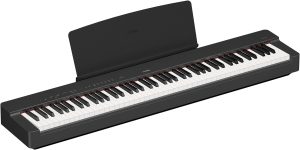
For the widest range of beginners, the Yamaha P-225 is our Best Overall recommendation.
Yamaha gives the P-225:
- 88-key Graded Hammer Compact (GHC) keyboard
- Yamaha CFX concert-grand piano sound
- VRM Lite
- 192-note maximum polyphony
- 24 instrument voices
- Split, Dual, and Duo functions
- 20 rhythms
- USB audio/MIDI
- Two headphone connections
- Optional three-pedal compatibility
The instrument weighs approximately 11.5 kg (25 lb 6 oz), making it relatively easy to relocate.
Why the P-225 Works So Well for Beginners
Yamaha has struck a useful balance here.
The P-225 is sophisticated enough that a student shouldn’t quickly outgrow it, but it doesn’t overwhelm a beginner with hundreds of controls and functions.
The GHC keyboard is designed to provide weighted acoustic-piano-like response while allowing Yamaha to keep the instrument relatively compact.
That makes the P-225 appropriate for:
- Children taking lessons
- Adult beginners
- Intermediate students
- Apartment dwellers
- College students
- Home musicians
CFX Piano Sound
The P-225 incorporates the sound of Yamaha’s flagship CFX concert grand, together with Virtual Resonance Modeling Lite to recreate some of the resonant behavior associated with an acoustic grand piano.
That’s important because beginners need to develop an ear for dynamics and tonal variation—not merely learn which keys correspond to which notes.
Who Should Buy It?
Choose the P-225 if you want a beginner instrument that can remain useful well beyond the beginner stage.
Pros
- 88 weighted keys
- Compact GHC action
- Yamaha CFX piano sound
- 192-note polyphony
- Relatively lightweight
- Strong long-term value
- Good balance of simplicity and features
Buyers seriously considering this model can explore its strengths and limitations in our in-depth Yamaha P-225 review.
Possible Drawback
It isn’t the cheapest piano in our selection, and some players may personally prefer the keyboard feel of competing Roland or Kawai models.
Beginners considering Yamaha can see how its entry-level choices fit into the full Yamaha piano lineup.
Best for:
Most beginners wanting a high-quality first digital piano they won’t quickly outgrow.
[Check Yamaha P-225 Price on Amazon →]
2. Roland FP-10 — Best for Serious Beginners on a Budget
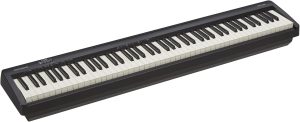
The Roland FP-10 deserves special attention because it gives budget-conscious students access to Roland’s PHA-4 Standard keyboard action.
That’s the same action family used in the more expensive FP-30X.
The FP-10 combines:
- 88 weighted hammer-action keys
- PHA-4 Standard action
- Escapement
- Ivory Feel key surfaces
- Roland SuperNATURAL piano technology
- 96-note polyphony
- Twin Piano mode
- Headphone capability
- USB connectivity
- Bluetooth MIDI
For a student primarily interested in learning piano rather than collecting features, this is a compelling package.
Why Keyboard Action Matters Here
The FP-10’s main attraction isn’t a huge list of sounds.
It’s the playing experience.
The PHA-4 Standard keyboard provides graded hammer weighting and escapement designed to approximate aspects of acoustic-piano touch.
For beginners taking traditional lessons, that can matter more than having hundreds of voices.
Twin Piano
Roland’s Twin Piano feature divides the keyboard into two identical pitch ranges.
A teacher and student can therefore sit alongside each other and demonstrate the same passage in the same register.
That’s genuinely useful for lessons.
Pros
- Strong hammer-action keyboard for the price
- 88 keys
- SuperNATURAL piano sound
- Good choice for traditional lessons
- Compact design
- Useful teacher/student mode
Possible Drawback
Its 96-note polyphony and speaker system are more modest than those of the FP-30X.
Best for:
Budget-conscious beginners who care more about developing piano technique than having numerous extra features.
[Check Roland FP-10 Price on Amazon →]
3. Roland FP-30X — Best Step-Up Beginner Piano
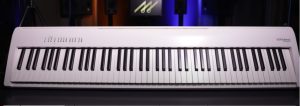
If your budget allows you to move above the FP-10, the Roland FP-30X is one of the strongest long-term choices for a beginner.
It retains Roland’s PHA-4 Standard action but expands other capabilities substantially.
Among its advantages are:
- 88 PHA-4 Standard keys
- SuperNATURAL piano technology
- 256-note polyphony
- More powerful speakers than the FP-10
- Bluetooth Audio and MIDI
- USB audio/MIDI
- Multiple sounds
- Optional three-pedal compatibility
Why Choose the FP-30X Instead of FP-10?
The keyboard action isn’t the main reason.
Both use PHA-4 Standard.
The FP-30X becomes attractive because of its improved:
- Polyphony
- Speakers
- Connectivity
- Sound selection
- Long-term versatility
If you’re buying for a child who has already demonstrated commitment to lessons—or you’re an adult who knows piano will be a long-term hobby—the additional investment may make sense.
256-Note Polyphony
This gives the FP-30X substantial headroom for sustained passages and more sophisticated playing.
Beginners don’t need 256-note polyphony.
But they may appreciate having an instrument they can grow into rather than out of.
Pros
- Excellent hammer-action keyboard
- 256-note polyphony
- Strong long-term choice
- Better speakers than FP-10
- Bluetooth Audio/MIDI
- Suitable beyond beginner level
Possible Drawback
If you’re completely unsure whether you’ll continue learning piano, the FP-10 or Alesis Recital Pro may represent a smaller initial investment.
Best for:
Committed beginners who want to buy once and keep the instrument well into the intermediate stage.
[Check Roland FP-30X Price on Amazon →]
Roland FP-10 vs FP-30X: Which Should a Beginner Buy?
This is actually a straightforward decision.
Choose the FP-10 if:
- Budget matters.
- Piano practice is your main priority.
- You don’t need powerful speakers.
- You don’t need extensive connectivity.
- You want PHA-4 action at the lowest practical cost.
Choose the FP-30X if:
- You expect to play for years.
- You want stronger speakers.
- Bluetooth Audio matters.
- You want 256-note polyphony.
- You want more room to grow.
For pure beginner value, FP-10.
For long-term value, FP-30X.
If Roland is your preferred brand, our comparison of Roland’s beginner piano lineup explains when the FP-10, FP-30X and other Roland options make the most sense.
4. Kawai ES120 — Best for Piano-Focused Learning
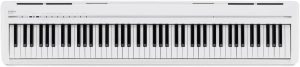
Kawai is particularly interesting for students because the company is deeply rooted in acoustic-piano manufacturing.
The ES120 brings some of that piano-oriented philosophy into a relatively compact digital instrument.
Kawai specifies:
- 88-key Responsive Hammer Compact action
- Grade-weighted hammers
- Matte key surfaces
- SK-EX and EX concert-grand sounds
- 88-key stereo sampling
- 192-note polyphony
- 25 sounds
- 20W speaker output
- Bluetooth MIDI and Audio
- USB-MIDI
- 100 drum rhythms
- Optional three-pedal compatibility
The ES120 weighs about 12 kg (26.5 lb) without the music rest.
Responsive Hammer Compact Action
Kawai’s keyboard uses grade-weighted hammers, meaning the resistance varies across the keyboard to imitate the heavier bass and lighter treble behavior associated with acoustic pianos.
For students focused on traditional piano repertoire, this is particularly attractive.
SK-EX Concert Grand Sound
The ES120 includes piano sounds based on Kawai’s Shigeru Kawai SK-EX and EX concert grands, with individual 88-key stereo sampling.
It also provides adjustable piano parameters through Kawai’s Virtual Technician functionality via the PianoRemote app.
Bluetooth
Bluetooth MIDI and Audio give the ES120 useful modern connectivity without turning the piano into a complicated workstation.
Pros
- Piano-focused design
- Grade-weighted hammer action
- 192-note polyphony
- SK-EX/EX piano sounds
- Bluetooth Audio/MIDI
- Relatively lightweight
- Excellent long-term beginner instrument
Students who place particular importance on realistic piano feel can also explore how the ES120 fits into Kawai’s broader digital-piano range.
Best for:
Students who care primarily about piano touch, sound, and traditional piano learning.
[Check Kawai ES120 Price on Amazon →]
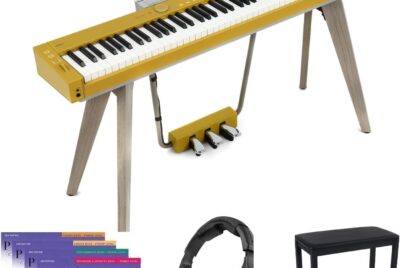
5. Casio Privia PX-S1100 — Best Compact Beginner Piano
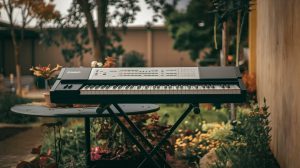
The Casio Privia PX-S1100 is particularly attractive where space matters.
Its slim cabinet makes it suitable for:
- Apartments
- Bedrooms
- Dorm rooms
- Smaller music areas
- Players who occasionally move their piano
But compact doesn’t mean toy-like.
Casio equips the PX-S1100 with:
- 88-key Smart Scaled Hammer Action Keyboard
- Five touch-sensitivity levels
- Multi-dimensional Morphing AiR sound source
- 192-note polyphony
- 18 tones
- MIDI recorder
- Audio recorder
- 60 built-in songs
- 16W speaker amplification
- Optional three-pedal compatibility
- Battery or AC operation
Why the PX-S1100 Appeals to Beginners
Not everyone has room for a large furniture-style digital piano.
Casio’s Privia design gives students a full 88-key hammer-action instrument in a particularly space-conscious format.
That’s useful for adults who might otherwise postpone learning piano because they think they don’t have room for one.
192-Note Polyphony
The PX-S1100 provides 192-note polyphony—plenty for beginner and intermediate playing.
Battery Operation
The ability to operate from six AA batteries adds portability. Casio estimates approximately four hours of continuous battery life under specified conditions.
Pros
- Very compact design
- 88 hammer-action keys
- 192-note polyphony
- Audio and MIDI recording
- Battery operation
- Attractive modern appearance
Possible Drawback
Keyboard feel is personal. Serious piano students should compare the Casio action with Yamaha, Roland, and Kawai if they have an opportunity to play them in person.
Beginners considering Casio can also see our Best Casio Digital Pianos with Weighted Keys in 2026: 5 Models Compared for options ranging from the affordable CDP-S160 to premium Privia models.
The PX-S1100’s unusually slim design also makes it worth considering when appearance and living-room space influence your piano choice.
Best for:
Beginners needing a slim, attractive 88-key digital piano for limited spaces.
[Check Casio Privia PX-S1100 Price on Amazon →]
6. Alesis Recital Pro — Best Affordable Hammer-Action Alternative
The Alesis Recital Pro gives beginners another route into an 88-key hammer-action instrument without necessarily moving into the price territory of more established premium piano brands.
Alesis specifies:
- 88 full-size hammer-action keys
- Adjustable touch response
- 12 built-in voices
- 128-note polyphony
- 20W speakers
- Lesson Mode
- Record Mode
- Split and Layer modes
- Metronome
- USB-MIDI
- Headphone connection
- Battery operation
Why I Prefer the Recital Pro to the Basic Recital for Serious Learners
The basic Alesis Recital uses semi-weighted keys.
The Recital Pro moves to hammer action.
For casual playing, semi-weighted keys may be perfectly acceptable.
For someone specifically learning traditional piano technique, however, I think the Recital Pro is worth prioritizing.
Lesson Mode
Lesson Mode divides the keyboard into two zones with identical pitch ranges, allowing a teacher and student to play alongside each other.
Record Mode
Students can record a performance and listen back critically.
This is a surprisingly effective practice technique because you’ll often hear:
- Timing problems
- Uneven dynamics
- Rushed passages
- Missed notes
that you didn’t notice while playing.
Pros
- 88 hammer-action keys
- 128-note polyphony
- Affordable alternative
- Lesson Mode
- Recording
- USB-MIDI
- Battery operation
Possible Drawback
Players with a larger budget should also compare the keyboard action and piano sound against Yamaha, Roland, Kawai, and Casio.
Best for:
Budget-conscious students who specifically want hammer-action keys.
[Check Alesis Recital Pro Price on Amazon →]
7. Donner DEP-20 — Best Feature-Rich Budget Choice
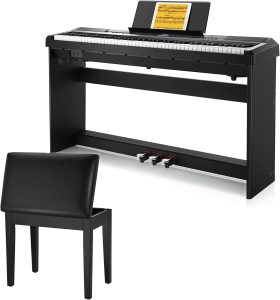
The Donner DEP-20 takes a different approach.
Rather than concentrating almost entirely on piano playing, it combines an 88-key weighted keyboard with a large collection of sounds and additional features.
Donner currently specifies:
- 88 keys
- Weighted keyboard
- 238 tones
- 128-note polyphony
- Dual 25W speakers
- USB-MIDI
- Dual headphone connections
- Audio input/output
- Three-pedal unit availability
238 Sounds
This is where the DEP-20 differs substantially from instruments such as the Kawai ES120.
A beginner interested not only in piano but also in:
- Pop music
- Arranging
- Songwriting
- Different instrument sounds
- Recreational playing
may enjoy the DEP-20’s broader sound library.
Strong Speakers
Donner lists two 25W speakers, giving the DEP-20 substantial amplification on paper for its category.
Three-Pedal Setup
Current configurations can include a furniture stand and three-pedal unit, depending on the Amazon package.
As always, check exactly what the specific Amazon listing includes before purchasing.
Pros
- 88 weighted keys
- 238 sounds
- 128-note polyphony
- Strong speaker specification
- USB-MIDI
- Three-pedal bundle options
- Good feature-to-price ratio
Possible Drawback
A student whose overriding priority is traditional piano touch should compare it directly with the Roland FP-10, Kawai ES120, Yamaha P-225, and other piano-focused alternatives.
Budget-conscious students considering Donner can also compare the brand’s other digital-piano options for developing players.
Best for:
Budget-conscious beginners who want weighted keys plus lots of sounds and features.
[Check Donner DEP-20 Price on Amazon →]
Which Beginner Digital Piano Should You Buy?
Here’s the simplest way to narrow the seven choices.
Best Overall: Yamaha P-225
Choose it if you want a safe, versatile first piano that can remain useful as your skills improve.
Best Budget Piano for Serious Learning: Roland FP-10
Choose it if your priority is a good hammer-action playing experience at a relatively accessible price.
Best Long-Term Roland: FP-30X
Choose it if you already know you’re serious about piano and want better speakers, connectivity, and considerably higher polyphony.
Best Piano-Focused Alternative: Kawai ES120
Choose it if acoustic-piano-style touch and piano sound are your priorities.
Best for Small Spaces: Casio PX-S1100
Choose it if you need a slim instrument without giving up an 88-key hammer-action keyboard.
Best Affordable Hammer-Action Alternative: Alesis Recital Pro
Choose it if budget matters but you still want hammer-action keys.
Best for Features: Donner DEP-20
Choose it if you enjoy experimenting with numerous sounds and want a lot of functionality for the money.
Best Digital Piano for a Child Beginner
For a child taking formal piano lessons, I’d prioritize:
Roland FP-10
Yamaha P-225
Kawai ES120
All three provide 88 weighted/hammer-action keys and are suitable for developing proper technique.
But don’t automatically buy the most expensive instrument for a very young child who has never taken lessons.
A sensible approach is to consider:
- The child’s level of interest.
- The teacher’s recommendation.
- Your budget.
- Whether other family members will use the piano.
- How long you expect to keep the instrument.
If the child becomes committed, buying a better instrument initially can prevent an early upgrade.
Best Digital Piano for an Adult Beginner
Adults often approach piano differently.
An adult may already know:
“I’ve wanted to learn piano for 20 years. I’m finally going to do it.”
In that situation, I’d be inclined to buy a better instrument from the beginning.
Consider:
Yamaha P-225 for overall balance.
Roland FP-30X for long-term capability.
Kawai ES120 for piano-focused playing.
Casio PX-S1100 when space is limited.
An enjoyable instrument can encourage practice—and regular practice matters far more than owning a piano with the longest specification sheet.
What Is the Best Beginner Piano for Classical Music?
For classical study, I’d narrow our seven recommendations to:
Yamaha P-225
Roland FP-10
Roland FP-30X
Kawai ES120
These instruments emphasize weighted hammer actions and piano-focused playing.
The FP-10 deserves particular consideration for a budget-conscious classical beginner, while the FP-30X provides more room for growth.
The Kawai ES120 is also especially interesting because of its grade-weighted Responsive Hammer Compact action and SK-EX/EX piano sounds.
Do Beginners Really Need 88 Keys?
Strictly speaking, no.
A beginner’s earliest pieces may use only a small portion of the keyboard.
But I still recommend 88 keys whenever budget and space permit.
Why?
Because you won’t have to upgrade merely because:
- Your repertoire expands.
- Your teacher introduces wider-range pieces.
- You begin classical music.
- You use split/layer functions.
- Your skill level increases.
Think of 88 keys as buying room to grow.
Do Beginners Need Weighted Keys?
Again, technically no.
You can learn:
- Note names
- Chords
- Scales
- Rhythm
- Basic music theory
on an unweighted keyboard.
But if your goal is piano playing, weighted keys are highly desirable.
They help develop the physical control required to produce expressive dynamics and prepare you more naturally for acoustic pianos.
For serious students, I’d prioritize:
keyboard action before hundreds of sounds.
Should a Beginner Buy a Digital or Acoustic Piano?
Both can be excellent.
An acoustic piano provides the genuine mechanical interaction of keys, hammers, strings, soundboard, and pedals.
But digital pianos offer practical advantages:
- Lower entry prices in many cases
- Headphone practice
- No traditional tuning
- Easier relocation
- Smaller footprints
- Recording
- USB/MIDI
- Multiple sounds
For many modern households, a quality digital piano is the more practical starting point.
Beginner Piano Buying Mistakes to Avoid
Buying based only on the number of sounds
Five hundred sounds don’t make a keyboard better for learning piano than an instrument with twenty excellent sounds and a superior keyboard action.
Assuming 88 keys means weighted keys
It doesn’t.
Always check the type of key action.
Buying too cheaply and upgrading six months later
If you’re already committed to piano, buying an extremely basic keyboard may ultimately cost more when you replace it.
Buying far more piano than you need
The opposite mistake also happens.
A complete beginner doesn’t necessarily need a premium professional instrument.
Ignoring headphones and pedals
Both can become important parts of everyday practice.
Ignoring dimensions
An 88-key piano is wide.
Measure your available space before ordering.
Frequently Asked Questions
What is the best digital piano for beginners in 2026?
For most beginners, our overall recommendation is the Yamaha P-225 because it combines 88 GHC weighted keys, Yamaha CFX sound, VRM Lite, 192-note polyphony, useful connectivity, and a relatively compact design.
What is the best affordable digital piano for learning?
The Roland FP-10 is particularly attractive for students prioritizing piano technique on a tighter budget.
The Alesis Recital Pro is another affordable hammer-action alternative.
Is 88 keys enough to learn piano?
Yes. A standard piano has 88 keys, so an 88-key digital piano provides the complete traditional piano range.
Is 61 keys enough for a beginner?
It can be enough for introductory learning, particularly for children or casual players.
However, if you intend to study piano seriously, I’d generally buy an 88-key instrument from the start.
Is the Yamaha P-225 good for beginners?
Yes. Its combination of GHC weighted action, CFX sound and 192-note polyphony makes it suitable for beginners while providing enough capability for continued development.
Is the Kawai ES120 good for beginners?
Yes. Its Responsive Hammer Compact keyboard uses grade-weighted hammers, and it provides 192-note polyphony and individually sampled piano sounds.
Does the Casio PX-S1100 have weighted keys?
Yes. Casio uses its Smart Scaled Hammer Action Keyboard with 88 keys and adjustable touch response.
Does the Alesis Recital Pro have hammer-action keys?
Yes. Alesis specifies 88 full-size hammer-action keys with adjustable touch response.
Is the Donner DEP-20 suitable for beginners?
Yes, particularly for beginners who want an 88-key weighted instrument with a large selection of sounds and features. Donner specifies 238 tones and 128-note polyphony.
Do digital pianos need tuning?
No.
Unlike acoustic pianos, digital pianos don’t have strings that gradually go out of tune.
Final Verdict: The Best Digital Piano for Learning
There is no single beginner piano that’s perfect for everybody.
But among the seven models we’ve compared, here’s how I’d make the final decision.
Best Overall — Yamaha P-225
The P-225 provides an excellent combination of weighted action, CFX concert-grand sound, 192-note polyphony, portability and long-term usability.
[Check Yamaha P-225 Price on Amazon →]
Best Serious Beginner Piano on a Budget — Roland FP-10
Choose the FP-10 if your priority is learning proper piano technique and you want Roland’s PHA-4 Standard action without moving immediately to the FP-30X.
[Check Roland FP-10 Price on Amazon →]
Best Step-Up Beginner Piano — Roland FP-30X
Choose the FP-30X if you want an instrument capable of carrying you comfortably from beginner into intermediate playing.
[Check Roland FP-30X Price on Amazon →]
Best for Piano-Focused Learning — Kawai ES120
Choose the ES120 if touch and acoustic-piano character matter more to you than having hundreds of instrument sounds. Its grade-weighted Responsive Hammer Compact action and 192-note polyphony make it particularly attractive for piano study.
[Check Kawai ES120 Price on Amazon →]
Best Compact Choice — Casio Privia PX-S1100
Choose the PX-S1100 when space matters. It still provides 88 hammer-action keys, 192-note polyphony and recording capabilities in a slim format.
[Check Casio PX-S1100 Price on Amazon →]
Best Affordable Hammer-Action Alternative — Alesis Recital Pro
Choose the Recital Pro if you’re looking for a lower-cost route to an 88-key hammer-action instrument.
[Check Alesis Recital Pro Price on Amazon →]
Best Feature-Rich Budget Choice — Donner DEP-20
Choose the DEP-20 if you want weighted keys plus lots of sounds and features. Donner lists 238 tones, 128-note polyphony and dual 25W speakers.
[Check Donner DEP-20 Price on Amazon →]
If you’re still undecided, narrow your shortlist to two or three instruments and play them in person if possible.
Specifications tell you how many sounds, speakers, connections and notes of polyphony a digital piano has.
But they can’t completely tell you how the keyboard will feel under your fingers.
For a beginner who intends to keep learning, that feeling may ultimately matter more than almost anything else.
If an 88-key digital piano is still beyond your budget, our Best Cheap Keyboards in 2026: 5 Budget Picks That Are Actually Worth Buying includes several lower-cost alternatives for beginning musicians.
If you’re planning to teach yourself, our Simply Piano Review 2026: Is It Good for Beginners? explains how the popular learning app works with digital pianos and keyboards.
If you’ve already decided that you want a full-size weighted instrument, see our Best 88-Key Weighted Keyboards for Beginners in 2026: 7 Top Picks for a more focused comparison.
Beginners with limited space or those who need to move their instrument should also see our Best Portable Digital Pianos for Beginners in 2026: 5 Lightweight Picks.
Before deciding how much to spend, you may want to read 88 Weighted Keys: Do You Really Need Them on a Digital Piano? to determine whether a full-size weighted action is necessary for your goals.
Beginners with a larger budget can compare several stronger long-term options in our Best Digital Pianos Under $1,000 in 2026: 7 Top Picks.
Beginners who don’t need portability and prefer a more traditional piano-style setup should also see our Best Digital Upright Pianos for Home Use: 2026 Buying Guide.
If Kawai’s piano-focused approach appeals to you, see our Best Kawai Digital Pianos 2026: Which Model Is Right for You? for a comparison of Kawai models ranging from the beginner-friendly ES120 to premium home digital pianos.
If you’d like to see how beginner-friendly instruments compare with premium and professional options, read our Best Digital Pianos in 2026: 7 Top-Rated Picks for Different Players.
Beginners who prioritize portability, accompaniment and multiple sounds over weighted keys may prefer a 61-key keyboard; see our Yamaha PSR-E373 vs PSR-E383: Should You Still Buy the Older Keyboard in 2026? for one current Yamaha option.
Choosing the instrument is only the beginning; our Piano Essentials: A Beginner’s Guide to Buying and Playing Piano explains the broader fundamentals of starting your piano journey and includes access to our free 182-page piano guide.
Beginners will frequently encounter names such as Yamaha, Roland, Kawai and Casio when shopping for their first instrument. Our Best Piano Brands in 2026: 10 Top Names Compared explains what distinguishes these manufacturers and several other major piano brands.
Brand reputation can help narrow your search, but no single manufacturer is best for every pianist. Our Best Piano Brands in 2026: 10 Top Names Compared explains the strengths of ten leading piano manufacturers and the types of players they may suit.
Beginners living in apartments or smaller homes may also want to see our Best Compact Digital Pianos for Small Spaces in 2026: 6 Top Picks, where physical footprint is one of the main selection criteria.
Beginners considering this Yamaha can learn more about Yamaha P-225’s features and performance, including whether its GHC weighted action provides enough room for long-term progress.
The Korg B2 is another popular beginner option, and our Korg keyboard buying guide explains how it compares with Korg’s more advanced stage and arranger instruments.”
If you’re not ready to compare specific models yet, start by learning what to look for when buying a keyboard piano, including key action, polyphony, pedals, speakers and connectivity.
If you’ve already decided on Roland, our comparison of the best Roland digital pianos for beginners goes deeper into the FP-10, FP-30X and other Roland choices for new players.
Beginners who prefer a more traditional piano feel may want to explore Kawai’s beginner and home piano options, particularly the ES120 and KDP120.
Beginners planning to study piano long term should also understand why 88 keys and weighted action matter as their playing develops.
As your technique develops, your priorities change; our piano recommendations from beginner through advanced level show when an upgrade actually becomes worthwhile.
If you’re still learning the terminology and comparing instrument types, our complete digital piano buying guide explains action, sound, pedals, connectivity and other important specifications.