Digital Piano vs Keyboard: Which Should You Buy in 2026?
If you’re thinking about learning to play piano, one of the first decisions you’ll face is surprisingly basic:
Should you buy a digital piano or a keyboard?
At first glance, they can look very similar. Both have black and white keys, built-in electronic sounds, volume controls, headphone connections, and often USB or Bluetooth connectivity.
But they’re designed with different priorities.
A digital piano is primarily intended to reproduce the experience of playing an acoustic piano. It typically emphasizes 88 weighted keys, realistic piano sound, expressive touch, pedals, and a relatively straightforward interface.
A keyboard, on the other hand, generally emphasizes portability and versatility. It may offer hundreds—or even more than a thousand—instrument sounds, automatic accompaniment, rhythms, creative tools, and a lighter keyboard.
Neither is automatically better.
The right choice depends on what you actually want to do with it.
In this guide, we’ll compare digital pianos and keyboards in detail and help you decide which type of instrument makes more sense for you.
Disclosure: Some links on Pianos-Galore are affiliate links. If you purchase through these links, we may receive a small commission at no additional cost to you.
Digital Piano vs Keyboard at a Glance
| Feature | Digital Piano | Keyboard |
|---|---|---|
| Typical keys | Usually 88 | Often 61 |
| Key action | Usually weighted/hammer action | Usually lightweight/unweighted |
| Main purpose | Realistic piano playing | Versatility & music creation |
| Piano sound | Major priority | One of many sounds |
| Instrument sounds | Usually fewer | Often hundreds |
| Rhythms/accompaniment | Limited or none | Often extensive |
| Portability | Moderate | Usually excellent |
| Pedals | Sustain/optional 3-pedal systems | Usually sustain-pedal option |
| Classical study | Excellent | Limited |
| Songwriting | Good | Excellent |
| Kids/casual use | Good | Excellent |
| Serious piano lessons | Usually preferable | Less ideal |
| Price | Often higher | Often lower |
The most important distinction is not the number of sounds.
It’s the playing experience and intended purpose.
What Is a Digital Piano?
A digital piano is an electronic instrument designed primarily to reproduce the sound and playing experience of an acoustic piano.
Most serious digital pianos have:
- 88 full-size keys
- Weighted or hammer-action keyboards
- Touch sensitivity
- High-quality acoustic-piano sounds
- Sustain-pedal capability
- Headphone outputs
- Built-in speakers
- USB/MIDI connectivity
Better models may also provide:
- Graded hammer action
- Three-pedal systems
- String/damper resonance modeling
- Advanced sampling
- Recording
- Bluetooth
- Furniture-style stands and cabinets
A good digital piano therefore tries to answer the question:
How closely can an electronic instrument reproduce the experience of playing an acoustic piano?
That doesn’t mean it must physically look like an acoustic piano.
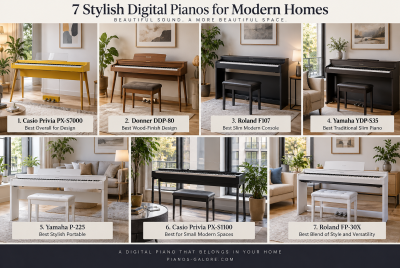
Portable models such as the Yamaha P-225, Roland FP-30X, and Casio PX-S1100 are relatively compact instruments but still have 88 weighted keys.
What Is a Keyboard?
The term keyboard covers a much broader range of electronic instruments.
A typical portable keyboard might have:
- 61 keys
- Lightweight key action
- Hundreds of instrument sounds
- Automatic accompaniment
- Drum rhythms
- Built-in songs
- Learning functions
- Recording
- Split and Layer modes
- USB/MIDI
- Battery operation
Some modern keyboards go considerably further.
For example, Roland’s GO:KEYS 3 provides 1,154 tones, 74 drum kits and 203 accompaniment styles in a 61-key instrument weighing about 4.5 kg.
That tells you immediately what the design priority is.
A digital piano says:
“Let’s make this feel and sound like a piano.”
A creative keyboard says:
“Let’s give you an entire world of sounds and musical possibilities.”
1. Key Action: Probably the Biggest Difference
If your goal is to learn traditional piano, this is the most important section of the article.
Digital Piano Keys
Digital pianos generally use weighted or hammer-action mechanisms.
An acoustic piano key operates a mechanical hammer that strikes a string. This creates physical resistance under your fingers.
Digital-piano manufacturers use different technologies to simulate that sensation.
For example:
Yamaha P-225 — Graded Hammer Compact (GHC)
Roland FP-30X — PHA-4 Standard hammer action
Casio PX-S1100 — Smart Scaled Hammer Action
The Yamaha P-225, for instance, uses an 88-key GHC weighted action with four touch-sensitivity settings.
Keyboard Keys
Portable keyboards usually have lighter actions.
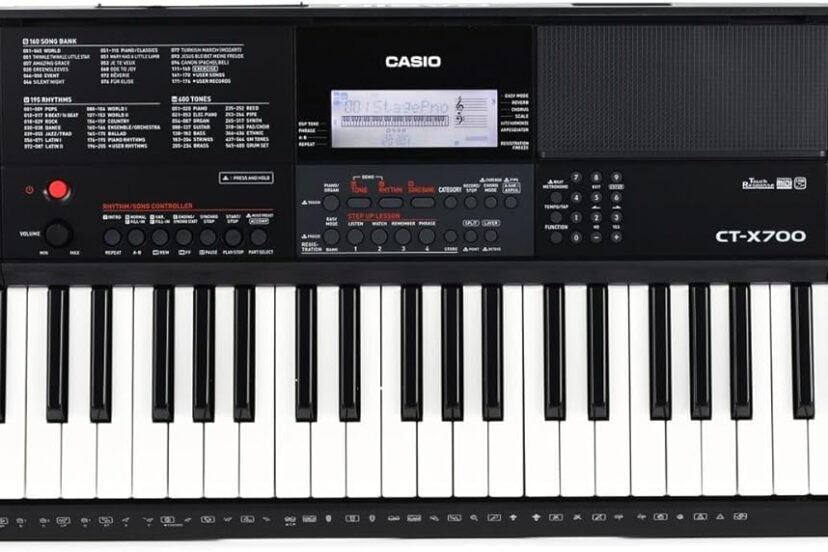
The Casio CT-S300 and CT-S400 both have 61 touch-sensitive keys, but they aren’t hammer-action digital-piano keyboards.
Roland’s GO:KEYS 3 similarly uses 61 velocity-sensitive keys rather than an 88-key piano-style hammer action.
Why does this matter?
If you’re learning traditional piano technique, weighted keys help develop:
- Finger control
- Strength
- Dynamic expression
- Articulation
- Coordination
This is one reason I generally recommend a digital piano rather than a keyboard for serious piano students.
2. Number of Keys: 88 vs 61
A standard acoustic piano has 88 keys.
Most portable keyboards have 61, although other sizes exist.
Does a beginner need 88 keys immediately?
Not necessarily.
Your first lessons will probably use only a small portion of the keyboard.
But as your repertoire develops, 88 keys become increasingly valuable.
For:
- Classical music
- Advanced repertoire
- Two-handed arrangements
- Long-term piano study
I strongly prefer 88 keys.
For:
- Pop music
- Chords
- Songwriting
- Casual playing
- Children experimenting with music
- Maximum portability
61 keys may be perfectly adequate.
3. Piano Sound Quality
A digital piano usually devotes much more of its design to reproducing acoustic-piano sound.
The Yamaha P-225, for example, uses Yamaha CFX concert-grand sound together with VRM Lite resonance technology.
The Roland FP-30X uses Roland’s SuperNATURAL Piano sound engine.
Casio’s PX-S1100 uses its Multi-dimensional Morphing AiR sound source.
A keyboard can certainly have good piano sounds.
But acoustic piano is usually one category among many, rather than the instrument’s entire reason for existing.
If you’re buying primarily to play piano, the digital piano wins this category.
4. Number of Sounds: Keyboard Wins Easily
Here’s where keyboards fight back.
Consider these examples:
Casio CT-S300 — 400 tones
Casio CT-S400 — 600 tones
Roland GO:KEYS 3 — 1,154 tones + 74 drum kits
Compare that with the Yamaha P-225’s 24 voices.
Does that mean the keyboard is better?
No.
It means it’s designed for something different.
If you want to explore:
- Synthesizers
- Strings
- Brass
- Organs
- Guitars
- Bass
- Electronic sounds
- World instruments
- Drum kits
a keyboard becomes enormously attractive.
If you mostly want an excellent piano sound, having 1,000 other sounds may not matter.
5. Rhythms and Automatic Accompaniment
This is another major keyboard advantage.
The Casio CT-S300 includes 77 rhythms, while the CT-S400 provides 200 rhythms.
The Roland GO:KEYS 3 provides 203 preset accompaniment styles plus chord-sequencing capabilities.
These features can effectively provide a virtual backing band.
Play chords with your left hand and the keyboard can generate:
- Drums
- Bass
- Harmonic accompaniment
- Rhythmic patterns
For songwriting and recreational playing, that’s tremendous fun.
A digital piano may offer some rhythms—the P-225, for example, provides 20—but accompaniment isn’t usually its primary purpose.
6. Portability
Keyboard wins again.
The Casio CT-S300 weighs only about 3.3 kg (7.3 lb).
The CT-S400 weighs approximately 4.5 kg (9.9 lb).
Roland’s GO:KEYS 3 is also approximately 4.5 kg.
Compare that with:
Yamaha P-225 — about 11.5 kg
Roland FP-30X — about 14.8 kg
The P-225 is quite portable for an 88-key weighted digital piano, but it’s still considerably heavier than a typical 61-key keyboard.
If you frequently carry your instrument between:
- School
- Rehearsals
- Church
- Friends’ houses
- Music lessons
a lightweight keyboard has obvious advantages.
7. Digital Piano vs Keyboard for Beginners
This depends entirely on what you mean by “beginner.”
Beginner who wants to learn piano seriously
Digital piano.
I’d prioritize:
- 88 keys
- Hammer action
- Touch sensitivity
- Sustain pedal
- Good acoustic-piano sound
Beginner who wants to explore music
Keyboard.
A 61-key portable keyboard can be excellent for learning:
- Notes
- Chords
- Melody
- Rhythm
- Basic music theory
- Songwriting
Beginner who isn’t sure they’ll stick with music
A lower-cost keyboard can reduce the initial investment.
However, if the student is already committed to formal piano lessons, buying an inexpensive unweighted keyboard may simply result in having to upgrade later.
8. Digital Piano vs Keyboard for Children
For young children, there’s no universal answer.
A keyboard can make learning feel more like play.
Children may enjoy:
- Drum rhythms
- Hundreds of sounds
- Automatic accompaniment
- Built-in songs
- Musical games/apps
That can encourage experimentation.
But if the child is taking formal piano lessons, ask the teacher what they recommend.
Many piano teachers prefer students to practice on 88 weighted keys because that more closely reflects the technique taught on an acoustic piano.
9. Digital Piano vs Keyboard for Classical Music
This one is easy.
Choose a digital piano.
Classical piano repertoire increasingly requires:
- Full keyboard range
- Dynamic control
- Weighted action
- Sustain-pedal technique
- Expressive touch
A 61-key lightweight keyboard can teach you the notes of beginner pieces, but it isn’t the ideal long-term instrument for classical piano development.
Good options include the Yamaha P-225 and Roland FP-30X.
Internal link: Link classical piano learning to your Piano Keyboards for Learning Classical Music article.
10. Digital Piano vs Keyboard for Songwriting
Here the answer may reverse.
Keyboard often wins.
Imagine you’re writing a song.
You start with a piano chord progression.
Then you add:
- Bass
- Drums
- Strings
- Synth pad
- Guitar
- Brass
A feature-rich keyboard can let you explore all of these ideas from one instrument.
The Roland GO:KEYS 3 is particularly interesting for this purpose because its ZEN-Core engine provides over 1,100 tones, while its accompaniment system offers more than 200 styles.
For a budding songwriter or producer, that’s more useful than an ultra-realistic piano action may be.
11. Digital Piano vs Keyboard for Home Recording
Both can work extremely well.
A digital piano is attractive if your recordings are piano-centered.
A keyboard is attractive if you’re creating arrangements with many different sounds.
Modern instruments can also communicate with computers and mobile devices using MIDI and/or USB audio, depending on the model.
The Roland FP-30X, for example, supports USB MIDI/audio and Bluetooth Audio/MIDI.
12. Digital Piano vs Keyboard for Small Apartments
This is closer than you might expect.
A 61-key keyboard is obviously smaller.
But slim digital pianos have become remarkably compact.
The Casio PX-S1100 provides 88 hammer-action keys in a slim portable design, with 192-note polyphony and 8W + 8W amplification.
The Yamaha P-225 is only about 272 mm (10.7 inches) deep without its music rest.
So apartment dwellers no longer have to choose a 61-key keyboard purely because of space.
13. Digital Piano vs Keyboard for Older Adult Beginners
For an adult whose lifelong goal is:
“I’ve always wanted to learn piano.”
I’d generally recommend a digital piano.
If the goal is:
“I’d like to learn some songs, play chords, experiment with sounds and have fun.”
a keyboard may be the better purchase.
The distinction isn’t age.
It’s musical intention.
Recommended Digital Pianos in 2026
If you’ve decided that a digital piano is right for you, these three are excellent places to start.
Yamaha P-225 — Best All-Round Choice
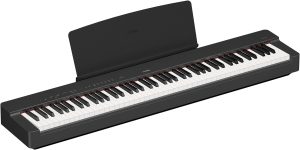
The P-225 combines:
- 88 GHC weighted keys
- Yamaha CFX sound
- VRM Lite
- 192-note polyphony
- 24 voices
- USB audio/MIDI
- Compact dimensions
It’s an excellent choice for beginners and intermediate pianists who want a portable instrument without sacrificing a piano-oriented playing experience.
[Check Yamaha P-225 Price on Amazon →]
Roland FP-30X — Best for Serious Piano Learning
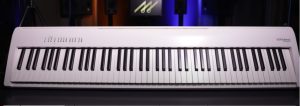
The FP-30X provides:
- 88 PHA-4 Standard keys
- Escapement and Ivory Feel
- SuperNATURAL Piano
- 256-note polyphony
- 11W x 2 amplification
- Bluetooth Audio/MIDI
- USB audio/MIDI
It’s particularly attractive for students who want an instrument they can continue using well beyond beginner level.
[Check Roland FP-30X Price on Amazon →]
Casio Privia PX-S1100 — Best Compact Digital Piano
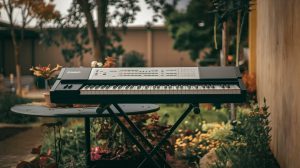
The PX-S1100 combines:
- 88 Smart Scaled Hammer Action keys
- 192-note polyphony
- 18 tones
- MIDI and audio recording
- 8W + 8W speakers
- Battery operation
It’s especially compelling for smaller homes and apartments.
[Check Casio PX-S1100 Price on Amazon →]
Recommended Keyboards in 2026
If versatility and portability matter more than hammer-action piano feel, consider these three.
Casio CT-S300 — Best Affordable Beginner Keyboard
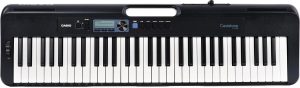
The CT-S300 provides:
- 61 touch-sensitive keys
- 400 tones
- 77 rhythms
- 60 built-in songs
- Lesson functions
- Pitch-bend wheel
- USB connectivity
- Battery operation
At approximately 3.3 kg, it’s extremely portable.
Best for:
Beginners, children, students and casual players wanting an affordable portable keyboard.
[Check Casio CT-S300 Price on Amazon →]
Casio CT-S400 — Best Step-Up Portable Keyboard
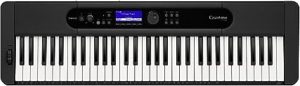
The CT-S400 moves considerably beyond the CT-S300.
It provides:
- 61 touch-sensitive keys
- 600 tones
- 200 rhythms
- 160 built-in songs
- AiX sound source
- 5-song/6-track MIDI recorder
- Layer and Split functions
- 100 arpeggiator types
- Pitch-bend wheel
This makes it more attractive for players interested in arranging and songwriting.
Best for:
Players wanting a feature-rich portable keyboard without moving into a professional workstation.
[Check Casio CT-S400 Price on Amazon →]
Roland GO:KEYS 3 — Best Creative Keyboard
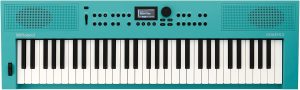
The GO:KEYS 3 is the most ambitious keyboard among these three.
It provides:
- 61 velocity-sensitive keys
- 1,154 tones
- 74 drum kits
- 203 accompaniment styles
- 304 preset chord patterns
- ZEN-Core sound engine
- Bluetooth Audio/MIDI
- USB audio/MIDI
- Recording capability
- Arpeggiator
Roland also specifies maximum polyphony of up to 256 notes for GO:KEYS 3 and GO:KEYS 5.
Best for:
Songwriters, creative beginners and musicians who want to explore far beyond traditional piano sounds.
[Check Roland GO:KEYS 3 Price on Amazon →]
What About Roland GO:KEYS 5?
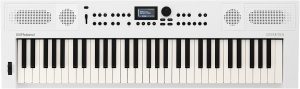
Since it is also currently available on Amazon, it’s worth mentioning as an upgrade option.
I wouldn’t make it a fourth principal recommendation because this article is about choosing between instrument categories, not ranking every keyboard available.
But someone attracted to GO:KEYS 3 who wants the additional capabilities of the higher model should certainly compare the GO:KEYS 5 before buying.
[Check Roland GO:KEYS 5 Price on Amazon →]
Digital Piano or Keyboard: Which Should YOU Buy?
Here’s my simplest decision guide.
Buy a DIGITAL PIANO if:
- You primarily want to learn piano.
- You’re taking formal piano lessons.
- You want to play classical music.
- Acoustic-piano-like touch matters.
- You want 88 weighted keys.
- You expect to progress to intermediate or advanced repertoire.
- You may eventually play an acoustic piano.
Buy a KEYBOARD if:
- Portability is extremely important.
- You want hundreds of instrument sounds.
- You enjoy rhythms and automatic accompaniment.
- You’re interested in songwriting.
- You want to experiment with different musical styles.
- You’re buying for recreational use.
- Space and budget are major concerns.
And there’s nothing wrong with eventually owning both.
Many musicians use a digital piano for serious practice and a portable keyboard for composing, arranging, performing or experimenting with sounds.
Frequently Asked Questions
Is a digital piano better than a keyboard?
Not universally.
A digital piano is generally better for traditional piano learning and realistic piano playing, while a keyboard can be better for portability, songwriting, accompaniment and sound variety.
Is a keyboard or digital piano better for beginners?
For a beginner taking serious piano lessons, I’d generally recommend an 88-key weighted digital piano.
For a casual beginner exploring music, a portable keyboard can be an excellent and less expensive starting point.
Can you learn piano on a keyboard?
Yes.
You can learn notes, chords, scales, rhythm and many songs on a keyboard.
However, a lightweight keyboard doesn’t reproduce the physical response of an acoustic piano as closely as a good hammer-action digital piano.
Do beginners need 88 keys?
Not immediately.
But 88 keys give you the complete piano range and reduce the likelihood that you’ll outgrow the instrument.
Are weighted keys important?
For serious piano learning, yes.
Weighted keys help develop finger control and dynamic technique that transfer more naturally to acoustic piano.
Can a digital piano have other instrument sounds?
Yes.
For example, the Yamaha P-225 has 24 voices, while the Roland FP-30X provides many additional tones beyond its piano sounds.
Digital pianos simply tend to put greater emphasis on piano rather than sheer sound quantity.
Why do keyboards have so many sounds?
Because they’re designed for musical versatility.
A keyboard may function as a piano, organ, synthesizer, string section, bass, drum machine and accompaniment system within one instrument.
Which is easier to carry?
Usually a keyboard.
Our Casio CT-S300 example weighs approximately 3.3 kg, compared with 11.5 kg for the Yamaha P-225 and 14.8 kg for the Roland FP-30X.
Which is better for classical music?
A digital piano with 88 weighted hammer-action keys.
Which is better for songwriting?
Often a keyboard because of its larger sound library, rhythms and accompaniment functions.
Final Verdict
The difference between a digital piano and a keyboard becomes much easier to understand when you stop asking:
“Which instrument is better?”
and instead ask:
“What kind of musician do I want to become?”
If you dream of playing Beethoven, Chopin, jazz standards or beautiful solo-piano arrangements, start with a digital piano.
If you’re fascinated by songwriting, rhythms, synthesizers, accompaniment and experimenting with hundreds of sounds, a keyboard may be far more inspiring.
For most people who specifically say:
“I want to learn piano.”
my recommendation is an 88-key weighted digital piano.
Among our examples, the Yamaha P-225 is an excellent all-round choice, while the Roland FP-30X is especially compelling for serious long-term piano study and the Casio PX-S1100 is excellent where space is limited.
If you’ve decided that a keyboard suits you better, the Casio CT-S300 is an affordable starting point, the CT-S400 provides substantially more creative capability, and the Roland GO:KEYS 3 is the strongest choice here for musicians interested in songwriting and musical exploration.
The best instrument isn’t necessarily the one with the most sounds, the most keys or the highest price.
It’s the one that makes you want to sit down and play every day.
If you’ve decided that a keyboard better suits your needs and budget, see our Best Cheap Keyboards in 2026: 5 Budget Picks That Are Actually Worth Buying for our current recommendations.
Whichever instrument you choose, our Simply Piano Review 2026: Is It Good for Beginners? looks at an app-based approach to learning your first notes, chords and songs.
If you’ve decided on a full-size digital piano rather than a portable keyboard, our Best 88-Key Weighted Keyboards for Beginners in 2026: 7 Top Picks compares seven beginner-friendly options.
Players who like the portability of a keyboard but want a more piano-like action can see our Best Portable Digital Pianos for Beginners in 2026: 5 Lightweight Picks.
One of the biggest differences between many keyboards and digital pianos is the key action; 88 Weighted Keys: Do You Really Need Them on a Digital Piano? explains when full-size weighted action is worth having.
If you’re considering a lightweight 61-key Yamaha rather than an 88-key digital piano, our Yamaha PSR-E373 vs PSR-E383: Should You Still Buy the Older Keyboard in 2026? compares two popular generations of Yamaha’s beginner portable keyboard.
If you’re buying your first instrument and want to understand the basics before choosing between a keyboard and digital piano, read our Piano Essentials: A Beginner’s Guide to Buying and Playing Piano.
Once you decide that a digital piano is right for you, the next step is choosing a manufacturer. Our digital piano brand comparison explains which brands are strongest for beginners, home practice, classical playing and stage use.
Players who want a more acoustic-piano-like response may want to explore full-size Yamaha keyboards with weighted action before choosing between a keyboard and a digital piano.
If a lighter, more portable instrument suits your goals better than an 88-key digital piano, our guide to Yamaha 61-key keyboards for beginners looks at several compact Yamaha options designed for learning, casual playing and versatility.
Players who want Casio’s portability without giving up realistic resistance can also compare our weighted Casio digital pianos to see which models best balance touch, size and features.
Another advantage of many modern instruments is the possibility of using a digital piano as a MIDI controller for virtual instruments, recording software and compatible apps.
If you have decided that a digital piano suits your goals better than a lightweight keyboard, our guide to budget-friendly digital pianos with realistic sound highlights models that balance price, touch and piano tone.
If recording is part of your plans, our guide to choosing a keyboard for a home studio explains which features matter most for connecting to recording software and capturing expressive performances.
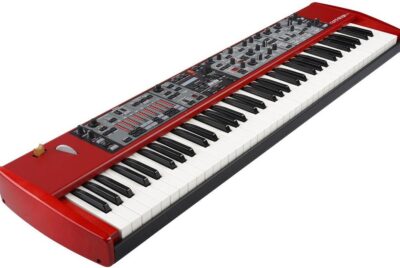
At the professional end of the keyboard spectrum, instruments such as the Nord Wave 2 performance synthesizer demonstrate just how far a keyboard can move beyond the traditional digital-piano concept.
Once you’ve decided which type of instrument suits you, our guide to choosing the right keyboard piano explains the specifications and features worth checking before you buy.
Related readings:

- Start with beginner lessons or advanced courses.
- Learn at your own pace with instant feedback.
- Play classical, pop, and Disney tunes with tailored exercises.
- Begin your piano journey today with SIMPLY PIANO!