Best Casio Digital Pianos with Weighted Keys in 2026: 5 Models Compared
If you’re looking for a Casio keyboard with weighted keys, there’s an important distinction to understand before you buy.
Not every Casio keyboard has weighted keys—and even among Casio’s 88-key digital pianos, the keyboard actions aren’t all the same.
Some models are designed primarily for beginners who want an affordable introduction to realistic piano playing. Others offer more sophisticated hammer-action systems intended for experienced pianists who care considerably more about touch and expression.
For 2026, five Casio models stand out at different levels:
- Casio CDP-S160 — Best Budget Weighted Casio
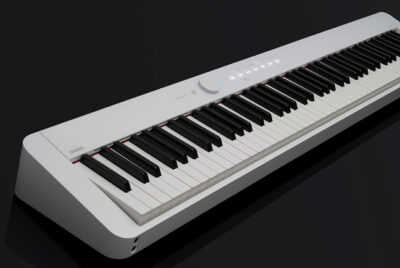
- Casio PX-S1100 — Best Overall
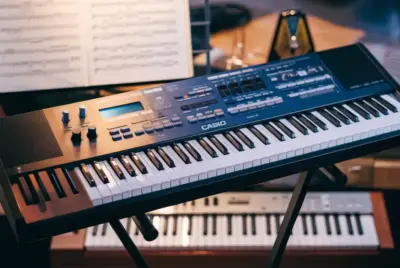
- Casio PX-S3100 — Best for Features and Versatility
- Casio PX-S5000 — Best Premium Portable Action
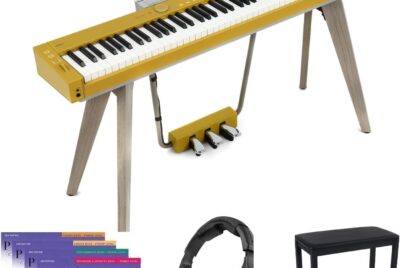
- Casio PX-S7000 — Best Premium Design and Home Piano
All five have 88 weighted, hammer-action keys, but there are significant differences in keyboard action, sounds, features, portability and intended use.
Let’s compare them.
Disclosure: Some links on Pianos-Galore are affiliate links. If you purchase through these links, we may receive a small commission at no additional cost to you.
Best Casio Weighted-Key Digital Pianos: Quick Comparison
| Model | Keys/Action | Polyphony | Tones | Best For |
|---|---|---|---|---|
| Casio CDP-S160 | 88, Scaled Hammer Action II | 64 | 10 | Budget beginners |
| Casio PX-S1100 | 88, Smart Scaled Hammer Action | 192 | 18 | Best overall |
| Casio PX-S3100 | 88, Smart Scaled Hammer Action | 192 | 700 | Versatility |
| Casio PX-S5000 | 88, Smart Hybrid Hammer Action | 192 | 23 | Premium portable piano feel |
| Casio PX-S7000 | 88, Smart Hybrid Hammer Action | 256 | 400 | Premium home/design piano |
Quick Recommendation
For beginners on a tight budget, start with the CDP-S160.
For the best balance of price, portability and piano-oriented features, our overall recommendation is the PX-S1100.
Choose the PX-S3100 if you want weighted keys but also enjoy experimenting with hundreds of sounds, accompaniment and performance features.
Move up to the PX-S5000 if keyboard action and piano feel are higher priorities.
And if you want Casio’s premium combination of piano performance, sophisticated features and furniture-quality presentation, consider the PX-S7000.
Why Weighted Keys Matter
When you press a key on an acoustic piano, you’re moving a mechanical system that ultimately causes a hammer to strike a string.
That mechanical process creates resistance beneath your fingers.
An inexpensive portable keyboard normally feels much lighter because there isn’t an acoustic hammer mechanism behind the keys.
Digital-piano manufacturers therefore design weighted and hammer-action keyboards to simulate some of the physical characteristics of an acoustic piano.
This matters because your fingers aren’t merely learning which notes to play.
They’re also learning:
- How much force to apply
- How to control dynamics
- How to play softly
- How to play loudly without losing control
- How to balance notes within chords
- How to control repeated notes
- How to shape musical phrases
For serious piano practice, keyboard feel can be more important than having hundreds of additional instrument sounds.
[Internal link: Weighted vs Semi-Weighted Keys]
Are All Casio Weighted Keyboards the Same?
No.
This is one of the most important things to understand when comparing Casio digital pianos.
The five models in this guide use three different Casio keyboard-action families.
Scaled Hammer Action Keyboard II
Found on:
CDP-S160
This is Casio’s affordable hammer-action solution for its compact CDP series.
Smart Scaled Hammer Action Keyboard
Found on:
PX-S1100 PX-S3100
These Privia models combine compact dimensions with an 88-key hammer-action keyboard.
Smart Hybrid Hammer Action Keyboard
Found on:
PX-S5000 PX-S7000
This is the significant step upward in our comparison.
The keys use a hybrid of wood and resin, giving Casio considerably more scope to create a premium playing experience while maintaining the slim Privia design.
So although all five instruments qualify as weighted-key digital pianos, don’t assume they’ll feel identical.
1. Casio CDP-S160 — Best Budget Weighted Casio
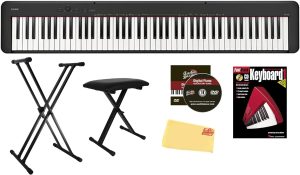
Best for:
Beginners who want an affordable 88-key hammer-action digital piano without paying for features they may not need.
The CDP-S160 demonstrates something Casio does particularly well:
Putting a full 88-key hammer-action keyboard into a remarkably compact instrument.
Its main specifications include:
- 88 Scaled Hammer Action Keyboard II keys
- 3 touch-sensitivity levels plus off
- 64-note maximum polyphony
- 10 tones
- 8W + 8W amplification
- MIDI recording
- USB MIDI
- Duet mode
- Damper pedal included
- Optional three-pedal support
- Battery operation
- Approximately 10.5 kg weight
Those specifications aren’t spectacular when compared with premium digital pianos.
But that’s missing the point.
The CDP-S160 is about getting the essentials right.
Why We Like the CDP-S160 for Beginners
A beginner doesn’t necessarily need:
- 700 sounds
- Sophisticated effects
- Hundreds of accompaniment patterns
- Advanced recording
- Professional stage controls
What a piano student does need is a keyboard that helps develop appropriate playing technique.
The CDP-S160 provides 88 hammer-action keys in an affordable, portable package.
That’s much more relevant to a serious piano beginner than buying an inexpensive 61-key keyboard simply because it offers hundreds of sounds.
64-Note Polyphony: Is That Enough?
The CDP-S160’s 64-note polyphony is considerably lower than the 192 notes available on the PX-S1100, PX-S3100 and PX-S5000.
But for typical beginner practice, it should be adequate.
Higher polyphony becomes more important as arrangements become more complex, particularly when:
- Using sustain extensively
- Layering sounds
- Playing complex repertoire
- Using accompaniment
- Working with more sophisticated arrangements
For straightforward piano practice, 64-note polyphony shouldn’t automatically disqualify the CDP-S160.
Extremely Compact
The CDP-S160 is only about 232 mm deep and weighs approximately 10.5 kg.
That’s useful for:
- Apartments
- Bedrooms
- Small music rooms
- Students
- People who need to store the piano after practice
- Musicians who occasionally transport their instrument
It can also run on batteries, adding another level of flexibility.
Who Should Buy the CDP-S160?
Choose it if:
- You’re a beginner.
- You want 88 weighted keys.
- Your budget is limited.
- You don’t need hundreds of sounds.
- Space is limited.
- Portability matters.
- Your primary purpose is learning piano.
If your budget allows more, however, the PX-S1100 is worth considering.
[Check Casio CDP-S160 Price on Amazon →]
2. Casio PX-S1100 — Best Overall Casio Weighted Digital Piano
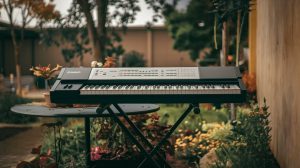
Best for:
Beginners through intermediate players wanting an excellent balance of piano feel, sound, portability and value.
If we had to recommend one model from this list to the widest range of buyers, it would be the PX-S1100.
It offers:
- 88 Smart Scaled Hammer Action keys
- 5 touch-sensitivity levels plus off
- Multi-Dimensional Morphing AiR sound source
- 192-note polyphony
- 18 tones
- 60 built-in songs
- 8W + 8W amplification
- MIDI recording
- Audio recording
- String resonance
- Damper resonance
- Key-action noise simulation
- Duet mode
- Optional three-pedal support
- Wireless MIDI and audio adapter
- Battery operation
- Approximately 11.2 kg weight
That’s an impressive package for such a slim instrument.
Why the PX-S1100 Is Our Best Overall Pick
The PX-S1100 strikes a particularly attractive balance.
It’s more sophisticated than the entry-level CDP-S160 without becoming unnecessarily complex.
You get better polyphony, Casio’s AiR sound engine, acoustic-simulation features, wireless connectivity and more recording capability.
But the instrument remains extremely compact.
This makes it suitable for:
- Piano students
- Adult beginners
- Intermediate players
- Apartment dwellers
- Home practice
- Musicians who need portability
Piano Sound and AiR Technology
Casio uses its Multi-Dimensional Morphing AiR sound source in the PX-S1100.
Digital-piano sound isn’t simply about recording one piano note and playing it back whenever you press a key.
The challenge is reproducing how an acoustic piano changes according to:
- Playing intensity
- Sustain pedal use
- Resonance between strings
- Key release
- Other physical interactions
The PX-S1100 includes acoustic-simulation features such as string and damper resonance to make the playing experience more responsive.
192-Note Polyphony
Moving from 64-note polyphony in the CDP-S160 to 192 notes gives the PX-S1100 considerably more headroom.
Remember that sustained piano notes continue consuming polyphony even after your fingers leave the keys.
For more advanced playing, generous polyphony helps reduce the likelihood of notes being cut off prematurely.
Wireless Connectivity
The included wireless adapter provides Bluetooth audio and MIDI capability.
That makes it easier to integrate the instrument with compatible:
- Phones
- Tablets
- Music apps
- Learning applications
You can also use Casio Music Space.
Who Should Buy the PX-S1100?
Choose it if:
- You want a serious first digital piano.
- You want 88 weighted keys.
- You value portability.
- You want stronger piano features than the CDP-S160.
- You don’t need hundreds of instrument sounds.
- You want Bluetooth capability.
- You want a digital piano that you won’t immediately outgrow.
For many home players, the PX-S1100 may be all the digital piano they actually need.
[Check Casio PX-S1100 Price on Amazon →]
3. Casio PX-S3100 — Best for Features and Versatility
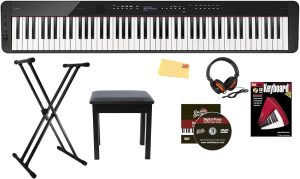
Best for:
Players who want weighted piano keys plus a huge sound library, rhythms, accompaniment and creative features.
The PX-S3100 is an interesting instrument because it combines two worlds.
It gives you the same general Smart Scaled Hammer Action keyboard family as the PX-S1100, but adds a dramatically larger collection of sounds and performance features.
Highlights include:
- 88 Smart Scaled Hammer Action keys
- 5 touch-sensitivity levels plus off
- Multi-Dimensional Morphing AiR sound source
- 192-note polyphony
- 700 tones
- 200 rhythms
- Automatic accompaniment
- 310 music presets
- 100 arpeggiator types
- Pitch-bend wheel
- Two assignable knobs
- 96 registration setups
- MIDI recorder
- Audio recorder
- 8W + 8W amplification
- Bluetooth audio/MIDI via included adapter
- Approximately 11.4 kg weight
This is much more than a straightforward piano.
PX-S1100 vs PX-S3100
This is probably the most important comparison for many buyers.
Both have:
- 88 keys
- Smart Scaled Hammer Action
- 192-note polyphony
- AiR sound technology
- Compact dimensions
- Built-in speakers
- Wireless capability
- Battery operation
So why buy the PX-S3100?
Features.
The PX-S1100 provides 18 tones.
The PX-S3100 provides 700.
It also gives you 200 rhythms, automatic accompaniment, registrations, arpeggiator functions, pitch bend and assignable controls.
Who Needs 700 Sounds?
Not everyone.
If you’re primarily studying classical piano, you may spend nearly all your time using one or two acoustic-piano sounds.
In that case, the PX-S1100 may make more financial sense.
But if you play:
- Pop
- Rock
- Jazz
- Worship music
- Contemporary music
- Arrangements
- One-person performances
the PX-S3100’s versatility becomes much more attractive.
Who Should Buy the PX-S3100?
Choose it if:
- You want weighted piano keys.
- You also enjoy keyboards and synthesizer-style features.
- You want hundreds of sounds.
- You use accompaniment.
- You perform.
- You compose or arrange.
- You want more controls than the PX-S1100 provides.
Think of it as a digital piano that also wants to be a versatile performance keyboard.
[Check Casio PX-S3100 Price on Amazon →]
4. Casio PX-S5000 — Best Premium Portable Action
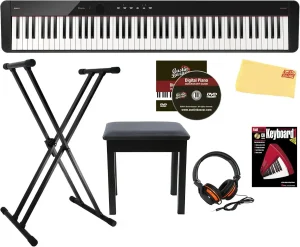
Best for:
Pianists who prioritize keyboard feel but still want a remarkably slim and portable digital piano.
This is where our comparison changes significantly.
The PX-S5000 introduces Casio’s Smart Hybrid Hammer Action Keyboard.
Its keys use a hybrid of wood and resin.
Specifications include:
- 88 Smart Hybrid Hammer Action keys
- Hybrid wood/resin key construction
- 5 touch-sensitivity levels plus off
- Multi-Dimensional Morphing AiR sound source
- 192-note polyphony
- 23 tones
- 60 built-in songs
- Acoustic simulation
- MIDI and audio recording
- 8W + 8W amplification
- Wireless MIDI/audio adapter
- Optional three-pedal support
- Battery operation
- Approximately 11.5 kg weight
Why the PX-S5000 Is Different
Compare its 23 tones with the PX-S3100’s 700 and you might initially wonder why the PX-S5000 belongs higher in the range.
The answer is simple:
The PX-S5000 isn’t primarily about giving you more sounds.
It’s about giving the pianist a more sophisticated keyboard action.
This illustrates an important lesson when buying a digital piano:
More features do not necessarily mean a better piano.
A serious pianist may happily trade hundreds of sounds for a more satisfying action.
Smart Hybrid Hammer Action
Casio’s Smart Hybrid Hammer Action keyboard uses keys made from a combination of wood and resin.
It also incorporates digital scaling and hammer-response technologies designed to create differences in playing response across the keyboard.
The goal is a more nuanced piano-playing experience while maintaining the exceptionally slim Privia form factor.
PX-S3100 vs PX-S5000
This is another important choice.
Choose PX-S3100 if you prioritize:
- Sounds
- Rhythms
- Accompaniment
- Performance controls
- Versatility
Choose PX-S5000 if you prioritize:
- Piano action
- Key feel
- Piano practice
- Simplicity
- Premium playing experience
Neither is automatically “better.”
They’re aimed at different players.
Who Should Buy the PX-S5000?
Choose it if:
- Piano feel matters more than hundreds of sounds.
- You’re an intermediate or experienced pianist.
- You want a premium portable digital piano.
- You value the hybrid wood/resin keyboard.
- You want a sophisticated instrument without a large cabinet.
- You need something relatively easy to move.
[Check Casio PX-S5000 Price on Amazon →]
5. Casio PX-S7000 — Best Premium Design and Home Piano
Best for:
Players who want premium Casio piano technology combined with a distinctive furniture-style instrument for the home.
The PX-S7000 sits at the top of this comparison.
Like the PX-S5000, it uses Casio’s Smart Hybrid Hammer Action Keyboard with hybrid wood/resin keys.
But the PX-S7000 goes considerably further in presentation, sound options and acoustic simulation.
Highlights include:
- 88 Smart Hybrid Hammer Action keys
- Hybrid wood/resin key construction
- 5 touch-sensitivity levels plus off
- 256-note maximum polyphony
- 400 built-in tones
- Advanced acoustic simulation
- Built-in speaker system
- Wireless MIDI/audio adapter
- Included stand
- Included fixed three-pedal unit
- Battery operation
- Premium furniture-oriented design
Unlike many digital pianos, the PX-S7000 is designed to look attractive from multiple angles rather than simply being pushed against a wall.
That makes it particularly interesting for modern living spaces.
Piano Meets Interior Design
Most portable digital pianos look like electronic instruments.
Most console digital pianos look like traditional piano furniture.
The PX-S7000 takes a different approach.
Its integrated stand and contemporary design make it much more visually distinctive.
That matters if the piano will occupy a prominent position in:
- A living room
- An open-plan home
- A studio
- A modern apartment
- A professionally designed interior
A piano is a musical instrument, but in a home it is also a large piece of furniture.
Casio clearly recognizes that with the PX-S7000.
More Than Good Looks
The PX-S7000 isn’t simply an expensive cabinet around an ordinary keyboard.
Its Smart Hybrid Hammer Action system puts it into the premium action category alongside the PX-S5000.
It also raises maximum polyphony to 256 notes and provides 400 tones, making it significantly more versatile than the PX-S5000.
Its acoustic-simulation capabilities are also more extensive.
PX-S5000 vs PX-S7000
Choose PX-S5000 if:
- You want premium action.
- Portability matters.
- You don’t need hundreds of sounds.
- You want to keep the instrument relatively simple.
Choose PX-S7000 if:
- The piano will stay primarily at home.
- Appearance matters.
- You want an integrated stand and pedals.
- You want more sounds and premium features.
- You’re willing to pay more for the complete package.
Who Should Buy the PX-S7000?
Choose it if:
- You want one of Casio’s premium digital pianos.
- You care about both playing experience and design.
- The piano will be part of your living space.
- You want a three-pedal setup.
- You want substantially more sounds than the PX-S5000.
- Portability isn’t your highest priority.
[Check Casio PX-S7000 Price on Amazon →]
Casio Weighted-Key Actions Explained
Let’s simplify the entire lineup.
Level 1: Scaled Hammer Action Keyboard II
CDP-S160
Best for:
Budget-conscious beginners.
Level 2: Smart Scaled Hammer Action
PX-S1100 PX-S3100
Best for:
Beginners through intermediate players wanting a slim Privia digital piano.
Level 3: Smart Hybrid Hammer Action
PX-S5000 PX-S7000
Best for:
Players who put greater emphasis on piano touch and keyboard feel.
The important point is that you shouldn’t choose a Casio weighted digital piano based only on the words “88 weighted keys.”
The specific action matters.
Which Casio Weighted Piano Is Best for Beginners?
For most beginners, we’d narrow the choice to:
CDP-S160
Best if keeping the purchase price low is the priority.
PX-S1100
Best if your budget allows you to invest in an instrument with more room for progression.
The PX-S1100 would be our preferred choice if affordable because its 192-note polyphony, AiR sound engine, acoustic simulation and connectivity make it a more complete long-term instrument.
[Internal link: Best Digital Pianos for Beginners]
Which Is Best for Classical Piano Practice?
If classical practice is a major priority, keyboard action becomes especially important.
We’d look closely at:
PX-S5000
and
PX-S7000
because of their Smart Hybrid Hammer Action keyboards.
However, beginners shouldn’t assume they need the most expensive instrument immediately.
The PX-S1100 can still be a very capable practice instrument for many students.
[Internal link: Best Digital Pianos for Classical Music Practice]
Which Casio Weighted Piano Is Most Portable?
The CDP-S160 is the lightest of our five recommendations at approximately 10.5 kg.
The PX-S1100, PX-S3100 and PX-S5000 remain surprisingly portable considering they contain full 88-key hammer-action keyboards.
This is one of the major strengths of Casio’s compact digital-piano designs.
If you’re regularly transporting the instrument, also consider:
- Overall weight
- Stand weight
- Pedals
- Protective case
- Power supply
- Whether you’ll need external amplification
Which Casio Is Best for Home Use?
That depends on what you mean by “home use.”
Small apartment:
PX-S1100
Beginner practice room:
CDP-S160
Home entertainment and multiple sounds:
PX-S3100
Serious pianist wanting premium action:
PX-S5000
Piano as part of the room’s interior:
PX-S7000
[Internal link: Best Casio Keyboards for Home Use]
Casio Weighted Keys vs Semi-Weighted Keys
Don’t confuse these terms.
A semi-weighted keyboard generally adds resistance to the key action but doesn’t reproduce acoustic-piano hammer behavior in the same way as a hammer-action digital piano.
All five models in this guide are intended to provide a more piano-oriented hammer-action experience.
That’s why they’re generally more appropriate for traditional piano study than lightweight synthesizer-style keyboard actions.
[Internal link: Weighted vs Semi-Weighted Keys]
Casio vs Yamaha and Roland Weighted Keys
There isn’t one universally “best” keyboard action.
Touch preference is personal.
Some pianists prefer a heavier action; others prefer something faster or lighter.
Casio’s particular advantage in this comparison is its ability to fit hammer-action keyboards into unusually slim instruments.
Yamaha and Roland also produce excellent weighted digital pianos, so brand shouldn’t be your only consideration.
Compare:
- Key resistance
- Return speed
- Surface texture
- Dynamic response
- Piano sound
- Pedaling
- Speaker system
- Portability
- Price
Whenever possible, play the instruments yourself before buying.
[Internal link: Best Piano Brands]
What to Look for When Buying a Casio Weighted Digital Piano
1. Keyboard Action
Don’t stop at “88 weighted keys.”
Identify the actual action.
2. Polyphony
64 notes can be adequate for beginners.
192 or 256 provides considerably more headroom for advanced playing and complex sustain.
3. Piano Sound
For serious piano practice, quality matters more than quantity.
Don’t automatically choose 700 sounds over 18.
4. Speakers
Built-in speakers are convenient, but headphones may be equally important for home practice.
5. Pedals
Beginners may start with a single sustain pedal.
More advanced players should consider a proper three-pedal setup with half-pedaling support.
6. Portability
An 88-key digital piano can still be portable, but stands and pedal systems add weight.
7. Connectivity
Consider whether you need:
- USB MIDI
- Bluetooth MIDI
- Bluetooth audio
- Audio recording
- Line outputs
- App connectivity
8. Your Long-Term Goals
The right piano for your first three months isn’t necessarily the right piano for your next five years.
Think ahead.
Common Mistakes When Buying a Weighted Casio
Buying the cheapest model automatically
The CDP-S160 is excellent value, but the PX-S1100 may be worth the additional investment for committed students.
Buying by number of sounds
700 sounds don’t make the PX-S3100 a better piano than the PX-S5000.
Assuming all weighted keys feel the same
They don’t.
Ignoring pedals
Pedaling becomes increasingly important as your repertoire progresses.
Paying for features you won’t use
A classical pianist may not need hundreds of rhythms and accompaniment patterns.
Ignoring size
Measure your space before buying—even Casio’s slim instruments are more than 1.3 meters wide.
Frequently Asked Questions
Which Casio keyboard has weighted keys?
Many Casio 88-key digital pianos have weighted hammer-action keyboards. Current examples include the CDP-S160, PX-S1100, PX-S3100, PX-S5000 and PX-S7000.
What is the cheapest Casio with weighted keys?
Among the models compared here, the CDP-S160 is our budget recommendation.
Prices change frequently, so check current retailer pricing before buying.
What is the best Casio weighted digital piano for beginners?
Our overall recommendation is the PX-S1100 if your budget allows.
For tighter budgets, consider the CDP-S160.
Is the Casio PX-S1100 fully weighted?
Yes. It uses Casio’s 88-key Smart Scaled Hammer Action Keyboard.
What’s the difference between PX-S1100 and PX-S3100?
They share many core piano characteristics, but the PX-S3100 adds far more sounds, rhythms, accompaniment and performance features.
What’s the difference between PX-S3100 and PX-S5000?
The PX-S3100 emphasizes versatility and features.
The PX-S5000 emphasizes premium piano action through Casio’s Smart Hybrid Hammer Action keyboard with hybrid wood/resin keys.
Does the PX-S7000 have wooden keys?
Its Smart Hybrid Hammer Action keys use a hybrid construction combining wood and resin.
Are weighted keys important for beginners?
They’re not absolutely necessary for learning basic notes, chords and music theory.
However, they’re strongly recommended for students who want to develop traditional piano technique.
Are Casio weighted digital pianos good for classical music?
Yes. Several Casio digital pianos are suitable for classical practice.
More advanced pianists should pay particular attention to keyboard action and pedal support rather than simply counting features.
Is Casio a good digital-piano brand?
Yes. Casio has an extensive digital-piano range spanning affordable beginner instruments through premium Privia models.
Best Casio Keyboards & Digital Pianos
Final Verdict: Which Casio Weighted Digital Piano Should You Buy?
There’s no single Casio weighted digital piano that’s best for everyone.
Best Budget — Casio CDP-S160
Choose this if you want to get started with 88 hammer-action keys for as little investment as practical.
Best Overall — Casio PX-S1100
Our recommendation for the widest range of buyers.
It combines a compact design, 88-key Smart Scaled Hammer Action, 192-note polyphony, good piano-oriented features and modern connectivity.
Best for Features — Casio PX-S3100
Choose this if you want the piano characteristics of the Privia range plus hundreds of sounds, rhythms, accompaniment and performance controls.
Best Premium Portable Action — Casio PX-S5000
Choose this if keyboard feel matters more to you than having hundreds of sounds.
Its Smart Hybrid Hammer Action keyboard is the primary reason to step up.
Best Premium Home/Design Piano — Casio PX-S7000
Choose this if you want premium Casio action, sophisticated features and an instrument designed to become part of your home’s interior.
If you’re still undecided, use this shortcut:
Tight budget → CDP-S160
Best all-around choice → PX-S1100
Want lots of sounds/features → PX-S3100
Prioritize premium keyboard feel → PX-S5000
Want premium feel + home design → PX-S7000
The most important thing is not simply buying a Casio with weighted keys.
It’s choosing the right Casio weighted-key action and feature set for the kind of pianist you want to become.
Related Articles
- Best Casio Keyboards & Digital Pianos in 2026: 6 Picks for Every Budget
- Best Casio Keyboards for Home Use in 2026: 4 Top Picks
- Best Digital Pianos for Beginners in 2026: 7 Top Picks for Learning Piano
- Digital Piano vs Keyboard: Which Should You Buy in 2026?
- Digital Pianos in 2026: The Complete Guide Before You Buy