Best Digital Pianos Under $1,000 in 2026: 7 Top Picks
You don’t need to spend several thousand dollars to get a digital piano that feels and sounds good enough for serious practice.
In fact, the under-$1,000 category may be the sweet spot of the digital piano market.
At this level, you can find instruments with:
- 88 weighted or hammer-action keys
- Realistic acoustic-piano sounds
- Good polyphony
- Built-in speakers
- Headphone practice
- USB/MIDI connectivity
- Bluetooth on selected models
- Pedal support
- Enough capability to take many beginners well into the intermediate stage
But there’s an interesting question:
If you have $1,000 available, should you actually spend the entire $1,000?
Not necessarily.
Some excellent digital pianos cost considerably less, and the right $400–$600 instrument may serve you better than a more expensive model packed with features you don’t need.
For 2026, these are our seven top choices:
- Yamaha P-225 — Best Overall
- Roland FP-30X — Best for Long-Term Value
- Kawai ES120 — Best for Piano-Focused Players
- Casio PX-S1100 — Best Slim & Portable Choice
- Roland FP-10 — Best Lower-Cost Piano Feel
- Alesis Prestige Artist — Best Features for the Money
- Donner DEP-20 — Best Budget Alternative
Let’s compare them.
Disclosure: Some links on Pianos-Galore are affiliate links. If you purchase through these links, we may receive a small commission at no additional cost to you.
Price note: Digital-piano prices change frequently. The models in this guide were available below $1,000 when checked, but always verify the current price before purchasing. Bundles containing furniture stands, benches, headphones or three-pedal systems may cost more than the base instrument.
Best Digital Pianos Under $1,000: Quick Comparison
| Model | Keyboard | Polyphony | Best For |
|---|---|---|---|
| Yamaha P-225 | 88-key GHC | 192 | Best Overall |
| Roland FP-30X | 88-key PHA-4 Standard | 256 | Long-Term Value |
| Kawai ES120 | 88-key RHC | 192 | Piano-Focused Players |
| Casio PX-S1100 | 88-key Smart Scaled Hammer Action | 192 | Portability |
| Roland FP-10 | 88-key PHA-4 Standard | 96 | Lower-Cost Piano Feel |
| Alesis Prestige Artist | 88-key Graded Hammer Action | 256 | Features & Speakers |
| Donner DEP-20 | 88-key Full-Weighted Action | 128 | Budget Alternative |
Our Quick Recommendations
Best overall: Yamaha P-225
Best long-term value: Roland FP-30X
Best for piano-focused practice: Kawai ES120
Best for apartments and portability: Casio PX-S1100
Best if keyboard feel matters on a lower budget: Roland FP-10
Best for features and powerful speakers: Alesis Prestige Artist
Best budget alternative: Donner DEP-20
What Should $1,000 Buy You in a Digital Piano?
If you’re prepared to spend up to $1,000, you should expect considerably more than a basic beginner keyboard.
At minimum, I’d look for:
88 Keys
If you’re buying primarily to learn piano, the full 88-key range is preferable.
Weighted or Hammer Action
The keyboard should provide resistance appropriate for piano-oriented playing.
Touch Sensitivity
The instrument should respond dynamically to how you play.
Good Piano Sound
The acoustic-piano voice should be convincing enough that you actually enjoy practicing.
Adequate Polyphony
Modern digital pianos in this price category generally provide plenty for normal piano practice.
Headphone Output
Essential for quiet practice.
Sustain Pedal Support
Preferably with half-pedal or three-pedal upgrade options if you intend to progress seriously.
USB/MIDI Connectivity
Useful for learning apps, recording and computer-based music applications.
[Internal link: Digital Pianos in 2026: The Complete Guide Before You Buy]
Do You Need to Spend the Full $1,000?
No.
This is one of the most important lessons in this guide.
Your goal should not be:
“How do I spend $1,000?”
It should be:
“What’s the least I need to spend to get the playing experience I want?”
Think of the market in roughly three levels.
Around $300–$500: Strong Beginner Value
This is where instruments such as the Roland FP-10 and Donner DEP-20 can become attractive, depending on current prices.
You’re often giving up some combination of:
- Speaker power
- Premium sound systems
- Connectivity
- Extra voices
- More advanced controls
- Higher polyphony
But you can still get 88 weighted keys.
For a beginner, that may matter far more than having hundreds of features.
Around $500–$750: The Sweet Spot
This is where competition becomes particularly strong.
Models such as the:
- Yamaha P-225
- Kawai ES120
- Casio PX-S1100
demonstrate just how capable mid-priced portable digital pianos have become.
For many home players, this level is all they’ll realistically need.
Around $750–$1,000: More Capability, Not Necessarily More Necessity
As you approach $1,000, you’re often paying for refinements rather than suddenly crossing from “bad” to “good.”
Those refinements can include:
- More powerful speakers
- Higher polyphony
- More sounds
- Better connectivity
- More sophisticated control
- Stronger performance capabilities
Whether they’re worth paying for depends on how you play.
[Internal link: Best Digital Pianos for Every Budget in 2026: Beginner to Pro]
1. Yamaha P-225 — Best Digital Piano Under $1,000 Overall
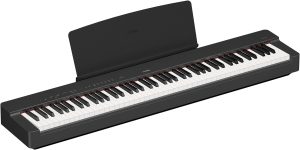
Best for:
Beginners and intermediate players who want an excellent balance of piano quality, portability, brand reputation and useful modern features.
The Yamaha P-225 is our overall choice because it doesn’t depend on one spectacular specification.
Instead, it does almost everything well.
Important features include:
- 88 Graded Hammer Compact keys
- Matte black keytops
- Yamaha CFX piano sound
- VRM Lite
- 192-note polyphony
- 24 voices
- Dual mode
- Split mode
- Duo mode
- USB audio/MIDI
- Optional three-pedal support
- Compact cabinet
- Approximately 25.4 lb / 11.5 kg weight
Graded Hammer Compact Action
Yamaha’s GHC, or Graded Hammer Compact, keyboard is designed to provide weighted piano response while allowing the instrument itself to remain relatively compact.
The lower register feels heavier than the upper register, following the general principle found in acoustic pianos.
That’s important for students developing traditional piano technique.
Yamaha CFX Sound
The P-225’s primary piano sound is based on Yamaha’s CFX concert grand.
It also incorporates Virtual Resonance Modeling Lite, which helps recreate some of the resonance characteristics associated with acoustic pianos.
A beginner may not analyze these details consciously.
But ultimately, a digital piano should make you want to sit down and play.
Sound quality contributes significantly to that.
Portability
The P-225 weighs only about 25.4 pounds.
That’s a major advantage if:
- You live in an apartment.
- You need to move the piano between rooms.
- You take it to lessons.
- You don’t want permanent furniture.
- You occasionally perform elsewhere.
You can use it on a portable stand or add a compatible furniture-style stand for a more traditional home setup.
Who Should Buy the Yamaha P-225?
Choose it if:
- You want one safe all-around recommendation.
- You’re a beginner planning to continue for years.
- You value Yamaha’s piano heritage.
- You want 192-note polyphony.
- You need portability.
- You want USB audio/MIDI.
- You don’t need hundreds of sounds.
[Check Yamaha P-225 Price on Amazon →]
2. Roland FP-30X — Best for Long-Term Value
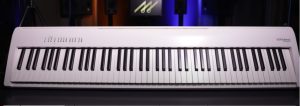
Best for:
Players willing to spend more within the sub-$1,000 category for an instrument with a strong keyboard action, high polyphony, good speakers and useful connectivity.
The Roland FP-30X sits above the FP-10 in Roland’s portable digital-piano family.
Key features include:
- 88 PHA-4 Standard keys
- Escapement
- Ivory Feel surfaces
- SuperNATURAL Piano sound
- 256-note polyphony
- 56 sounds accessible from the front panel
- Additional sounds through Roland’s compatible app
- 11W + 11W amplification
- Bluetooth audio
- Bluetooth MIDI
- USB audio/MIDI
- Twin Piano
- Optional three-pedal support
PHA-4 Standard Keyboard
One reason the FP-30X is particularly compelling is that it uses Roland’s PHA-4 Standard keyboard.
This includes:
- Hammer action
- Escapement
- Ivory Feel surfaces
The action is designed around piano playing rather than simply providing generic keyboard resistance.
For serious beginners, that’s a major strength.
256-Note Polyphony
The FP-30X provides up to 256-note polyphony.
Do beginners need 256 notes?
No.
But it gives the instrument plenty of headroom for:
- Sustain
- More advanced repertoire
- Layering
- Complex passages
It’s one reason the FP-30X can continue serving a player well beyond the first year of lessons.
Stronger Speakers
The FP-30X provides 11W + 11W amplification.
That’s useful if you regularly play without headphones and want more room-filling sound from the instrument itself.
Connectivity
Bluetooth audio lets you stream music through the piano’s speakers.
Bluetooth MIDI can be useful with compatible learning and music apps.
USB audio/MIDI adds further flexibility.
This makes the FP-30X particularly attractive for someone who wants a digital piano that integrates easily into a modern learning or recording setup.
Who Should Buy the Roland FP-30X?
Choose it if:
- You value keyboard feel.
- You want 256-note polyphony.
- You want stronger built-in speakers.
- Bluetooth matters.
- You want an instrument with room for long-term progression.
- You’re comfortable spending toward the upper part of your budget.
[Check Roland FP-30X Price on Amazon →]
3. Kawai ES120 — Best for Piano-Focused Players
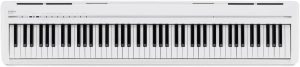
Best for:
Students and home players who care primarily about piano playing rather than having the longest feature list.
Kawai has a strong acoustic-piano heritage, and the ES120 reflects that orientation.
It includes:
- 88-key Responsive Hammer Compact action
- Grade-weighted hammers
- Matte key surfaces
- Harmonic Imaging sound technology
- 88-key stereo piano sampling
- 192-note polyphony
- 25 sounds
- Damper resonance
- String resonance
- Virtual Technician
- Bluetooth MIDI
- Bluetooth audio
- USB MIDI
- 20W speaker system
- Approximately 26.5 lb / 12 kg weight
Responsive Hammer Compact Action
The ES120 uses Kawai’s Responsive Hammer Compact, or RHC, action.
It includes grade-weighted hammers, meaning the resistance varies across the keyboard in a piano-oriented way.
For students focused primarily on developing piano technique, this should put the ES120 high on the shortlist.
Harmonic Imaging
The ES120 uses Kawai’s Harmonic Imaging sound technology with 88-key stereo sampling.
Its acoustic-piano sounds include recordings associated with Kawai’s SK-EX, EX and K-60 instruments.
It also incorporates damper resonance and string resonance.
Virtual Technician
Kawai’s Virtual Technician allows various aspects of the piano’s response and sound to be adjusted through supported controls/apps.
You don’t need to obsess over these parameters as a beginner.
But they’re useful as your ears and preferences develop.
Who Should Buy the Kawai ES120?
Choose it if:
- Piano practice is your main purpose.
- You value Kawai’s piano-oriented design.
- You want graded hammer action.
- You want Bluetooth audio and MIDI.
- You want 192-note polyphony.
- You want an instrument you can keep using as your skills improve.
[Check Kawai ES120 Price on Amazon →]
4. Casio PX-S1100 — Best Slim and Portable Digital Piano Under $1,000
Best for:
Apartment dwellers, students and anyone who needs a full 88-key weighted piano in the smallest practical space.
The Casio PX-S1100 demonstrates that an 88-key weighted digital piano doesn’t have to be bulky.
It includes:
- 88 Smart Scaled Hammer Action keys
- Five touch-response levels plus off
- Multi-Dimensional Morphing AiR sound source
- 192-note polyphony
- 18 tones
- MIDI recorder
- Audio recorder
- 8W + 8W amplification
- Wireless MIDI/audio adapter
- Optional three-pedal support
- Battery operation
- Approximately 24.7 lb / 11.2 kg weight
Its cabinet is only about 9.1 inches deep.
Why Size Matters
Digital-piano reviews often focus almost entirely on sound and keyboard action.
But the best piano in the world isn’t very useful if you have nowhere to put it.
The PX-S1100 is particularly attractive for:
- Apartments
- Condominiums
- Bedrooms
- Dormitories
- Small studios
- Multipurpose rooms
Its slim design can make the difference between having a piano permanently dominating a room and having an instrument that fits naturally into your living space.
Battery Operation
The PX-S1100 can also operate on AA batteries under specified conditions.
Most people will use the AC adapter at home.
But battery operation increases flexibility for rehearsals, lessons and unusual playing locations.
Who Should Buy the Casio PX-S1100?
Choose it if:
- Space is limited.
- You need to move your piano.
- You want one of the lightest models in this comparison.
- Battery operation is useful.
- You like modern minimalist design.
- You still want 88 weighted keys.
[Internal link: Best Portable Digital Pianos for Beginners in 2026: 5 Lightweight Picks]
[Check Casio PX-S1100 Price on Amazon →]
5. Roland FP-10 — Best Lower-Cost Piano Feel
Best for:
Budget-conscious players who want Roland’s PHA-4 Standard action without paying for all the FP-30X’s additional capabilities.
The FP-10 is one of the most interesting instruments in this comparison because it raises an important question:
Why spend more if the feature you care about most is already available for less?
The FP-10 includes:
- 88 PHA-4 Standard keys
- Escapement
- Ivory Feel
- SuperNATURAL Piano sound
- 96-note polyphony
- Dual mode
- Twin Piano
- USB connectivity
- Bluetooth MIDI in supported configurations
- Half-pedal capability with an optional compatible pedal
The FP-10 vs FP-30X Question
This is an important buying decision.
Both use Roland’s PHA-4 Standard keyboard.
So why pay more for the FP-30X?
The FP-30X adds advantages including:
- Higher polyphony
- More powerful speakers
- More sounds
- Bluetooth audio
- Broader connectivity
- Greater overall flexibility
But suppose you practice mostly with headphones.
Suppose you primarily use the acoustic-piano sound.
And suppose keyboard feel matters far more to you than having additional features.
The FP-10 may give you what you need while leaving a significant portion of your $1,000 budget untouched.
That’s value.
Who Should Buy the Roland FP-10?
Choose it if:
- Keyboard action is a priority.
- Your budget is limited.
- You don’t need powerful speakers.
- You mainly want to practice piano.
- You don’t need a huge sound library.
- You’d rather spend less than automatically use your entire $1,000 budget.
[Check Roland FP-10 Price on Amazon →]
6. Alesis Prestige Artist — Best Features for the Money
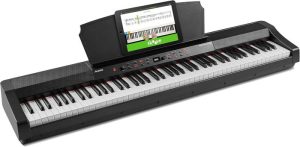
Best for:
Players who want strong speakers, high polyphony and plenty of built-in sounds without crossing the $1,000 threshold.
The Prestige Artist offers an impressive specification sheet:
- 88 graded hammer-action keys
- Adjustable touch response
- 30 premium multi-sampled voices
- 256-note polyphony
- 50W total speaker amplification
- OLED display
- Layer mode
- Split mode
- Lesson mode
- Record mode
- Stereo outputs
- Two headphone outputs
- Aux input
- USB MIDI
- Three-pedal connector
50-Watt Speaker System
This is one of the Prestige Artist’s standout features.
Its micro-array speaker system provides 50 watts total amplification.
If you regularly play without headphones, speaker power may matter more to you than it does to someone practicing quietly in an apartment.
The Prestige Artist is therefore worth considering for:
- Larger rooms
- Family playing
- Teaching
- Situations where stronger onboard sound is useful
256-Note Polyphony
Like the Roland FP-30X, the Prestige Artist provides up to 256-note polyphony.
Again, that’s more than a beginner needs.
But combined with 30 sounds, split/layer capability and its stronger speakers, it contributes to a very generous feature package.
Lesson Mode
Lesson Mode divides the keyboard into two identical pitch ranges.
A teacher and student can therefore sit together and demonstrate passages without constantly moving positions.
That’s a useful feature for formal instruction.
Who Should Buy the Alesis Prestige Artist?
Choose it if:
- You want powerful onboard speakers.
- You want 256-note polyphony.
- You like having more sounds.
- You want an OLED display.
- Lesson Mode appeals to you.
- You’re looking for maximum features per dollar.
[Check Alesis Prestige Artist Price on Amazon →]
7. Donner DEP-20 — Best Budget Alternative
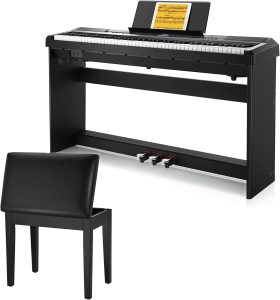
Best for:
Beginners who want 88 weighted keys and lots of sounds while spending considerably less than the $1,000 ceiling.
The Donner DEP-20 takes a different approach.
Rather than competing primarily on premium piano refinement, it offers a broad collection of features at an aggressive price.
Key specifications include:
- 88 full-weighted keys
- Adjustable touch response
- 128-note polyphony
- 238 tones
- 200 rhythms
- 100 demo songs
- Dual-tone functionality
- Keyboard split
- Recording
- USB MIDI
- LCD display
- Two 25W speakers
238 Sounds
The DEP-20 offers considerably more sounds than the piano-focused models in this comparison.
That can appeal to:
- Beginners exploring different instruments
- Casual players
- Songwriters
- Families
- Players who enjoy experimenting
If you only ever use one acoustic-piano voice, this number won’t matter much.
But if variety is important to you, it’s a genuine selling point.
128-Note Polyphony
The DEP-20’s 128-note polyphony is entirely respectable at this level.
Again, don’t become obsessed with the biggest number.
128 notes are enough for a wide range of normal piano playing.
Who Should Buy the Donner DEP-20?
Choose it if:
- Price is a major priority.
- You want 88 weighted keys.
- You like having many sounds.
- You want built-in rhythms.
- USB MIDI matters.
- You want to maximize features while minimizing cost.
Best Donner Digital Pianos in 2026: 6 Models for Beginners and Home Players
[Check Donner DEP-20 Price on Amazon →]
Which Digital Piano Under $1,000 Has the Best Keyboard?
This is subjective.
But I’d put these high on the shortlist:
Roland FP-30X / FP-10 — PHA-4 Standard action
Kawai ES120 — Responsive Hammer Compact
Yamaha P-225 — Graded Hammer Compact
All are designed around piano-oriented playing.
The best choice depends partly on personal preference.
If possible, try them before purchasing.
88 Weighted Keys: Do You Really Need Them on a Digital Piano?]
Best Digital Piano Under $1,000 for Beginners
Yamaha P-225 is our overall choice.
It offers a strong combination of:
- 88 graded weighted keys
- Good piano sound
- 192-note polyphony
- Manageable weight
- Useful connectivity
- Long-term usability
But don’t overlook the FP-10 if you’re trying to spend less.
Best Digital Pianos for Beginners in 2026: 7 Top Picks for Learning Piano
Best Digital Piano Under $1,000 for Classical Music
I’d particularly compare:
- Kawai ES120
- Yamaha P-225
- Roland FP-30X
For classical practice, I’d prioritize:
- Keyboard action
- Dynamic response
- Piano sound
- Pedal capability
over huge sound libraries or accompaniment features.
Best Digital Pianos for Classical Music Practice
Best Digital Piano Under $1,000 for Apartments
Casio PX-S1100
Its shallow cabinet and approximately 24.7-pound weight make it especially easy to fit into smaller homes.
Headphones also allow quiet practice.
Best Digital Piano Under $1,000 for Features
Alesis Prestige Artist
Its combination of:
- 256-note polyphony
- 30 sounds
- 50W amplification
- OLED display
- Lesson Mode
- Record Mode
makes it especially strong if specifications and built-in capabilities matter to you.
Best Value If You Don’t Want to Spend $1,000
Roland FP-10 deserves serious consideration.
You get the same PHA-4 Standard keyboard family used in the more expensive FP-30X while giving up some of the latter’s speaker power, polyphony and connectivity.
The Donner DEP-20 is another alternative if your priorities lean toward feature quantity and low price.
[Internal link: Best Cheap Keyboards in 2026: 5 Budget Picks That Are Actually Worth Buying]
Should a Beginner Spend $1,000 on a Digital Piano?
Only if the additional quality and features are useful.
Suppose you’re choosing between:
$450 instrument + regular lessons
and
$1,000 instrument + no lessons because you’ve exhausted your budget.
For many beginners, I’d choose the first option.
Your total piano-learning budget may also need to cover:
- Stand
- Bench
- Sustain pedal
- Headphones
- Lessons
- Sheet music
- Learning apps
Don’t spend your entire budget on the instrument while forgetting everything else.
What Matters More Than Price?
Once you’re shopping within a reasonable quality range, several things matter more than simply buying the most expensive model.
Keyboard Feel
You’ll interact with the keyboard every time you play.
Piano Sound
Choose something you enjoy hearing.
Practice Habits
A $500 piano played daily will do more for your progress than a $1,000 piano collecting dust.
Proper Height
A stable stand and appropriate bench height matter.
Pedal
A decent sustain pedal becomes increasingly important.
Lessons or Structured Learning
The instrument is only part of the equation.
7 Mistakes to Avoid When Buying a Digital Piano Under $1,000
1. Assuming More Expensive Automatically Means Better for You
A lower-cost instrument may already satisfy your needs.
2. Looking Only at Polyphony
256 isn’t automatically “twice as good” as 128.
3. Ignoring Keyboard Action
For piano study, action is one of the most important considerations.
4. Buying Hundreds of Sounds You’ll Never Use
If you primarily play piano, don’t let huge tone counts distract you.
5. Forgetting Accessories
Check whether you need to buy a stand, bench, pedal or headphones separately.
6. Ignoring Weight and Size
Measure your room before ordering.
7. Assuming the Amazon Bundle Is the Same as the Base Piano
Bundles vary.
A piano may be under $1,000 while a package containing furniture, pedals and other accessories exceeds your budget.
Frequently Asked Questions
What is the best digital piano under $1,000?
Our overall choice is the Yamaha P-225 because it provides an excellent balance of weighted action, piano sound, portability, polyphony and useful features.
Is $1,000 enough for a good digital piano?
Yes.
You can buy a very capable 88-key hammer-action digital piano for considerably less than $1,000.
Should a beginner spend $1,000 on a digital piano?
Not necessarily.
Many beginners will be well served by instruments costing significantly less. Spend more when the additional action, sound, speakers or features genuinely benefit you.
What is the best Roland digital piano under $1,000?
The FP-30X is our preferred Roland if your budget allows it. The FP-10 is an excellent lower-cost alternative.
What is the best portable digital piano under $1,000?
The Casio PX-S1100 is our portability choice because of its slim dimensions and low weight.
Which model is best for classical piano?
I’d shortlist the Kawai ES120, Yamaha P-225 and Roland FP-30X.
Do I need 256-note polyphony?
Probably not.
It’s useful, but 96, 128 or 192 notes can already be sufficient for a great deal of piano repertoire.
Should I buy a console piano instead?
Possibly, if portability isn’t important and you want a permanent furniture-style setup.
But portable slab-style digital pianos generally offer excellent value because you’re paying less for cabinetry.
Are weighted keys necessary?
If your goal is serious piano learning, I recommend them.
For casual keyboard playing, songwriting or music production, they’re less essential.
Should I buy online or try the piano first?
If possible, try several actions in person.
Keyboard feel is highly personal.
Once you know what you like, online buying can make it easier to compare prices and packages.
Final Verdict: Which Digital Piano Under $1,000 Should You Buy?
The sub-$1,000 digital-piano market offers remarkably good choices.
You don’t have to spend the full amount.
Instead, choose according to what matters most to you.
Best Overall — Yamaha P-225
Our safest all-around recommendation for beginners and intermediate home players.
Best Long-Term Value — Roland FP-30X
Excellent PHA-4 Standard action, 256-note polyphony, stronger speakers and useful connectivity.
Best for Piano-Focused Players — Kawai ES120
A strong choice for students who prioritize piano action, piano sound and serious practice.
Best for Portability — Casio PX-S1100
Ideal when space, weight and easy storage matter.
Best Lower-Cost Piano Feel — Roland FP-10
A compelling choice if you want Roland’s PHA-4 Standard action without paying for the FP-30X’s extra features.
Best Features for the Money — Alesis Prestige Artist
256-note polyphony, 50W speakers, 30 sounds and graded hammer action make it an impressive feature package.
Best Budget Alternative — Donner DEP-20
A low-cost route to 88 weighted keys with a large sound library and plenty of additional features.
If you’re still unsure, use this shortcut:
Want the best all-rounder? → Yamaha P-225
Want stronger long-term features? → Roland FP-30X
Focused mainly on piano practice? → Kawai ES120
Need maximum portability? → Casio PX-S1100
Want to spend less without sacrificing a serious piano action? → Roland FP-10
Want powerful speakers and lots of features? → Alesis Prestige Artist
Want the lowest-cost feature-rich alternative? → Donner DEP-20
The most important takeaway is simple:
A $1,000 budget doesn’t mean you need to buy a $1,000 piano.
Buy the least expensive instrument that provides the keyboard action, sound, speakers, connectivity and long-term capability you genuinely need.
Then use the money you save for the thing that matters even more:
learning to play it.
If you’re particularly interested in Kawai, our Best Kawai Digital Pianos 2026: Which Model Is Right for You? explains how the ES120 and ES920 fit into Kawai’s broader range of portable and home digital pianos.
If your budget can extend beyond $1,000, our Best Digital Pianos in 2026: 7 Top-Rated Picks for Different Players also compares premium instruments for advanced pianists and professional performers.
Many of the instruments in this guide come from manufacturers with very different approaches to keyboard action, sound and design. Our Best Piano Brands in 2026: 10 Top Names Compared explains the strengths of the leading piano manufacturers in more detail.
Yamaha, Roland, Kawai and Casio all compete strongly in this price range, but each approaches digital-piano design somewhat differently. See our Best Piano Brands in 2026: 10 Top Names Compared for the bigger picture on these manufacturers.
Buyers working with both a limited budget and limited floor space can also see our Best Compact Digital Pianos for Small Spaces in 2026: 6 Top Picks for models selected specifically with smaller rooms in mind.
For a deeper examination of one of our leading choices in this price category, read our Yamaha P-225 review covering its strengths, compromises and ideal users.
Related Articles
- Best Digital Pianos for Every Budget in 2026: Beginner to Pro
- Best Digital Pianos for Beginners in 2026: 7 Top Picks for Learning Piano
- Best 88-Key Weighted Keyboards for Beginners in 2026: 7 Top Picks
- 88 Weighted Keys: Do You Really Need Them on a Digital Piano?
- Digital Pianos in 2026: The Complete Guide Before You Buy
——————————-
Ready to learn piano? Simply Piano is the app you’ve been searching for.

• Beginner-friendly lessons and advanced courses are tailored to your goals.
• Learn at your own pace with real-time feedback to guide your progress.
• Play classical masterpieces, pop hits, and Disney favorites.
• Start your piano journey today with SIMPLY PIANO!