Digital Pianos in 2026: The Complete Guide Before You Buy

Digital pianos have changed dramatically.
Not very long ago, buying a digital piano often meant accepting obvious compromises in keyboard feel and sound in exchange for lower cost, portability and convenience.
That is no longer the whole story.
Today’s digital pianos range from compact instruments for beginners to sophisticated home and stage pianos designed for demanding musicians. Some use detailed samples of world-class concert grands. Others combine sampling with modeling technologies designed to reproduce string resonance, pedal behavior and other acoustic characteristics.
Yet the huge range of choices creates another problem:
How do you know which digital piano is actually right for you?
An instrument with hundreds of sounds isn’t automatically better than one with ten.
A piano with 256-note polyphony isn’t automatically better than one with 192.
More expensive doesn’t always mean better for your particular needs.
And the phrase “weighted keys” by itself tells you much less than many buyers realize.
This guide explains the important things you should understand before buying a digital piano in 2026.
What Is a Digital Piano?
A digital piano is an electronic keyboard instrument designed primarily to reproduce the experience of playing an acoustic piano.
Unlike an acoustic piano, it does not use strings and a soundboard to generate its primary sound.
Instead, pressing a key triggers electronically generated sound through headphones, internal speakers or external amplification.
Most serious digital pianos combine:
- 88 piano-size keys
- Weighted or hammer-action keyboard mechanisms
- Touch sensitivity
- Acoustic-piano sounds
- Built-in speakers or professional audio outputs
- Sustain-pedal capability
- Headphone connections
- MIDI or USB connectivity
Higher-level instruments may also offer:
- Multiple grand-piano sounds
- Physical modeling
- String and damper resonance
- Half-pedaling
- Wooden key components
- Multi-speaker sound systems
- Bluetooth
- USB audio
- Recording
- Smartphone-app integration
The aim is not simply to produce “a piano sound.”
The better instruments attempt to recreate both the physical response and musical behavior of an acoustic piano.
Digital Piano vs Keyboard: They Are Not the Same Thing
The terms “keyboard” and “digital piano” are often used interchangeably.
Technically, however, they describe somewhat different instruments.
A typical portable keyboard emphasizes:
- Many sounds
- Rhythms
- Accompaniment
- Light weight
- Smaller 61- or 76-key layouts
- Synth-style or lightly weighted keys
A digital piano generally emphasizes:
- Piano playing
- 88 keys
- Weighted action
- Acoustic-piano tone
- Sustain-pedal control
- Realistic dynamics
There is plenty of overlap.
Some keyboards have 88 weighted keys.
Some digital pianos contain hundreds of additional sounds and rhythms.
But if your primary goal is learning or playing piano, keyboard action should usually receive far more attention than the number of extra sounds.
[Internal link: Digital Piano vs Keyboard: Which Should You Buy?]
The Four Main Types of Digital Piano
Digital pianos come in several distinct forms.
Understanding these categories can narrow your search immediately.
1. Portable Digital Pianos
Portable digital pianos are usually slab-shaped instruments designed to sit on a stand.
Examples include popular models in Yamaha’s P series, Roland’s FP range, Kawai’s ES line and Casio’s Privia family.
They typically offer:
- 88 weighted keys
- Built-in speakers
- Headphone output
- Sustain-pedal input
- Relatively compact dimensions
- Optional furniture stands and pedal units
Best for:
- Beginners
- Students
- Apartments
- Small rooms
- Pianists who occasionally move their instrument
- Buyers wanting strong value
Portable does not necessarily mean lightweight, especially at the premium end.
But these instruments generally occupy much less permanent space than console digital pianos.
2. Console or Digital Upright Pianos
Console digital pianos are built into furniture-style cabinets.
They are designed to resemble traditional upright pianos and normally include:
- 88 weighted keys
- Integrated stand
- Three-pedal unit
- Built-in speaker system
- Music rest
- Furniture-style cabinet
They are primarily intended to remain in one location.
Best for:
- Family homes
- Piano students
- Formal living rooms
- Players who want a traditional piano appearance
- People who don’t need portability
Many console models also have larger speaker systems than similarly priced portable instruments.
Best Digital Upright Pianos for Home Use: 2026 Buying Guide
3. Stage Pianos
Stage pianos are designed primarily for professional performance.
They often emphasize:
- High-quality piano and electric-piano sounds
- Professional audio outputs
- Real-time controls
- Splits and layers
- MIDI control
- Durability
- Fast access to sounds
Many do not include built-in speakers.
That is because professional musicians frequently connect them directly to:
- PA systems
- Stage monitors
- Mixing consoles
- Studio equipment
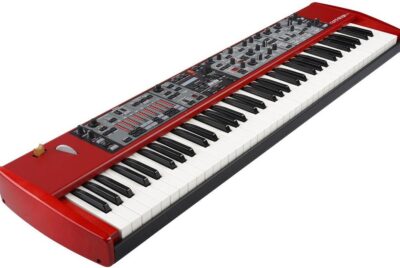
Stage pianos such as the Yamaha CP88 and professional Roland and Nord models can be exceptional instruments, but they may be unnecessarily expensive or inconvenient for a beginner who only wants a home practice piano.
4. Hybrid Digital Pianos
Hybrid instruments attempt to bridge the gap between acoustic and digital piano technologies.
Some use actual or highly sophisticated acoustic-style actions combined with digital sound generation.
They can offer:
- Advanced mechanical keyboard actions
- Premium pedal systems
- High-end speaker arrays
- Resonance simulation
- Acoustic-style cabinetry
These instruments can provide an extraordinary playing experience.
But they are generally considerably more expensive than mainstream portable and console digital pianos.
The Most Important Feature: Keyboard Action
When comparing digital pianos, buyers often begin with sounds.
For serious piano playing, however, keyboard action may be even more important.
An acoustic piano key activates a mechanical action containing levers and a hammer.
That mechanism naturally creates resistance.
A digital piano must imitate that sensation mechanically.
Yamaha, for example, explains that weighted digital-piano actions use physical mechanisms to approximate the resistance of acoustic piano keys, while graded weighting makes the bass keys feel heavier than the treble keys.
What Does “Weighted Keys” Actually Mean?
Not all weighted keyboards feel the same.
There are several broad levels.
Semi-Weighted Keys
Semi-weighted actions generally combine springs with additional resistance.
They can feel more substantial than completely unweighted keyboard keys but normally don’t replicate acoustic-piano action as closely as hammer-action systems.
They are more common in:
- Synthesizers
- MIDI controllers
- Some beginner keyboards
For serious piano study, a hammer-action keyboard is usually preferable.
Hammer Action
Hammer-action digital pianos incorporate mechanical resistance designed to simulate the hammer mechanism of an acoustic piano.
The goal is to create a more realistic relationship between:
finger movement → key resistance → musical dynamics
Hammer actions vary greatly in quality.
Two instruments can both advertise “88 weighted hammer-action keys” yet feel noticeably different.
Graded Hammer Action
Acoustic piano bass keys generally feel heavier than treble keys because of differences in the corresponding hammer and string system.
Graded digital actions attempt to imitate this behavior.
The lower register is weighted more heavily and the upper register progressively lighter.
For pianists learning traditional technique, graded hammer action can provide a more familiar transition between digital and acoustic instruments.
Triple Sensors and Repetition
Some higher-level digital piano actions use three sensors rather than two.
Why does that matter?
The additional sensing can allow a repeated note to trigger before the key has returned completely to its original position.
That can improve responsiveness for:
- Trills
- Repeated notes
- Fast classical passages
- Advanced repertoire
Triple sensors alone do not make an action great.
Mechanical design, pivot length, weighting and overall geometry also matter.
But repetition capability becomes increasingly important for advanced players.
Wooden Keys: Helpful, But Don’t Buy Based on Wood Alone
Premium digital pianos sometimes advertise wooden keys.
That can sound automatically superior.
It isn’t quite that simple.
Some instruments use solid wooden key structures.
Others incorporate wood into portions of the key.
And excellent actions can also be built using high-quality synthetic components.
What matters is the complete action:
- Weighting
- Key length
- Pivot behavior
- Repetition
- Sensor design
- Surface texture
- Consistency
Don’t buy a piano simply because the product page says “wood.”
Play it if possible.
How Digital Pianos Produce Their Sound
Digital piano sound generation typically relies on one or both of two broad approaches:
sampling and modeling.
Sampling
Sampling involves recording an acoustic piano and using those recordings as the basis of the digital sound.
Manufacturers may record:
- Individual keys
- Multiple dynamic levels
- Key-release sounds
- Pedal behavior
- Different microphone positions
- Resonances
Higher-level sampling systems can involve extremely detailed recordings.
Yamaha, for example, uses recordings of its flagship CFX concert grand and the Bösendorfer Imperial in various digital-piano ranges.
The resulting samples are mapped across the digital keyboard.
Modeling
Modeling takes a different approach.
Rather than relying entirely on recordings, mathematical algorithms recreate aspects of acoustic-piano behavior in real time.
These systems can model elements such as:
- String interaction
- Damper resonance
- Soundboard behavior
- Sympathetic vibration
- Note decay
Many modern instruments actually combine sampling and modeling techniques.
Yamaha’s Virtual Resonance Modeling, for example, calculates interactions among strings and other resonant elements according to notes and pedal behavior.
The practical lesson is this:
Don’t choose solely by whether a piano says “sampled” or “modeled.”
Listen to how convincingly the complete instrument responds when you play.
Polyphony: Important, But Often Misunderstood
Polyphony refers to the number of notes or sound elements an instrument can produce simultaneously.
Common figures include:
- 64
- 128
- 192
- 256
Some buyers assume:
256 polyphony must sound twice as good as 128.
That’s incorrect.
Polyphony affects how much simultaneous note information the sound engine can process before older notes potentially need to be dropped.
Pedaling, layering and complex sounds can use more polyphony than simply counting the keys you press.
For beginners
64 or 128 notes may be perfectly adequate depending on the instrument.
For intermediate and advanced pianists
192 or 256 can provide more headroom, particularly with extensive pedaling or layered sounds.
But polyphony should never be evaluated independently from:
- Sound engine
- Action
- Speakers
- Pedals
- Intended use
Built-In Speakers Matter More Than Many Buyers Realize
A digital piano can have excellent internal piano samples and still sound disappointing through inadequate speakers.
This is one weakness in many buying decisions.
People compare:
- Polyphony
- Number of voices
- Apps
- Bluetooth
but barely consider amplification.
Yet speakers are the final stage between the sound engine and your ears.
Important factors include:
- Amplifier power
- Number of speakers
- Speaker size
- Speaker positioning
- Cabinet acoustics
Premium console pianos may use several speakers positioned to create a more immersive sound field.
Portable models usually compromise more heavily because of size and weight.
Headphones Can Change the Experience Completely
One of the biggest practical advantages of a digital piano is headphone practice.
You can play:
- Late at night
- Early in the morning
- In an apartment
- While someone else watches television
- Without disturbing neighbors
Some premium instruments go further by using binaural or spatial headphone processing designed to make the piano seem less like sound coming directly from headphones.
For many households, this feature alone makes digital piano ownership dramatically more practical than acoustic piano ownership.
Don’t Ignore Pedals
Beginners sometimes treat the sustain pedal as an accessory.
For serious piano playing, pedals are fundamental.
An acoustic grand normally has three pedals:
- Damper/sustain
- Sostenuto
- Soft
Entry-level portable digital pianos may come with a simple footswitch.
Higher-level instruments may support full three-pedal assemblies.
What Is Half-Pedaling?
On an acoustic piano, the damper pedal isn’t simply:
ON or OFF.
Different pedal depths produce different amounts of damping.
Digital pianos with half-pedal support can reproduce more of that continuous control.
For beginner repertoire this may not seem important.
For advanced classical and expressive playing, it becomes much more significant.
If you plan to progress seriously, check whether the piano and pedal system support half-pedaling.
Connectivity: What Do You Actually Need?
Digital pianos can include a bewildering range of connection options.
Focus on what you will genuinely use.
USB-MIDI
USB-MIDI allows the piano to communicate performance data with a computer, tablet or compatible smartphone.
This can be used with:
- Music notation software
- Learning apps
- DAWs
- Virtual instruments
- Recording programs
It does not necessarily transmit the actual sound of the piano.
USB Audio
USB audio can transmit digital audio between the instrument and a computer or device.
This can simplify recording because the piano’s actual sound can be sent digitally without a separate audio interface in some setups.
Not every piano with USB-MIDI also supports USB audio.
Check carefully.
Bluetooth MIDI
Bluetooth MIDI can allow wireless communication with compatible apps.
This is useful for:
- Learning apps
- Sheet music applications
- MIDI control
Latency should still be considered in some professional applications.
Bluetooth Audio
Bluetooth audio generally allows music from a phone or tablet to play through the piano’s speakers.
That can be convenient for:
- Backing tracks
- Listening
- Playing along with recordings
Bluetooth audio is different from Bluetooth MIDI.
A piano may support one, both or neither.
Number of Sounds: More Isn’t Necessarily Better
One digital piano may contain 10 sounds.
Another may offer 700.
Which is better?
It depends on what you want to do.
A classical pianist may spend 95% of the time using one excellent grand-piano sound.
A songwriter may appreciate:
- Electric pianos
- Strings
- Pads
- Organs
- Bass
- Synth sounds
An arranger keyboard player may need hundreds of voices and accompaniment styles.
So instead of asking:
“How many sounds does this piano have?”
ask:
“Does it have the sounds I will actually use, and are they good?”
Recording Features
Even a basic recorder can be extremely helpful.
Recording yourself allows you to evaluate:
- Timing
- Dynamics
- Rhythm
- Accuracy
- Pedaling
Problems that are difficult to notice while playing often become obvious when listening back.
Some digital pianos offer simple one-track MIDI recording.
Others support:
- Multiple tracks
- Audio recording
- USB recording
- Computer DAW integration
For students, even the simplest recording function can be valuable.
Digital Pianos Don’t Need Tuning
This is one of their greatest practical advantages.
Acoustic piano strings gradually move out of tune and require professional tuning.
Digital pianos generate pitch electronically.
They therefore do not require periodic tuning.
That saves:
- Money
- Time
- Scheduling
- Maintenance
But “doesn’t need tuning” doesn’t mean “needs no care whatsoever.”
A digital piano still contains:
- Mechanical keys
- Electronic components
- Pedals
- Speakers
- Connectors
- Software
It should be protected from:
- Excessive moisture
- Extreme heat
- Dust
- Liquid spills
- Improper power sources
Firmware updates can also improve some models over their usable life.
Do Digital Pianos Depreciate?
Usually, yes.
Digital pianos are electronic products.
New generations can introduce:
- Improved actions
- Better sound engines
- New connectivity
- Updated apps
- Improved speakers
That tends to reduce the resale value of older models.
But the statement that acoustic pianos automatically appreciate while digital pianos lose value is misleading.
Many ordinary acoustic pianos also depreciate significantly.
Only certain high-quality acoustic instruments in desirable condition may retain or increase value under particular circumstances.
A piano should primarily be purchased as a musical instrument—not as an investment vehicle.
How Long Does a Digital Piano Last?
There is no single lifespan.
Durability depends on:
- Construction
- Playing frequency
- Environment
- Mechanical wear
- Electronics
- Parts availability
- Manufacturer support
The keyboard action receives the most physical use.
Over time, heavily played instruments may develop:
- Noisy keys
- Uneven response
- Worn contacts
- Mechanical looseness
A well-built digital piano used responsibly can serve for many years.
But unlike an acoustic piano, an old digital instrument may eventually become difficult to repair if proprietary electronic components are discontinued.
Are Digital Pianos Good Enough for Beginners?
Absolutely.
In fact, digital pianos offer several practical advantages for beginners:
- Lower initial cost than many acoustic pianos
- No tuning
- Headphones
- Metronome
- Recording
- Compact size
- Adjustable volume
- Learning-app connectivity
However, beginners should avoid choosing solely on price.
If you are learning conventional piano technique, prioritize:
88 keys + touch sensitivity + weighted hammer action + sustain pedal compatibility.
That foundation matters much more than having hundreds of extra sounds.
Best Digital Pianos for Beginners in 2026: 7 Top Picks for Learning Piano
Are Digital Pianos Good Enough for Classical Music?
Yes—provided the instrument is appropriate.
Classical pianists should prioritize:
- 88 weighted keys
- Good repetition
- Graded action
- Dynamic control
- Realistic pedal response
- Strong piano tone
- Adequate polyphony
More advanced players may benefit from:
- Triple sensors
- Longer key pivots
- Wooden-key actions
- Half-pedaling
- Detailed resonance modeling
No digital piano completely reproduces every physical characteristic of a fine acoustic grand.
But modern premium digital instruments can be highly capable practice tools.
Best Digital Pianos for Classical Music Practice
Digital Piano vs Acoustic Piano
Neither instrument is universally better.
They solve different problems.
| Feature | Digital Piano | Acoustic Piano |
|---|---|---|
| Sound Production | Electronic | Strings and soundboard |
| Tuning | Not required | Required |
| Headphones | Yes | Usually no |
| Volume Control | Yes | No |
| Recording | Often built in | External equipment needed |
| Moving | Generally easier | Difficult |
| Multiple Sounds | Often | No |
| Natural Acoustic Resonance | Simulated | Physical |
| Maintenance | Relatively low | Higher |
| Technology Obsolescence | Possible | Much lower |
Choose digital if:
- Quiet practice matters.
- You live in limited space.
- You want recording/connectivity.
- You don’t want tuning.
- You need portability.
Consider acoustic if:
- Acoustic resonance is a top priority.
- You have appropriate space.
- You enjoy the mechanical interaction of a real acoustic action.
- Regular tuning and maintenance are acceptable.
Why Digital Pianos Are Outselling Acoustic Pianos in 2026
How Much Should You Spend on a Digital Piano?
Instead of focusing on exact prices—which change constantly—think in terms of buying levels.
Entry Level
Best for:
- Beginners
- Children
- Casual adult players
Prioritize:
- 88 keys
- Hammer action
- Touch sensitivity
- Sustain-pedal support
- Headphone output
Avoid paying extra for hundreds of sounds you don’t need.
Midrange
Best for:
- Intermediate students
- Serious adult learners
- Long-term home use
Improvements may include:
- Better action
- Better speakers
- More detailed piano sound
- More polyphony
- Three-pedal compatibility
- Bluetooth
- Improved cabinet construction
For many households, this category offers the best overall value.
Premium
Best for:
- Advanced pianists
- Professional musicians
- Serious classical players
- Buyers seeking a near-acoustic home experience
Premium instruments may add:
- Wooden-key actions
- Longer pivots
- Advanced modeling
- Powerful multi-speaker systems
- Premium cabinets
- Sophisticated pedal systems
- Professional connectivity
At this level, personal preference becomes extremely important.
Best Digital Pianos for Every Budget in 2026: Beginner to Pro
10 Questions to Ask Before Buying
Before choosing any digital piano, answer these:
1. Who will play it?
A six-year-old beginner and an advanced classical pianist have very different needs.
2. Do I need 88 keys?
For serious piano learning, generally yes.
3. Is the action hammer-weighted?
Don’t rely on the word “weighted” alone.
4. Will I move it?
A 12-kg portable piano and a 60-kg console solve different problems.
5. Do I need built-in speakers?
Stage performers may not. Home users usually do.
6. Do I need three pedals?
Serious classical players eventually may.
7. Does the damper support half-pedaling?
Worth checking for long-term study.
8. Will I use headphones often?
If so, test headphone sound quality where possible.
9. What connectivity do I actually need?
USB-MIDI? USB audio? Bluetooth MIDI? Bluetooth audio?
10. Can I try the keyboard action before buying?
Whenever possible, yes.
Specifications never completely describe touch.
Common Digital Piano Buying Mistakes
1. Buying Based on the Number of Sounds
More voices don’t necessarily improve piano quality.
2. Ignoring the Key Action
For pianists, this is one of the most important features.
3. Assuming All “Weighted Keys” Are Equal
They’re not.
4. Ignoring Speaker Quality
A great sound engine through weak speakers can still disappoint.
5. Buying Too Little Piano
A serious student can outgrow a very basic keyboard quickly.
6. Buying Too Much Piano
A beginner doesn’t automatically need a professional stage instrument.
7. Forgetting the Accessories
You may need:
- Stand
- Bench
- Pedals
- Headphones
- Cover
- External speakers
Include these in your budget.
What Digital Piano Brands Should You Consider?
Several manufacturers have established strong reputations in digital pianos.
Among the major names are:
Yamaha
Strong across beginner, home and professional categories.
Roland
Known especially for digital piano technology, modeling and stage instruments.
Kawai
Highly piano-focused, with a reputation for keyboard action and acoustic-piano heritage.
Casio
Particularly strong in compact design and value.
Nord
A major choice for professional stage musicians.
Donner
Popular in the budget segment, particularly among beginners and home users.
Other manufacturers also produce excellent instruments.
The important rule is:
Buy the model, not merely the logo.
Two instruments from the same company can be designed for completely different users.
Best Piano Brands in 2026: 10 Top Names Compared
Frequently Asked Questions
Is a digital piano the same as an electronic keyboard?
No.
Digital pianos primarily attempt to reproduce acoustic-piano playing. Electronic keyboards often emphasize portability, many sounds and accompaniment features.
Do digital pianos need tuning?
No.
Their pitch is generated electronically.
Are weighted keys necessary?
For serious piano learning, weighted hammer-action keys are strongly recommended because they more closely reproduce acoustic-piano resistance.
Should a beginner buy 61 or 88 keys?
If the goal is traditional piano study, 88 keys is generally the better long-term choice.
Is 128-note polyphony enough?
For many players, yes. More may be useful for advanced repertoire, heavy pedaling and layering, but polyphony alone does not determine quality.
Do digital pianos have real hammers?
Hammer-action digital keyboards use mechanical hammer-like components or lever mechanisms to create resistance, but they do not strike acoustic strings.
Can I use a digital piano with a computer?
Most modern digital pianos support some form of USB or MIDI connection. Exact capabilities vary.
Can a digital piano replace an acoustic piano?
For many households, yes.
For musicians seeking the complete mechanical and acoustic interaction of strings, soundboard and traditional action, it remains a different experience.
Are expensive digital pianos worth it?
They can be, particularly when the extra money buys a significantly better action, speaker system, pedals and piano sound.
But expensive features are only worthwhile if they matter to the player.
Final Thoughts: The Best Digital Piano Is the One That Fits the Player
Digital pianos have reached a point where the question is no longer:
“Are digital pianos good enough?”
A better question is:
“Which digital piano is good enough for what I want to do?”
A beginner may be perfectly served by a straightforward 88-key portable instrument.
A family may prefer a console piano with three pedals and a furniture-style cabinet.
A performing musician may need a rugged stage piano with professional outputs.
An advanced classical pianist may prioritize sophisticated action and pedal response above every other specification.
That’s why there is no single digital piano that is best for everyone.
When comparing models, concentrate on the fundamentals:
Keyboard action
Piano sound
Pedal response
Speaker or headphone quality
Connectivity
Physical size
Intended use
Then look at extra features.
Not the other way around.
The best digital piano isn’t necessarily the one with the biggest specification sheet.
It’s the one that responds naturally enough, sounds convincing enough and feels enjoyable enough that you keep coming back to play it.
For a deeper explanation of one of the most important digital-piano specifications, read 88 Weighted Keys: Do You Really Need Them on a Digital Piano?
For shoppers working with a defined mid-range budget, see our Best Digital Pianos Under $1,000 in 2026: 7 Top Picks.
If you prefer a digital piano with a more traditional furniture-style cabinet, integrated pedals and a permanent home setup, see our Best Digital Upright Pianos for Home Use: 2026 Buying Guide.
Once you understand the features that matter most, see our Best Digital Pianos in 2026: 7 Top-Rated Picks for Different Players to compare recommended models for beginners, advanced pianists, home players and professional performers.
If you’re completely new to piano ownership, start with our Piano Essentials: A Beginner’s Guide to Buying and Playing Piano, which covers choosing an instrument, weighted keys, accessories, learning, practice and basic piano care.
Brand reputation can be useful when narrowing your choices, but different manufacturers have different strengths. See our Best Piano Brands in 2026: 10 Top Names Compared for a closer look at Yamaha, Kawai, Roland, Casio and other leading piano makers.
If floor space is one of your biggest constraints, see our Best Compact Digital Pianos for Small Spaces in 2026: 6 Top Picks for instruments particularly suited to apartments, bedrooms and smaller homes.
Yamaha is particularly strong in this category. If realistic piano touch is important to you, see our guide to Yamaha 88-key weighted keyboards for a closer look at Yamaha’s graded hammer actions and full-size digital piano options.
If you plan to connect your piano to a computer, DAW or virtual instrument, our guide to 88-key digital pianos with MIDI compares several piano-oriented models with modern connectivity.
Parents who are still deciding between a full digital piano and a lighter portable keyboard may also want to read our guide to choosing a piano or keyboard for an autistic child, where sensory comfort, key resistance and ease of use are considered alongside traditional piano features.
Brands also differ considerably in the types of instruments they specialize in. For example, Korg’s digital pianos and performance keyboards range from straightforward beginner pianos to vintage stage instruments and professional arrangers.
Professional stage keyboards take the concept much further by combining multiple sound engines and extensive live controls. The Nord Stage 4 is a good example of this all-in-one approach, combining dedicated piano, organ and synthesizer sections.
Before comparing individual models, it helps to understand what actually makes a good keyboard piano, from keyboard action and sound to speakers, pedals and connectivity.
Beginners attracted to Roland can narrow the company’s lineup with our guide to choosing your first Roland digital piano, including portable and furniture-style options.
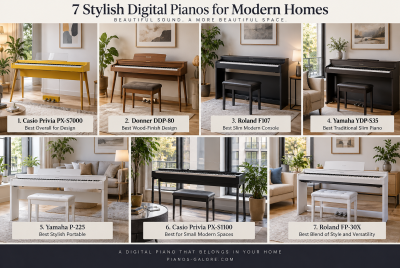
If appearance is an important part of your buying decision, see our guide to the best stylish digital pianos for modern homes, where we compare models designed to complement contemporary living spaces.
Keyboard size and action are two of the most important specifications to understand before buying; our complete guide to full-size 88-key instruments explains both in detail.
New players don’t need the most expensive instrument, but they do need the right foundation; our seven recommended first digital pianos balance keyboard action, sound, price and room for improvement.
Related Articles: