Best Digital Pianos in 2026: 7 Top-Rated Picks for Different Types of Players
There is no single “best digital piano” for everyone.
A beginner learning basic technique has very different needs from an advanced pianist practicing classical repertoire. Someone living in an apartment may prioritize portability, while a professional performer may need extensive sounds, splits, layers and real-time controls.
That’s why choosing a digital piano based solely on ratings—or simply buying the most expensive model you can afford—isn’t always the best approach.
The better question is:
Which digital piano is best for the way YOU intend to play?
For 2026, we’ve selected seven standout digital pianos covering very different types of players:
- Yamaha P-225 — Best Overall
- Roland FP-30X — Best for Serious Beginners & Intermediate Players
- Kawai ES920 — Best Premium Portable Digital Piano
- Yamaha P-525 — Best for Advanced Home Pianists
- Casio PX-S7000 — Best for Stylish Home Use
- Alesis Recital Pro — Best Budget Choice
- Nord Stage 4 88 — Best for Professional Performers
Rather than declaring one instrument universally superior, we’ll explain who should buy each one—and who shouldn’t.
Disclosure: Some links on Pianos-Galore are affiliate links. If you purchase through these links, we may receive a small commission at no additional cost to you.
Best Digital Pianos in 2026: Quick Comparison
| Model | Keys / Action | Polyphony | Best For |
|---|---|---|---|
| Yamaha P-225 | 88 GHC weighted keys | 192 | Best Overall |
| Roland FP-30X | 88 PHA-4 Standard | 256 | Serious Beginners & Intermediate Players |
| Kawai ES920 | 88 RHIII weighted keys | 256 | Premium Portable Piano |
| Yamaha P-525 | 88 GrandTouch-S | 256 | Advanced Home Pianists |
| Casio PX-S7000 | 88 Smart Hybrid Hammer Action | 256 | Stylish Home Use |
| Alesis Recital Pro | 88 Hammer-Action Keys | 128 | Budget Buyers |
| Nord Stage 4 88 | 88 Triple Sensor Hammer Action | 120 piano section | Professional Performers |
Our Quick Recommendations
Want one excellent all-around digital piano? → Yamaha P-225
Serious beginner planning to progress? → Roland FP-30X
Want premium quality but still need portability? → Kawai ES920
Advanced pianist wanting a sophisticated piano-focused instrument? → Yamaha P-525
Want a digital piano that looks exceptional in your home? → Casio PX-S7000
Working with a tighter budget? → Alesis Recital Pro
Professional stage performer? → Nord Stage 4 88
How We Chose These Digital Pianos
A long specification sheet doesn’t automatically make a digital piano better.
For this guide, we considered factors that have a meaningful effect on real-world use:
- Keyboard action
- Piano sound
- Polyphony
- Speaker system
- Portability
- Connectivity
- Pedal capability
- Ease of use
- Additional sounds and features
- Suitability for the intended player
- Long-term usefulness
Most importantly, each model needs a clear reason to exist on this list.
That’s why we haven’t simply filled the article with seven similar entry-level portable pianos.
Digital Pianos in 2026: The Complete Guide Before You Buy
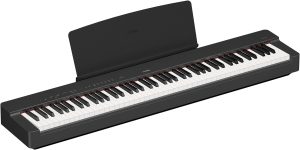
1. Yamaha P-225 — Best Digital Piano Overall
Best for:
Beginners through intermediate players who want a dependable all-around digital piano without paying for features they may never use.
If someone asked us to recommend one digital piano without giving us much additional information, the Yamaha P-225 would be one of the safest places to start.
It combines:
- 88 Graded Hammer Compact keys
- Yamaha CFX piano sound
- VRM Lite
- 192-note polyphony
- 24 voices
- Dual mode
- Split mode
- Duo mode
- USB audio/MIDI
- Optional three-pedal support
- Compact dimensions
- Approximately 25.4 lb / 11.5 kg weight
The P-225 doesn’t try to be a synthesizer, arranger keyboard and professional stage workstation all at once.
It’s primarily a portable digital piano.
And it does that job very well.
Graded Hammer Compact Keyboard
Yamaha uses its GHC, or Graded Hammer Compact, action in the P-225.
The lower keys have greater resistance than the higher keys, following the general principle of acoustic-piano keyboard weighting.
For beginners, this is important because you’re not merely learning where the notes are.
You’re developing physical control of the keyboard.
Yamaha CFX Piano Sound
The P-225’s main piano voice is based on Yamaha’s CFX concert grand.
It also incorporates Virtual Resonance Modeling Lite, designed to reproduce some of the resonance behavior associated with acoustic pianos.
For most home players, the result is a satisfying piano-focused instrument without requiring a premium budget.
Excellent Portability
At approximately 25.4 pounds, the P-225 is easy to move compared with console-style digital pianos.
That’s useful if you:
- Live in an apartment
- Take your piano to lessons
- Need to move it between rooms
- Occasionally perform outside the home
- Don’t want a permanent furniture-style instrument
Who Should Buy the Yamaha P-225?
Choose it if:
- You want a strong all-around digital piano.
- You’re a beginner or intermediate player.
- You want 88 weighted keys.
- Portability matters.
- You value Yamaha’s CFX piano sound.
- You want an instrument you won’t immediately outgrow.
If your budget is below $1,000, the P-225 is also one of the models worth comparing in our dedicated budget guide.
Best Digital Pianos Under $1,000 in 2026: 7 Top Picks
[Check Yamaha P-225 Price on Amazon →]
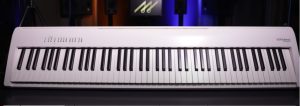
2. Roland FP-30X — Best for Serious Beginners & Intermediate Players
Best for:
Players who are serious about developing piano technique and want an instrument with enough capability to remain useful as they progress.
The Roland FP-30X is particularly compelling because of its combination of keyboard action, sound, polyphony, speakers and connectivity.
Features include:
- 88 PHA-4 Standard keys
- Hammer action
- Escapement
- Ivory Feel surfaces
- SuperNATURAL Piano sound
- 256-note polyphony
- 11W + 11W speakers
- Bluetooth audio
- Bluetooth MIDI
- USB audio/MIDI
- Twin Piano
- Optional three-pedal support
PHA-4 Standard Action
The FP-30X uses Roland’s PHA-4 Standard keyboard.
It combines hammer action with escapement and textured Ivory Feel surfaces.
For someone planning to progress beyond casual keyboard playing, the action is one of the FP-30X’s strongest reasons for consideration.
256-Note Polyphony
The FP-30X offers up to 256-note polyphony.
A beginner doesn’t need that much just to play simple pieces.
But additional polyphony becomes useful with:
- Sustain
- More advanced repertoire
- Layered sounds
- Complex passages
It gives the FP-30X considerable room for growth.
Better Than Buying a Beginner Piano Twice?
This is where the FP-30X makes particular sense.
A complete beginner can certainly spend less.
But if you’re already confident that piano will become a long-term pursuit, spending more initially on an instrument with stronger long-term capability can make sense.
Best Digital Pianos for Beginners in 2026: 7 Top Picks for Learning Piano
Who Should Buy the Roland FP-30X?
Choose it if:
- You’re serious about learning piano.
- You value keyboard action.
- You want strong polyphony.
- Bluetooth connectivity matters.
- You want more powerful speakers than many entry-level portable pianos.
- You’d prefer not to upgrade after a short period.
[Check Roland FP-30X Price on Amazon →]
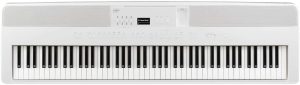
3. Kawai ES920 — Best Premium Portable Digital Piano
Best for:
Pianists who want a more premium playing experience but still need an instrument that can be moved.
Kawai has long experience building acoustic pianos, and the ES920 sits toward the upper end of its portable digital-piano range.
It offers:
- 88-key Responsive Hammer III action
- Grade-weighted hammers
- Triple-sensor key detection
- Counterweights
- Let-off simulation
- Ivory Touch key surfaces
- Harmonic Imaging XL sound technology
- 256-note polyphony
- Premium acoustic-piano sounds
- Bluetooth MIDI
- Bluetooth audio
- USB connectivity
- Powerful built-in speakers
Responsive Hammer III Action
The ES920’s Responsive Hammer III, or RHIII, action is one of the biggest reasons to consider it over less expensive portable models.
Features such as:
- Triple sensors
- Counterweights
- Let-off simulation
- Grade weighting
are designed to create a more refined piano-playing experience.
Piano-Focused Sound
Kawai’s digital pianos tend to appeal particularly strongly to players whose priority is:
piano first, extra features second.
The ES920 uses Kawai’s Harmonic Imaging XL sound technology and includes detailed acoustic-piano sounds suitable for serious practice.
Premium Without Becoming Furniture
This is what makes the ES920 especially interesting.
You can get a more sophisticated piano experience without committing to a large console cabinet.
That makes it suitable for:
- Serious home pianists
- Teachers
- Advanced students
- Musicians who occasionally transport their instrument
- Players who want premium quality but limited furniture
Who Should Buy the Kawai ES920?
Choose it if:
- Piano quality matters more than having hundreds of sounds.
- You want a more sophisticated action.
- You need portability.
- You’re an intermediate or advanced player.
- You like Kawai’s piano-focused design philosophy.
For a closer look at how it compares with other Kawai models, see our complete Kawai guide.
Best Kawai Digital Pianos 2026: Which Model Is Right for You?
[Check Kawai ES920 Price on Amazon →]
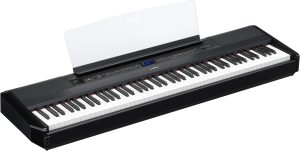
4. Yamaha P-525 — Best for Advanced Home Pianists
Best for:
Experienced pianists who want a high-quality digital-piano playing experience without moving to a full furniture-style console.
The P-525 sits in a very different category from the P-225.
While both are technically portable digital pianos, the P-525 is designed for more demanding players.
Important features include:
- 88 GrandTouch-S keys
- Wooden white keys
- Synthetic ebony and ivory keytops
- Escapement
- Yamaha CFX concert grand sound
- Bösendorfer Imperial sound
- Virtual Resonance Modeling
- Grand Expression Modeling
- 256-note polyphony
- 44 voices
- 18 drum/SFX kits
- 480 XG voices
- LCD display
- MIDI recording
- USB audio recording
- Optional three-pedal unit
GrandTouch-S Keyboard
This is one of the biggest differences between the P-525 and cheaper Yamaha models.
The P-525 uses Yamaha’s GrandTouch-S keyboard with wooden white keys, synthetic ebony and ivory keytops, and escapement.
It’s designed to deliver a substantially more sophisticated piano feel.
Yamaha CFX + Bösendorfer Imperial
Instead of giving you only one flagship acoustic-piano character, the P-525 includes sounds based on two prestigious concert grands:
- Yamaha CFX
- Bösendorfer Imperial
These offer different tonal personalities.
That can become increasingly meaningful as your playing and listening skills develop.
Not Really Lightweight
The P-525 weighs approximately 48.5 pounds / 22 kg.
So although Yamaha classifies it within its portable P-Series, don’t confuse it with something like the P-225.
The P-525 can certainly be moved.
But if you’re carrying your piano to lessons several times per week, there are easier options.
For many owners, the P-525 will spend most of its life at home.
Who Should Buy the Yamaha P-525?
Choose it if:
- You’re an advanced or ambitious pianist.
- You want a more sophisticated keyboard action.
- You value CFX and Bösendorfer piano sounds.
- You want strong built-in features.
- You don’t need extreme portability.
- You want premium capability without buying a large console piano.
[Check Yamaha P-525 Price on Amazon →]
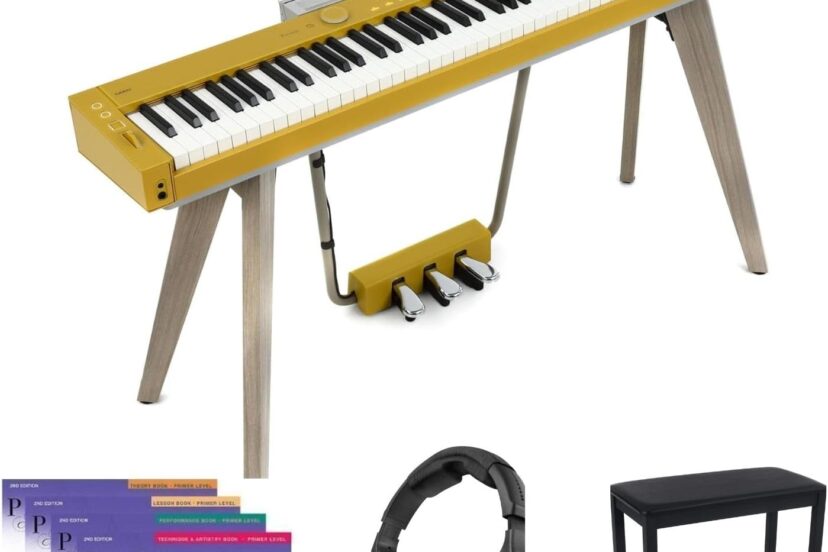
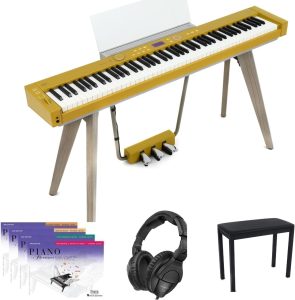
5. Casio PX-S7000 — Best Digital Piano for Stylish Home Use
Best for:
Players who want their digital piano to function as both a serious musical instrument and an attractive piece of contemporary furniture.
Digital pianos have traditionally fallen into two visual categories:
Portable black slabs
or
Traditional furniture-style cabinets.
The Casio PX-S7000 takes a different approach.
It combines contemporary furniture design with advanced digital-piano technology.
Features include:
- 88 Smart Hybrid Hammer Action keys
- Wood/resin hybrid key construction
- Five touch-response levels
- Multi-Dimensional Morphing AiR sound
- 256-note polyphony
- 400 tones
- Built-in pedals
- Integrated stand
- Bluetooth connectivity
- MIDI recording
- Audio recording
- Modern minimalist styling
Smart Hybrid Hammer Action
The PX-S7000 uses Casio’s Smart Hybrid Hammer Action keyboard with a hybrid wood-and-resin construction.
This is a more sophisticated action than you’ll find on Casio’s lower-priced portable PX-S models.
400 Tones
The PX-S7000 is not limited to acoustic-piano sounds.
Its 400 tones make it much more versatile for players who enjoy exploring:
- Electric pianos
- Organs
- Strings
- Synth sounds
- Other instrument voices
Design Is Part of the Product
With many digital pianos, appearance is almost irrelevant.
Not here.
The PX-S7000 is deliberately designed for people who care about how their piano fits into:
- Living rooms
- Modern apartments
- Studios
- Contemporary interiors
If your piano is going to remain visible in a carefully designed room, that may genuinely matter.
A beautiful instrument can also encourage you to keep it accessible rather than storing it away.
Who Should Buy the Casio PX-S7000?
Choose it if:
- Appearance matters.
- The piano will remain permanently visible in your home.
- You want an integrated stand and pedals.
- You want 256-note polyphony.
- You enjoy having many sounds.
- You want a modern rather than traditional cabinet.
Best Casio Digital Pianos in 2026
[Check Casio PX-S7000 Price on Amazon →]
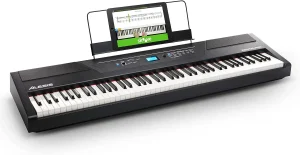
6. Alesis Recital Pro — Best Budget Digital Piano
Best for:
Beginners who want 88 hammer-action keys without spending heavily on their first instrument.
The Alesis Recital Pro is the budget outlier in this comparison.
That’s intentional.
Not everyone shopping for the “best digital piano” needs—or should buy—a premium instrument.
The Recital Pro includes:
- 88 full-size hammer-action keys
- Adjustable touch response
- 128-note polyphony
- 12 built-in voices
- Layer mode
- Split mode
- Lesson mode
- Record mode
- Metronome
- Reverb
- Chorus
- 20-watt speakers
- USB MIDI
- Battery operation
And to be clear:
The Recital Pro has hammer-action keys, not semi-weighted keys.
Why Include a Budget Model?
Because price matters.
Suppose you’re a complete beginner who isn’t yet certain whether piano will become a lifelong hobby.
Spending several thousand dollars may make little sense.
The Recital Pro gives you a route into 88-key hammer-action playing at a much lower cost.
Lesson Mode
Lesson Mode divides the keyboard into two identical pitch zones.
That allows a teacher and student to sit side by side and play equivalent notes.
For beginners taking lessons, that’s genuinely useful.
Who Should Buy the Alesis Recital Pro?
Choose it if:
- You’re a beginner.
- Budget is important.
- You want 88 hammer-action keys.
- You want battery operation.
- Lesson Mode appeals to you.
- You’re not ready to invest in a premium instrument.
Check Alesis Recital Pro Price on Amazon
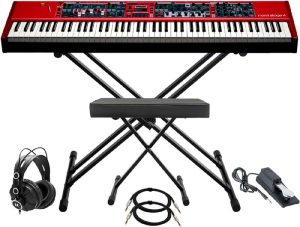
7. Nord Stage 4 88 — Best for Professional Performers
Best for:
Professional keyboardists, touring musicians and advanced performers who need far more than a traditional digital piano.
The Nord Stage 4 88 is different from every other instrument in this guide.
It’s not simply a digital piano.
It’s a professional stage keyboard combining sophisticated:
- Piano
- Organ
- Synthesizer
- Effects
- Performance-control
capabilities.
The 88-key model includes:
- 88-key Triple Sensor Hammer Action
- Aftertouch
- 120-note piano polyphony
- 2 GB piano memory
- Replaceable piano sounds
- Multiple piano layers
- Organ section
- Nord Wave 2 synth engine
- Three independent synth layers
- Extensive effects
- Physical drawbars
- Split zones
- Morph controls
- MIDI
- USB
- Professional audio outputs
Designed for the Stage
The Nord Stage 4 is designed around real-time performance.
Instead of burying everything inside menus, Nord gives performers extensive physical controls.
That matters when you’re onstage and need to change:
- Sounds
- Layers
- Effects
- Organ settings
- Synth parameters
quickly.
Piano + Organ + Synth
This is the Nord’s greatest advantage—and also the reason many home pianists shouldn’t buy it.
If you only want to practice acoustic piano at home, you’re paying for an enormous amount of professional functionality you may never use.
But if you’re performing live and need one keyboard to cover:
Grand piano → electric piano → organ → synth → layered performance sounds
the Stage 4 becomes much more compelling.
No Built-In Speakers
Unlike most home-oriented digital pianos, professional stage keyboards generally assume you’ll connect them to:
- PA systems
- Stage monitors
- Keyboard amplifiers
- Studio monitors
- Headphones
That’s another reason the Nord isn’t intended as a typical beginner living-room piano.
Who Should Buy the Nord Stage 4 88?
Choose it if:
- You’re a professional or serious performing musician.
- You need piano, organ and synthesizer capabilities.
- You perform live.
- You need extensive real-time controls.
- Aftertouch matters.
- Splits and layers are central to your playing.
- You already have appropriate amplification.
For a closer look at Nord’s lineup, see our dedicated Nord guide.
Best Nord Keyboards in 2026: Which Nord Is Right for You?
[Check Nord Stage 4 88 Price on Amazon →]
Which Digital Piano Has the Best Keyboard Action?
There isn’t one universal winner.
Keyboard feel is personal.
But for serious piano playing, I’d particularly compare:
Yamaha P-525
GrandTouch-S with wooden white keys and escapement.
Kawai ES920
Responsive Hammer III with triple sensors, counterweights and let-off simulation.
Roland FP-30X
PHA-4 Standard with escapement and Ivory Feel.
The P-225 offers a simpler GHC action at a lower price, while the Alesis Recital Pro provides hammer action for budget-conscious beginners.
Best Digital Piano for Beginners
For most beginners, I’d choose between:
Yamaha P-225
and
Roland FP-30X
The Yamaha is our general all-around recommendation.
The Roland becomes particularly attractive if you already know you’re serious about progressing.
If budget is tight, consider the Alesis Recital Pro.
Best Digital Pianos for Beginners in 2026: 7 Top Picks for Learning Piano
Best Digital Piano for Intermediate Players
The Roland FP-30X is an excellent transition point between beginner and more advanced instruments.
The Kawai ES920 becomes especially interesting for players willing to pay more for a refined piano-oriented experience.
Best Digital Piano for Advanced Players
The Yamaha P-525 gets our recommendation here.
Its GrandTouch-S keyboard, wooden white keys, CFX and Bösendorfer piano sounds and advanced modeling make it far more suitable for demanding players than entry-level portable instruments.
Best Digital Piano for Classical Music
I’d particularly consider:
- Yamaha P-525
- Kawai ES920
- Roland FP-30X
For classical practice, prioritize:
- Keyboard action
- Dynamic response
- Acoustic-piano sound
- Pedal support
over large sound libraries.
Best Digital Pianos for Classical Music Practice
Best Digital Piano for Home Use
This depends on whether you want portability.
Want a portable/slab design?
Consider:
- Yamaha P-225
- Roland FP-30X
- Kawai ES920
- Yamaha P-525
Want furniture-style integration?
The Casio PX-S7000 is particularly attractive.
You should also consider dedicated console digital pianos if your instrument will never need to move.
Best Digital Upright Pianos for Home Use: 2026 Buying Guide
Best Digital Piano for Professional Performance
Nord Stage 4 88
But remember:
The best professional stage keyboard isn’t automatically the best digital piano for home practice.
Professional musicians pay for capabilities such as:
- Extensive sound engines
- Real-time controls
- Outputs
- Splits
- Layers
- Synthesizers
- Organ engines
- Performance effects
If you don’t need those things, don’t pay for them.
Portable Digital Piano vs Console Digital Piano vs Stage Piano
Understanding these three categories can dramatically simplify your decision.
Portable Digital Piano
Examples:
- Yamaha P-225
- Roland FP-30X
- Kawai ES920
- Yamaha P-525
Best if you want:
- 88 weighted keys
- Home practice
- Headphones
- Some portability
- Flexible stands
Console Digital Piano
Best if you want:
- Permanent home installation
- Furniture-style appearance
- Integrated pedals
- Stronger speaker systems
- More acoustic-piano-like presentation
Stage Piano / Stage Keyboard
Example:
- Nord Stage 4
Best if you want:
- Live performance
- Professional outputs
- Extensive sounds
- Splits and layers
- Real-time control
- Portability between venues
Digital Piano vs Keyboard: Which Should You Buy in 2026?
How Much Should You Spend on a Digital Piano?
Don’t begin with the assumption that spending more always produces a better choice.
Think about what you’re buying the instrument to accomplish.
Budget / Beginner Level
Good if you’re:
- Just starting
- Uncertain about long-term commitment
- Working with limited funds
Mid-Range
Often the sweet spot for:
- Serious beginners
- Intermediate players
- Home practice
- Long-term learning
Premium
Makes more sense for:
- Advanced pianists
- Demanding players
- Serious classical study
- Players sensitive to keyboard-action differences
Professional Stage Level
Justified when the instrument helps you earn money, perform professionally or cover multiple keyboard roles.
Best Digital Pianos for Every Budget in 2026: Beginner to Pro
7 Mistakes to Avoid When Choosing a Digital Piano
1. Buying Based Only on Ratings
A highly rated stage keyboard can still be completely wrong for a beginner.
2. Looking Only at Polyphony
256-note polyphony doesn’t automatically make one piano better than another.
3. Ignoring Keyboard Action
For serious piano playing, action deserves high priority.
4. Paying for Features You Won’t Use
Don’t pay for synthesizer engines if you only want acoustic piano.
5. Ignoring Size and Weight
Measure your room before ordering.
6. Forgetting Pedals, Stand and Bench
The base instrument isn’t always the complete setup.
7. Assuming Your First Piano Must Be Your Last
Beginners don’t necessarily need professional instruments.
Buy appropriately for your current needs while allowing reasonable room for growth.
Frequently Asked Questions
What is the best digital piano in 2026?
There is no single best model for everyone. Our overall all-around choice is the Yamaha P-225, but advanced pianists, professional performers and budget-conscious beginners have different needs.
What is the best digital piano for beginners?
The Yamaha P-225 and Roland FP-30X are excellent choices. The Alesis Recital Pro is worth considering if budget is the main concern.
What is the best digital piano for advanced players?
The Yamaha P-525 is our choice among these seven for advanced piano-focused players.
What is the best premium portable digital piano?
The Kawai ES920 combines a sophisticated piano action and sound system with a transportable slab-style format.
What is the best digital piano for an apartment?
The Yamaha P-225 is particularly attractive because of its compact size and low weight. If design matters more than portability, consider the Casio PX-S7000.
What is the best digital piano for classical music?
I’d shortlist the Yamaha P-525, Kawai ES920 and Roland FP-30X.
What is the best digital piano for live performance?
The Nord Stage 4 88 is the strongest professional performance instrument in this comparison.
Do beginners need 88 weighted keys?
Not absolutely, but they’re strongly recommended if your goal is traditional piano study.
Do I need 256-note polyphony?
Most beginners don’t.
Keyboard action, sound and practice habits are usually more important.
Is a $3,000 digital piano three times better than a $1,000 digital piano?
Not necessarily.
As prices rise, you’re often paying for increasingly refined keyboard actions, sounds, speakers, materials and professional features.
The improvement isn’t necessarily proportional to the price.
Final Verdict: Which Digital Piano Is Right for You?
The best digital piano isn’t necessarily the instrument with the highest price, biggest sound library or longest specification sheet.
It’s the instrument that best fits how you actually intend to play.
Best Overall — Yamaha P-225
A strong balance of weighted action, piano sound, portability, features and price.
Best for Serious Beginners & Intermediate Players — Roland FP-30X
Excellent for players who want a capable instrument they can continue using as their skills progress.
Best Premium Portable — Kawai ES920
A refined piano-oriented instrument for serious players who still need some portability.
Best for Advanced Home Pianists — Yamaha P-525
GrandTouch-S action, wooden white keys and premium Yamaha and Bösendorfer piano sounds make it our choice for demanding home pianists.
Best for Stylish Home Use — Casio PX-S7000
A sophisticated combination of digital-piano technology and contemporary furniture design.
Best Budget Choice — Alesis Recital Pro
A practical route to 88 hammer-action keys without premium pricing.
Best for Professional Performers — Nord Stage 4 88
A powerful piano, organ and synthesizer performance platform built for professional stage use.
Still undecided?
Use this shortcut:
First serious digital piano → Yamaha P-225
Planning to progress for years → Roland FP-30X
Want premium quality + portability → Kawai ES920
Advanced pianist → Yamaha P-525
Beautiful permanent home setup → Casio PX-S7000
Tighter budget → Alesis Recital Pro
Professional gigs → Nord Stage 4 88
The key is not to ask:
“Which digital piano has the best specifications?”
Ask:
“Which digital piano has the specifications that matter for the way I play?”
Answer that question first, and choosing the right instrument becomes much easier.
If you’re particularly interested in Korg, our Best Korg Keyboards & Digital Pianos guide compares models ranging from the beginner-friendly B2 to professional stage and arranger instruments.”
Related Articles
- Digital Pianos in 2026: The Complete Guide Before You Buy
- Best Digital Pianos for Beginners in 2026: 7 Top Picks for Learning Piano
- Best Digital Pianos Under $1,000 in 2026: 7 Top Picks
- Best Digital Pianos for Every Budget in 2026: Beginner to Pro
- Best Digital Pianos for Classical Music Practice
—————–
Ready to start playing piano? Simply Piano offers lessons to help you play your favorite songs.

- Start with beginner lessons or advanced courses.
- Learn at your own pace with instant feedback.
- Play classical, pop, and Disney tunes with tailored exercises.
- Begin your piano journey today with SIMPLY PIANO!