
Best Korg Keyboards & Digital Pianos in 2026: Which Type Is Right for You?
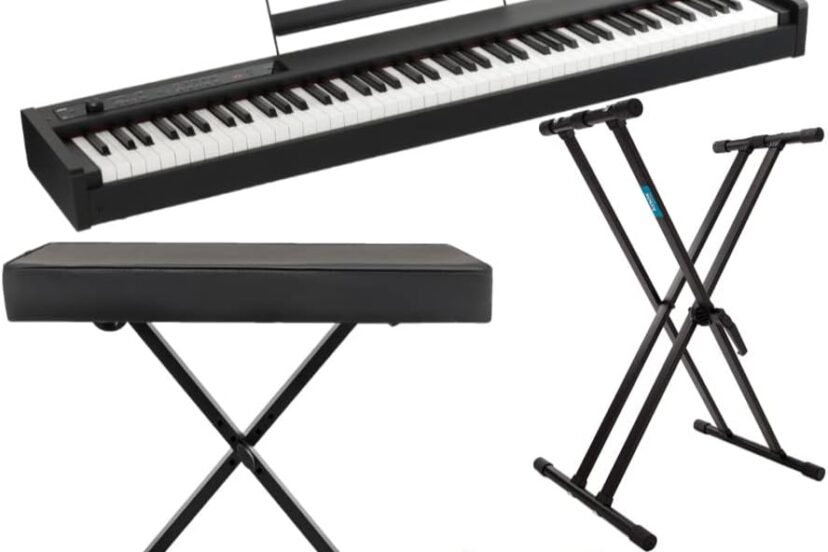
Choosing the best Korg keyboard isn’t quite as simple as picking the model with the most sounds or the highest price.
That’s because Korg makes several very different types of keyboard instruments.
Some Korg models are designed primarily for learning and playing piano. Others are built for stage performers. Some specialize in classic electric-piano and vintage keyboard sounds, while Korg’s professional arranger keyboards can provide an entire virtual backing band controlled from the keyboard.
So before asking, “Which Korg keyboard is best?”, there’s a more important question:
What kind of keyboard do you actually need?
For most buyers, these six Korg models represent particularly useful choices:
- Korg B2 — Best for Beginner Piano Players
- Korg D1 — Best Affordable Stage/Digital Piano
- Korg SV-2 — Best for Vintage Piano and Keyboard Sounds
- Korg XE20 — Best for Piano + Automatic Accompaniment
- Korg Pa1000 — Best Arranger Keyboard
- Korg Pa5X — Best Premium Professional Arranger
This guide explains how they differ, what each model does best, and which type of musician should consider each one.
If you’re still deciding between a traditional digital piano and a broader keyboard instrument, our Digital Pianos in 2026: The Complete Guide Before You Buy explains the main categories, features, and buying considerations.
Quick Comparison: Best Korg Keyboards & Digital Pianos
| Model | Keys | Keyboard Type | Best For |
|---|---|---|---|
| Korg B2 | 88 | NH weighted hammer action | Beginners and piano practice |
| Korg D1 | 88 | RH3 weighted hammer action | Piano feel and stage use |
| Korg SV-2 | 73 or 88 | RH3 weighted hammer action | Vintage keyboard sounds |
| Korg XE20 | 88 | NH weighted hammer action | Piano + automatic accompaniment |
| Korg Pa1000 | 61 | Semi-weighted with aftertouch | Arranger players and entertainers |
| Korg Pa5X | 61, 76 or 88 | Varies by version | Professional arranger performance |
Our Quick Recommendations
If you’re primarily learning piano, start with the Korg B2.
If keyboard action matters more than built-in speakers, consider the Korg D1.
If you’re a performing musician who loves acoustic pianos, electric pianos and vintage keyboard sounds, the Korg SV-2 is the specialist of the group.
If you want 88 weighted keys plus automatic backing arrangements, the Korg XE20 is an interesting bridge between a digital piano and an arranger.
For serious arranger players, the Korg Pa1000 offers extensive accompaniment and performance capabilities.
And for professional performers seeking Korg’s flagship arranger platform, there’s the Pa5X.
Affiliate Disclosure
Some links on Pianos-Galore are affiliate links. If you purchase through these links, we may receive a small commission at no additional cost to you.
1. Korg B2 — Best for Beginner Piano Players
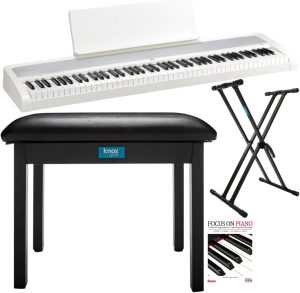
Best for: Beginners who want an affordable 88-key digital piano with weighted keys and built-in speakers
The Korg B2 is the easiest model in this guide to recommend to someone whose primary goal is simply:
“I want to learn piano.”
It doesn’t try to be a workstation, synthesizer or professional arranger.
Instead, Korg designed the B2 around the basic requirements of piano playing.
You get an 88-key Natural Weighted Hammer Action keyboard, with the lower notes feeling heavier and the upper notes progressively lighter.
That’s important for beginners because learning on a weighted keyboard provides a much more appropriate foundation for piano technique than starting on a lightweight synth-action keyboard.
The B2 also provides 12 sounds, including a selection of acoustic-piano tones, with up to 120-note polyphony.
Its built-in amplification is rated at 15 watts per side, so you don’t need external speakers just to practice at home.
Connectivity includes a combined headphone/line output, audio input and USB connection.
What We Like About the Korg B2
The B2 keeps things relatively simple.
That can actually be an advantage.
Beginners often don’t need hundreds of sounds, elaborate recording systems and dozens of buttons. They need a keyboard that encourages them to sit down and practice.
The B2 provides:
- 88 weighted keys
- Built-in speakers
- Headphone capability
- Piano-focused sounds
- Metronome
- USB connectivity
- Optional three-pedal support
At approximately 25 pounds, it’s also reasonably manageable for an 88-key weighted digital piano with speakers.
What Could Be Better?
The B2’s simplicity can become a limitation for more advanced users.
There are only 12 built-in sounds, and the keyboard action isn’t as sophisticated as Korg’s RH3 action used in models such as the D1 and SV-2.
But that’s not really the point of the B2.
It’s designed as an accessible digital piano rather than a professional performance instrument.
Who Should Buy the Korg B2?
Choose the B2 if you:
- Are learning piano
- Want 88 weighted keys
- Need built-in speakers
- Primarily practice at home
- Don’t need hundreds of sounds
- Want a straightforward first digital piano
Beginners comparing the B2 with other entry-level models may also want to see our Best Digital Pianos for Beginners in 2026: 7 Top Picks for Learning Piano.
If you specifically want a full-size beginner instrument, our guide to the Best 88-Key Weighted Keyboards for Beginners in 2026 compares several popular alternatives.”
[Check Korg B2 Price on Amazon →]
2. Korg D1 — Best Affordable Stage/Digital Piano
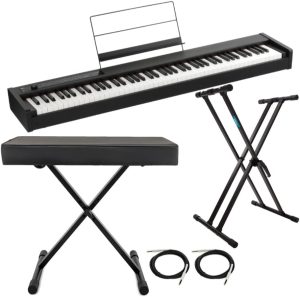
Best for: Players who prioritize keyboard feel and don’t need built-in speakers
At first glance, the Korg D1 might look like another basic 88-key digital piano.
It isn’t.
The important difference is the keyboard.
The D1 uses Korg’s RH3 — Real Weighted Hammer Action 3 — keyboard.
This is a more sophisticated action than the NH action in the B2 and is designed to provide a more substantial piano-playing experience.
The keyboard is graded, so lower notes feel heavier than higher ones.
The D1 also offers five touch-response settings, giving players some control over how the keyboard responds to their playing.
There are 30 internal sounds and up to 120-note polyphony.
But there’s an important catch:
The D1 does not have built-in speakers.
That tells you a lot about its intended role.
Why No Speakers Can Actually Make Sense
For a beginner practicing in a bedroom, built-in speakers are extremely convenient.
For a performing musician, they’re much less important.
On stage, you’re typically connecting to:
- A PA system
- Powered monitors
- An amplifier
- A mixer
- An audio interface
The D1 provides dedicated line outputs for this purpose.
It also has conventional MIDI IN and OUT connections, allowing it to integrate with other MIDI equipment or a computer through an appropriate interface.
Korg B2 vs D1
This is an important decision.
Choose the B2 if convenience matters most.
It has weighted keys and speakers, making it easier to use as a self-contained home piano.
Choose the D1 if keyboard feel matters more and you’re comfortable using headphones or external amplification.
The D1’s RH3 action is the major reason to move up from the B2.
Who Should Buy the Korg D1?
The D1 is particularly suitable for:
- Intermediate pianists
- Serious students
- Gigging keyboardists
- Players using virtual instruments
- Musicians with external amplification
- Players prioritizing action over extra features
[Check Korg D1 Price on Amazon →]
3. Korg SV-2 — Best for Vintage Piano and Keyboard Sounds
Best for: Performing musicians who want acoustic pianos, electric pianos and classic keyboard sounds with hands-on controls
The Korg SV-2 is very different from the B2 and D1.
This is a Stage Vintage Piano.
And that’s an important distinction.
The SV-2 is aimed at musicians who want to perform with a broad collection of classic keyboard sounds without spending their time navigating complicated menus.
It is available in 73-key and 88-key versions, both using Korg’s RH3 weighted hammer action.
The SV-2 offers 128-note maximum polyphony and an extensive collection of acoustic and electric keyboard sounds.
These include variations inspired by the kinds of instruments professional keyboardists have relied on for decades:
- Acoustic grand pianos
- Upright pianos
- Vintage tine electric pianos
- Reed electric pianos
- FM pianos
- Clavs
- Organs
- Strings
- Pads
- Brass
- Classic digital piano sounds
This is where the SV-2 starts to separate itself from conventional home digital pianos.
Designed for Hands-On Performance
One of the SV-2’s greatest strengths is its physical control panel.
Instead of burying everything inside layers of menus, Korg provides direct controls for important functions.
Its effects architecture includes:
- Equalization
- Pre-effects
- Amplifier models
- Modulation effects
- Ambient effects
- Total effects
There are vintage-style chorus, phaser, flanger, rotary, tremolo, vibrato, delay and reverb options.
The amplifier section even incorporates Korg’s Valve Reactor technology.
For stage musicians, this can make the instrument feel more immediate than a keyboard that depends heavily on touchscreen menus.
SV-2 or SV-2S?
Korg also offers the SV-2S.
The major distinction is that the SV-2S includes built-in speakers, while the standard SV-2 is intended for external amplification.
If you’re primarily using the instrument on stage, the regular SV-2 may make perfect sense.
If you want to play it at home without always connecting external speakers, the SV-2S becomes more attractive.
Who Should Buy the Korg SV-2?
Consider the SV-2 if you:
- Perform professionally
- Love vintage electric-piano sounds
- Need excellent acoustic-piano sounds too
- Prefer physical controls
- Want RH3 weighted action
- Play rock, jazz, soul, funk, blues or pop
- Frequently switch between classic keyboard sounds on stage
This is not the obvious choice for a first-time piano student.
It’s a specialized performance instrument.
Players interested in professional performance keyboards may also find our Nord Wave 2 review useful for seeing how a synthesis-focused stage instrument differs from the SV-2’s vintage-piano approach.
[Check Korg SV-2 Price on Amazon →]
4. Korg XE20 — Best for Piano + Automatic Accompaniment
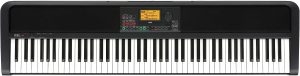
Best for: Players who want weighted piano keys plus a virtual backing band
The XE20 occupies one of the most interesting positions in Korg’s lineup.
Korg calls it a Digital Ensemble Piano.
That description makes sense because it combines characteristics of two different instrument categories.
On one side, it’s a digital piano.
It has:
- 88 weighted keys
- Graded hammer action
- Acoustic-piano sounds
- Built-in speakers
On the other side, it has extensive automatic accompaniment capabilities.
That’s where things get interesting.
What Is Automatic Accompaniment?
Imagine you’re playing a song by yourself.
With a normal digital piano, you play everything you can with your two hands.
With the XE20, you can select an accompaniment Style and play chords with your left hand.
The instrument recognizes the chords and generates an appropriate backing arrangement.
That backing can include elements such as:
- Drums
- Bass
- Guitar
- Keyboard
- Other instrumental parts
You play the melody or other material with your right hand while the XE20 follows your chord progression.
In effect, you’re controlling a virtual backing band.
More Than 700 Sounds
The XE20 isn’t limited to piano sounds.
It provides more than 700 sounds plus drum kits, covering categories such as:
- Acoustic pianos
- Electric pianos
- Organs
- Strings
- Brass
- Synth sounds
- Guitars
- Other instruments
It also provides 280 preset accompaniment Styles covering a wide range of musical genres.
That makes it dramatically more versatile than something like the B2.
Two Different Concert Grand Piano Sounds
Korg gives the XE20 two principal concert-grand piano characters: German and Italian.
That helps preserve its identity as a genuine digital piano rather than making piano sound like an afterthought attached to an arranger.
Recording and Playback
The XE20 can record performances and also play back audio and MIDI material.
For musicians who like practicing or performing along with existing material, this adds another layer of usefulness.
Who Should Buy the Korg XE20?
The XE20 makes sense for:
- Home entertainers
- Singer-keyboardists
- Hobby musicians
- Players who enjoy accompaniment
- Solo performers
- Songwriters
- Families wanting an entertainment-oriented piano
- Pianists who want more than a conventional digital piano
If your only objective is classical piano practice, you probably don’t need all these features.
But if you want piano playing plus an entire accompaniment system, the XE20 becomes much more interesting.
For a broader explanation of how piano keyboards differ in size, action, features, and intended use, see our Piano Keyboards: The Complete 2026 Buying Guide
[Check Korg XE20 Price on Amazon →]
5. Korg Pa1000 — Best Arranger Keyboard
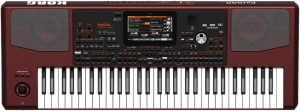
Best for: Serious arranger players, entertainers, singers and solo performers
Now we move into a completely different category.
The Korg Pa1000 is not primarily a digital piano.
It is a Professional Arranger.
That means its design priorities are very different from those of the B2, D1 or SV-2.
Instead of 88 hammer-action keys, the Pa1000 uses 61 semi-weighted keys with velocity sensitivity and aftertouch.
Why?
Because arranger performers often need quick access to a huge range of instrument sounds and performance techniques rather than traditional acoustic-piano action.
And the Pa1000 provides an enormous palette.
More Than 1,750 Factory Sounds
The Pa1000 includes more than 1,750 factory sounds, including:
- Acoustic pianos
- Electric pianos
- Organs
- Strings
- Brass
- Guitars
- Synths
- World instruments
- Drum kits
Its EDS-X sound engine provides up to 128 voices of polyphony.
But sounds are only part of the story.
Hundreds of Accompaniment Styles
The Pa1000’s arranger system provides hundreds of Styles covering musical genres from around the world.
A Style isn’t merely a drum rhythm.
It’s an interactive musical arrangement.
As you play chords, the arranger follows your harmony and generates appropriate accompaniment.
You can move between variations, trigger fills, use intros and endings, and manipulate the arrangement in real time.
This is why arranger keyboards are so popular with:
- Solo entertainers
- Singer-keyboardists
- Wedding performers
- Restaurant musicians
- Lounge performers
- Church musicians
- Composers and arrangers
One musician can create a surprisingly complete ensemble sound.
Built-In Speakers
Unlike many professional stage keyboards, the Pa1000 has its own substantial amplification system.
That makes rehearsing and smaller performances possible without necessarily setting up external amplification.
For larger venues, you’d normally use its outputs and a proper PA system.
Vocal Processing
One particularly useful feature for singing keyboardists is the integrated vocal processing capability.
The Pa1000 includes vocal processing and harmony functionality, allowing a performer to integrate vocals directly into a keyboard-based setup.
For a solo entertainer, that’s a major advantage.
SongBook
Another performance-oriented feature is Korg’s SongBook system.
Instead of remembering the correct sound, Style, tempo, effects and other settings for every song, you can organize performance setups and recall them when needed.
For musicians playing long sets, this can be extremely useful.
Who Should Buy the Pa1000?
Choose the Pa1000 if:
- You’re a solo entertainer
- You sing while playing
- You use backing arrangements
- You perform many musical styles
- You need hundreds of sounds
- You want extensive live-performance controls
- You don’t need 88 hammer-action keys
For someone simply learning piano, the Pa1000 would be excessive.
For the right performer, however, it’s an entirely different kind of musical tool.
[Check Korg Pa1000 Price on Amazon →]
6. Korg Pa5X — Best Premium Professional Arranger
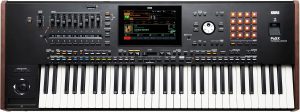
Best for: Professional arranger performers who want Korg’s flagship Pa-Series platform
At the top of this particular Korg selection sits the Pa5X.
Korg positions the Pa5X as its flagship Professional Arranger.
It’s available in different keyboard configurations, including 61-, 76- and 88-key versions.
That alone makes it considerably more flexible than many arranger keyboards.
But the real story is what’s happening inside.
A Flagship Arranger Platform
The Pa5X uses Korg’s EDS-XP sound engine and provides an enormous collection of sounds and Styles.
It draws on technologies and sounds associated with other major Korg instruments, including its professional stage and workstation families.
The instrument is designed to let a performer control sophisticated arrangements in real time.
Its interface includes a large tiltable touchscreen along with extensive physical controls.
That combination is important.
Professional performers need deep functionality, but they also need to access that functionality quickly.
Dual Players
One of the Pa5X’s major performance capabilities is its dual-player architecture.
Rather than simply loading one accompaniment or song and stopping before moving to the next, the Pa5X is designed around smoother transitions between musical elements.
For professional entertainers, that’s valuable because dead time between songs can interrupt the flow of a performance.
Extensive Live Controls
The Pa5X includes physical controls designed for manipulating sounds, accompaniment and performance functions while playing.
That makes it considerably more than a keyboard containing a large collection of presets.
It’s essentially a sophisticated performance environment.
Pa1000 vs Pa5X
This is an important comparison because both are powerful arranger keyboards.
The Pa1000 remains extremely capable and will be more than enough for many performers.
The Pa5X is the flagship option for musicians who want Korg’s more advanced arranger platform, newer workflow and broader professional performance architecture.
If you’re an occasional home player, the Pa5X is probably far more instrument than you need.
If your livelihood involves live keyboard performance and arranger functions are central to your work, the additional capabilities become much easier to justify.
Who Should Buy the Korg Pa5X?
The Pa5X is primarily for:
- Professional entertainers
- Advanced arranger players
- Singer-keyboardists
- Professional solo performers
- Musicians who create sophisticated live arrangements
- Players who need extensive real-time performance control
- Professionals who want Korg’s flagship arranger platform
[Check Korg Pa5X Price on Amazon →]
What Type of Korg Keyboard Should You Buy?
Now that we’ve looked at the individual models, the easiest way to choose is to stop comparing specifications and start with your intended use.
If You’re Learning Piano
Choose the Korg B2.
Its 88 weighted keys, built-in speakers and relatively straightforward design make it the most logical first piano among these six.
If Piano Feel Is Your Priority
Consider the Korg D1.
Its RH3 action is its biggest attraction.
Just remember that you’ll need headphones or external amplification because it doesn’t have built-in speakers.
If You Perform Vintage Keyboard Music
Choose the Korg SV-2.
It’s particularly attractive to musicians playing electric pianos, acoustic pianos, organs and other classic keyboard sounds.
If You Want Piano Plus a Backing Band
Choose the Korg XE20.
It combines 88 weighted keys with automatic accompaniment in a way that conventional digital pianos generally don’t.
If You’re a Serious Solo Entertainer
Consider the Korg Pa1000.
It provides extensive arranger capabilities, built-in speakers, vocal processing and a huge collection of sounds and Styles.
If You’re a Professional Arranger Performer
The Korg Pa5X is the flagship choice.
Its price and complexity make little sense for casual users, but its capabilities are aimed at a different audience.
Korg B2 vs D1: Which Is Better?
For straightforward home piano use, the B2 is easier to recommend.
It has weighted keys and built-in speakers, so you can set it up and start playing.
The D1, however, gives you Korg’s RH3 action.
That makes the D1 attractive to more serious pianists and performers who already have an amplification solution.
Think of it this way:
B2 = convenience and value
D1 = better action and stage-oriented connectivity
Korg D1 vs SV-2: Which Is Better for Performing?
Both use Korg’s RH3 weighted action, but they’re aimed at very different users.
The D1 is comparatively straightforward.
The SV-2 is a full-fledged performance instrument built around a much larger palette of acoustic, electric and vintage keyboard sounds, along with extensive effects and hands-on controls.
If you mainly need a good weighted keyboard and a selection of core sounds, the D1 may be enough.
If your live performances require frequent sound changes, vintage electric pianos and effects, the SV-2 is in another category.
XE20 vs Pa1000: Which Arranger Is Better?
The XE20 is the better choice for someone who thinks of themselves primarily as a piano player who also wants accompaniment.
It gives you 88 weighted keys.
The Pa1000 is better suited to someone who thinks of themselves primarily as an arranger keyboard performer.
Its 61-key semi-weighted keyboard isn’t intended to imitate an acoustic grand piano.
Instead, the emphasis is on:
- Sounds
- Styles
- Arranging
- Singing
- Performance control
- Entertainment
Your playing style should determine which approach makes more sense.
Pa1000 vs Pa5X: Is the Pa5X Worth It?
That depends largely on how seriously you use arranger features.
The Pa1000 is already an advanced professional arranger and provides far more capability than most casual musicians will ever need.
The Pa5X makes more sense for professionals who want Korg’s flagship arranger architecture, more advanced live workflow and choice of keyboard configurations.
For home entertainment, the Pa1000 is probably already more than enough.
For professional stage use where arranger performance is central to your work, the Pa5X deserves serious consideration.
Are Korg Keyboards Good for Beginners?
Yes—but choose the right Korg.
A beginner interested primarily in learning piano should not automatically buy the keyboard with the most sounds.
For piano study, we’d prioritize:
- 88 keys
- Weighted action
- Appropriate touch response
- Pedal support
- Headphone capability
- Simple operation
That’s why the Korg B2 is our first recommendation for beginners among the models in this guide.
The XE20 can also work for a beginner who wants extensive accompaniment features.
The Pa1000 and Pa5X are generally unnecessary for someone whose primary objective is learning basic piano technique.
Which Korg Is Best for Classical Piano?
Of these six, we’d look most closely at the D1 if keyboard action is the priority.
Its RH3 weighted hammer action makes it more piano-focused than the arranger keyboards.
However, serious classical players should compare it with other dedicated digital pianos before buying, particularly if they want:
- Built-in speakers
- Three-pedal systems
- Furniture-style cabinets
- More advanced acoustic-piano simulation
The best keyboard for classical practice isn’t necessarily the keyboard with the largest sound library.
Touch and pedal behavior matter enormously.
Classical players should also compare Korg’s options with the models in our Best Digital Pianos for Classical Music Practice guide.
Which Korg Is Best for Gigging?
That depends on the gig.
For straightforward piano playing, consider the D1.
For vintage electric pianos and classic keyboard sounds, the SV-2 is the standout.
For solo entertainment with automatic accompaniment, consider the Pa1000.
For high-end professional arranger performance, the Pa5X is the flagship choice.
That’s why simply asking for the “best Korg keyboard” doesn’t produce a very useful answer.
Different performers need fundamentally different instruments.
Players choosing an instrument according to experience level may also find our Best Digital Pianos by Skill Level in 2026: Beginner to Advanced useful.
Which Korg Is Best for a One-Person-Band Setup?
This is exactly what arranger keyboards are good at.
The Pa1000 is particularly compelling for a solo entertainer because it can combine:
- Keyboard performance
- Automatic accompaniment
- Extensive instrument sounds
- Song playback
- Vocal processing
- Performance presets
- Built-in amplification
The Pa5X takes the arranger concept considerably further for professional users.
If you’re performing alone but want to create the impression of a fuller ensemble, these are far more appropriate than a conventional digital piano.
Which Korg Is Best for Church or Worship Music?
There isn’t one universal answer.
A church pianist who mainly plays acoustic-piano parts might prefer the D1 or another dedicated digital piano.
A worship keyboardist who needs electric pianos, pads, organs and layered keyboard sounds could find the SV-2 more versatile.
A musician responsible for providing accompaniment without a full band could benefit from the XE20, Pa1000 or Pa5X.
Again, the role you perform matters more than the brand name on the front panel.
Which Korg Is Best for Recording?
Several models can work in a recording setup, but their roles differ.
The D1 can function as a straightforward weighted MIDI keyboard and piano sound source.
The SV-2 gives you a large collection of performance-ready acoustic and vintage keyboard sounds.
The XE20 adds accompaniment and sequencing capabilities.
The Pa1000 and Pa5X are much more elaborate production and arrangement tools.
If your recording workflow is primarily computer-based, also consider whether you actually need an instrument with extensive built-in arranger functions.
Sometimes a simpler weighted digital piano combined with a DAW and virtual instruments is the more flexible solution.
Digital Piano vs Stage Piano vs Arranger Keyboard
Understanding these categories will make choosing a Korg much easier.
Digital Piano
A digital piano attempts to recreate the basic playing experience of an acoustic piano.
Examples include the Korg B2 and, in a more stage-oriented format, the D1.
The priorities are typically:
- Weighted keys
- Piano sounds
- Pedal response
- Playing feel
Stage Piano
A stage piano is designed for performance.
It may omit built-in speakers because performers typically connect to professional amplification.
The D1 can fill this role, while the SV-2 takes the concept much further with its specialized performance features and vintage sounds.
Digital Ensemble Piano
The XE20 combines a piano-oriented keyboard with automatic accompaniment.
It’s effectively a bridge between the digital-piano and arranger worlds.
Arranger Keyboard
An arranger keyboard such as the Pa1000 or Pa5X is designed to create interactive musical accompaniment based on what you’re playing.
Its priorities include:
- Styles
- Large sound libraries
- Real-time arrangement
- Song management
- Performance controls
- Accompaniment
That’s a very different objective from simply reproducing the experience of playing a grand piano.
Frequently Asked Questions
Is Korg a good digital piano brand?
Yes. Korg has produced electronic musical instruments for decades and offers everything from beginner digital pianos to professional stage instruments and flagship arranger keyboards.
The important thing is choosing the Korg product family that matches your needs.
Which Korg keyboard is best for beginners?
Among the models in this guide, the Korg B2 is our preferred starting point for traditional piano learning because it combines 88 weighted keys with built-in speakers and relatively simple operation.
Does the Korg B2 have weighted keys?
Yes. The standard B2 uses Korg’s NH weighted hammer-action keyboard.
Does the Korg D1 have speakers?
No. The D1 requires headphones or external amplification.
Is the Korg D1 better than the B2?
Its RH3 keyboard action is a major step up, but “better” depends on your needs. The B2’s built-in speakers make it more convenient for many beginners and home players.
Does the Korg SV-2 have weighted keys?
Yes. Both the 73-key and 88-key SV-2 versions use Korg’s RH3 weighted hammer action.
What is the difference between the SV-2 and SV-2S?
The SV-2S includes an internal speaker system. The standard SV-2 is designed for external amplification.
Is the Korg XE20 a digital piano or arranger?
It’s best thought of as both. Korg describes it as a Digital Ensemble Piano: it combines 88 weighted keys and piano sounds with extensive automatic accompaniment.
What is an arranger keyboard?
An arranger keyboard generates accompaniment that responds to the chords you play. It can provide drums, bass and other instrumental parts, effectively allowing one musician to control an entire backing arrangement.
Is the Pa1000 good for piano practice?
You can certainly play piano sounds on it, but its 61-key semi-weighted action isn’t designed to reproduce the experience of an 88-key acoustic piano. It’s primarily an arranger keyboard.
What is Korg’s flagship arranger keyboard?
The Pa5X is Korg’s flagship Professional Arranger.
Do I need a Pa5X?
Probably not unless you’re a serious arranger player or professional performer. Its sophisticated capabilities are valuable to the right musician but unnecessary for someone simply learning piano or playing casually at home.
Final Verdict: Which Korg Keyboard Should You Buy?
Korg’s lineup demonstrates why choosing a keyboard based solely on specifications can be misleading.
The Korg B2 has far fewer sounds and features than the Pa5X.
That doesn’t make it an inferior choice for a beginner pianist.
In fact, for that buyer, it may be considerably more appropriate.
Likewise, the D1’s lack of speakers might look like a disadvantage until you realize it’s aimed at players who value RH3 weighted action and may already use external amplification.
The SV-2 makes sense for a completely different musician—someone who wants classic acoustic and electric keyboard sounds with direct, stage-friendly controls.
The XE20 bridges digital piano and arranger keyboard by combining 88 weighted keys with automatic accompaniment.
And the Pa1000 and Pa5X move firmly into the professional arranger world.
So our final recommendations are:
For beginners: Korg B2
For piano feel and straightforward stage use: Korg D1
For vintage sounds and live keyboard performance: Korg SV-2
For piano plus automatic accompaniment: Korg XE20
For serious arranger players and solo entertainers: Korg Pa1000
For professional flagship arranger performance: Korg Pa5X
There isn’t one “best Korg keyboard” for everyone.
The better question is:
Which type of Korg keyboard best matches the way you actually play?
Once you’ve answered that question, choosing among these six becomes much easier.
The Korg D1’s slim design and RH3 action make it an interesting stage option, and our guide to the best keyboards for musicians on the go compares it with lighter alternatives from Yamaha, Roland, Casio and Kawai.
Related Articles
- Digital Pianos in 2026: The Complete Guide Before You Buy
- Best Digital Pianos for Beginners in 2026: 7 Top Picks for Learning Piano
- Best Digital Pianos by Skill Level in 2026: Beginner to Advanced
- Piano Keyboards: The Complete 2026 Buying Guide
- Best 88-Key MIDI Keyboards & Digital Pianos in 2026: 6 Top Picks
Want to learn piano? Simply Piano is the ultimate app to get started.

• Access beginner-friendly lessons and advanced courses designed for all levels.
• Learn comfortably at your own speed with real-time feedback to guide you.
• Play iconic songs, from classical pieces to pop hits and Disney classics.
• Start your musical adventure now with SIMPLY PIANO!
