Top Roland Digital Pianos for 2026: Cutting-Edge Technology

Roland has been one of the most influential names in electronic musical instruments for decades, and its digital-piano lineup now covers almost every type of player—from complete beginners to professional stage musicians.
That range is useful, but it can also make choosing difficult.
Should a beginner buy the affordable Roland FP-10? Is the FP-30X worth the extra money? When does the premium FP-90X make sense? And who actually needs something as sophisticated as the RD-2000 EX?
The right answer depends on your playing level, budget, space, and whether you primarily practice at home, record music, or perform professionally.
In this guide, we’ll compare four Roland digital pianos that represent very different levels of the market:
- Roland FP-10 — Best for Beginners
- Roland FP-30X — Best Overall Value
- Roland FP-90X — Best Premium Portable
- Roland RD-2000 EX — Best Professional Stage Piano
These four models provide a useful progression from entry-level piano study to advanced professional performance.
Disclosure: Some links on Pianos-Galore are affiliate links. If you purchase through these links, we may receive a small commission at no additional cost to you.
Roland Digital Pianos at a Glance
| Model | Best For | Keyboard | Main Piano Technology | Format |
|---|---|---|---|---|
| Roland FP-10 | Beginners | PHA-4 Standard | SuperNATURAL Piano | Portable |
| Roland FP-30X | Best Overall Value | PHA-4 Standard | SuperNATURAL Piano | Portable |
| Roland FP-90X | Advanced/Premium | PHA-50 | PureAcoustic Piano Modeling | Portable |
| Roland RD-2000 EX | Professional Stage Players | PHA-50 | V-Piano + SuperNATURAL | Stage Piano |
The most important thing to notice is that Roland doesn’t simply add more sounds as prices rise.
The company also upgrades the keyboard action, piano technology, speakers, connectivity, and professional control capabilities.
Why Consider a Roland Digital Piano?
Roland has built much of its reputation around electronic sound generation and keyboard technology.
Its digital pianos are particularly notable for three things:
1. Weighted Keyboard Actions
Roland’s entry and midrange instruments commonly use the PHA-4 Standard action.
Higher-end models such as the FP-90X and RD-2000 EX move to the more sophisticated PHA-50 hybrid action.
This creates a fairly understandable progression for buyers.
2. Piano Modeling and Sound Technology
Roland uses different piano technologies at different levels.
You’ll encounter:
- SuperNATURAL Piano
- PureAcoustic Piano Modeling
- V-Piano technology
Rather than relying only on conventional note samples, Roland increasingly uses modeling to reproduce aspects of how an acoustic piano responds dynamically.
3. Modern Connectivity
Many Roland models combine traditional piano features with:
- Bluetooth
- USB
- MIDI
- Recording functions
- App connectivity
- Headphones
- Computer integration
That makes them particularly useful in modern homes and studios.
Understanding Roland Keyboard Actions
PHA-4 Standard
The PHA-4 Standard is found in both the FP-10 and FP-30X.
Roland specifies:
- 88 weighted keys
- Escapement
- Ivory Feel key surfaces
- Five touch-sensitivity settings plus fixed touch
The action is designed to reproduce the graded feel associated with acoustic-piano keyboards.
For beginners and developing pianists, this is a major strength.
Roland’s PHA-4 Standard provides 88 weighted keys with hammer action, escapement and Ivory Feel surfaces designed to support proper piano technique.
PHA-50
Move to the FP-90X and RD-2000 EX and Roland uses its PHA-50 keyboard.
This combines wooden and molded components and incorporates escapement with ebony/ivory-style key surfaces. Roland positions it as a premium action intended to combine piano-like feel with durability.
For experienced pianists, this can become increasingly valuable because they tend to notice subtle differences in:
- Dynamic control
- Repetition
- Stability
- Key response
- Long-term playing comfort
If you’re comparing PHA-4 and PHA-50 primarily for piano feel, our guide to weighted keyboard action and realistic piano feel explains why two 88-key instruments can feel very different.
1. Roland FP-10 — Best Roland Digital Piano for Beginners
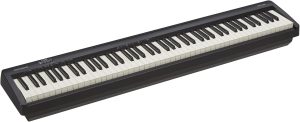
The Roland FP-10 is the logical entry point into Roland’s portable digital-piano lineup.
Its biggest advantage is that Roland gives it the same PHA-4 Standard keyboard family used in the more expensive FP-30X.
That means you’re getting a full 88-key weighted hammer-action keyboard with escapement and Ivory Feel surfaces at a relatively accessible level.
Piano Sound
The FP-10 uses Roland’s SuperNATURAL Piano Sound engine.
Roland specifies 96-note maximum polyphony and currently makes up to 36 tones accessible through the Roland Piano App, with 15 directly accessible from the instrument’s front panel.
For a beginner, those numbers are more than adequate for ordinary piano study.
You don’t need hundreds of sounds to learn:
- Scales
- Chords
- Classical pieces
- Sight-reading
- Pedaling
- Basic technique
Built-In Speakers
The FP-10 provides two 12 cm speakers powered by 6W × 2 amplification.
This makes it a self-contained practice piano.
You don’t need external speakers simply to begin playing.
Bluetooth MIDI and USB
The FP-10 supports Bluetooth MIDI and USB MIDI connectivity.
That allows integration with compatible:
- Piano-learning apps
- Tablets
- Smartphones
- Computers
- Music software
Twin Piano
Roland’s Twin Piano mode divides the keyboard into two matching pitch ranges.
This can be useful during lessons because teacher and student can play similar passages side by side.
Who Should Buy the FP-10?
The FP-10 is especially suitable for:
- Complete beginners
- Children starting lessons
- Adult beginners
- Classical students
- Apartment dwellers
- Buyers moving from an unweighted keyboard
Main Strength
Excellent weighted-key fundamentals at an entry-level price.
Main Limitation
The speaker system, controls, connectivity, and overall feature set are more basic than those of the FP-30X.
Beginners who want to stay within the Roland lineup can compare these choices in more detail in our dedicated guide to Roland digital pianos for beginners.
Best for:
Beginners who care more about proper piano action than about having many extra features.
Check Roland FP-10 Price on Amazon
2. Roland FP-30X — Best Overall Roland Digital Piano
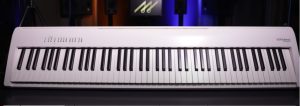
For many buyers, the Roland FP-30X is the sweet spot of the lineup.
It retains the PHA-4 Standard keyboard but substantially improves the instrument around it.
Roland specifies:
- 88 PHA-4 Standard keys
- SuperNATURAL Piano sound
- 256-note maximum polyphony
- 321 available tones through the Roland Piano App
- 11W × 2 speakers
- Bluetooth Audio
- Bluetooth MIDI
- USB audio/MIDI
- Dedicated audio outputs
- Three-pedal compatibility
Why the FP-30X Is Such a Strong All-Rounder
It can serve several roles without feeling badly compromised.
As a Practice Piano
The weighted PHA-4 keyboard and stronger speaker system make it a capable everyday instrument.
As a Student Piano
It can support beginners well into intermediate study.
As a Home Recording Piano
The USB Computer port supports USB MIDI and audio, which is useful for DAWs and home recording.
As an Occasional Performance Piano
The FP-30X includes dedicated L/Mono and R 1/4-inch outputs, so it can connect cleanly to external sound systems.
More Powerful Speakers
Compared with the FP-10’s 6W × 2 system, the FP-30X provides 11W × 2 amplification.
This is one of the most noticeable everyday upgrades.
If you frequently play without headphones, speaker performance matters.
256-Note Polyphony
The FP-30X provides 256-note polyphony, compared with the FP-10’s 96.
You shouldn’t buy a digital piano solely because one polyphony number is higher, but additional capacity becomes useful for:
- Heavy pedaling
- Layered voices
- Complex repertoire
- Recording
- More advanced arrangements
Bluetooth Audio
Unlike the FP-10, the FP-30X also supports Bluetooth Audio as well as Bluetooth MIDI.
That allows you to stream compatible audio through the piano’s speakers, which can be useful for practice tracks and music playback.
Who Should Buy the FP-30X?
- Serious beginners
- Intermediate students
- Adults returning to piano
- Home musicians
- Pianists interested in recording
- Players wanting a long-term instrument
Best for:
Most buyers seeking Roland’s strongest balance of price, keyboard action, speakers, connectivity, and room for progression.
[Check Roland FP-30X Price on Amazon →]
Roland FP-10 vs FP-30X
Because both use the PHA-4 Standard keyboard, choosing between them is largely about everything surrounding the action.
| Feature | FP-10 | FP-30X |
|---|---|---|
| Keys | 88 | 88 |
| Action | PHA-4 Standard | PHA-4 Standard |
| Piano engine | SuperNATURAL | SuperNATURAL |
| Polyphony | 96 | 256 |
| Speaker power | 6W × 2 | 11W × 2 |
| Bluetooth MIDI | Yes | Yes |
| Bluetooth Audio | No | Yes |
| USB MIDI | Yes | Yes |
| USB Audio | More limited | Yes |
| Dedicated line outputs | No dedicated pair | Yes |
| Best For | Budget beginner | Long-term/general use |
Choose FP-10 if:
- Budget is important.
- You’re a beginner.
- Basic speakers are sufficient.
- You mainly want traditional piano practice.
Choose FP-30X if:
- You expect to continue for years.
- Better speakers matter.
- Recording matters.
- Bluetooth Audio is useful.
- Greater connectivity matters.
For a committed beginner whose budget permits it, I would generally choose the FP-30X.
3. Roland FP-90X — Best Premium Portable Roland Piano
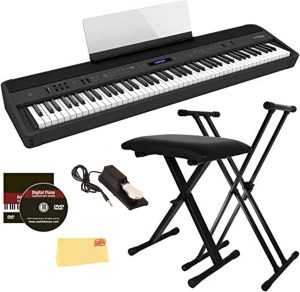
The Roland FP-90X represents a major step upward.
Unlike the FP-10 and FP-30X, it uses Roland’s premium PHA-50 hybrid keyboard and PureAcoustic Piano Modeling.
This moves the FP-90X from a strong student/home instrument into serious pianist territory.
PHA-50 Hybrid Keyboard
Roland specifies:
- 88 keys
- Hybrid wood and plastic construction
- Escapement
- Ebony/Ivory Feel surfaces
The move from PHA-4 to PHA-50 is one of the clearest reasons to pay more for the FP-90X.
PureAcoustic Piano Modeling
The FP-90X uses PureAcoustic Piano Modeling rather than the SuperNATURAL system found in the FP-10 and FP-30X.
Roland’s modeling approach is designed to recreate piano behavior dynamically rather than treating the instrument merely as playback of fixed recordings.
For an experienced pianist, this can provide a greater sense of interaction between touch and tone.
Full Piano Polyphony
Roland specifies limitless polyphony when using selected solo piano tones, while other sounds provide 256-note polyphony.
Again, the practical significance isn’t simply the number.
It helps the instrument handle complex playing, sustained resonance, and sophisticated piano modeling without conventional note-stealing limitations in its primary piano voices.
Four-Speaker System
The FP-90X uses:
- Two main speakers
- Two dome tweeters
- 25W × 2 amplification
This is a considerably more substantial onboard system than the FP-30X.
For a home pianist who doesn’t always want headphones or external monitors, that can make a large difference.
Microphone Input
The FP-90X also includes a microphone input with vocal effects.
That can be particularly useful for:
- Singer-pianists
- Solo performers
- Rehearsals
- Small performances
USB Audio and MIDI
The USB Computer connection supports both MIDI and audio, making the FP-90X suitable for computer-based music production and recording.
Weight
The FP-90X weighs approximately 23.6 kg / 52 lb 1 oz.
So while it is technically portable in form, it’s better described as transportable.
Who Should Buy the FP-90X?
- Advanced students
- Experienced pianists
- Classical players
- Piano teachers
- Serious home musicians
- Singer-pianists
- Performing musicians
- Buyers wanting premium touch without a permanent cabinet
Best for:
Experienced pianists wanting Roland’s strongest premium portable-piano experience.
[Check Roland FP-90X Price on Amazon →]
FP-30X vs FP-90X: Is the Upgrade Worth It?
This is one of the most important Roland comparisons.
The upgrade is substantial.
FP-30X
- PHA-4 Standard
- SuperNATURAL Piano
- 256-note polyphony
- 11W × 2 speakers
- 14.8 kg / 32 lb 11 oz
FP-90X
- PHA-50 hybrid action
- PureAcoustic Piano Modeling
- Limitless selected piano polyphony
- Four-speaker system
- 25W × 2 amplification
- 23.6 kg / 52 lb 1 oz
For a beginner, the upgrade may be unnecessary.
For an experienced pianist who increasingly notices differences in key response, tonal behavior, speaker quality, and dynamic control, it can be meaningful.
4. Roland RD-2000 EX — Best Professional Roland Stage Piano
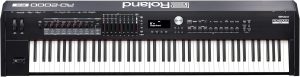
The RD-2000 EX is fundamentally different from the other three instruments.
It isn’t primarily designed as a living-room digital piano.
It is a professional stage piano and master controller.
Roland equips it with:
- PHA-50 keyboard
- V-Piano engine
- SuperNATURAL engine
- More than 1,100 sounds
- Eight assignable zones
- Nine sliders
- Eight knobs
- XLR outputs
- USB audio/MIDI
- Two pre-installed V-Piano expansions
PHA-50 Action
Like the FP-90X, the RD-2000 EX uses Roland’s PHA-50 keyboard. It weighs approximately 21.7 kg / 47 lb 14 oz.
The difference between the two instruments isn’t primarily about key quality.
It’s about purpose.
The FP-90X is a premium portable digital piano.
The RD-2000 EX is a professional performance controller.
Dual Sound Engines
The RD-2000 EX combines:
V-Piano
Used for sophisticated modeled piano sounds with full polyphony and Piano Designer customization.
SuperNATURAL
Used for electric pianos and a broad range of additional sounds.
Roland says the instrument includes over 1,100 SuperNATURAL-driven sounds.
German Concert and Essential Upright
The EX model includes two V-Piano expansions:
- German Concert
- Essential Upright
These are pre-installed on the RD-2000 EX.
The German Concert expansion provides additional concert-grand-style tones, while Essential Upright focuses on the distinct character of premium upright pianos.
Eight Zones
The RD-2000 EX supports eight assignable zones.
That means one keyboard can simultaneously manage:
- Internal piano
- Strings
- Synth pads
- Bass
- External hardware
- Software instruments
This is extremely useful in professional stage setups.
Physical Controls
The front panel includes:
- Nine illuminated sliders
- Eight illuminated knobs
- Modulation wheels
- Pitch/modulation controls
These allow rapid changes during live performance without excessive menu navigation.
Professional Audio Connections
The RD-2000 EX provides:
- Balanced XLR main outputs
- 1/4-inch main outputs
- Separate sub outputs
- MIDI
- USB audio/MIDI
- Multiple pedal inputs
It can therefore serve as the centerpiece of a complex professional rig.
24-Bit / 192 kHz USB Audio
Roland specifies USB audio support at up to 24-bit / 192 kHz.
This makes it especially capable in studio and hybrid software/hardware setups.
No Built-In Speakers
The RD-2000 EX does not have built-in speakers.
That’s normal for this type of professional stage piano.
You’ll use:
- PA system
- Powered monitors
- Stage amplification
- Headphones
Who Should Buy It?
- Professional keyboardists
- Touring musicians
- Worship players
- Studio musicians
- Theater/Broadway-style performers
- Musicians using MainStage or software instruments
- Players managing complex multi-sound setups
Musicians comparing Roland with stage instruments from other manufacturers may also want to see our portable keyboard recommendations for gigging musicians.
Best for:
Professional musicians who need a serious piano action combined with advanced stage control.
[Check Roland RD-2000 EX Price on Amazon →]
FP-90X vs RD-2000 EX
These instruments share PHA-50 technology but serve very different musicians.
| Feature | FP-90X | RD-2000 EX |
|---|---|---|
| Primary use | Premium home/portable | Professional stage |
| Keyboard | PHA-50 | PHA-50 |
| Main piano technology | PureAcoustic Modeling | V-Piano |
| Built-in speakers | Yes | No |
| Advanced stage zones | Limited | 8 |
| XLR outputs | No | Yes |
| Controller depth | Moderate | Extensive |
| Best For | Pianists | Professional keyboardists |
Choose FP-90X if:
You mainly want a premium piano for playing, practice, recording, and occasional performance.
Choose RD-2000 EX if:
You need to manage multiple sounds, software instruments, hardware, zones, and professional stage connections.
Which Roland Is Best for Beginners?
The FP-10 is the obvious entry-level choice.
It provides the PHA-4 action, SuperNATURAL Piano sound, built-in speakers, and essential connectivity without forcing beginners to pay for features they don’t yet need.
The FP-30X becomes more attractive for a committed beginner who expects to continue for many years.
Which Roland Is Best for Intermediate Players?
For most intermediate players, I’d choose the FP-30X.
Its combination of:
- PHA-4 action
- 256-note polyphony
- Better speakers
- USB audio/MIDI
- Bluetooth
- Three-pedal expandability
makes it flexible enough for substantial musical development.
Experienced intermediate players should also try the FP-90X.
If you’re unsure whether you’re actually ready to move beyond an entry-level piano, our digital piano recommendations by playing level explain how priorities change as technique develops.
Which Roland Is Best for Advanced Pianists?
The FP-90X is the most natural choice among these four for an advanced pianist primarily concerned with piano playing.
The PHA-50 action and PureAcoustic Modeling represent a significant jump over the FP-30X.
The RD-2000 EX is more appropriate when professional stage-control requirements are equally important.
Which Roland Is Best for Classical Music?
Beginner Classical Student
FP-10
Serious Beginner / Intermediate
FP-30X
Advanced Classical Player
FP-90X
Advanced Player Who Also Performs Professionally
RD-2000 EX, depending on stage requirements.
Which Roland Is Best for Home Recording?
The FP-30X is probably sufficient for most home studios because of its USB audio/MIDI capability.
The FP-90X provides a more premium keyboard and piano engine.
The RD-2000 EX becomes attractive to professional producers and performers who want extensive MIDI zones, virtual-instrument integration, and 24-bit/192 kHz USB audio.
Roland vs Yamaha
This is one of the most common digital-piano comparisons.
At roughly comparable levels, buyers might consider:
FP-10 vs entry Yamaha P-Series
FP-30X vs Yamaha P-225
FP-90X vs Yamaha P-525
Roland tends to emphasize:
- PHA keyboard actions
- Modeling
- Bluetooth integration
- Modern digital features
Yamaha brings:
- Yamaha acoustic-piano heritage
- CFX/Bösendorfer sound ecosystem
- Its own graded and GrandTouch actions
Neither manufacturer is automatically better.
Try the keyboards personally whenever possible.
Roland vs Kawai
Kawai has developed a particularly strong reputation for its Responsive Hammer actions and acoustic-piano-focused design.
A useful beginner comparison is:
Roland FP-10 vs Kawai ES120
At a higher level:
Roland FP-90X vs Kawai ES920
These instruments feel noticeably different.
Keyboard action is personal enough that specifications shouldn’t make the final decision.
Do Roland Digital Pianos Need Tuning?
No.
Digital pianos don’t contain acoustic strings that gradually drift out of tune.
This is one of their practical advantages over acoustic instruments.
Are Roland Digital Pianos Good for Headphone Practice?
Yes.
All four instruments can be used with headphones, although their intended use differs greatly.
For apartment living and late-night practice, the FP-10, FP-30X, and FP-90X are particularly convenient because they also function as self-contained home instruments with built-in speakers.
Frequently Asked Questions
What is the best Roland digital piano for beginners?
The Roland FP-10 is my choice for beginners because it provides an 88-key PHA-4 Standard action, SuperNATURAL Piano sound, built-in speakers, Bluetooth MIDI, and USB connectivity at the entry level.
Is the Roland FP-30X better than the FP-10?
Overall, yes.
Both use PHA-4 Standard action, but the FP-30X adds 256-note polyphony, stronger 11W × 2 speakers, Bluetooth Audio, USB audio/MIDI, dedicated outputs, and greater flexibility.
Is the Roland FP-90X worth the extra money?
For experienced players, it can be.
The move to PHA-50 action, PureAcoustic Piano Modeling, more powerful speakers, and premium performance features represents a genuine upgrade rather than merely adding more sounds.
Does the Roland FP-90X have wooden keys?
Its PHA-50 action uses a hybrid wood and plastic construction rather than being an all-wooden key mechanism.
Does the RD-2000 EX have speakers?
No.
It is designed for professional stage and studio use with external amplification.
Is the RD-2000 EX good for classical piano?
Its PHA-50 weighted action is capable of serious piano playing, but if your only purpose is home classical practice, the FP-90X may be more convenient because it has built-in speakers and a more piano-centered interface.
What is the difference between SuperNATURAL and PureAcoustic Modeling?
SuperNATURAL is Roland’s established piano sound technology used in models such as the FP-10 and FP-30X.
PureAcoustic Piano Modeling, found in the FP-90X, moves further toward dynamically modeling the behavior of an acoustic piano rather than relying primarily on a traditional sample-based approach.
What is Roland V-Piano?
V-Piano is Roland’s advanced piano-modeling technology used in instruments such as the RD-2000 EX. It allows detailed piano behavior and tone to be generated through modeling, with extensive user customization.
Which Roland is best for professional performance?
The RD-2000 EX is the clear choice among these four when professional stage control is the priority.
Which Roland is best for an apartment?
The FP-10 or FP-30X.
Both are relatively compact, include built-in speakers, and support headphone practice.
Final Verdict: Which Roland Digital Piano Should You Buy?
Roland’s lineup becomes much easier to understand when you match each piano to a particular type of player.
Best for Beginners — Roland FP-10
Choose it if you’re beginning piano and want a proper 88-key weighted action without paying for features you don’t yet need.
Best Overall Value — Roland FP-30X
Choose it if you want a piano that can carry you from beginner through intermediate playing while also providing stronger speakers, recording capability, Bluetooth, and better connectivity.
Best Premium Portable — Roland FP-90X
Choose it if you’re an experienced pianist who values the more sophisticated PHA-50 action, PureAcoustic Piano Modeling, strong onboard speakers, and premium home/performance capability.
Best Professional Stage Piano — Roland RD-2000 EX
Choose it if your needs extend far beyond ordinary piano practice into professional stage control, software integration, multiple zones, and complex performance setups.
The progression is therefore:
FP-10 → learn
FP-30X → develop
FP-90X → refine
RD-2000 EX → perform professionally
The best model isn’t necessarily the most expensive one.
It is the instrument whose keyboard, sound, features, portability, and price match the way you actually play.
Whenever possible, sit down at the final two models you’re considering.
Play softly.
Play loudly.
Try repeated notes.
Use the sustain pedal.
Listen through headphones and speakers where applicable.
Specifications create the shortlist.
Your fingers and ears should make the final choice.
Players interested in Roland’s professional end of the range can also read our detailed Roland RD-2000 stage piano guide to see how the original model compares with the newer RD-2000 EX.
Related readings:
Best Roland Digital Pianos for Beginners: Top Picks for 2026
Roland has been one of the most influential names in electronic musical instruments for decades, and its digital-piano lineup now covers almost every type of player—from complete beginners to professional stage musicians.
That range is useful, but it can also make choosing difficult.
Should a beginner buy the affordable Roland FP-10? Is the FP-30X worth the extra money? When does the premium FP-90X make sense? And who actually needs something as sophisticated as the RD-2000 EX?
The right answer depends on your playing level, budget, space, and whether you primarily practice at home, record music, or perform professionally.
In this guide, we’ll compare four Roland digital pianos that represent very different levels of the market:
- Roland FP-10 — Best for Beginners
- Roland FP-30X — Best Overall Value
- Roland FP-90X — Best Premium Portable
- Roland RD-2000 EX — Best Professional Stage Piano
These four models provide a useful progression from entry-level piano study to advanced professional performance.
Disclosure: Some links on Pianos-Galore are affiliate links. If you purchase through these links, we may receive a small commission at no additional cost to you.
Roland Digital Pianos at a Glance
| Model | Best For | Keyboard | Main Piano Technology | Format |
|---|---|---|---|---|
| Roland FP-10 | Beginners | PHA-4 Standard | SuperNATURAL Piano | Portable |
| Roland FP-30X | Best Overall Value | PHA-4 Standard | SuperNATURAL Piano | Portable |
| Roland FP-90X | Advanced/Premium | PHA-50 | PureAcoustic Piano Modeling | Portable |
| Roland RD-2000 EX | Professional Stage Players | PHA-50 | V-Piano + SuperNATURAL | Stage Piano |
The most important thing to notice is that Roland doesn’t simply add more sounds as prices rise.
The company also upgrades the keyboard action, piano technology, speakers, connectivity, and professional control capabilities.
Why Consider a Roland Digital Piano?
Roland has built much of its reputation around electronic sound generation and keyboard technology.
Its digital pianos are particularly notable for three things:
1. Weighted Keyboard Actions
Roland’s entry and midrange instruments commonly use the PHA-4 Standard action.
Higher-end models such as the FP-90X and RD-2000 EX move to the more sophisticated PHA-50 hybrid action.
This creates a fairly understandable progression for buyers.
2. Piano Modeling and Sound Technology
Roland uses different piano technologies at different levels.
You’ll encounter:
- SuperNATURAL Piano
- PureAcoustic Piano Modeling
- V-Piano technology
Rather than relying only on conventional note samples, Roland increasingly uses modeling to reproduce aspects of how an acoustic piano responds dynamically.
3. Modern Connectivity
Many Roland models combine traditional piano features with:
- Bluetooth
- USB
- MIDI
- Recording functions
- App connectivity
- Headphones
- Computer integration
That makes them particularly useful in modern homes and studios.
Understanding Roland Keyboard Actions
PHA-4 Standard
The PHA-4 Standard is found in both the FP-10 and FP-30X.
Roland specifies:
- 88 weighted keys
- Escapement
- Ivory Feel key surfaces
- Five touch-sensitivity settings plus fixed touch
The action is designed to reproduce the graded feel associated with acoustic-piano keyboards.
For beginners and developing pianists, this is a major strength.
Roland’s PHA-4 Standard provides 88 weighted keys with hammer action, escapement and Ivory Feel surfaces designed to support proper piano technique.
PHA-50
Move to the FP-90X and RD-2000 EX and Roland uses its PHA-50 keyboard.
This combines wooden and molded components and incorporates escapement with ebony/ivory-style key surfaces. Roland positions it as a premium action intended to combine piano-like feel with durability.
For experienced pianists, this can become increasingly valuable because they tend to notice subtle differences in:
- Dynamic control
- Repetition
- Stability
- Key response
- Long-term playing comfort
If you’re comparing PHA-4 and PHA-50 primarily for piano feel, our guide to weighted keyboard action and realistic piano feel explains why two 88-key instruments can feel very different.
1. Roland FP-10 — Best Roland Digital Piano for Beginners
The Roland FP-10 is the logical entry point into Roland’s portable digital-piano lineup.
Its biggest advantage is that Roland gives it the same PHA-4 Standard keyboard family used in the more expensive FP-30X.
That means you’re getting a full 88-key weighted hammer-action keyboard with escapement and Ivory Feel surfaces at a relatively accessible level.
Piano Sound
The FP-10 uses Roland’s SuperNATURAL Piano Sound engine.
Roland specifies 96-note maximum polyphony and currently makes up to 36 tones accessible through the Roland Piano App, with 15 directly accessible from the instrument’s front panel.
For a beginner, those numbers are more than adequate for ordinary piano study.
You don’t need hundreds of sounds to learn:
- Scales
- Chords
- Classical pieces
- Sight-reading
- Pedaling
- Basic technique
Built-In Speakers
The FP-10 provides two 12 cm speakers powered by 6W × 2 amplification.
This makes it a self-contained practice piano.
You don’t need external speakers simply to begin playing.
Bluetooth MIDI and USB
The FP-10 supports Bluetooth MIDI and USB MIDI connectivity.
That allows integration with compatible:
- Piano-learning apps
- Tablets
- Smartphones
- Computers
- Music software
Twin Piano
Roland’s Twin Piano mode divides the keyboard into two matching pitch ranges.
This can be useful during lessons because teacher and student can play similar passages side by side.
Who Should Buy the FP-10?
The FP-10 is especially suitable for:
- Complete beginners
- Children starting lessons
- Adult beginners
- Classical students
- Apartment dwellers
- Buyers moving from an unweighted keyboard
Main Strength
Excellent weighted-key fundamentals at an entry-level price.
Main Limitation
The speaker system, controls, connectivity, and overall feature set are more basic than those of the FP-30X.
Beginners who want to stay within the Roland lineup can compare these choices in more detail in our dedicated guide to Roland digital pianos for beginners.
Best for:
Beginners who care more about proper piano action than about having many extra features.
Check Roland FP-10 Price on Amazon
2. Roland FP-30X — Best Overall Roland Digital Piano
For many buyers, the Roland FP-30X is the sweet spot of the lineup.
It retains the PHA-4 Standard keyboard but substantially improves the instrument around it.
Roland specifies:
- 88 PHA-4 Standard keys
- SuperNATURAL Piano sound
- 256-note maximum polyphony
- 321 available tones through the Roland Piano App
- 11W × 2 speakers
- Bluetooth Audio
- Bluetooth MIDI
- USB audio/MIDI
- Dedicated audio outputs
- Three-pedal compatibility
Why the FP-30X Is Such a Strong All-Rounder
It can serve several roles without feeling badly compromised.
As a Practice Piano
The weighted PHA-4 keyboard and stronger speaker system make it a capable everyday instrument.
As a Student Piano
It can support beginners well into intermediate study.
As a Home Recording Piano
The USB Computer port supports USB MIDI and audio, which is useful for DAWs and home recording.
As an Occasional Performance Piano
The FP-30X includes dedicated L/Mono and R 1/4-inch outputs, so it can connect cleanly to external sound systems.
More Powerful Speakers
Compared with the FP-10’s 6W × 2 system, the FP-30X provides 11W × 2 amplification.
This is one of the most noticeable everyday upgrades.
If you frequently play without headphones, speaker performance matters.
256-Note Polyphony
The FP-30X provides 256-note polyphony, compared with the FP-10’s 96.
You shouldn’t buy a digital piano solely because one polyphony number is higher, but additional capacity becomes useful for:
- Heavy pedaling
- Layered voices
- Complex repertoire
- Recording
- More advanced arrangements
Bluetooth Audio
Unlike the FP-10, the FP-30X also supports Bluetooth Audio as well as Bluetooth MIDI.
That allows you to stream compatible audio through the piano’s speakers, which can be useful for practice tracks and music playback.
Who Should Buy the FP-30X?
- Serious beginners
- Intermediate students
- Adults returning to piano
- Home musicians
- Pianists interested in recording
- Players wanting a long-term instrument
Best for:
Most buyers seeking Roland’s strongest balance of price, keyboard action, speakers, connectivity, and room for progression.
[Check Roland FP-30X Price on Amazon →]
Roland FP-10 vs FP-30X
Because both use the PHA-4 Standard keyboard, choosing between them is largely about everything surrounding the action.
| Feature | FP-10 | FP-30X |
|---|---|---|
| Keys | 88 | 88 |
| Action | PHA-4 Standard | PHA-4 Standard |
| Piano engine | SuperNATURAL | SuperNATURAL |
| Polyphony | 96 | 256 |
| Speaker power | 6W × 2 | 11W × 2 |
| Bluetooth MIDI | Yes | Yes |
| Bluetooth Audio | No | Yes |
| USB MIDI | Yes | Yes |
| USB Audio | More limited | Yes |
| Dedicated line outputs | No dedicated pair | Yes |
| Best For | Budget beginner | Long-term/general use |
Choose FP-10 if:
- Budget is important.
- You’re a beginner.
- Basic speakers are sufficient.
- You mainly want traditional piano practice.
Choose FP-30X if:
- You expect to continue for years.
- Better speakers matter.
- Recording matters.
- Bluetooth Audio is useful.
- Greater connectivity matters.
For a committed beginner whose budget permits it, I would generally choose the FP-30X.
3. Roland FP-90X — Best Premium Portable Roland Piano
The Roland FP-90X represents a major step upward.
Unlike the FP-10 and FP-30X, it uses Roland’s premium PHA-50 hybrid keyboard and PureAcoustic Piano Modeling.
This moves the FP-90X from a strong student/home instrument into serious pianist territory.
PHA-50 Hybrid Keyboard
Roland specifies:
- 88 keys
- Hybrid wood and plastic construction
- Escapement
- Ebony/Ivory Feel surfaces
The move from PHA-4 to PHA-50 is one of the clearest reasons to pay more for the FP-90X.
PureAcoustic Piano Modeling
The FP-90X uses PureAcoustic Piano Modeling rather than the SuperNATURAL system found in the FP-10 and FP-30X.
Roland’s modeling approach is designed to recreate piano behavior dynamically rather than treating the instrument merely as playback of fixed recordings.
For an experienced pianist, this can provide a greater sense of interaction between touch and tone.
Full Piano Polyphony
Roland specifies limitless polyphony when using selected solo piano tones, while other sounds provide 256-note polyphony.
Again, the practical significance isn’t simply the number.
It helps the instrument handle complex playing, sustained resonance, and sophisticated piano modeling without conventional note-stealing limitations in its primary piano voices.
Four-Speaker System
The FP-90X uses:
- Two main speakers
- Two dome tweeters
- 25W × 2 amplification
This is a considerably more substantial onboard system than the FP-30X.
For a home pianist who doesn’t always want headphones or external monitors, that can make a large difference.
Microphone Input
The FP-90X also includes a microphone input with vocal effects.
That can be particularly useful for:
- Singer-pianists
- Solo performers
- Rehearsals
- Small performances
USB Audio and MIDI
The USB Computer connection supports both MIDI and audio, making the FP-90X suitable for computer-based music production and recording.
Weight
The FP-90X weighs approximately 23.6 kg / 52 lb 1 oz.
So while it is technically portable in form, it’s better described as transportable.
Who Should Buy the FP-90X?
- Advanced students
- Experienced pianists
- Classical players
- Piano teachers
- Serious home musicians
- Singer-pianists
- Performing musicians
- Buyers wanting premium touch without a permanent cabinet
Best for:
Experienced pianists wanting Roland’s strongest premium portable-piano experience.
[Check Roland FP-90X Price on Amazon →]
FP-30X vs FP-90X: Is the Upgrade Worth It?
This is one of the most important Roland comparisons.
The upgrade is substantial.
FP-30X
- PHA-4 Standard
- SuperNATURAL Piano
- 256-note polyphony
- 11W × 2 speakers
- 14.8 kg / 32 lb 11 oz
FP-90X
- PHA-50 hybrid action
- PureAcoustic Piano Modeling
- Limitless selected piano polyphony
- Four-speaker system
- 25W × 2 amplification
- 23.6 kg / 52 lb 1 oz
For a beginner, the upgrade may be unnecessary.
For an experienced pianist who increasingly notices differences in key response, tonal behavior, speaker quality, and dynamic control, it can be meaningful.
4. Roland RD-2000 EX — Best Professional Roland Stage Piano
The RD-2000 EX is fundamentally different from the other three instruments.
It isn’t primarily designed as a living-room digital piano.
It is a professional stage piano and master controller.
Roland equips it with:
- PHA-50 keyboard
- V-Piano engine
- SuperNATURAL engine
- More than 1,100 sounds
- Eight assignable zones
- Nine sliders
- Eight knobs
- XLR outputs
- USB audio/MIDI
- Two pre-installed V-Piano expansions
PHA-50 Action
Like the FP-90X, the RD-2000 EX uses Roland’s PHA-50 keyboard. It weighs approximately 21.7 kg / 47 lb 14 oz.
The difference between the two instruments isn’t primarily about key quality.
It’s about purpose.
The FP-90X is a premium portable digital piano.
The RD-2000 EX is a professional performance controller.
Dual Sound Engines
The RD-2000 EX combines:
V-Piano
Used for sophisticated modeled piano sounds with full polyphony and Piano Designer customization.
SuperNATURAL
Used for electric pianos and a broad range of additional sounds.
Roland says the instrument includes over 1,100 SuperNATURAL-driven sounds.
German Concert and Essential Upright
The EX model includes two V-Piano expansions:
- German Concert
- Essential Upright
These are pre-installed on the RD-2000 EX.
The German Concert expansion provides additional concert-grand-style tones, while Essential Upright focuses on the distinct character of premium upright pianos.
Eight Zones
The RD-2000 EX supports eight assignable zones.
That means one keyboard can simultaneously manage:
- Internal piano
- Strings
- Synth pads
- Bass
- External hardware
- Software instruments
This is extremely useful in professional stage setups.
Physical Controls
The front panel includes:
- Nine illuminated sliders
- Eight illuminated knobs
- Modulation wheels
- Pitch/modulation controls
These allow rapid changes during live performance without excessive menu navigation.
Professional Audio Connections
The RD-2000 EX provides:
- Balanced XLR main outputs
- 1/4-inch main outputs
- Separate sub outputs
- MIDI
- USB audio/MIDI
- Multiple pedal inputs
It can therefore serve as the centerpiece of a complex professional rig.
24-Bit / 192 kHz USB Audio
Roland specifies USB audio support at up to 24-bit / 192 kHz.
This makes it especially capable in studio and hybrid software/hardware setups.
No Built-In Speakers
The RD-2000 EX does not have built-in speakers.
That’s normal for this type of professional stage piano.
You’ll use:
- PA system
- Powered monitors
- Stage amplification
- Headphones
Who Should Buy It?
- Professional keyboardists
- Touring musicians
- Worship players
- Studio musicians
- Theater/Broadway-style performers
- Musicians using MainStage or software instruments
- Players managing complex multi-sound setups
Musicians comparing Roland with stage instruments from other manufacturers may also want to see our portable keyboard recommendations for gigging musicians.
Best for:
Professional musicians who need a serious piano action combined with advanced stage control.
[Check Roland RD-2000 EX Price on Amazon →]
FP-90X vs RD-2000 EX
These instruments share PHA-50 technology but serve very different musicians.
| Feature | FP-90X | RD-2000 EX |
|---|---|---|
| Primary use | Premium home/portable | Professional stage |
| Keyboard | PHA-50 | PHA-50 |
| Main piano technology | PureAcoustic Modeling | V-Piano |
| Built-in speakers | Yes | No |
| Advanced stage zones | Limited | 8 |
| XLR outputs | No | Yes |
| Controller depth | Moderate | Extensive |
| Best For | Pianists | Professional keyboardists |
Choose FP-90X if:
You mainly want a premium piano for playing, practice, recording, and occasional performance.
Choose RD-2000 EX if:
You need to manage multiple sounds, software instruments, hardware, zones, and professional stage connections.
Which Roland Is Best for Beginners?
The FP-10 is the obvious entry-level choice.
It provides the PHA-4 action, SuperNATURAL Piano sound, built-in speakers, and essential connectivity without forcing beginners to pay for features they don’t yet need.
The FP-30X becomes more attractive for a committed beginner who expects to continue for many years.
Which Roland Is Best for Intermediate Players?
For most intermediate players, I’d choose the FP-30X.
Its combination of:
- PHA-4 action
- 256-note polyphony
- Better speakers
- USB audio/MIDI
- Bluetooth
- Three-pedal expandability
makes it flexible enough for substantial musical development.
Experienced intermediate players should also try the FP-90X.
If you’re unsure whether you’re actually ready to move beyond an entry-level piano, our digital piano recommendations by playing level explain how priorities change as technique develops.
Which Roland Is Best for Advanced Pianists?
The FP-90X is the most natural choice among these four for an advanced pianist primarily concerned with piano playing.
The PHA-50 action and PureAcoustic Modeling represent a significant jump over the FP-30X.
The RD-2000 EX is more appropriate when professional stage-control requirements are equally important.
Which Roland Is Best for Classical Music?
Beginner Classical Student
FP-10
Serious Beginner / Intermediate
FP-30X
Advanced Classical Player
FP-90X
Advanced Player Who Also Performs Professionally
RD-2000 EX, depending on stage requirements.
Which Roland Is Best for Home Recording?
The FP-30X is probably sufficient for most home studios because of its USB audio/MIDI capability.
The FP-90X provides a more premium keyboard and piano engine.
The RD-2000 EX becomes attractive to professional producers and performers who want extensive MIDI zones, virtual-instrument integration, and 24-bit/192 kHz USB audio.
Roland vs Yamaha
This is one of the most common digital-piano comparisons.
At roughly comparable levels, buyers might consider:
FP-10 vs entry Yamaha P-Series
FP-30X vs Yamaha P-225
FP-90X vs Yamaha P-525
Roland tends to emphasize:
- PHA keyboard actions
- Modeling
- Bluetooth integration
- Modern digital features
Yamaha brings:
- Yamaha acoustic-piano heritage
- CFX/Bösendorfer sound ecosystem
- Its own graded and GrandTouch actions
Neither manufacturer is automatically better.
Try the keyboards personally whenever possible.
Roland vs Kawai
Kawai has developed a particularly strong reputation for its Responsive Hammer actions and acoustic-piano-focused design.
A useful beginner comparison is:
Roland FP-10 vs Kawai ES120
At a higher level:
Roland FP-90X vs Kawai ES920
These instruments feel noticeably different.
Keyboard action is personal enough that specifications shouldn’t make the final decision.
Do Roland Digital Pianos Need Tuning?
No.
Digital pianos don’t contain acoustic strings that gradually drift out of tune.
This is one of their practical advantages over acoustic instruments.
Are Roland Digital Pianos Good for Headphone Practice?
Yes.
All four instruments can be used with headphones, although their intended use differs greatly.
For apartment living and late-night practice, the FP-10, FP-30X, and FP-90X are particularly convenient because they also function as self-contained home instruments with built-in speakers.
Frequently Asked Questions
What is the best Roland digital piano for beginners?
The Roland FP-10 is my choice for beginners because it provides an 88-key PHA-4 Standard action, SuperNATURAL Piano sound, built-in speakers, Bluetooth MIDI, and USB connectivity at the entry level.
Is the Roland FP-30X better than the FP-10?
Overall, yes.
Both use PHA-4 Standard action, but the FP-30X adds 256-note polyphony, stronger 11W × 2 speakers, Bluetooth Audio, USB audio/MIDI, dedicated outputs, and greater flexibility.
Is the Roland FP-90X worth the extra money?
For experienced players, it can be.
The move to PHA-50 action, PureAcoustic Piano Modeling, more powerful speakers, and premium performance features represents a genuine upgrade rather than merely adding more sounds.
Does the Roland FP-90X have wooden keys?
Its PHA-50 action uses a hybrid wood and plastic construction rather than being an all-wooden key mechanism.
Does the RD-2000 EX have speakers?
No.
It is designed for professional stage and studio use with external amplification.
Is the RD-2000 EX good for classical piano?
Its PHA-50 weighted action is capable of serious piano playing, but if your only purpose is home classical practice, the FP-90X may be more convenient because it has built-in speakers and a more piano-centered interface.
What is the difference between SuperNATURAL and PureAcoustic Modeling?
SuperNATURAL is Roland’s established piano sound technology used in models such as the FP-10 and FP-30X.
PureAcoustic Piano Modeling, found in the FP-90X, moves further toward dynamically modeling the behavior of an acoustic piano rather than relying primarily on a traditional sample-based approach.
What is Roland V-Piano?
V-Piano is Roland’s advanced piano-modeling technology used in instruments such as the RD-2000 EX. It allows detailed piano behavior and tone to be generated through modeling, with extensive user customization.
Which Roland is best for professional performance?
The RD-2000 EX is the clear choice among these four when professional stage control is the priority.
Which Roland is best for an apartment?
The FP-10 or FP-30X.
Both are relatively compact, include built-in speakers, and support headphone practice.
Final Verdict: Which Roland Digital Piano Should You Buy?
Roland’s lineup becomes much easier to understand when you match each piano to a particular type of player.
Best for Beginners — Roland FP-10
Choose it if you’re beginning piano and want a proper 88-key weighted action without paying for features you don’t yet need.
Best Overall Value — Roland FP-30X
Choose it if you want a piano that can carry you from beginner through intermediate playing while also providing stronger speakers, recording capability, Bluetooth, and better connectivity.
Best Premium Portable — Roland FP-90X
Choose it if you’re an experienced pianist who values the more sophisticated PHA-50 action, PureAcoustic Piano Modeling, strong onboard speakers, and premium home/performance capability.
Best Professional Stage Piano — Roland RD-2000 EX
Choose it if your needs extend far beyond ordinary piano practice into professional stage control, software integration, multiple zones, and complex performance setups.
The progression is therefore:
FP-10 → learn
FP-30X → develop
FP-90X → refine
RD-2000 EX → perform professionally
The best model isn’t necessarily the most expensive one.
It is the instrument whose keyboard, sound, features, portability, and price match the way you actually play.
Whenever possible, sit down at the final two models you’re considering.
Play softly.
Play loudly.
Try repeated notes.
Use the sustain pedal.
Listen through headphones and speakers where applicable.
Specifications create the shortlist.
Your fingers and ears should make the final choice.
Players interested in Roland’s professional end of the range can also read our detailed Roland RD-2000 stage piano guide to see how the original model compares with the newer RD-2000 EX.
Related readings:
Best Roland Digital Pianos for Beginners: Top Picks for 2026