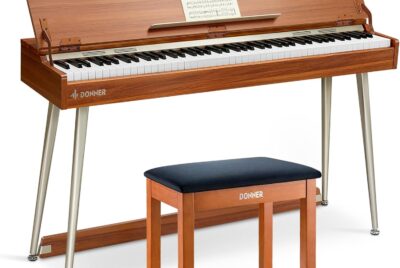
Donner DDP-80 Review 2026: Is This Stylish Budget Piano Actually Worth It?
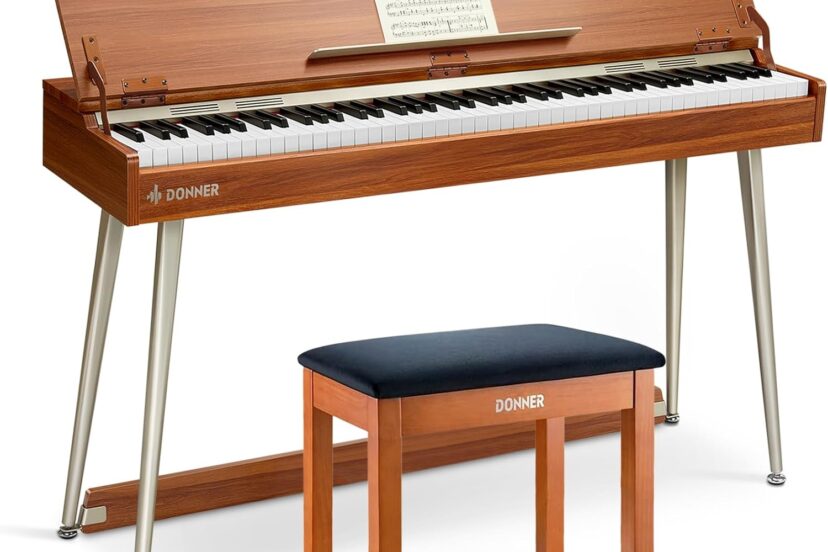
At first glance, the Donner DDP-80 doesn’t look like a typical budget digital piano.
There is no large control panel filled with buttons.
There is no LCD screen.
There aren’t hundreds of instrument voices staring back at you from a complicated menu.
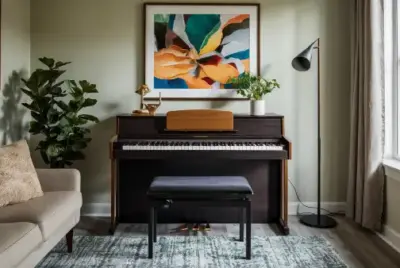
Instead, the DDP-80 looks more like a piece of modern furniture—a slim wooden piano designed to sit permanently in a living room, bedroom or music area.
And that raises an interesting question:
Is the Donner DDP-80 genuinely a good digital piano, or are you mainly paying for its stylish appearance?
For the right buyer, the answer may be surprisingly favorable.
The DDP-80 combines 88 weighted hammer-action keys, a piano-focused sound system, three pedals, built-in speakers and an attractive wooden cabinet at a price generally associated with entry-level digital pianos.
But its minimalist design also means giving up features that are common on competing instruments.
So before buying one, you need to understand exactly what the DDP-80 is—and what it isn’t.
Here’s our detailed 2026 Donner DDP-80 review.
Disclosure: Some links on Pianos-Galore are affiliate links. If you purchase through these links, we may receive a small commission at no additional cost to you.
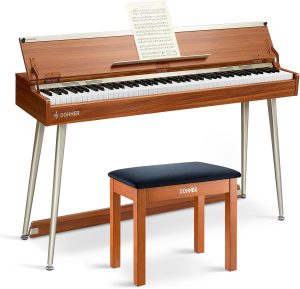
Donner DDP-80 at a Glance
| Feature | Donner DDP-80 |
|---|---|
| Keys | 88 |
| Keyboard Type | Weighted Hammer-Action |
| Primary Purpose | Home Piano Practice |
| Pedals | Sustain, Sostenuto & Soft |
| Speakers | Built In |
| Headphone Practice | Yes |
| USB-MIDI | Yes |
| Cabinet Style | Minimalist Wood/Furniture Style |
| Best For | Beginners & Home Players |
| Biggest Strength | Design + 88 Weighted Keys |
| Biggest Limitation | Very Limited Extra Features |
Our Verdict
The Donner DDP-80 makes the most sense for someone who wants an affordable 88-key home piano that actually looks good in the room—and doesn’t care about having hundreds of sounds, rhythms and buttons.
[Check Donner DDP-80 Price on Amazon →]
What Is the Donner DDP-80?
The DDP-80 is an 88-key digital piano designed primarily for home use.
Unlike portable slab-style digital pianos, it incorporates its keyboard, speakers, stand and pedal system into a furniture-style structure.
But Donner doesn’t try to imitate the large black cabinet of a traditional upright piano.
Instead, the DDP-80 takes a much more contemporary approach.
Its wooden appearance, angled legs and minimalist control layout make it look closer to Scandinavian-inspired furniture than a conventional electronic keyboard.
That immediately gives the DDP-80 a selling point that doesn’t show up on a specification sheet:
It can become part of the room rather than something you feel compelled to hide when visitors arrive.
The DDP-80’s Biggest Attraction: Its Design
Let’s start with the obvious.
The DDP-80 is attractive.
Many inexpensive digital pianos look exactly like what they are:
electronic keyboards mounted on stands.
There’s nothing necessarily wrong with that.
But if the instrument will remain permanently in your living room, appearance may matter.
The DDP-80 takes a different approach with:
- Wood-style construction
- Clean lines
- Minimal visible controls
- Integrated legs
- Integrated pedals
- Slim profile
It has a distinctly modern appearance.
For someone furnishing:
- An apartment
- Condominium
- Living room
- Bedroom
- Home office
- Small music room
that can be a significant advantage.
But Don’t Buy a Piano Just Because It Looks Good
This is where we need to separate the DDP-80 from ordinary furniture.
A digital piano still has to function as a musical instrument.
The three questions that matter most are:
- How does the keyboard feel?
- How convincing is the piano sound?
- Can it support a beginner as their playing improves?
Let’s look at those individually.
88 Weighted Keys: The DDP-80’s Most Important Feature
The Donner DDP-80 provides a full 88-key weighted hammer-action keyboard.
That matters much more than having hundreds of sounds.
A standard acoustic piano has 88 keys.
If you intend to learn traditional piano, having the full keyboard range means you won’t encounter the limitations of a 61-key beginner keyboard as your repertoire develops.
88 Keys to Mastery: Unlocking the Full Potential of Piano Playing
Why Weighted Keys Matter
An acoustic piano does not have extremely light electronic-keyboard keys.
Pressing a key activates a mechanical action that ultimately causes a hammer to strike a string.
Digital pianos attempt to reproduce aspects of that resistance through weighted or hammer-action keyboard mechanisms.
This helps a student develop:
- Finger control
- Dynamic control
- Coordination
- Articulation
- Strength
- More transferable piano technique
That doesn’t mean an affordable digital action feels identical to a good acoustic grand piano.
It doesn’t.
But for a beginner, weighted hammer action is generally much more appropriate for traditional piano study than a lightweight 61-key keyboard.
Weighted Keys: The Foundation of Expressive Piano Performance
Is the Donner DDP-80 Good for Beginners?
Yes—provided we define the type of beginner.
Suppose you’re a beginner who wants to:
- Learn traditional piano
- Read sheet music
- Practice scales
- Learn chords
- Play classical pieces
- Play popular piano music
- Develop basic piano technique
The DDP-80 makes sense.
It provides the fundamentals without surrounding the player with unnecessary distractions.
But suppose your idea of a beginner keyboard is something with:
- Hundreds of instrument voices
- Drum rhythms
- Auto accompaniment
- Built-in lessons
- Display screen
- Recording features
- Lots of buttons
The DDP-80 may disappoint you.
It deliberately takes a much simpler approach.
Simplicity: Advantage or Disadvantage?
This may be the most important question in the entire review.
The DDP-80’s simplicity can be viewed in two completely different ways.
The Positive View
You sit down.
Turn on the piano.
And play.
There is little temptation to spend your practice session scrolling through 300 instrument voices.
For a student trying to learn piano, that’s arguably a good thing.
The Negative View
You may eventually wonder:
“Where are all the features?”
Compared with many digital pianos and keyboards, the DDP-80 is deliberately sparse.
If you love technology and experimentation, this may feel restrictive.
So simplicity is neither inherently good nor bad.
It depends on the player.
Piano Sound: Focused Rather Than Feature-Packed
The DDP-80’s philosophy is straightforward:
This is supposed to be a piano.
It isn’t trying to become an arranger keyboard or synthesizer.
That is important because entry-level buyers can sometimes be misled by enormous specification lists.
One keyboard might advertise:
500 sounds!
Another might offer far fewer.
That doesn’t automatically make the 500-sound instrument better for learning piano.
If you spend 95% of your practice time using an acoustic-piano voice, what matters more is:
- How convincing that piano sounds
- How it responds dynamically
- How the keys feel
- Whether the speakers reproduce it effectively
The DDP-80 prioritizes that simpler piano experience.
Built-In Speakers
The DDP-80 includes its own speaker system, so you don’t need external amplification for ordinary home practice.
That’s important because this is designed as a self-contained home instrument.
Turn it on and play.
You don’t need:
- Studio monitors
- Keyboard amplifier
- PA system
for everyday use.
For most beginners practicing at home, built-in speakers are exactly what you want.
Three Pedals Included
One of the DDP-80’s advantages as a furniture-style instrument is its integrated three-pedal setup.
The pedals correspond to the traditional piano functions:
- Damper/Sustain
- Sostenuto
- Soft
Beginners will use the sustain pedal most frequently.
But having all three pedals gives the instrument a more complete piano-style configuration and means you don’t have a loose sustain pedal sliding around the floor.
Why Pedaling Matters
Beginners sometimes treat pedals as accessories.
They aren’t.
As repertoire becomes more sophisticated, pedal technique becomes an important part of musical expression.
Good pedaling can:
- Connect notes
- Add resonance
- Shape phrases
- Change tonal character
Poor pedaling can turn beautiful music into a muddy blur.
Having a proper pedal setup from the beginning is therefore a useful advantage.
Headphone Practice: One of the DDP-80’s Best Home Features
One reason to choose any digital piano over an acoustic piano is the ability to practice quietly.
Connect headphones and the player can practice without disturbing everyone else.
This is especially useful if you:
- Live in an apartment
- Share a house
- Practice early
- Practice late
- Have children learning piano
- Have neighbors close by
This feature alone can dramatically increase the number of hours during which piano practice is practical.
USB-MIDI: The Hidden Feature That Expands the DDP-80
The DDP-80’s minimalist interface doesn’t mean it has to remain completely isolated from modern music technology.
USB-MIDI connectivity allows the piano to communicate with compatible computers and devices.
That opens several possibilities.
You can potentially use the DDP-80 with:
- Piano-learning software
- Music notation programs
- DAWs
- Virtual instruments
- MIDI recording software
This is particularly useful because it compensates for the DDP-80’s limited onboard sound selection.
Want More Sounds? Use Virtual Instruments
Suppose you like the DDP-80’s furniture-style design and weighted keyboard but eventually want better or different sounds.
MIDI gives you another route.
Connect the piano to a computer running compatible virtual-instrument software and the DDP-80 can act as a controller.
You could potentially play:
- Sampled concert grands
- Electric pianos
- Organs
- Strings
- Synthesizers
from software.
So its simple onboard architecture doesn’t necessarily mean you’re permanently restricted to a basic setup.
DDP-80 for Piano Learning Apps
MIDI connectivity can also make the DDP-80 useful with compatible learning software.
For a beginner, interactive piano-learning systems can supplement:
- Traditional lessons
- Piano books
- YouTube instruction
- Independent practice
I would not necessarily replace a good teacher with an app.
But digital learning tools can help with:
- Note recognition
- Rhythm
- Repetition
- Practice motivation
- Basic repertoire
Is the DDP-80 Good for Classical Piano?
For beginner classical study, it can be.
The important foundations are present:
- 88 keys
- Weighted hammer action
- Three pedals
- Headphone practice
- Piano-focused design
These are much more relevant to classical learning than hundreds of instrument voices.
However, advanced classical pianists are much more demanding about keyboard action, repetition, dynamic response, pedaling and tonal nuance.
At that level, I would look toward more sophisticated digital pianos from Yamaha, Kawai, Roland and other manufacturers—or potentially an acoustic piano.
So:
Beginner classical student? Yes.
Advanced classical pianist seeking an acoustic-grand substitute? Probably not.
Best Digital Pianos for Learning Classical Music in 2026
Is the Donner DDP-80 Good for Children?
It can be an excellent choice if the child is taking genuine piano lessons.
There are advantages to giving a child an instrument that feels like a permanent piano rather than a toy keyboard.
The DDP-80 provides:
- 88 keys
- Weighted action
- Pedals
- Dedicated practice location
- Few distracting controls
There is also a psychological benefit to having a piano permanently set up.
A keyboard stored in a closet has to be:
- Taken out.
- Placed on a stand.
- Connected.
- Set up.
A DDP-80 sitting in the room simply invites someone to sit down and play.
Reducing friction can encourage practice.
Is the DDP-80 Good for Adults Learning Piano?
This may actually be one of its strongest audiences.
Adult beginners often want something different from children.
Many don’t care about:
- 500 instrument sounds
- Flashing lesson systems
- Drum beats
- Games
They want to sit down after work and play piano.
They may also care more about how the instrument looks in their home.
For that buyer, the DDP-80’s combination of:
minimalist design + 88 weighted keys + three pedals + simple operation
is compelling.
DDP-80 for Apartments and Small Homes
The furniture-style design makes the DDP-80 especially attractive for smaller living spaces.
Unlike an acoustic upright, it doesn’t have a massive soundboard and traditional piano cabinet.
And unlike a portable keyboard, it doesn’t necessarily look temporary.
This gives it an interesting middle position:
more elegant than a keyboard on an X-stand
but
less visually imposing than a traditional upright piano.
For apartment dwellers, headphone practice adds another major advantage.
DDP-80 vs Portable Digital Piano
Should you buy the DDP-80 or something like a portable 88-key digital piano?
It depends on whether the instrument will move.
Choose the DDP-80 If:
- The piano will stay in one room.
- Appearance matters.
- You want integrated pedals.
- You prefer a furniture-style setup.
- You like simplicity.
Choose a Portable Digital Piano If:
- You move the instrument frequently.
- You perform outside the home.
- You need to store the piano.
- You want more controls and features.
- Portability matters more than appearance.
The DDP-80 is best treated as a home piano, not a gigging instrument.
DDP-80 vs Donner DEP-20
This is another useful comparison because these Donner models target different buyers.
The DEP-20 is more like a conventional feature-rich digital piano.
It offers numerous tones and functions and is better suited to someone who enjoys experimenting with different sounds.
The DDP-80 takes the opposite approach.
Choose the DDP-80 If:
- Appearance matters.
- The piano stays at home.
- You want an integrated furniture-style setup.
- You prefer simplicity.
Choose the DEP-20 If:
- Features matter.
- You want many tones.
- You prefer a conventional digital-piano format.
- Versatility matters more than furniture-style appearance.
Neither approach is inherently better.
They simply target different buyers.
Best Donner Digital Pianos in 2026: 6 Models for Beginners and Home Players
DDP-80 vs More Expensive Digital Pianos
This is where expectations matter.
The DDP-80 is positioned as an affordable instrument.
You should not expect its keyboard action, sound system and refinement to compete directly with substantially more expensive instruments such as:
- Yamaha P-525
- Kawai ES920
- Roland FP-90X
- Nord Grand 2
Those instruments target more demanding and experienced musicians.
The DDP-80’s appeal is not:
“This plays exactly like a premium concert-level digital piano for a fraction of the price.”
That’s unrealistic.
Its appeal is:
“This gives beginners 88 weighted keys, pedals, built-in sound and an attractive home cabinet without requiring a premium budget.”
That’s a much more credible value proposition.
What We Like About the Donner DDP-80
1. The Design
It’s genuinely distinctive.
The minimalist wooden aesthetic makes it easier to integrate into a modern home.
2. 88 Weighted Keys
This makes it much more suitable for traditional piano learning than inexpensive unweighted keyboards.
3. Integrated Three-Pedal System
A proper furniture-style pedal setup is more convenient than a loose sustain switch.
4. Simplicity
There are very few distractions.
Turn it on and practice.
5. Headphone Practice
Excellent for apartments and shared homes.
6. MIDI Connectivity
This gives the otherwise minimalist instrument access to a much larger digital ecosystem.
7. Value
The combination of furniture-style design, weighted keys and pedals is attractive for budget-conscious home players.
What We Don’t Like About the Donner DDP-80
No piano is perfect, and this review wouldn’t be useful if we ignored the weaknesses.
1. Limited Onboard Sounds
Players wanting a large sound library should look elsewhere.
2. Minimal Controls
Some people will love this.
Others will find it restrictive.
3. Not Designed for Gigging
This is fundamentally a home instrument.
4. Experienced Pianists May Want a Better Action
More advanced players may prefer the refinement of higher-end Yamaha, Roland or Kawai actions.
5. Feature Hunters May Be Disappointed
If your buying decision revolves around:
- Maximum polyphony
- Hundreds of tones
- Rhythms
- Accompaniment
- Displays
- Advanced recording
the DDP-80 is probably not your piano.
Who Should Buy the Donner DDP-80?
The DDP-80 makes the most sense for:
Beginner Piano Students
The 88-key weighted action provides a better foundation than a basic unweighted keyboard.
Adult Beginners
Especially those who want a straightforward piano rather than an electronic workstation.
Families
The instrument can remain permanently set up and ready for practice.
Apartment Dwellers
Its relatively compact furniture-style design and headphone capability are useful in smaller spaces.
Design-Conscious Buyers
If appearance matters almost as much as features, the DDP-80 stands out.
Budget-Conscious Home Pianists
It offers an appealing combination of piano fundamentals and furniture-style design.
7 Things to Know Before Buying a Donner DDP-80
1. You’re Buying Simplicity
Don’t expect a workstation.
2. It Is Primarily a Home Piano
This isn’t designed around frequent transportation.
3. Its Appearance Is Part of the Value
If you don’t care how your piano looks, other models may offer more features for the money.
4. Weighted Keys Matter More Than Hundreds of Sounds for Piano Learning
For traditional piano students, this is one of its strongest features.
5. Three Pedals Give It a More Complete Piano Setup
This becomes increasingly useful as repertoire advances.
6. MIDI Adds Flexibility
You can expand beyond the built-in piano experience using compatible software.
7. Advanced Pianists Should Keep Expectations Realistic
This is an affordable home digital piano—not a replacement for a premium digital or acoustic grand.
Frequently Asked Questions
Is the Donner DDP-80 worth buying in 2026?
For the right buyer, yes.
It is particularly attractive for beginners and home players who want 88 weighted keys, three pedals and an elegant furniture-style design without moving into premium digital-piano pricing.
Is the Donner DDP-80 good for beginners?
Yes.
Its 88-key weighted hammer-action keyboard provides a useful foundation for traditional piano learning.
Does the Donner DDP-80 have weighted keys?
Yes. It has a full 88-key weighted hammer-action keyboard.
Does the Donner DDP-80 have three pedals?
Yes.
Its furniture-style setup includes sustain, sostenuto and soft pedals.
Can I practice the DDP-80 with headphones?
Yes.
Quiet headphone practice is one of the reasons the DDP-80 works well in apartments and shared homes.
Does the Donner DDP-80 have MIDI?
Yes.
USB-MIDI allows it to communicate with compatible computers, software and learning applications.
Is the DDP-80 good for classical music?
It can be suitable for beginner classical study because it provides 88 weighted keys and three pedals.
More advanced classical pianists may prefer a higher-end action and more sophisticated piano engine.
Is the DDP-80 better than the Donner DEP-20?
They serve different purposes.
The DDP-80 emphasizes furniture-style appearance and simplicity.
The DEP-20 emphasizes features and sound variety.
Is the DDP-80 portable?
Not in the same sense as a slab-style portable digital piano.
It is better suited to a relatively permanent location in the home.
Does the DDP-80 look like an acoustic piano?
Not exactly.
It has a minimalist wooden furniture-style design rather than trying to reproduce the appearance of a traditional upright piano.
Donner DDP-80 Review: Final Verdict
So, is the Donner DDP-80 actually worth buying?
Yes—for a specific type of buyer.
The DDP-80 isn’t impressive because it has the longest specification list.
It doesn’t.
And that’s partly the point.
Its strengths are much easier to understand:
88 weighted keys.
Three pedals.
Built-in speakers.
Headphone practice.
MIDI connectivity.
An unusually attractive minimalist cabinet.
If you’re a beginner or home pianist who simply wants to sit down and play piano, that combination can make considerable sense.
If you’re an advanced pianist, touring musician, sound designer or feature-obsessed keyboard player, there are much better choices.
But for an adult beginner, family or design-conscious home player looking for an affordable digital piano that doesn’t make the living room look like a rehearsal studio, the DDP-80 occupies an interesting niche.
Our Rating by Category
| Category | Verdict |
|---|---|
| Design | Excellent |
| Beginner Friendliness | Very Good |
| Piano Learning | Very Good |
| Features | Basic |
| Portability | Limited |
| Home Use | Excellent |
| Value | Very Good |
| Advanced Pianists | Limited |
Best For:
Beginners and home players who value 88 weighted keys, simplicity and furniture-style design.
[Check Donner DDP-80 Price on Amazon →]
The DDP-80’s greatest strength may ultimately be something very simple:
It looks like a piano you want to keep in the room—and it’s always there waiting to be played. If you like the DDP-80’s space-conscious furniture design, you may also want to compare it with other apartment-friendly instruments in our Best Compact Digital Pianos for Small Spaces in 2026: 6 Top Picks.Related articles:
————————-Looking to learn piano or to improve your playing skill? Discover SIMPLY PIANO and play the tunes you love.

- Begin with beginner tutorials or dive into advanced courses for experienced players.
- Learn at your own pace with lessons customized to your skill level, and receive real-time feedback.
- Play a wide range of music, from classical pieces to popular hits and Disney songs. Improve with warm-ups, personalized exercises, and sheet music.