Top 4 Kawai Pianos: Best Picks for Beginners and Professionals

Kawai has earned an enviable reputation among pianists for one particular reason: the company takes piano feel seriously.
While many keyboard manufacturers compete on the number of sounds, rhythms, displays and electronic features they can provide, Kawai’s digital-piano philosophy has traditionally placed considerable emphasis on reproducing the experience of playing an acoustic piano.
That makes Kawai particularly interesting for:
- Classical-piano students
- Experienced acoustic pianists
- Adult beginners
- Piano teachers
- Home musicians
- Performers who want realistic weighted action
Kawai also manufactures some of the world’s highly regarded acoustic grand pianos, including the prestigious Shigeru Kawai instruments.
That acoustic-piano heritage influences the company’s digital instruments through technologies such as Responsive Hammer keyboard actions, Harmonic Imaging sound technology and Shigeru Kawai SK-EX concert-grand samples.
But Kawai’s digital-piano lineup covers several price levels.
Which one should you buy?
In this guide, we’ll compare some of the most interesting Kawai digital pianos for 2026 and explain which type of pianist each model suits best.
Disclosure: Some links on Pianos-Galore are affiliate links. If you purchase through these links, we may receive a small commission at no additional cost to you.
Why Choose a Kawai Digital Piano?
Digital-piano buyers often compare three major Japanese brands:
Kawai, Yamaha and Roland.
All three make excellent instruments, but Kawai has developed a particularly strong reputation for piano-oriented keyboard actions.
That doesn’t automatically mean Kawai is better for every player.
It means Kawai deserves particular attention when realistic piano touch ranks highly among your priorities.
Kawai’s Acoustic-Piano Heritage
Kawai was founded in Japan in 1927 by Koichi Kawai and has spent almost a century building acoustic and digital instruments.
Today its range stretches from relatively affordable portable digital pianos all the way to premium acoustic grands.
Its flagship Shigeru Kawai SK-EX concert grand is particularly relevant to digital-piano buyers because recordings of this instrument are incorporated into several Kawai digital-piano sound systems.
In other words, when you select a concert-grand voice on a modern Kawai digital piano, you’re benefiting indirectly from Kawai’s acoustic-piano expertise.
Understanding Kawai Keyboard Actions
This is one of the most important sections of this article.
Not all “88 weighted keys” are equal.
Two digital pianos can both advertise:
88 weighted hammer-action keys
yet feel quite different.
Kawai uses several action systems across its range.
Responsive Hammer Compact (RHC)
RHC is used in affordable portable models such as the ES120.
It provides 88 grade-weighted hammer keys in a relatively compact mechanism.
This makes it particularly appropriate for beginners and musicians who need portability.
Responsive Hammer Compact II (RHCII)
The ES520 moves to RHCII.
One significant difference is triple-sensor hammer detection, which gives the action more sophisticated note detection than the basic ES120 action.
Responsive Hammer III (RHIII)
Move to the ES920 and you get Kawai’s more sophisticated RHIII action.
It provides:
- Grade-weighted hammers
- Ivory Touch white-key surfaces
- Let-off simulation
- Triple-sensor detection
- Counterweights
This is one reason the ES920 deserves its position above the ES120 and ES520.
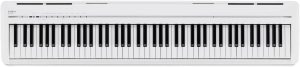
1. Kawai ES120 — Best Kawai Digital Piano for Beginners
Check out the price of Kawai ES120 at Amazon
For many buyers, the Kawai ES120 is the logical entry point into the Kawai digital-piano family.
It combines a full 88-key weighted keyboard with Kawai piano sampling, Bluetooth connectivity and a compact portable design.
Kawai describes the ES120 as an accessible model balancing quality and affordability.
Keyboard Action
The ES120 uses Kawai’s Responsive Hammer Compact (RHC) action.
It provides:
- 88 keys
- Grade-weighted hammers
- Matte key surfaces
The graded weighting is important for piano students because lower-register keys are designed to feel heavier than higher-register keys.
That more closely resembles the basic weighting characteristics of an acoustic piano.
Piano Sound
The ES120 uses Kawai’s Harmonic Imaging (HI) technology with 88-key stereo sampling.
Its piano recordings include:
- Shigeru Kawai SK-EX
- Kawai EX
- Kawai K-60
and it provides 192-note maximum polyphony.
That’s a strong specification for an entry-level instrument.
Bluetooth Connectivity
The ES120 also includes Bluetooth MIDI and Bluetooth Audio, allowing integration with compatible smartphones, tablets and apps. Kawai specifically highlights these wireless capabilities in its current ES120 product information.
Pedal Upgrade Options
The standard instrument can be expanded with more sophisticated pedal accessories.
Kawai supports the F-10H damper pedal as well as compatible triple-pedal options, including half-pedal functionality.
That makes the ES120 more useful as a student progresses.
Who Should Buy the ES120?
The ES120 is particularly suitable for:
- Beginners
- Children taking piano lessons
- Adult beginners
- Apartment dwellers
- College students
- Pianists needing a portable practice instrument
The ES120 is also one of several strong choices for new players; see our beginner digital piano recommendations for alternatives from Yamaha, Roland, Casio and others.
Best for: Beginners wanting genuine Kawai weighted-key feel at an accessible price.
2. Kawai ES520 — Best Balance of Portability and Features
Check out the price of Kawai ES520 at Amazon
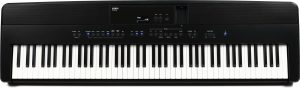
The Kawai ES520 occupies an interesting position between the ES120 and ES920.
It retains the portable philosophy of the ES series but moves upward in keyboard action, piano technology and overall capability.
RHCII Keyboard
The ES520 uses Kawai’s Responsive Hammer Compact II action.
Unlike the basic RHC action in the ES120, RHCII incorporates triple-sensor hammer detection.
That makes it attractive to players wanting something beyond an entry-level action without immediately moving to the ES920.
Piano Sound
Kawai gives the ES520 Progressive Harmonic Imaging (PHI) piano technology with 88-key stereo sampling and 192-note polyphony.
Who Should Buy It?
Consider the ES520 if:
- You have outgrown an entry-level instrument
- You still value portability
- You want a more sophisticated keyboard than the ES120
- You practice at home but occasionally perform
- The ES920 exceeds your budget
Best for: Intermediate players wanting a step up from the ES120 while retaining portability.
3. Kawai ES920 — Best Portable Kawai Digital Piano
Check out the price of Kawai ES920 at Amazon
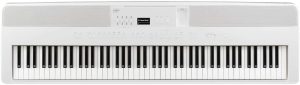
If piano feel is particularly important but you still need a portable instrument, the Kawai ES920 is the standout model in this group.
Its biggest advantage is its Responsive Hammer III action.
Kawai’s specifications confirm that RHIII includes:
- 88 grade-weighted keys
- Ivory Touch white-key surfaces
- Let-off simulation
- Triple-sensor key detection
- Counterweights
That represents a meaningful upgrade from both the ES120 and ES520.
Harmonic Imaging XL
The ES920 also upgrades the sound system to Harmonic Imaging XL (HI-XL) with 88-key stereo sampling.
Its piano recordings include:
- Shigeru Kawai SK-EX
- Shigeru Kawai SK-5
- Kawai EX
- Kawai K-60
and maximum polyphony rises to 256 notes.
This corrects an error in your current article, which lists the ES920 at 192-note polyphony.
Acoustic Rendering
Kawai also gives the ES920 more extensive resonance simulation through Acoustic Rendering, including characteristics such as damper, string, undamped-string and cabinet resonance.
These details become increasingly relevant as a pianist becomes more sensitive to tonal nuance.
Who Should Buy the ES920?
- Intermediate and advanced students
- Experienced pianists
- Classical musicians
- Piano teachers
- Gigging pianists
- Players wanting a premium portable instrument
Players considering the ES920 for stage use may also want to compare it with other portable pianos for gigging musicians.
Best for: Pianists wanting Kawai’s strongest portable combination of keyboard action and piano sound.
4. Kawai KDP120 — Best Traditional Home Digital Piano
Check out the price of Kawai KDP120 at Amazon
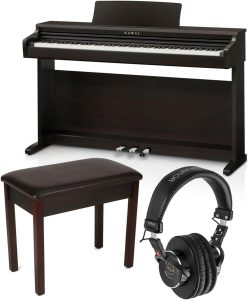
The Kawai KDP120 is fundamentally different from the three ES instruments.
The ES120, ES520 and ES920 are portable/slab-style digital pianos.
The KDP120 is a furniture-style home digital piano.
That makes it attractive to families and students who don’t need to transport their instrument.
Keyboard
The KDP120 uses Responsive Hammer Compact II with:
- 88 keys
- Grade-weighted hammers
- Triple-sensor hammer detection
Piano Sound
Kawai gives the KDP120 Harmonic Imaging piano technology with an SK-EX concert-grand recording and 192-note polyphony.
Three-Pedal System
Another important advantage is its integrated Grand Feel Pedal System.
You get:
- Damper with half-pedal support
- Soft pedal
- Sostenuto
This gives the KDP120 a more traditional home-piano configuration than a portable digital piano supplied with a basic pedal.
Who Should Buy It?
- Families
- Serious beginners
- Classical students
- Home pianists
- Players who don’t need portability
Best for: Students wanting a permanent Kawai home digital piano with an integrated three-pedal system.
Quick Comparison
| Model | Keyboard Action | Polyphony | Best For |
|---|---|---|---|
| ES120 | RHC | 192 | Beginners |
| ES520 | RHCII | 192 | Intermediate/value |
| ES920 | RHIII | 256 | Serious/advanced portable |
| KDP120 | RHCII | 192 | Home/classical student |
Kawai ES120 vs ES520 vs ES920
This is probably the comparison most readers need.
Choose the ES120 if:
You’re a beginner, budget matters, and you want a good 88-key Kawai digital piano without paying for advanced features.
Choose the ES520 if:
You want a better action and overall specification than the ES120 while retaining a relatively lightweight portable format.
Choose the ES920 if:
Keyboard feel and piano realism matter significantly and you’re prepared to pay more for RHIII action, HI-XL piano technology and 256-note polyphony.
The progression is therefore quite logical:
ES120 → beginner/value
ES520 → intermediate/balanced
ES920 → premium portable
ES120 vs KDP120: Which Is Better for a Beginner?
This depends more on where you’ll use the piano than on which model is universally “better.”
Choose ES120 if:
- Portability matters
- Space is limited
- You may move the piano
- Lower cost matters
- You want Bluetooth Audio and MIDI
Choose KDP120 if:
- The piano will stay permanently at home
- You want a furniture cabinet
- An integrated three-pedal system matters
- You prefer a traditional piano appearance
For a child taking lessons at home, the KDP120 can provide a more traditional practice setup.
For an adult in an apartment, the ES120 may be far more practical.
Why Kawai Key Actions Get So Much Attention
Kawai doesn’t have a monopoly on good digital-piano actions. Yamaha, Roland and other manufacturers make excellent weighted keyboards.
But Kawai has made keyboard action one of the defining characteristics of its digital-piano identity.
The differences between RHC, RHCII and RHIII illustrate this.
As you move upward, you encounter increasingly sophisticated features such as:
- Triple sensors
- Let-off simulation
- Counterweights
- Improved key surfaces
The ES920’s RHIII action, for example, is considerably more sophisticated on paper than the ES120’s RHC mechanism.
This doesn’t mean every beginner needs an ES920.
It means experienced players have genuine reasons to consider moving higher in the range.
What Is Kawai Harmonic Imaging?
Harmonic Imaging is Kawai’s digital-piano sound technology.
Rather than treating every note identically, Kawai uses individual key sampling and processing designed to reproduce tonal changes across the keyboard.
The ES120 uses HI, the ES520 moves to PHI, and the ES920 uses HI-XL.
Higher-level implementations provide more sophisticated piano reproduction.
But remember:
Sound-engine acronyms should not be the sole reason you buy a piano.
Listen to the instrument yourself whenever possible.
What Is the Shigeru Kawai SK-EX?
The Shigeru Kawai SK-EX is Kawai’s flagship concert grand piano.
Its tonal character forms an important part of Kawai’s premium digital-piano identity.
For example, the ES120 includes an SK-EX recording, while the ES920 includes recordings associated with the SK-EX and SK-5 as part of its broader HI-XL piano system.
For digital-piano buyers, this provides access to Kawai’s concert-grand tonal character without owning a concert grand.
That doesn’t mean a digital piano becomes acoustically identical to an SK-EX.
It means the digital instrument uses recordings and processing derived from those acoustic instruments.
Are Kawai Digital Pianos Good for Classical Music?
Yes.
In fact, classical students are one of the groups I would particularly encourage to consider Kawai.
Why?
Classical study places heavy demands on:
- Keyboard response
- Dynamic control
- Repetition
- Pedaling
- Full 88-key range
All four models in this comparison provide 88 weighted keys.
For a beginner, the ES120 or KDP120 can be appropriate.
For an intermediate or more experienced pianist, the ES920’s RHIII action becomes particularly interesting.
Kawai vs Yamaha: Which Is Better?
There isn’t a universal winner.
Both companies have deep acoustic-piano heritage and extensive digital-piano ranges.
Kawai deserves particular consideration if keyboard action and traditional piano feel rank highly among your priorities.
Yamaha offers an extremely broad ecosystem and distinctive Yamaha concert-grand sounds.
Rather than asking:
“Which brand is better?”
a more useful question is:
“Which Kawai and Yamaha models at my budget feel and sound best to me?”
Try both whenever possible.
This also gives us a natural internal link to your Yamaha content without turning the article into a brand war.
For a model-by-model comparison of action, sound, portability and home use, see our Yamaha vs Kawai digital piano comparison for 2026.
Kawai vs Roland
Again, personal preference matters.
Roland relies heavily on its own piano modeling/sampling technologies and has developed highly regarded PHA keyboard actions.
Kawai brings its own acoustic-piano heritage, Harmonic Imaging systems and Responsive Hammer actions.
For serious buyers, playing equivalent models side-by-side is much more informative than choosing from specifications alone.
If you are also considering Roland, our guide to Roland digital pianos explains how its PHA actions and SuperNATURAL technology compare across different price levels.
Portable vs Console Kawai Digital Piano
This is another decision readers should make early.
Choose a portable model such as the ES series if:
- You gig
- You move frequently
- Space is limited
- You need flexible placement
- You want easier transportation
Choose a console model such as KDP120 if:
- The instrument stays at home
- You want furniture styling
- You want integrated pedals
- You prefer a traditional piano setup
Neither format is inherently superior.
They solve different problems.
If you prefer a permanent furniture-style setup, our home digital piano guide compares console-style instruments designed specifically for living-room use.
If you are still deciding how much keyboard action matters, our guide to 88 weighted keys and piano feel explains what beginners and experienced players should look for.
Frequently Asked Questions
What is the best Kawai digital piano for beginners?
The ES120 is my first recommendation for many beginners because it combines 88 weighted RHC keys, Kawai Harmonic Imaging piano sound and modern connectivity in a relatively affordable portable instrument.
For a permanent home setup, consider the KDP120.
Is the Kawai ES920 worth the extra money?
For experienced players who care about keyboard action, it can be.
The ES920 upgrades to RHIII action with triple sensors, counterweights and let-off simulation and provides HI-XL piano technology with 256-note polyphony.
Does the Kawai ES120 have weighted keys?
Yes. It uses Kawai’s 88-key Responsive Hammer Compact action with grade-weighted hammers.
Is Kawai good for classical piano?
Yes. Kawai’s emphasis on weighted hammer actions and acoustic-piano-oriented sound makes its digital instruments particularly relevant to classical students.
Is the ES920 better than the ES520?
Technically, the ES920 sits higher in the range.
Its RHIII action is more sophisticated than the ES520’s RHCII action, and it provides HI-XL sound with 256-note polyphony versus the ES520’s PHI system and 192-note polyphony.
Which Kawai should I buy for home use?
For a permanent furniture-style setup, consider the KDP120.
If you prefer something portable, choose among the ES120, ES520 and ES920 according to budget and playing level.
Do Kawai digital pianos need tuning?
No.
Unlike acoustic pianos, digital pianos don’t contain strings that gradually go out of tune.
That’s one of their major practical advantages.
Can I practice with headphones?
Yes. Digital-piano headphone capability allows quiet practice, which is particularly useful in apartments or shared households.
Final Thoughts
Kawai’s digital-piano lineup makes particular sense for buyers who care about the physical experience of playing piano, not merely the number of electronic features.
For beginners, the ES120 provides an excellent introduction to Kawai’s weighted-key philosophy.
The ES520 provides a useful middle ground for players wanting better action and features without immediately moving to the premium portable model.
For serious pianists who still need portability, the ES920 stands out with its RHIII keyboard, HI-XL piano technology and 256-note polyphony.
And for families or students wanting a permanent home instrument, the KDP120 provides a furniture-style alternative with RHCII action and an integrated three-pedal system.
But specifications should narrow your shortlist—not make the final decision for you.
If possible, sit down at the instruments.
Play softly.
Play loudly.
Try repeated notes.
Use the sustain pedal.
Play music you already know.
A piano is unusually personal.
If you are unsure which specification level suits your experience, compare our digital piano picks by skill level from beginner through advanced.
The best Kawai isn’t necessarily the most expensive one. It’s the model whose touch, sound, features and price best fit the way you actually play.