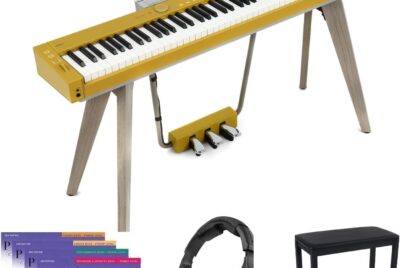
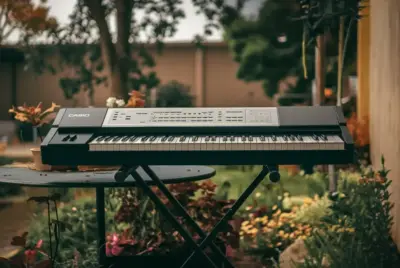
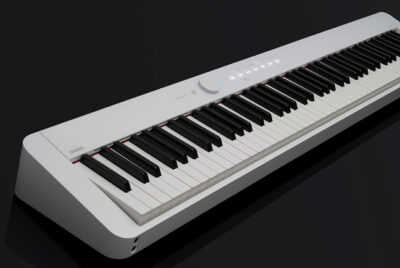
Best Casio Keyboards & Digital Pianos in 2026: 6 Picks for Every Budget
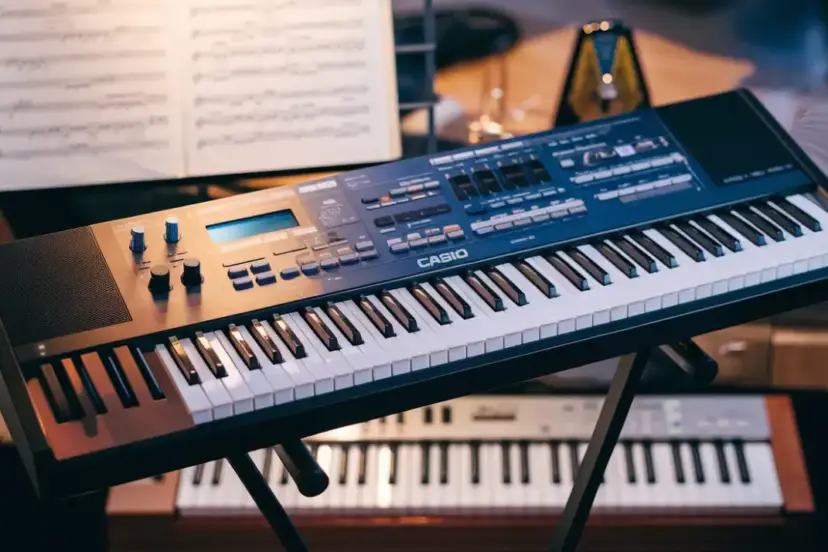
Casio makes such a wide variety of keyboards and digital pianos that choosing the right one can be surprisingly difficult.
Should you buy an inexpensive 61-key keyboard for learning?
Do you need 88 weighted keys?
Is a Privia worth paying more for?
And what’s the difference between models designed for piano practice and those offering hundreds of sounds and rhythms?
The answer depends on how you intend to use the instrument.
A child exploring music for the first time doesn’t necessarily need an 88-key hammer-action digital piano. A serious piano student probably does. Meanwhile, a songwriter or entertainer may care more about hundreds of tones, accompaniment rhythms and connectivity than reproducing an acoustic grand piano as closely as possible.
For 2026, our six Casio recommendations are:
- Casio CT-S300 — Best Budget Keyboard for Beginners
- Casio CT-S400 — Best Portable All-Round Keyboard
- Casio CDP-S160 — Best Affordable 88-Key Digital Piano
- Casio Privia PX-S1100 — Best Overall Casio Digital Piano
- Casio Privia PX-S3100 — Best for Sounds, Rhythms & Versatility
- Casio Privia PX-S5000 — Best Premium Portable Casio Piano
Rather than simply ranking them from best to worst, this guide explains which Casio is best for different players, uses and budgets.
Disclosure: Some links on Pianos-Galore are affiliate links. If you purchase through these links, we may receive a small commission at no additional cost to you.
Best Casio Keyboards at a Glance
| Model | Keys | Best For | Our Verdict |
|---|---|---|---|
| Casio CT-S300 | 61 | Beginners & Kids | Best Budget Keyboard |
| Casio CT-S400 | 61 | Casual Players & Creativity | Best Portable All-Rounder |
| Casio CDP-S160 | 88 | Piano Students | Best Affordable 88-Key |
| Casio PX-S1100 | 88 | Beginner–Intermediate Pianists | Best Overall |
| Casio PX-S3100 | 88 | Versatile Musicians | Best for Features |
| Casio PX-S5000 | 88 | Serious Pianists | Best Premium Portable |
The first major decision is therefore not:
Which Casio is best?
It’s:
Do you need a keyboard or a digital piano?
Casio Keyboard vs Casio Digital Piano
Casio’s product range covers two somewhat different types of buyer.
Choose a Portable Keyboard If:
- You’re a complete beginner.
- You’re buying for a child.
- Portability is important.
- You want lots of sounds.
- You enjoy rhythms and accompaniment.
- You’re interested in songwriting.
- Your budget is limited.
- You don’t necessarily need realistic acoustic-piano action.
The CT-S300 and CT-S400 fall broadly into this category.
Choose an 88-Key Digital Piano If:
- You’re taking traditional piano lessons.
- Classical piano interests you.
- You want weighted hammer-action keys.
- You expect to progress beyond beginner level.
- You want your technique to transfer more naturally to an acoustic piano.
- Piano sound and keyboard feel matter more than having hundreds of sounds.
The CDP-S160, PX-S1100, PX-S3100 and PX-S5000 are the models to examine.
Digital Piano vs Keyboard: Which Should You Buy in 2026?1. Casio CT-S300 — Best Budget Keyboard for Beginners
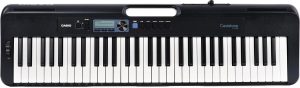
The Casio CT-S300 is our starting recommendation for someone who wants an inexpensive, portable and beginner-friendly keyboard.
It has:
- 61 full-size keys
- Touch response
- 400 tones
- 77 rhythms
- 60 built-in songs
- Dance Music Mode
- Pitch-bend wheel
- USB connectivity
- Built-in speakers
- Battery operation
- Compatibility with Casio’s learning ecosystem
One particularly important feature is touch sensitivity.
That means the keyboard responds to how you play.
Press a key gently and the note can sound softer. Play more strongly and the sound becomes louder.
That’s important because musical expression depends heavily on dynamics.
Why It’s Good for Beginners
The CT-S300 doesn’t overwhelm a first-time player with the size, weight or expense of a full digital piano.
At the same time, it provides enough sounds and rhythms to encourage musical exploration.
A young beginner can experiment with:
- Piano
- Electric piano
- Organ
- Strings
- Brass
- Synthesizers
- Drums
- Accompaniment rhythms
That can make early practice more enjoyable.
Portability Is a Major Advantage
At only around 3.3 kg, the CT-S300 is extremely easy to move.
It can also operate from batteries.
That makes it useful for:
- Children’s bedrooms
- Family rooms
- Lessons
- Travel
- Casual performances
- Small spaces
What’s the Compromise?
It has only 61 keys and does not provide an 88-key hammer-action piano experience.
If you already know that serious piano study is your goal, I’d consider moving directly to the CDP-S160 or PX-S1100.
Pros
- Very affordable
- Touch-sensitive keys
- 400 tones
- 77 rhythms
- Extremely lightweight
- Battery operation
- Pitch-bend wheel
- Beginner friendly
Consider Before Buying
Serious piano students may eventually outgrow both its 61-key range and lighter keyboard action.
Best for:
Children, first-time beginners, casual players and buyers wanting an inexpensive introduction to keyboard playing.
[Check Casio CT-S300 Price on Amazon →]
2. Casio CT-S400 — Best Portable All-Round Keyboard
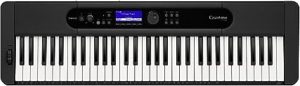
The Casio CT-S400 is a substantial step up for someone who likes the portability of the CT-S300 but wants greater musical capability.
It still uses a compact 61-key format, but moves into a more sophisticated sound and accompaniment environment.
Key attractions include:
- 61 touch-responsive keys
- AiX Sound Source
- 600 tones
- 200 rhythms
- Built-in songs
- Registration memory
- Layer and split functions
- MIDI recording
- USB connectivity
- Optional wireless connectivity
- Compact portable construction
CT-S300 vs CT-S400
This is an important distinction.
Choose the CT-S300 if your priority is keeping cost down while getting a touch-sensitive beginner keyboard.
Choose the CT-S400 if you’re prepared to spend more for:
- More sounds
- More rhythms
- A more sophisticated sound engine
- Greater creative flexibility
- More useful performance functions
The CT-S400 is therefore better suited to someone who sees the keyboard as more than simply a device for learning basic piano notes.
Who Will Appreciate It?
The CT-S400 is particularly attractive to:
- Hobbyists
- Songwriters
- Casual performers
- Intermediate keyboard players
- Students interested in many musical styles
- Players who enjoy accompaniment features
Its 600 tones give you plenty of room to explore sounds beyond acoustic piano.
Is It Good for Learning Piano?
Yes—with an important qualification.
You can certainly learn notes, chords, rhythm, harmony and basic keyboard skills on the CT-S400.
But if your goal is traditional piano technique, particularly classical playing, an 88-key hammer-action instrument is preferable.
Pros
- 600 tones
- 200 rhythms
- AiX sound engine
- Touch response
- Portable
- Layer and split
- Strong creative capabilities
- Good step up from basic keyboards
Consider Before Buying
It remains a 61-key portable keyboard rather than a full hammer-action digital piano.
Best for:
Players who want portability, sounds, rhythms and versatility rather than a strictly piano-focused instrument.
[Check Casio CT-S400 Price on Amazon →]
3. Casio CDP-S160 — Best Affordable 88-Key Digital Piano
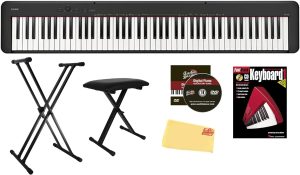
The Casio CDP-S160 is where our recommendations move firmly into traditional piano-learning territory.
It provides:
- 88 keys
- Scaled Hammer Action Keyboard II
- Touch response
- 64-note polyphony
- 10 tones
- Layer mode
- Duet Mode
- MIDI recorder
- USB-MIDI
- 8W + 8W amplification
- Optional three-pedal support
- Half-damper capability with compatible pedal setup
- Battery or AC operation
This is a very different instrument from the CT-S300 and CT-S400.
Why the CDP-S160 Matters
For serious piano study, two characteristics immediately stand out:
88 keys
and
hammer action.
A standard modern acoustic piano has 88 keys, so you have access to the complete range needed as your repertoire develops.
The Scaled Hammer Action Keyboard II also provides physical resistance intended to reproduce aspects of acoustic-piano feel.
Excellent for Students
A beginner doesn’t necessarily need 600 sounds.
For traditional piano lessons, I’d rather have:
10 useful sounds + 88 hammer-action keys
than:
600 sounds + lightweight keys.
The CDP-S160 is therefore especially attractive for students who want to learn piano properly while controlling costs.
Compact Design
Despite having a full-size keyboard, the CDP-S160 remains impressively slim and weighs approximately 10.5 kg.
It can also run on six AA batteries.
That’s unusual flexibility for an 88-key hammer-action digital piano.
Pedal Expansion
Beginners can start with a simple sustain pedal.
As their playing develops, the CDP-S160 can support a three-pedal setup including damper, soft and sostenuto functions, with half-damper operation available through a compatible configuration.
That gives the instrument more room to grow with a student.
Pros
- 88 keys
- Scaled Hammer Action Keyboard II
- Very slim
- 64-note polyphony
- USB-MIDI
- MIDI recording
- Optional three-pedal system
- Battery operation
- Strong value for piano students
Consider Before Buying
Its 10 tones and 64-note polyphony are modest compared with the Privia models below.
That’s not necessarily a problem for beginners, but intermediate players may prefer the greater capabilities of the PX-S1100.
Best for:
Budget-conscious students who want a genuine 88-key hammer-action digital piano rather than a portable keyboard.
[Check Casio CDP-S160 Price on Amazon →]
4. Casio Privia PX-S1100 — Best Overall Casio Digital Piano
For the largest number of piano-focused buyers, the Casio Privia PX-S1100 is our Best Overall choice.
It represents an important step above the CDP-S160 while retaining Casio’s emphasis on compactness and portability.
Key features include:
- 88-key Smart Scaled Hammer Action Keyboard
- Touch response
- 192-note polyphony
- 18 tones
- Acoustic-piano-focused sound technology
- Damper resonance
- String resonance
- Bluetooth Audio/MIDI capability
- USB connectivity
- Recording
- Built-in speakers
- Battery operation
Why We Picked It as Best Overall
A good all-round digital piano needs to balance several things:
keyboard action + sound + portability + features + price.
The PX-S1100 does that very effectively.
It isn’t Casio’s cheapest 88-key digital piano.
It isn’t the most advanced.
But for a beginner or intermediate pianist who wants a serious instrument without moving into premium prices, it occupies an attractive middle ground.
Slim Privia Design
One of Casio’s defining strengths with the PX-S series is cabinet depth.
The instrument manages to house an 88-key hammer-action mechanism inside an unusually slim chassis.
This is particularly valuable for:
- Apartments
- Condominiums
- Bedrooms
- Studios
- Smaller homes
192-Note Polyphony
The jump from the CDP-S160’s 64-note polyphony to 192 provides substantially more headroom for sustained passages and more complex playing.
Polyphony alone doesn’t determine piano quality, but it becomes increasingly useful as repertoire grows more demanding.
Who Should Buy It?
The PX-S1100 makes particular sense for:
- Adult beginners
- Intermediate players
- Students
- Apartment dwellers
- Home pianists
- Players who occasionally need portability
Pros
- 88 hammer-action keys
- 192-note polyphony
- Very slim design
- Piano-focused sound
- Bluetooth capability
- Portable
- Battery operation
- Strong beginner-to-intermediate longevity
Consider Before Buying
Players who want hundreds of tones and accompaniment rhythms should look at the PX-S3100 instead.
Best for:
Most buyers seeking a serious, compact Casio digital piano for home practice and continued learning.
[Check Casio PX-S1100 Price on Amazon →]
Best 88-Key Digital Pianos in 2026: 7 Top Picks for Every Pianist5. Casio Privia PX-S3100 — Best for Sounds, Rhythms & Versatility
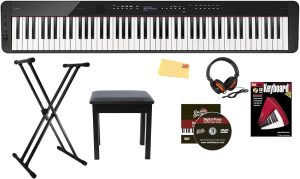
The Casio PX-S3100 answers a different question:
What if I want 88 hammer-action keys but I also want the creative versatility of an advanced keyboard?
That’s where this model becomes particularly interesting.
It combines the slim Privia concept with a much broader range of sounds and accompaniment capabilities.
Key attractions include:
- 88-key Smart Scaled Hammer Action Keyboard
- 192-note polyphony
- Hundreds of instrument tones
- Extensive rhythms
- Accompaniment functions
- Pitch-bend wheel
- Assignable controls
- DSP effects
- Recording
- Bluetooth Audio/MIDI capability
- USB connectivity
PX-S1100 vs PX-S3100
These models can look similar, but their intended users differ.
Choose the PX-S1100 If:
- Piano is your main priority.
- You don’t need hundreds of sounds.
- You primarily practice at home.
- Simplicity appeals to you.
Choose the PX-S3100 If:
- You enjoy many instrument sounds.
- You use accompaniment rhythms.
- You write or arrange songs.
- You perform different musical styles.
- You want more hands-on performance control.
In other words:
PX-S1100 = piano-focused simplicity
PX-S3100 = piano + creative versatility
Who Is It For?
The PX-S3100 is particularly attractive to:
- Songwriters
- Entertainers
- Worship musicians
- Home-studio users
- Multi-style performers
- Players who don’t want to choose between a digital piano and feature-rich keyboard
Pros
- 88 hammer-action keys
- 192-note polyphony
- Huge sound selection
- Accompaniment rhythms
- Performance controls
- Slim design
- Bluetooth capability
- Strong creative versatility
Consider Before Buying
If you’ll spend almost all your time playing acoustic-piano sounds, you may not need to pay extra for its broader feature set.
Best for:
Musicians wanting an 88-key digital piano that can also function as a highly versatile creative keyboard.
[Check Casio PX-S3100 Price on Amazon →]
6. Casio Privia PX-S5000 — Best Premium Portable Casio Piano
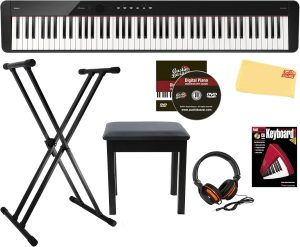
The Casio PX-S5000 takes us into a more premium, piano-focused category.
At this level, you’re increasingly paying for improvements to the playing experience, particularly keyboard action.
One of its defining features is Casio’s Smart Hybrid Hammer Action Keyboard.
The action incorporates wood into the white keys and is designed to provide a more sophisticated response than Casio’s less expensive portable actions.
Why Pay More?
This is the critical question.
A premium digital piano doesn’t automatically justify its higher price simply by offering more features.
For a serious pianist, improvements to the keyboard itself can matter much more.
As your technique develops, you become increasingly sensitive to:
- Key resistance
- Repetition
- Dynamic control
- Response
- Key surfaces
- Pedal behavior
- Tonal variation
That’s where a model such as the PX-S5000 begins to make more sense.
Who Is It For?
The PX-S5000 is aimed less at the casual beginner and more toward:
- Intermediate players
- Advanced pianists
- Serious adult players
- Pianists wanting premium touch in a portable format
- Musicians with limited space who don’t want an entry-level action
Pros
- 88 keys
- Smart Hybrid Hammer Action
- Wood-containing white-key construction
- Premium piano-focused approach
- Slim Privia design
- Suitable for more advanced playing
- Portable compared with furniture-style premium pianos
Consider Before Buying
A complete beginner probably doesn’t need to spend this much.
The advantages become more meaningful as your technique develops.
Best for:
Intermediate and advanced pianists who want a more sophisticated Casio keyboard action without giving up the compact Privia format.
[Check Casio PX-S5000 Price on Amazon →]
Casio CT-S300 vs CT-S400
This is the easiest comparison in our list.
Buy the CT-S300 If:
- You’re a complete beginner.
- You’re buying for a child.
- Budget is the priority.
- 400 tones are already more than enough.
- You want maximum simplicity.
Buy the CT-S400 If:
- You’re willing to spend more.
- Sound variety matters.
- You want the AiX sound engine.
- You want more rhythms.
- Songwriting and musical exploration interest you.
For basic beginner learning, the CT-S300 is enough.
For broader musical creativity, the CT-S400 is worth the step up.
Casio CDP-S160 vs PX-S1100
This is probably the most important comparison for piano students.
Both provide:
- 88 keys
- Hammer-action keyboards
- Slim designs
- Portable construction
But the PX-S1100 is the more sophisticated instrument.
Choose the CDP-S160 If:
- Budget is tight.
- You’re a beginner.
- You mainly need a good piano-learning instrument.
- You don’t care about many sounds.
- Portability matters.
Choose the PX-S1100 If:
- You can spend more.
- You expect to keep the instrument for years.
- 192-note polyphony appeals to you.
- Better connectivity matters.
- You’re progressing beyond the earliest beginner stages.
For a first-time student, the CDP-S160 can be excellent value.
For long-term ownership, I’d lean toward the PX-S1100 when budget permits.
PX-S1100 vs PX-S3100
This isn’t really about which piano is “better.”
It’s about how you make music.
Choose the PX-S1100 for straightforward piano practice.
Choose the PX-S3100 if you want a much broader creative instrument.
A classical student probably doesn’t need hundreds of sounds and accompaniment rhythms.
A songwriter or entertainer may consider them essential.
PX-S1100 vs PX-S5000
Here the distinction shifts toward keyboard quality.
The PX-S1100 is our all-round recommendation because it delivers a strong combination of piano capability, portability and value.
The PX-S5000 is for someone prepared to spend more for a more sophisticated action.
If you’re a beginner, the PX-S1100 is probably sufficient.
If you’re an experienced pianist who notices and cares about subtle differences in key response, the PX-S5000 becomes much more interesting.
Which Casio Is Best for Beginners?
There are actually two answers.
Casual Beginner — CT-S300
Choose this if you’re exploring music, buying for a child or aren’t yet sure how serious you’ll become.
Serious Piano Beginner — CDP-S160
Choose this if you’re taking formal piano lessons and want to develop technique on 88 hammer-action keys.
That’s an important distinction.
A beginner keyboard and a beginner digital piano don’t necessarily serve the same purpose.
Which Casio Is Best for Classical Piano?
For classical study, I would concentrate on:
CDP-S160
PX-S1100
PX-S5000
Why?
Because traditional piano technique benefits from:
- 88 keys
- Hammer action
- Dynamic response
- Proper sustain-pedal support
- Piano-focused sound
For an early beginner, the CDP-S160 provides an affordable starting point.
The PX-S1100 offers greater long-term capability.
More experienced pianists should consider the PX-S5000.
[Internal link: Best Digital Pianos for Classical Music Practice]
Which Casio Is Best for Small Spaces?
Casio is particularly strong here.
The CT-S300 and CT-S400 are obviously compact because they’re 61-key keyboards.
But the slim CDP-S and Privia PX-S ranges are impressive because they fit 88 hammer-action keys into relatively shallow cabinets.
For an apartment or condominium, I’d particularly consider the PX-S1100.
It gives you a serious full-size piano without requiring the permanent floor space of a traditional console instrument.
Which Casio Is Best for Songwriting?
I’d choose between:
CT-S400
and
PX-S3100.
Choose the CT-S400 if portability and affordability matter more.
Choose the PX-S3100 if you also want 88 hammer-action keys and a more piano-capable instrument.
Which Casio Is Best for an Intermediate Player?
The PX-S1100 is our starting recommendation.
It’s capable enough for continued study without forcing you into premium pricing.
If you’re more interested in arrangements and multiple musical styles, choose the PX-S3100.
If keyboard action is becoming your primary concern, investigate the PX-S5000.
How Much Should You Spend on a Casio Keyboard?
Don’t start with a price.
Start with your intended use.
Spend Less If:
- You’re experimenting with music.
- You’re buying for a young child.
- You need maximum portability.
- You aren’t yet committed to piano study.
The CT-S300 may be all you need.
Spend More for 88 Hammer-Action Keys If:
- You’re taking piano lessons.
- Classical music interests you.
- You want proper piano technique.
- You expect to keep playing for years.
That’s where the CDP-S160 and PX-S1100 make more sense.
Move Into Premium Territory If:
- You’re an experienced player.
- Keyboard action matters greatly.
- You’re sensitive to touch and response.
- You know exactly what you’re paying extra for.
That’s when something like the PX-S5000 becomes easier to justify.
[Internal link: Best Digital Pianos for Every Budget]
7 Mistakes to Avoid When Buying a Casio Keyboard
1. Assuming More Sounds Means a Better Piano
It doesn’t.
A piano student may be better served by an instrument with 10 good sounds and hammer-action keys than one with hundreds of tones and lightweight keys.
2. Buying 61 Keys for Long-Term Classical Study
It’s fine initially, but serious repertoire eventually requires more range.
3. Assuming All 88-Key Casios Feel the Same
They don’t.
Casio uses different keyboard-action systems across its ranges.
4. Ignoring Pedal Support
Pedaling becomes increasingly important as your repertoire advances.
5. Paying for Features You Won’t Use
Don’t buy hundreds of accompaniment features if you only want to practice piano.
6. Buying Too Cheaply
A committed piano student may outgrow a lightweight keyboard quickly.
Sometimes spending more initially saves money later.
7. Choosing From Specifications Alone
If possible, play the instrument.
Keyboard feel is subjective.
Your fingers may tell you more in ten minutes than a specification sheet can tell you in an hour.
If realistic piano action is your main priority, see our Best Casio Digital Pianos with Weighted Keys in 2026: 5 Models Compared for a closer look at Casio’s different hammer-action systems.Frequently Asked Questions
What is the best Casio keyboard in 2026?
It depends on your needs.
For a low-cost beginner keyboard, we recommend the CT-S300.
For most piano-focused buyers, our overall recommendation is the PX-S1100.
For advanced players wanting a more premium action, consider the PX-S5000.
What is the best Casio keyboard for a beginner?
For casual beginners and children, the CT-S300.
For serious piano students, the CDP-S160 is a stronger choice because it provides 88 hammer-action keys.
Which Casio has weighted keys?
The CDP-S160 and Privia PX-S models in this guide use hammer-action keyboard systems intended to provide piano-like resistance.
The CT-S300 and CT-S400 are portable keyboards and shouldn’t be confused with hammer-action digital pianos.
Is Casio good for learning piano?
Yes.
Casio offers instruments ranging from basic beginner keyboards to serious 88-key digital pianos.
The important thing is choosing the appropriate model for your learning goals.
Is the Casio CDP-S160 good for beginners?
Yes.
Its 88-key Scaled Hammer Action Keyboard II makes it particularly suitable for beginners taking traditional piano lessons.
Is the PX-S1100 worth paying more than the CDP-S160?
For many committed students, yes.
The PX-S1100 offers a more sophisticated overall package and 192-note polyphony, making it attractive for longer-term use.
Is the PX-S3100 better than the PX-S1100?
Not necessarily.
The PX-S3100 is better suited to musicians wanting extensive sounds, rhythms and creative features.
The PX-S1100 may actually be the more sensible choice for someone primarily interested in piano practice.
Is the PX-S5000 worth it for beginners?
Usually not.
A beginner can develop very effectively on a less expensive model.
The PX-S5000’s more sophisticated keyboard action becomes increasingly valuable as a player’s technique advances.
Are 61 keys enough for learning piano?
They’re sufficient for basic lessons and many popular songs.
For long-term traditional or classical piano study, 88 keys are preferable.
Final Recommendations
Still undecided? Here’s the simplest way to choose.
Best Budget Beginner Keyboard — Casio CT-S300
Choose it for children, first-time players and casual musical exploration.
[Check Casio CT-S300 Price on Amazon →]
Best Portable All-Round Keyboard — Casio CT-S400
Choose it if you want more sounds, rhythms and creative flexibility while retaining a compact 61-key format.
[Check Casio CT-S400 Price on Amazon →]
Best Affordable 88-Key Piano — Casio CDP-S160
Choose it if you’re serious about learning piano but want to keep the initial investment reasonable.
[Check Casio CDP-S160 Price on Amazon →]
Best Overall Casio Digital Piano — Casio PX-S1100
Our sweet-spot choice for most beginner and intermediate pianists.
[Check Casio PX-S1100 Price on Amazon →]
Best for Versatility — Casio PX-S3100
Choose it if you want 88 hammer-action keys plus a much larger world of sounds, rhythms and performance features.
[Check Casio PX-S3100 Price on Amazon →]
Best Premium Portable — Casio PX-S5000
Choose it when keyboard action and a more refined piano experience matter enough to justify the additional investment.
[Check Casio PX-S5000 Price on Amazon →]
Final Verdict
Casio’s greatest strength is that it doesn’t force every musician into the same type of instrument.
A child can begin with the affordable CT-S300.
A creative keyboard player can step up to the CT-S400.
A serious beginner can learn on the 88-key CDP-S160.
A developing pianist can move to the PX-S1100.
A songwriter or performer can choose the feature-rich PX-S3100.
And a more experienced pianist can move toward the premium action of the PX-S5000.
So don’t ask simply:
“What’s the best Casio keyboard?”
Ask:
“What’s the best Casio for the way I intend to play?”
Once you answer that question, choosing the right model becomes much easier. ————————Want to learn piano? Simply Piano helps you play music you love, from classical to pop.

- Beginner tutorials and advanced courses are available.
- Learn at your pace with real-time feedback.
- Play classical, pop, and Disney songs with personalized exercises and sheet music.