Best Piano for Autistic Kids: A Parent’s Guide to Choosing the Right Keyboard
Choosing a piano or keyboard for an autistic child isn’t simply a matter of finding the instrument with the most features.
Every autistic child is different.
One child may enjoy rich piano sounds and weighted keys, while another may be sensitive to loud sounds or find heavy keys uncomfortable. Some children may enjoy colorful buttons and multiple instrument voices; others may prefer a simple keyboard without visual distractions.
That’s why there really isn’t one “best piano for kids with autism.”
A better question is:
Which piano best matches this particular child’s sensory preferences, physical abilities, interests, learning style, and musical goals?
For many families, a digital piano or keyboard can provide an enjoyable way for a child to explore sound, rhythm, melody, and creativity. The key is to choose an instrument that makes musical exploration inviting rather than overwhelming.
This guide explains what parents should consider and looks at several types of digital pianos worth investigating.
Disclosure: Some links on Pianos-Galore are affiliate links. If you purchase through them, we may receive a small commission at no additional cost to you.
Can Playing Piano Benefit Autistic Children?
Music can be an enjoyable and meaningful activity for many autistic children.
Research into music therapy for autistic people has produced encouraging findings in areas such as overall improvement and quality of life. More recent studies have also reported potential improvements in some behavioral outcomes.
However, this evidence needs to be interpreted carefully.
Music therapy is not the same thing as ordinary piano lessons or independently playing a keyboard at home.
Music therapy is a structured therapeutic intervention delivered by appropriately trained professionals. Research findings about music therapy therefore shouldn’t automatically be used to claim that purchasing a piano will improve an autistic child’s speech, behavior, social communication, or other developmental outcomes.
That doesn’t make piano playing any less worthwhile.
A child doesn’t need to receive a therapeutic benefit for music to be valuable.
Playing piano can simply provide opportunities to:
- Explore sounds
- Develop a musical interest
- Express creativity
- Practice hand and finger movements
- Discover rhythm and patterns
- Enjoy an absorbing activity
- Play music independently or with family members
For some children, music may become a lifelong interest.
And enjoyment is a perfectly good reason to play.
Start With the Child, Not the Piano
Before comparing Yamaha, Casio, Roland, Korg, or other brands, observe how your child responds to musical instruments.
Does your child enjoy music?
Do loud sounds cause discomfort?
Does your child like pressing keys repeatedly?
Are flashing lights distracting or enjoyable?
Does your child prefer predictable sounds?
Would headphones be useful—or would wearing headphones itself be uncomfortable?
Does your child enjoy structured activities or prefer exploring freely?
These observations may tell you more about the right instrument than a specification sheet.
Whenever possible, let the child try several keyboards before purchasing one.
What to Look for in a Piano for an Autistic Child
1. Adjustable Volume
This may be one of the most important features.
Some autistic children have heightened sensitivity to sound. A digital piano allows parents and children to control volume in a way that isn’t possible with an acoustic piano.
You can start quietly and allow the child to determine a comfortable listening level.
Avoid assuming that louder, fuller sound is always better.
2. Headphone Connection
Headphones can be useful because they allow the child to play without filling the room with sound.
They may also reduce environmental distractions.
But sensory preferences vary considerably.
Some children dislike having headphones over or inside their ears. Therefore, don’t assume that headphones will automatically solve sound-sensitivity issues.
Let the child’s response guide you.
3. Simple Controls
For some children, a minimalist interface can make an instrument easier to approach.
A keyboard covered with:
- Flashing lights
- Dozens of buttons
- Complex menus
- Hundreds of sound choices
may be entertaining for one child and distracting for another.
This is one reason simple digital pianos can be attractive.
You switch them on, select a piano sound, and play.
4. Touch Sensitivity
Touch-sensitive keys respond to how hard they are played.
Press gently and the sound is softer.
Play more firmly and the sound becomes louder.
This provides an important connection between physical movement and musical expression.
For children who enjoy exploring cause and effect, this can be particularly interesting.
5. Weighted vs Unweighted Keys
This decision deserves more thought than simply saying “weighted keys are better.”
Weighted Keys
Weighted hammer-action keys attempt to reproduce some of the resistance of an acoustic piano.
They are generally preferable if the child:
- Is taking traditional piano lessons
- Wants to develop acoustic-piano technique
- Is physically comfortable with the resistance
- Is likely to progress into more advanced repertoire
Light or Semi-Weighted Keys
A lighter keyboard may be preferable if:
- Heavy resistance is uncomfortable
- The child is very young
- The primary goal is musical exploration
- Portability matters
- The child isn’t yet committed to formal piano study
The best action is therefore the one the child is comfortable playing.
Suggested internal link: Link “weighted keys” to your Pianos-Galore Weighted Keyboard Keys guide.
6. Number of Keys
A child doesn’t necessarily need 88 keys to begin exploring music.
Smaller keyboards can be:
- Less expensive
- Easier to move
- Less physically imposing
- More convenient in small rooms
However, if the child is beginning formal piano lessons and is likely to continue, an 88-key digital piano avoids the need to upgrade simply because the repertoire eventually requires more notes.
Suggested internal link: Link “88-key digital piano” to your 88 Keyboard Keys category or strongest guide.
7. A Stable Stand and Comfortable Bench
Parents often concentrate on the keyboard and forget about posture.
Make sure:
- The keyboard is stable
- The bench is the correct height
- The child’s feet are supported where appropriate
- Wrists and arms can remain comfortable
- Cables aren’t creating a tripping hazard
For smaller children, an adjustable bench and foot support can make the playing position considerably more comfortable.
Five Digital Pianos Worth Considering
These aren’t “pianos medically recommended for autism.”
They are simply digital pianos with characteristics that may suit different children.
The right choice depends on the individual child.
1. Yamaha P-225 — Best Yamaha Option for Traditional Piano Learning
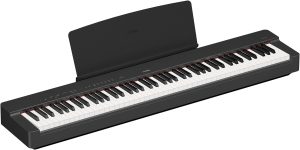
Check out the price of Yamaha P-225 at Amazon
The Yamaha P-225 is an excellent choice for a child who is beginning conventional piano lessons and is likely to continue developing as a pianist.
It features a full 88-key Graded Hammer Compact (GHC) keyboard, providing the weighted resistance expected from a digital piano designed for traditional piano study. Lower-register keys feel heavier while the upper register becomes progressively lighter, helping approximate the feel of an acoustic piano.
The P-225 also uses Yamaha’s CFX concert grand piano sound, giving the child a high-quality primary piano voice without requiring a large furniture-style instrument.
For an autistic child, another potential advantage is the relatively straightforward piano-oriented design. Although the P-225 offers modern features, a child can simply turn it on, select a piano sound, adjust the volume to a comfortable level, and play.
Why Parents Might Consider It
- 88 weighted GHC keys
- Full-size keyboard suitable for long-term piano study
- Yamaha CFX concert grand piano sound
- Adjustable volume
- Built-in speakers
- Headphone capability
- Compact and relatively portable design
- Suitable for both beginners and developing pianists
Best suited to: Children beginning traditional piano lessons who are comfortable with weighted keys and whose families want an instrument capable of supporting several years of musical development.
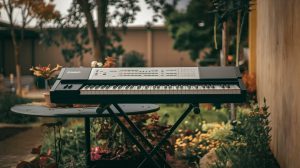
2. Casio Privia PX-S1100 — Best for Compact Spaces
Check out the price of Casio Privia PX-S1100 at Amazon
The Casio Privia PX-S1100 is unusually slim for an 88-key weighted digital piano.
That can be useful in bedrooms, apartments, therapy rooms, or family spaces where a larger instrument isn’t practical.
Its relatively clean physical appearance may also appeal to families wanting to minimize visual clutter.
Why Parents Might Consider It
- 88 weighted keys
- Slim cabinet
- Built-in speakers
- Headphone capability
- Bluetooth functions
- Portable compared with furniture-style digital pianos
Consider Something Else If:
Your child would benefit from a lighter, non-hammer keyboard.
Best suited to: Families wanting a full-size piano in a relatively compact space.
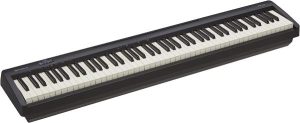
3. Roland FP-10 — Best for Piano Feel on a Moderate Budget
Check out the price of Roland FP-10 at Amazon
The Roland FP-10 is another compact 88-key digital piano aimed at beginners and developing pianists.
Its PHA-4 Standard hammer-action keyboard is designed to provide a more acoustic-piano-like playing experience than a typical lightweight keyboard.
Roland’s SuperNATURAL piano technology provides its primary piano sounds.
Why Parents Might Consider It
- 88 hammer-action keys
- Touch sensitivity
- Relatively simple design
- Built-in speakers
- Headphone output
- Bluetooth MIDI support for compatible applications
Consider Something Else If:
The child prefers a very lightweight action or wants an instrument with many obvious front-panel sounds and controls.
Best suited to: Beginning students who may continue into more serious piano study.
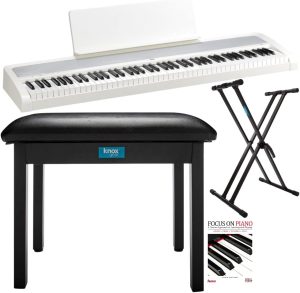
4. Korg B2 — Best for Straightforward Piano Practice
Check out the price of Korg B2 at Amazon
The Korg B2 takes a relatively simple approach to digital piano design.
It provides a full-size keyboard and focuses strongly on conventional piano playing rather than functioning like a feature-packed arranger keyboard.
For families looking for an instrument that primarily behaves like a piano, simplicity can be an advantage.
Why Parents Might Consider It
- 88 keys
- Piano-focused design
- Built-in speakers
- Straightforward controls
- Multiple piano sounds
- USB connectivity
Consider Something Else If:
Your child is motivated by colorful controls, accompaniment styles, games, or a large variety of interactive features.
Best suited to: Children who prefer a straightforward piano experience.
5. A Smaller Touch-Sensitive Keyboard — Best for Musical Exploration
For some autistic children, none of the four 88-key hammer-action instruments above may be the best starting point.
A smaller touch-sensitive keyboard can sometimes make more sense.
This is especially true when:
- The child is very young
- Interest in piano is still uncertain
- Heavy keys aren’t comfortable
- Space is limited
- The goal is initially exploration rather than formal training
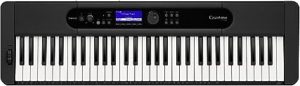
Casio Casiotone CT-S400 61-Key Touch-Responsive Keyboard
Check our the price of Casio Casiotone S400 at Amazon
A 61-key touch-sensitive keyboard can provide plenty of room for beginner melodies, chords, improvisation, and musical experimentation.
If the child’s interest develops into formal piano study, you can later move to an 88-key weighted digital piano.
This can be a better strategy than buying an expensive instrument before knowing whether the child enjoys playing it.
Quick Comparison
| Type | Key Feel | Best For | Possible Drawback |
|---|---|---|---|
| Yamaha P-145 | Weighted | Traditional piano learning | May feel heavy to some children |
| Casio PX-S1100 | Weighted | Compact full-size setup | Still a hammer-action keyboard |
| Roland FP-10 | Weighted | Developing piano technique | Limited front-panel controls |
| Korg B2 | Weighted | Simple piano practice | Fewer interactive features |
| 61-key touch-sensitive keyboard | Light | Exploration/younger children | May eventually require upgrading |
Don’t Choose a Piano Based on Autism Alone
This may be the most important advice in this article.
Autistic children don’t all share the same sensory preferences, learning styles, physical abilities, or musical interests.
A feature described as “autism-friendly” on a shopping website might be:
- Helpful to one child
- Irrelevant to another
- Uncomfortable for a third
Avoid looking for a mythical “autism piano.”
Instead, look for the piano that works for your child.
Creating a Comfortable Piano Space
The environment surrounding the piano can matter almost as much as the instrument itself.
Control the Sound
Start with a moderate or low volume and let the child indicate what feels comfortable.
Reduce Unnecessary Distractions
If the child becomes distracted easily, consider placing the instrument somewhere relatively calm rather than beside a television or busy family area.
Other children may actually prefer playing where family members are nearby.
Again, individual preference matters.
Keep Sessions Flexible
A child exploring a piano doesn’t necessarily need to begin with a traditional 30-minute practice session.
Five enjoyable minutes may be far more productive than thirty stressful ones.
Interest can develop gradually.
Allow Repetition
A child may want to play the same notes, patterns, or song repeatedly.
Musical exploration doesn’t always look like a conventional lesson.
Repetition can be part of discovering how an instrument works and enjoying predictable musical patterns.
Don’t Force Eye Contact or Performance
The goal doesn’t need to be performing for relatives or demonstrating progress.
Some children may enjoy playing privately.
Let music remain enjoyable.
Piano Lessons for Autistic Children
Finding the right teacher can be as important as choosing the right piano.
A good teacher should be willing to adapt instruction to the child rather than expecting every student to learn in exactly the same way.
Depending on the child, helpful approaches might include:
- Shorter lessons
- Clear routines
- Visual instructions
- Demonstration rather than lengthy verbal explanations
- Repetition
- Breaking tasks into smaller steps
- Allowing time to explore sounds
- Using favorite songs
- Predictable lesson structure
Parents should communicate openly with the teacher about the child’s preferences and what tends to make learning comfortable or stressful.
Piano Lessons and Music Therapy Are Not the Same
This distinction is important.
A piano teacher teaches musical skills.
A qualified music therapist uses music within a therapeutic framework to work toward individualized goals.
If your goal is for your child to learn piano, look for an adaptable and supportive piano teacher.
If you’re seeking music as part of therapy for developmental, behavioral, communication, or emotional goals, discuss that with appropriately qualified professionals.
A piano shouldn’t be marketed as a treatment for autism.
Should You Buy an Expensive Piano Immediately?
Usually, there is no need.
If you don’t yet know whether the child will enjoy playing, a modest touch-sensitive keyboard may be a sensible first experiment.
If the child shows sustained interest and begins formal lessons, moving to a better 88-key weighted digital piano may then be worthwhile.
On the other hand, if the child already enjoys playing piano and is committed to lessons, purchasing an appropriate full-size digital piano from the beginning can avoid upgrading later.
Try Before You Buy
This recommendation is especially important here.
If possible, take your child to a music store during a relatively quiet period.
Let the child try different instruments without pressure.
Observe:
- Reaction to weighted keys
- Reaction to lighter keys
- Preferred volume
- Response to different piano sounds
- Comfort with headphones
- Reaction to buttons and displays
- Interest in different instruments
You may discover that the keyboard parents assumed would be best isn’t the one the child enjoys most.
That information is far more valuable than any online “Top 5” ranking.
Frequently Asked Questions
Is piano good for autistic children?
Piano can be an enjoyable musical and creative activity for autistic children who are interested in it. Research also suggests potential benefits from structured music therapy, but music therapy and ordinary piano playing are not equivalent.
What is the best piano for an autistic child?
There isn’t one universally best model. Consider the child’s sensory preferences, comfort with weighted keys, interest level, available space, need for volume control, and whether the goal is exploration or formal piano study.
Are weighted keys better for autistic children?
Not necessarily.
Weighted keys are generally preferable for developing traditional piano technique, but some children may find the resistance uncomfortable. The child’s response should help determine the choice.
Are headphones useful?
They can be, particularly when controlling environmental sound is important. However, some children find headphones uncomfortable, so don’t assume they will suit every child.
Does an autistic child need 88 keys?
Not initially.
A smaller keyboard can be sufficient for musical exploration and early learning. An 88-key weighted piano becomes more valuable if the child progresses with traditional piano lessons.
Can piano improve communication in autistic children?
It shouldn’t be promised as a communication treatment. Some research into professionally delivered music therapy has reported encouraging outcomes, but evidence for specific communication improvements remains uncertain, and those findings shouldn’t automatically be applied to ordinary piano lessons.
What age should a child start piano lessons?
There is no autism-specific starting age. Readiness depends on the individual child’s interest, ability to engage with instruction, motor development, and the teaching approach.
Should I tell the piano teacher my child is autistic?
Sharing information that helps the teacher understand your child’s learning and sensory preferences can make it easier to adapt lessons appropriately. Focus on what specifically helps your child learn rather than assuming a diagnosis alone tells the teacher what to do.
Final Thoughts
Choosing a piano for an autistic child should begin with the child—not with a list of specifications.
Some children may love the substantial feel of an 88-key weighted Yamaha, Roland, Casio, or Korg.
Others may be much happier exploring music on a lightweight 61-key keyboard.
And that’s perfectly fine.
The goal doesn’t have to be producing a concert pianist. Nor should piano playing be presented as a treatment that promises developmental changes.
The first goal can simply be:
Does this child enjoy making music?
If the answer is yes, choose an instrument that makes that experience comfortable, accessible, and enjoyable.
Musical skills can develop from there.