Best Yamaha 88-Key Weighted Keyboards in 2026: 5 Models Compared
If you’re looking for a Yamaha keyboard that feels more like an acoustic piano, there’s one specification you should put near the top of your list:
88 weighted keys.
But there’s a catch.
Not all Yamaha weighted keyboards feel the same.
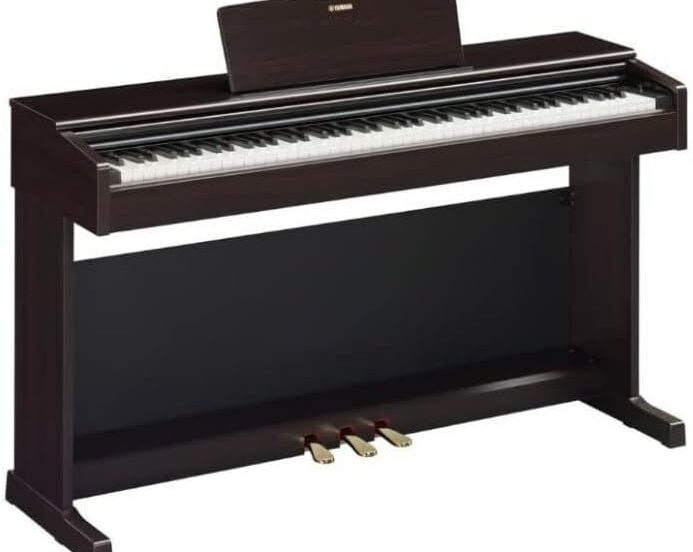
A Yamaha P-225, DGX-670, YDP-145, YDP-165 and P-525 all give you 88 weighted keys—but they are designed for very different players.
Some prioritize portability.
Some are designed to remain permanently in the home.
One emphasizes hundreds of sounds, accompaniment styles and entertainment features.
And Yamaha’s premium P-Series model uses a considerably more sophisticated keyboard action with wooden components.
So simply searching for a “Yamaha 88-key weighted keyboard” isn’t enough.
In this guide, we’ll compare five of Yamaha’s strongest choices and explain which one makes the most sense for beginners, home players, serious piano students and advanced pianists.
Disclosure: Some links on Pianos-Galore are affiliate links. If you purchase through these links, we may receive a small commission at no additional cost to you.
Our 5 Yamaha 88-Key Weighted Keyboard Picks
| Model | Keyboard Action | Best For |
|---|---|---|
| Yamaha P-225 | GHC | Best Overall |
| Yamaha DGX-670 | GHS | Best for Features & Entertainment |
| Yamaha YDP-145 | GHS | Best Affordable Home Piano |
| Yamaha YDP-165 | GH3 | Best for Serious Home Practice |
| Yamaha P-525 | GrandTouch-S | Best Premium Portable |
Quick Recommendation
For most buyers, our first choice is the Yamaha P-225 because it combines an 88-key weighted action, Yamaha CFX piano sound, compact dimensions and enough features for beginners through more experienced home players.
If keyboard action is your highest priority and your budget allows it, however, the P-525 is in another league.
[Check Yamaha P-225 Price on Amazon →]
What Does “Weighted Keyboard” Actually Mean?
An acoustic piano doesn’t have light spring-loaded keys.
When you press a key, you’re operating a mechanical system that ultimately sends a hammer toward a string.
That mechanism creates resistance beneath your fingers.
Digital pianos don’t need acoustic hammers to generate their sound, so manufacturers have developed mechanical keyboard actions designed to simulate that resistance.
This is what people generally mean when they talk about weighted piano keys.
But there are different levels of sophistication.
Weighted vs Graded Weighted Keys
These terms shouldn’t be confused.
A keyboard can be weighted without necessarily reproducing the changing resistance across an acoustic piano keyboard.
Graded weighting means the lower keys are designed to feel heavier and the resistance becomes progressively lighter toward the treble.
That reflects an important characteristic of an acoustic piano.
For students learning traditional piano technique, this is one reason an 88-key graded hammer action is generally preferable to a lightweight keyboard.
Yamaha’s Keyboard Actions Explained
One reason Yamaha’s lineup can be confusing is that the company uses several different keyboard-action systems.
The five instruments in this guide demonstrate that particularly well.
GHS — Graded Hammer Standard
GHS has been one of Yamaha’s widely used weighted actions.
In our comparison, you’ll find it in:
- DGX-670
- YDP-145
It provides 88 graded weighted keys, with heavier resistance toward the bass and lighter resistance toward the treble.
GHS is particularly appropriate for:
- Beginners
- Intermediate learners
- Recreational players
- Buyers moving from an unweighted keyboard to a digital piano
It provides the basic weighted-piano experience without the cost of Yamaha’s more advanced actions.
GHC — Graded Hammer Compact
The P-225 uses Yamaha’s newer GHC, or Graded Hammer Compact, action.
Its purpose is particularly interesting.
Yamaha wanted to provide the graded weighted feel expected from a P-Series digital piano while making the instrument more compact.
That makes GHC particularly useful in a portable instrument.
The P-225 is only about 27.2 cm deep and weighs approximately 11.5 kg.
For an 88-key weighted digital piano, that’s an attractive combination of piano functionality and portability.
GH3
Move up to the YDP-165 and you get Yamaha’s GH3 keyboard.
GH3 incorporates a three-sensor system.
The additional sensing becomes useful for quicker note repetition because a repeated note can be detected without requiring the key to return completely to its original position.
This becomes increasingly valuable as repertoire becomes more demanding.
For a serious student who expects to practice primarily at home, the YDP-165 therefore offers an important action upgrade over the YDP-145.
GrandTouch-S
At the top of our five-model comparison is the P-525.
It uses Yamaha’s GrandTouch-S action.
Notable features include:
- Wooden white keys
- Synthetic ebony and ivory keytops
- Escapement
- Graded weighting
- Advanced touch response
This is a significant step beyond Yamaha’s entry-level weighted actions.
For advanced pianists who place keyboard feel near the top of their priorities, the P-525 deserves particularly serious consideration.
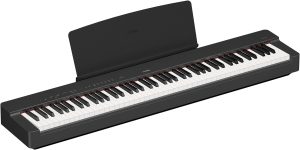
1. Yamaha P-225 — Best Overall
Best for:
Most beginners, intermediate players and home pianists who want an excellent balance of portability, piano feel and price.
The P-225 is arguably the sweet spot in Yamaha’s portable digital-piano range.
It gives you the fundamentals serious piano players need without becoming excessively large, heavy or complicated.
Key Features
- 88 GHC weighted keys
- Yamaha CFX piano sound
- 192-note polyphony
- VRM Lite
- 24 voices
- Built-in speakers
- Split, Dual and Duo modes
- USB connectivity
- Optional furniture stand and three-pedal unit
- Approximately 11.5 kg / 25.4 lb
The P-225’s biggest attraction is balance.
It isn’t Yamaha’s most sophisticated digital piano.
It isn’t Yamaha’s cheapest.
And it isn’t packed with the hundreds of voices found in the DGX-670.
Instead, it concentrates on delivering a convincing piano-oriented experience in a compact package.
Why We Like the GHC Action
The Graded Hammer Compact keyboard is particularly important to the P-225’s design.
Portable digital pianos face a fundamental engineering conflict:
Realistic keyboard mechanisms require physical space, but portable instruments are supposed to be compact.
GHC helps Yamaha make the cabinet shallower while retaining graded weighted action.
This makes the P-225 especially appealing for:
- Apartments
- Bedrooms
- Condominiums
- Small studios
- Students who occasionally transport their piano
Yamaha CFX Piano Sound
The P-225 uses a piano voice derived from Yamaha’s flagship CFX concert grand.
It also incorporates VRM Lite, designed to reproduce some of the resonant interactions associated with an acoustic piano.
That makes the P-225 much more than a generic weighted keyboard.
It is fundamentally a piano-focused instrument.
Who Should Buy the P-225?
Choose it if you want:
- 88 weighted keys
- A compact design
- Strong acoustic-piano sound
- Built-in speakers
- Headphone practice
- A piano suitable for long-term learning
- Reasonable portability
For most readers arriving at this page asking, “Which Yamaha 88-key weighted keyboard should I buy?” this is where I would start.
Players who have moved beyond beginner-level needs may want to narrow the choices further with our guide to Yamaha upgrade options for intermediate pianists.
[Check Yamaha P-225 Price on Amazon →]
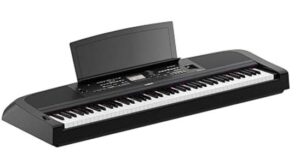
2. Yamaha DGX-670 — Best for Features and Entertainment
Best for:
Players who want a weighted piano keyboard plus hundreds of sounds, accompaniment styles, recording and entertainment features.
The DGX-670 is very different from the P-225.
Both have 88 weighted keys.
But their personalities are completely different.
The P-225 says:
“Play piano.”
The DGX-670 says:
“Play piano—and then let’s see what else we can do.”
GHS Weighted Action
The DGX-670 uses Yamaha’s 88-key GHS keyboard.
It provides graded hammer weighting appropriate for piano playing.
But the keyboard action isn’t the main reason to choose this model.
The feature set is.
Hundreds of Voices
The DGX-670 provides more than 600 preset voices plus drum and sound-effects kits.
These include sounds such as:
- Acoustic pianos
- Electric pianos
- Organs
- Strings
- Brass
- Guitars
- Synths
- Bass
It also provides hundreds of accompaniment styles.
This transforms the DGX-670 from a straightforward digital piano into something closer to a complete home music-making system.
Yamaha CFX + VRM
Despite all those extra features, Yamaha hasn’t forgotten the piano.
The DGX-670 includes Yamaha CFX piano sound and Virtual Resonance Modeling.
It also provides up to 256-note polyphony.
So it can still function as a serious digital piano while offering far more entertainment and arranging capabilities than the P-225.
The Trade-Off: Size and Weight
The DGX-670 weighs approximately 21.4 kg / 47 lb.
That’s nearly twice the weight of the P-225.
So while Yamaha classifies it within its Portable Grand family, don’t imagine something you’d casually carry under one arm.
The DGX-670 is better suited to a home, studio or relatively stable setup.
Who Should Buy the DGX-670?
Choose it if you want:
- 88 weighted keys
- Piano sounds
- Hundreds of additional voices
- Accompaniment styles
- Recording features
- A color display
- Songwriting and entertainment capability
If you only want to practice piano, much of that may be unnecessary.
But if you want your digital piano to become a complete musical entertainment and creativity center, the DGX-670 is one of Yamaha’s most interesting options.
[Check Yamaha DGX-670 Price on Amazon →]
3. Yamaha YDP-145 — Best Affordable Home Piano
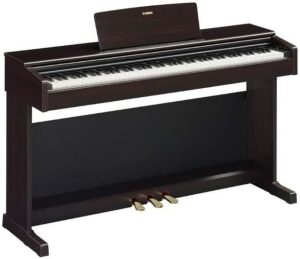
Best for:
Beginners and families who want an 88-key Yamaha digital piano in a traditional furniture-style cabinet.
The YDP-145 belongs to Yamaha’s Arius family.
Unlike the portable P-225, the YDP-145 is designed primarily to remain in the home.
Its cabinet gives it a much more traditional appearance.
You also get a built-in three-pedal system.
GHS Keyboard
The YDP-145 uses Yamaha’s GHS weighted action.
That makes it particularly appropriate for:
- Beginners
- Piano students
- Family practice
- Recreational home playing
It provides the graded resistance expected from a piano-oriented keyboard.
Yamaha CFX Sound
The YDP-145 also uses Yamaha CFX piano sampling.
VRM Lite adds additional resonance simulation.
Maximum polyphony is 192 notes.
This means the YDP-145 is much more focused than a feature-heavy keyboard such as the DGX-670.
Its job is straightforward:
Sit in the home and behave like a digital piano.
Why Choose It Instead of the P-225?
The P-225 and YDP-145 can appeal to similar players.
The biggest difference is lifestyle.
Choose P-225 if:
- Portability matters.
- Space is limited.
- You may move the instrument.
- You like a modern slab-style piano.
Choose YDP-145 if:
- The piano will remain in one room.
- You prefer furniture-style appearance.
- You want an integrated three-pedal unit.
- You want the experience of sitting down at a permanent home piano.
Who Should Buy the YDP-145?
This is a particularly sensible choice for families buying a first serious home piano for lessons.
You avoid the maintenance and tuning of an acoustic piano while retaining:
- 88 weighted keys
- Three pedals
- Traditional appearance
- Headphone practice
- Yamaha piano sound
[Check Yamaha YDP-145 Price on Amazon →]
4. Yamaha YDP-165 — Best for Serious Home Practice
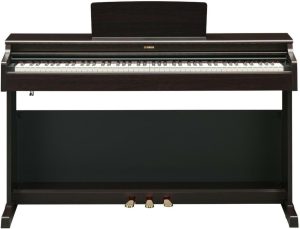
Best for:
Committed students and home pianists who want a better keyboard action than Yamaha’s entry-level GHS models.
At first glance, the YDP-145 and YDP-165 look similar.
That makes it tempting to think the YDP-165 is simply a slightly more expensive version.
But one of the most important differences is under your fingers.
The YDP-165 uses Yamaha’s GH3 action.
Why GH3 Matters
GH3 uses three sensors.
That provides improved detection during note repetition compared with simpler sensor arrangements.
For an absolute beginner playing basic repertoire, the difference may not initially seem dramatic.
But as technique progresses into:
- Faster passages
- Trills
- Repeated notes
- More demanding classical repertoire
keyboard responsiveness becomes increasingly important.
Three-Pedal System
The YDP-165 includes:
- Damper
- Sostenuto
- Soft pedal
The damper also supports half-pedal functionality.
That matters for developing more sophisticated pedal technique.
Yamaha CFX + 192-Note Polyphony
Like the YDP-145, the YDP-165 uses Yamaha CFX piano sound and provides 192-note maximum polyphony.
The major reason to spend more is therefore not that the specification sheet suddenly contains hundreds of additional sounds.
It’s about creating a more serious piano-playing experience.
YDP-145 vs YDP-165
This is one of the easiest comparisons in the article.
YDP-145
Best for:
- Beginners
- Families
- Recreational players
- Budget-conscious home buyers
YDP-165
Best for:
- Serious students
- Intermediate pianists
- Classical study
- Buyers who prioritize keyboard action
If your child is just starting lessons and you’re unsure whether piano will become a long-term pursuit, the YDP-145 may be sufficient.
If the player is already committed and progressing, I would lean toward the YDP-165.
[Check Yamaha YDP-165 Price on Amazon →]
5. Yamaha P-525 — Best Premium Portable
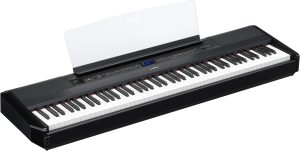
Best for:
Advanced pianists who want premium keyboard action and sound without committing to a permanent console piano.
The P-525 sits at the opposite end of the P-Series from Yamaha’s entry-level portable instruments.
This is where the phrase “weighted keyboard” becomes far too simplistic.
The P-525 isn’t merely weighted.
It uses Yamaha’s GrandTouch-S keyboard with wooden white keys, synthetic ebony and ivory keytops, and escapement.
Wooden White Keys
Wood itself doesn’t automatically make a keyboard action superior.
But in the P-525, the wooden-key construction is part of a substantially more sophisticated keyboard system.
Advanced pianists may appreciate the improved sense of control and physical response compared with more basic portable actions.
Escapement
On an acoustic grand piano, the action incorporates an escapement mechanism that allows the hammer to disengage before striking the string.
Digital piano manufacturers can simulate aspects of the subtle tactile sensation associated with this mechanism.
The P-525 incorporates escapement into its GrandTouch-S action.
For a beginner, this may not be a deciding factor.
For an experienced pianist sensitive to keyboard response, it can contribute to a more refined playing experience.
Two Prestigious Concert Grand Voices
The P-525 gives you two particularly important piano characters:
Yamaha CFX
and
Bösendorfer Imperial
Yamaha owns Bösendorfer, but the two acoustic piano traditions retain distinct tonal identities.
Having both gives the pianist meaningful tonal alternatives.
VRM and Grand Expression Modeling
The P-525 also uses Yamaha’s more advanced Virtual Resonance Modeling rather than the lighter VRM Lite system found in the P-225 and Arius models in this comparison.
Grand Expression Modeling is designed to reproduce additional tonal variation based on the pianist’s input.
Maximum polyphony is 256 notes.
Premium Doesn’t Mean Lightweight
There’s an important compromise.
The P-525 weighs approximately 22 kg / 48.5 lb.
So although it’s a portable-style piano rather than a permanent console, this isn’t an instrument most people will want to carry frequently.
Think of “portable” here as:
It can be moved.
Not:
It’s light.
Who Should Buy the P-525?
Choose it if:
- You’re an experienced pianist.
- Keyboard feel is extremely important.
- You want premium acoustic-piano sounds.
- You want built-in speakers.
- You want a movable instrument rather than a permanent console.
- Your budget allows a significant step up from entry and midrange models.
[Check Yamaha P-525 Price on Amazon →]
Yamaha 88-Key Weighted Keyboards Compared
| Feature | P-225 | DGX-670 | YDP-145 | YDP-165 | P-525 |
|---|---|---|---|---|---|
| Keys | 88 | 88 | 88 | 88 | 88 |
| Action | GHC | GHS | GHS | GH3 | GrandTouch-S |
| Graded | Yes | Yes | Yes | Yes | Yes |
| Wooden White Keys | No | No | No | No | Yes |
| Piano Sound | CFX | CFX | CFX | CFX | CFX + Bösendorfer |
| Polyphony | 192 | 256 | 192 | 192 | 256 |
| Cabinet | Portable | Portable | Console | Console | Portable |
| 3-Pedal Setup | Optional | Optional | Included | Included | Optional |
| Best For | Most Players | Features | Home Beginners | Serious Students | Advanced Pianists |
Which Yamaha Has the Most Realistic Keyboard Feel?
Among these five models, the P-525 is the clear winner for keyboard sophistication.
Its GrandTouch-S action with wooden white keys and escapement is designed for a more advanced playing experience.
Next, I would place the YDP-165, particularly for serious home study because of its GH3 triple-sensor action.
The P-225, YDP-145 and DGX-670 are more accessible choices intended for somewhat different priorities.
But remember:
“Most realistic” is partly subjective.
Pianists develop strong preferences about:
- Resistance
- Key return
- Pivot
- Surface texture
- Repetition
- Overall weight
Whenever possible, play the instrument yourself.
Which Yamaha Is Best for Beginners?
For most beginners, I’d choose between:
P-225 and YDP-145.
Choose the P-225 if you value:
- Portability
- Compact size
- Flexibility
Choose the YDP-145 if you value:
- Permanent furniture-style setup
- Integrated pedals
- Traditional piano appearance
For a particularly committed student, the YDP-165 offers greater room for technical development.
Which Is Best for Classical Piano?
For serious classical practice, our preference among these five would be:
Best Premium:
P-525
Best Permanent Home Choice:
YDP-165
Best More Affordable Portable:
P-225
Classical players should pay particular attention to:
- Action
- Repetition
- Dynamic control
- Pedaling
- Piano tone
Extra voices and accompaniment styles should be secondary considerations.
Which Is Best for Small Spaces?
The P-225.
Its compact design is one of its greatest strengths.
It can work particularly well in:
- Apartments
- Condominiums
- Bedrooms
- Small music rooms
If you want furniture-style appearance and have a dedicated location, consider the YDP-145.
Which Is Best for Songwriting and Entertainment?
The DGX-670 wins easily.
Its hundreds of voices, accompaniment styles, display, recording capabilities and extensive musical features make it far more versatile beyond traditional piano playing.
For someone who wants:
Piano + arranger + entertainment keyboard
the DGX-670 makes far more sense than the P-225.
Which Is Best for Advanced Pianists?
The P-525.
The combination of:
- GrandTouch-S
- Wooden white keys
- Escapement
- CFX
- Bösendorfer Imperial
- VRM
- Grand Expression Modeling
- 256-note polyphony
puts it well above the entry-level models in this comparison.
Portable or Console: Which Should You Choose?
This decision can narrow your choices quickly.
Choose Portable If:
- You may move the piano.
- Space is limited.
- You want flexibility.
- You don’t want a large cabinet.
Look at:
P-225, DGX-670 or P-525.
Choose Console If:
- The piano has a permanent room.
- Appearance matters.
- You want integrated pedals.
- You want a traditional home-piano experience.
Look at:
YDP-145 or YDP-165.
Do You Really Need Wooden Keys?
Probably not if you’re a beginner.
A good synthetic-key hammer action can provide an excellent foundation for learning piano.
Wooden components become more interesting for advanced pianists who are particularly sensitive to action behavior.
Don’t assume:
Wooden = automatically good
or:
Plastic = automatically bad.
The entire keyboard mechanism matters.
Frequently Asked Questions
What is the best Yamaha 88-key weighted keyboard?
For most buyers, we recommend the Yamaha P-225 because it balances weighted action, portability, CFX piano sound and price.
For advanced players, the P-525 offers a substantially more sophisticated action.
Which Yamaha digital piano has wooden keys?
Among the five models in this guide, the P-525 has wooden white keys as part of its GrandTouch-S action.
Is the Yamaha P-225 fully weighted?
Yes. It uses Yamaha’s 88-key Graded Hammer Compact action.
Is GHC better than GHS?
Not necessarily in every respect.
GHC is a newer compact action designed partly to allow slimmer portable instruments. Keyboard preference is subjective, so don’t assume the acronym alone determines which action you will prefer.
What is the difference between GHS and GH3?
GH3 incorporates a three-sensor system that can improve note repetition and responsiveness compared with simpler action designs.
Is the DGX-670 good for learning piano?
Yes.
It has 88 GHS weighted keys and Yamaha CFX piano sound. Its major advantage is that it also provides a very large selection of additional sounds, styles and entertainment features.
Is the YDP-165 worth buying instead of the YDP-145?
For serious piano study, it can be.
The GH3 action is the most important reason to consider stepping up to the YDP-165.
Is the P-525 suitable for beginners?
Certainly, but it may be more piano than most beginners need.
Its premium features are easier to justify for experienced or committed players.
Do all Yamaha 88-key keyboards have weighted keys?
No.
Yamaha produces different categories of 88-key instruments. Always check the specific keyboard action rather than assuming that 88 keys automatically means hammer weighting.
Final Verdict: Which Yamaha 88-Key Weighted Keyboard Should You Buy?
The five Yamaha pianos in this guide share something fundamental:
88 weighted keys.
But that’s where the similarity ends.
Best Overall — Yamaha P-225
Our recommendation for the largest number of buyers.
Compact, portable and piano-focused.
Best for Features — Yamaha DGX-670
Choose this if you want piano playing plus hundreds of sounds, accompaniment and extensive entertainment features.
Best Affordable Home Piano — Yamaha YDP-145
A sensible first serious digital piano for families wanting a traditional cabinet and integrated pedals.
Best for Serious Home Practice — Yamaha YDP-165
The GH3 action makes this the more compelling Arius choice for committed students.
Best Premium Portable — Yamaha P-525
The clear choice here for advanced pianists who prioritize keyboard action, premium piano sounds and expressive control.
Ultimately, don’t choose your Yamaha simply because one model has more voices or a bigger specification sheet.
Start with three questions:
How serious am I about piano?
Will the instrument stay at home or need to move?
How important is realistic keyboard feel to me?
For most buyers, the P-225 offers the best balance.
For serious home students, look closely at the YDP-165.
And for advanced pianists who want the most sophisticated keyboard action among these five, the P-525 is the standout.
[Check Yamaha P-225 Price on Amazon →]
The best Yamaha weighted keyboard isn’t necessarily the most expensive one.
It’s the one whose action, features and physical design best match the way you actually intend to play.
Yamaha players who intend to focus on classical repertoire may also want to see our guide to choosing a digital piano for classical music, which explains why full keyboard range, weighted action and dynamic response become increasingly important as technique develops.
If realistic piano tone matters just as much as keyboard feel, see our guide to Yamaha digital pianos with realistic acoustic sound for a closer look at CFX sampling, resonance technology and speaker performance.
The P-225 is our strongest all-around Yamaha recommendation for many buyers; see our full Yamaha P-225 review for a closer examination of its GHC action, CFX sound, connectivity and limitations.
The Yamaha CK88 is especially interesting for working musicians because of its combination of full-size weighted keys and manageable weight; we examine it further in our portable keyboard guide for gigging musicians.
If you want to compare Yamaha beyond weighted-key specifications alone, our broader guide to Yamaha digital pianos looks at models for different budgets, playing levels and uses.