Best Portable Keyboards for Gigging Musicians in 2026: 5 Top Picks
For a gigging musician, choosing a keyboard isn’t just about finding the best piano sound.
You also have to carry it.
That changes the buying decision considerably.
A keyboard that feels wonderful in a showroom may become much less appealing after you’ve carried it through parking lots, up staircases, into rehearsal rooms, and onto stages several times a week.
At the same time, simply buying the lightest keyboard isn’t necessarily the answer.
A working musician may need:
- 88 weighted keys
- Reliable piano and electric-piano sounds
- Professional audio outputs
- Splits and layers
- MIDI and USB connectivity
- Built-in speakers for rehearsals
- Fast access to sounds
- A manageable weight
- A compact chassis
- Enough versatility to cover different types of gigs
The best portable keyboard for gigging therefore has to balance playability, performance features and portability.
In this guide, we’ve selected five keyboards that approach that balance in different ways.
Quick Comparison: Best Portable Keyboards for Gigging
| Model | Best For | Keys | Approx. Weight | Built-In Speakers |
|---|---|---|---|---|
| Yamaha CK88 | Best Overall for Gigging | 88 weighted | 28.9 lb | Yes |
| Roland RD-88 | Best Compact Stage Piano | 88 weighted | 29.8 lb | Yes |
| Casio PX-S1100 | Best Lightweight Piano | 88 weighted | 24.7 lb | Yes |
| Kawai ES920 | Best for Piano-Focused Performers | 88 weighted | 37.5 lb | Yes |
| Korg D1 | Best for Players Who Prioritize Key Action | 88 weighted | 35.3 lb | No |
Our Quick Recommendations
Choose the Yamaha CK88 if you want the strongest overall balance of portability, stage versatility, weighted keys and live-performance features.
Choose the Roland RD-88 if you want a compact stage piano with a broad sound palette and strong computer integration.
Choose the Casio PX-S1100 if low weight and slim dimensions are your biggest priorities while still wanting 88 weighted keys.
Choose the Kawai ES920 if piano playing and a more substantial piano experience matter more than minimizing weight.
Choose the Korg D1 if you prioritize keyboard action and stage-piano simplicity and don’t need built-in speakers.
Affiliate Disclosure
Some links on Pianos-Galore are affiliate links. If you purchase through these links, we may receive a small commission at no additional cost to you.
What Makes a Good Keyboard for Gigging?
A home pianist can place a digital piano in one room and leave it there for years.
A working musician has a completely different relationship with an instrument.
You may have to:
- Pack it.
- Carry it to the vehicle.
- Load it.
- Unload it at the venue.
- Carry it to the stage.
- Set it up.
- Perform.
- Reverse the entire process at the end of the night.
Do that several times per week and five or ten extra pounds can become significant.
But portability shouldn’t come at the expense of the features you need to perform.
That’s why we considered more than weight when choosing these five keyboards.
1. Yamaha CK88 — Best Overall Portable Keyboard for Gigging
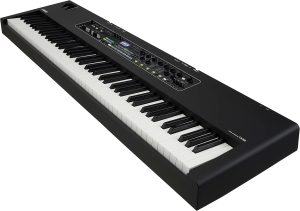
The Yamaha CK88 gets our Best Overall position because it combines an unusually gig-friendly weight with an 88-key weighted keyboard and a feature set designed specifically for live performance.
At approximately 28.9 pounds, it’s light for a full-size weighted stage keyboard.
That alone makes it attractive to working musicians.
But portability isn’t the CK88’s only advantage.
Why the CK88 Works So Well for Gigging
The CK88 is designed around three sound parts that can be combined through splits and layers.
That makes it easy to build common live setups such as:
- Piano + strings
- Piano + pad
- Electric piano + organ
- Bass + piano
- Organ + synth
- Multiple layered performance sounds
Its front panel is also designed for direct control rather than forcing you to navigate through deep menus for every adjustment.
For a gigging musician, that’s important.
You don’t want to spend the time between songs scrolling through complicated menus while the rest of the band is waiting.
88 Weighted Keys
The CK88 uses Yamaha’s GHS weighted keyboard.
This gives pianists a more familiar playing experience than a lightweight synth-style action while keeping the instrument relatively portable.
Players whose gigs involve substantial acoustic and electric piano work should appreciate having the full 88-key range.
Built-In Speakers
Unlike many professional stage keyboards, the CK88 includes built-in speakers.
That’s surprisingly useful for:
- Rehearsals
- Practice
- Small informal performances
- Backstage warm-ups
- Situations where a PA isn’t immediately available
For larger performances, you’d normally use the dedicated audio outputs.
Battery Operation
Another unusual advantage is battery operation.
The CK88 can run from batteries, giving musicians another level of flexibility in locations where convenient AC power isn’t available.
That’s not something every gigging musician will need, but when you do need it, it’s a major advantage.
Best For
The CK88 is particularly suitable for:
- Working keyboardists
- Cover-band musicians
- Worship players
- Singer-songwriters
- Rehearsing musicians
- Players who need several keyboard sounds during a set
Pros
- 88 weighted keys
- Very reasonable weight for a full-size stage keyboard
- Built-in speakers
- Battery operation
- Strong live controls
- Splits and layers
- Broad sound selection
- Good stage versatility
Cons
- GHS action may not satisfy players seeking a premium piano action
- Players who only need acoustic piano may not use many of its performance features
Pianists considering other Yamaha options can also compare Yamaha’s best 88-key weighted keyboards, ranging from portable digital pianos to more advanced models.
[Check Yamaha CK88 Price on Amazon →]
2. Roland RD-88 — Best Compact Stage Piano
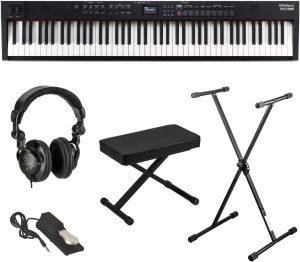
The Roland RD-88 is another excellent example of how much functionality can now fit into a relatively compact 88-key stage instrument.
It weighs about 29.8 pounds, putting it close to the CK88 despite offering a full weighted keyboard.
The RD series has long been associated with stage pianos, but the RD-88 takes a more portable approach than many traditional professional stage instruments.
Piano and Performance Sounds
The RD-88 isn’t limited to acoustic piano.
It’s designed to cover a much broader range of live sounds.
That makes it useful for musicians who might need:
- Acoustic piano
- Electric piano
- Organ
- Strings
- Pads
- Synths
- Brass
- Layered sounds
during a single performance.
PHA-4 Standard Keyboard
The RD-88 uses Roland’s PHA-4 Standard keyboard.
For musicians accustomed to weighted piano keys, this provides a more piano-oriented feel than typical synth actions.
Yet Roland has managed to keep the entire instrument under 30 pounds.
That’s an attractive compromise for regular gigging.
Built-In Speakers
The RD-88 also includes speakers.
Again, that can be extremely convenient for rehearsals.
Professional stage keyboards don’t necessarily need speakers, but having them means you can arrive at rehearsal, plug in the power supply and start playing without setting up additional amplification.
USB Audio and MIDI
Another major strength is computer connectivity.
The RD-88 supports USB audio and MIDI.
That’s useful for musicians who move between:
- Stage performance
- Home recording
- DAWs
- Virtual instruments
- MIDI-based production
If MIDI and computer integration are central to your setup, our guide to the best 88-key MIDI keyboards and digital pianos explores this subject in more detail.
Best For
The RD-88 is particularly suitable for:
- Gigging pianists
- Worship musicians
- Band keyboardists
- Home-studio musicians who also perform
- Players who need a broad sound library
Pros
- Under 30 pounds
- 88 weighted keys
- Built-in speakers
- Strong stage-oriented sound selection
- USB audio/MIDI
- Compact design
- Good live versatility
Cons
- More complex than a straightforward digital piano
- Players wanting a premium piano action may prefer a heavier instrument
If you’re comparing other instruments from the same manufacturer, our Roland digital piano guide covers several Roland models designed for different players and budgets.
[Check Roland RD-88 Price on Amazon →]
3. Casio PX-S1100 — Best Lightweight Digital Piano for Gigging
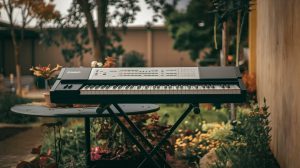
If your priority is carrying as little weight as possible while retaining 88 weighted keys, the Casio PX-S1100 deserves serious attention.
At approximately 24.7 pounds, it’s the lightest instrument among our five selections.
It’s also remarkably slim.
That makes it particularly appealing for musicians who regularly transport their keyboards.
Why Size Matters as Much as Weight
People often focus entirely on pounds or kilograms.
But dimensions matter too.
A deep, bulky keyboard can be difficult to maneuver through:
- Doorways
- Staircases
- Cars
- Elevators
- Narrow backstage areas
even if its actual weight isn’t excessive.
The PX-S1100’s slim chassis makes transportation easier.
88 Weighted Keys
Despite its compact body, the PX-S1100 provides a full 88-key hammer-action keyboard.
This makes it much more appropriate for piano-oriented playing than a typical lightweight 61-key portable keyboard.
Built-In Speakers
The PX-S1100 also includes speakers.
For a musician moving between home, rehearsal and occasional performances, this is extremely convenient.
A Different Kind of Gigging Keyboard
The PX-S1100 isn’t as stage-control-oriented as the Yamaha CK88 or Roland RD-88.
That’s important.
If you constantly switch between complex layers, organ sounds and synthesizer setups, one of those instruments may make more sense.
But if your gig mostly requires:
“Give me a good piano that is easy to transport,”
the Casio becomes extremely attractive.
Best For
The PX-S1100 is particularly suitable for:
- Solo pianists
- Singer-songwriters
- Small gigs
- Rehearsals
- Musicians with limited transport space
- Players who value low weight above elaborate stage controls
Pros
- Only about 24.7 pounds
- Extremely slim design
- 88 weighted keys
- Built-in speakers
- Good portability
- Suitable for home and stage use
- Battery operation adds flexibility
Cons
- Less performance-oriented than the CK88 or RD-88
- Not the ideal choice for complex live layers and extensive sound switching
[Check Casio PX-S1100 Price on Amazon →]
4. Kawai ES920 — Best for Piano-Focused Performers
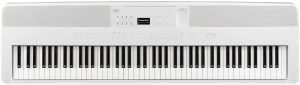
At approximately 37.5 pounds, the Kawai ES920 is noticeably heavier than our first three recommendations.
So why include it in an article about portability?
Because portability is always a compromise.
Some pianists are willing to carry an extra eight or twelve pounds in exchange for a more piano-oriented instrument.
That’s the audience for the ES920.
Piano Comes First
The ES920 is much more strongly oriented toward piano performance than a general-purpose gigging keyboard.
It uses Kawai’s Responsive Hammer III keyboard action, making it particularly interesting for players who care deeply about the playing experience.
For a pianist whose gigs consist mainly of:
- Solo piano
- Jazz
- Classical crossover
- Vocal accompaniment
- Piano-based worship
- Cocktail or hotel performances
the ES920’s extra weight may be entirely acceptable.
Built-In Speakers
The ES920 also has built-in amplification.
That makes it versatile enough to function as both:
- A home digital piano
- A portable performance instrument
Add the optional stand and pedal system and it can become a more permanent home setup.
Remove it from that setup and it can still travel to performances.
The Trade-Off
This is where buyers need to be realistic.
A 37.5-pound keyboard plus:
- Case
- Stand
- Pedals
- Cables
- Accessories
can become a substantial load.
If you perform three or four times a week and move your equipment alone, that matters.
If you perform less frequently and piano feel is your top priority, the trade-off may be worthwhile.
Best For
The ES920 is particularly suitable for:
- Serious pianists
- Jazz musicians
- Piano-focused performers
- Players who want one instrument for home and gigs
- Musicians willing to accept more weight for a more piano-oriented experience
Pros
- Strong piano orientation
- 88 weighted keys
- Responsive Hammer III action
- Built-in speakers
- Suitable for both home and performance use
- Excellent option for piano-focused players
Cons
- Significantly heavier than CK88, RD-88 and PX-S1100
- Less attractive for musicians who move equipment constantly
- More piano-focused than all-purpose stage-oriented
For a broader look at Kawai’s portable and console instruments, see our guide to the best Kawai digital pianos in 2026.
[Check Kawai ES920 Price on Amazon →]
5. Korg D1 — Best for Players Who Prioritize Key Action
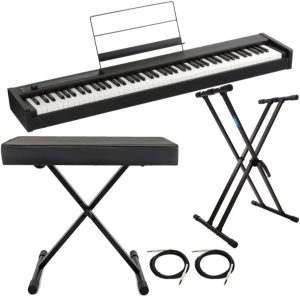
The Korg D1 takes yet another approach.
At approximately 35.3 pounds, it isn’t exceptionally lightweight.
But its body is very slim, and its main attraction is the RH3 Real Weighted Hammer Action 3 keyboard.
For players who want a stage-friendly piano without paying for a huge collection of features they may never use, the D1 is worth considering.
RH3 Keyboard Action
The RH3 action is graded, meaning the lower keys feel heavier while the upper keys become lighter.
That’s designed to approximate an important characteristic of acoustic-piano action.
For a pianist, the action may justify accepting the D1’s additional weight.
Simple, Stage-Oriented Design
The D1 isn’t trying to be everything.
It provides 30 sounds rather than hundreds or thousands.
For some buyers, that could look like a weakness.
For others, it’s exactly the point.
If your gigging needs are primarily:
- Acoustic piano
- Electric piano
- A selection of useful keyboard sounds
you may not need hundreds of presets.
No Built-In Speakers
The D1 doesn’t include built-in speakers.
That makes it different from the other four keyboards in this guide.
For home use, that’s less convenient.
For stage use, it may not matter at all.
If you’re always connecting to a:
- PA system
- Keyboard amplifier
- Powered monitor
- Audio interface
internal speakers would add little value.
The D1 provides line outputs specifically suited to external amplification.
Best For
The Korg D1 is particularly suitable for:
- Pianists
- Stage players
- Jazz musicians
- Players who prioritize key action
- Musicians who don’t need internal speakers
Pros
- RH3 weighted hammer action
- 88 keys
- Slim chassis
- Straightforward controls
- Line outputs
- MIDI IN/OUT
- Piano-oriented design
Cons
- About 35 pounds
- No built-in speakers
- Less versatile than CK88 or RD-88 for complex multi-sound performances
- Limited sound selection compared with performance keyboards
The D1 is only one part of a much broader lineup; our Korg keyboard buying guide compares its digital pianos, stage instruments and arranger keyboards.
[Check Korg D1 Price on Amazon →]
How Heavy Is Too Heavy for a Gigging Keyboard?
There’s no universal answer, but this question deserves more attention than it normally receives.
Here’s a practical way to think about it.
Under 25 Pounds
Excellent portability
A keyboard around this weight is relatively easy for most able-bodied musicians to move regularly.
The PX-S1100 falls into this territory.
25–30 Pounds
Very good portability for an 88-key weighted instrument
This is arguably the sweet spot for gigging pianists.
The CK88 and RD-88 demonstrate that you can now get 88 weighted keys without carrying a 40- or 50-pound stage piano.
30–40 Pounds
Portable, but you’ll notice it
The Korg D1 and Kawai ES920 fall here.
They’re still transportable, but regular movement becomes more of a consideration.
Over 40 Pounds
Think carefully if you’re frequently moving it yourself
Plenty of outstanding professional keyboards weigh more than 40 pounds.
But once you add a protective case, the total load can become substantial.
That’s why weight should be considered before—not after—you buy.
Don’t Forget the Weight of the Case
Keyboard specifications normally give you the weight of the instrument.
But that’s not necessarily what you’ll actually carry.
A protective case can add significant weight.
Then you may also have:
- Keyboard stand
- Pedals
- Cables
- Power supplies
- Music stand
- Tablet/laptop
- Audio interface
- Mixer
- Monitor
- Bench or stool
A 30-pound keyboard can easily become part of a 60- or 80-pound equipment load.
For frequent gigging, every pound you eliminate from the main keyboard can help.
88 Keys vs 73/76 vs 61 Keys for Gigging
All five keyboards in our main list have 88 keys.
But do gigging musicians actually need 88?
Not always.
Choose 88 Keys If:
- Piano is central to your performances
- You play classical or jazz repertoire
- You use the full keyboard range
- You regularly play two-handed piano arrangements
- You don’t want to adjust octaves during performances
Choose 73 or 76 Keys If:
- You need a smaller stage footprint
- You’re willing to sacrifice some piano range
- You play organ, synth and piano
- Portability matters more than having all 88 keys
Choose 61 Keys If:
- Synth and organ are your priorities
- You rarely play full-range piano parts
- Portability is extremely important
- You use multiple keyboards
- The 61-key instrument is only one component of your rig
This is why “best portable keyboard” can’t have a single answer for every musician.
Weighted Keys vs Lightweight Action for Live Performance
Another common assumption is that weighted keys are always superior.
They aren’t.
They’re superior for certain kinds of playing.
Weighted Keys Are Usually Better For:
- Acoustic piano
- Electric piano
- Classical music
- Jazz piano
- Traditional piano technique
Lightweight or Semi-Weighted Keys Can Be Better For:
- Organ
- Synthesizer
- Fast repeated notes
- Glissandos
- Some pop styles
- Multi-keyboard rigs
A professional organist may actively dislike playing organ parts on a heavy hammer-action keyboard.
Likewise, a classical pianist may dislike playing serious piano repertoire on a lightweight synth action.
Choose the action according to what you’ll actually play.
Our guide on whether you really need 88 weighted keys explores this decision in greater detail.
Do Gigging Keyboards Need Built-In Speakers?
Not necessarily.
For professional gigs, your keyboard will usually connect to external amplification.
That might include:
- Venue PA
- Powered speakers
- Stage monitors
- Keyboard amplifier
- In-ear monitoring system
So why do we consider built-in speakers useful?
Because gigging musicians don’t spend all their time on stage.
Speakers are convenient for:
- Rehearsals
- Practice
- Teaching
- Warm-ups
- Informal performances
The CK88, RD-88, PX-S1100 and ES920 give you that flexibility.
The D1 assumes external amplification.
Neither approach is inherently better.
Connections Matter More on Stage
For home playing, a headphone jack may be enough.
For gigging, connectivity becomes much more important.
Line Outputs
Dedicated line outputs allow you to send the keyboard signal directly to:
- PA system
- Mixer
- Powered speakers
- Audio interface
For regular performance use, these are extremely valuable.
MIDI
MIDI allows a keyboard to control or communicate with:
- Computers
- Synthesizers
- Sound modules
- Software instruments
- Other keyboards
USB
USB functionality varies significantly.
One keyboard may support MIDI only.
Another may support MIDI and audio.
Never assume that a USB port automatically gives you every type of computer connectivity.
Pedal Connections
Also consider how many pedals or controllers you use.
A pianist may need sustain or a triple-pedal setup.
A stage player might want:
- Sustain
- Expression
- Assignable footswitches
The more complicated your performances become, the more these details matter.
Portability vs Small Size: They’re Not the Same Thing
We’ve deliberately separated this article from our guide to compact digital pianos.
A compact piano is designed primarily to occupy less physical space.
A portable gigging keyboard is designed to be moved regularly.
Those goals overlap, but they’re not identical.
A very slim piano could still be heavy.
A lightweight performance keyboard could still be relatively wide because it has 88 keys.
If your main concern is fitting a piano into an apartment, bedroom or condominium rather than transporting it to gigs, see our guide to the best compact digital pianos for small spaces.
Portable Keyboard for Beginners vs Portable Keyboard for Gigging
This is another distinction worth making.
A beginner generally prioritizes:
- Appropriate key action
- Good piano sound
- Headphones
- Simple controls
- Reasonable price
- Ease of learning
A gigging musician may prioritize:
- Weight
- Audio outputs
- Fast controls
- Splits
- Layers
- MIDI
- Reliability
- Easy setup
- Sound versatility
The same instrument can work for both groups, but the buying priorities are different.
If you’re purchasing primarily for learning rather than performing, see our Best Portable Digital Pianos for Beginners in 2026 instead.
Which Portable Gigging Keyboard Should You Buy?
Let’s reduce the decision to five scenarios.
Choose Yamaha CK88 If…
You want the best balance of:
portability + 88 weighted keys + stage versatility + speakers + live controls.
It’s our overall choice for the widest range of working musicians.
Choose Roland RD-88 If…
You want:
a compact 88-key stage piano with extensive sounds and strong computer connectivity.
It’s especially attractive for musicians who perform and record.
Choose Casio PX-S1100 If…
You want:
the lightest and slimmest 88-key piano in this group.
It’s particularly attractive to piano-focused musicians who don’t need elaborate stage controls.
Choose Kawai ES920 If…
You want:
a more piano-oriented instrument and you’re willing to carry additional weight.
It’s our choice for the player who puts piano feel ahead of maximum portability.
Choose Korg D1 If…
You want:
a straightforward stage piano with a highly regarded weighted action and don’t need internal speakers.
Its simplicity can actually be an advantage.
Frequently Asked Questions
What is the best portable keyboard for gigging?
For overall versatility, we favor the Yamaha CK88 because it combines 88 weighted keys, a relatively low weight, built-in speakers, battery operation and extensive live-performance features.
What is the lightest 88-key keyboard in this comparison?
The Casio PX-S1100 is the lightest of our five choices at approximately 24.7 pounds.
Is a 30-pound keyboard easy to gig with?
For an 88-key weighted instrument, around 30 pounds is quite manageable compared with many heavier stage pianos. However, remember to include the weight of the carrying case and other equipment.
Do I need 88 keys for gigging?
No. Pianists often prefer 88 keys, but organists, synthesizer players and multi-keyboard performers may prefer 61, 73 or 76 keys for greater portability.
Are weighted keys better for live performance?
They’re generally better for piano-oriented playing. Organ and synth players may prefer lighter or semi-weighted actions.
Do I need built-in speakers for gigs?
Usually not for professional performances because you’ll connect to external amplification. Speakers are still useful for rehearsals and practice.
Can I use a home digital piano for gigs?
Yes, provided it’s reasonably portable and has appropriate outputs. However, stage-oriented keyboards often provide faster controls, more sounds, splits, layers and better performance connectivity.
What’s more important: weight or keyboard action?
That depends on how often you transport the instrument and what you play. Frequent gigging favors lower weight, while piano-focused performers may willingly accept more weight for an action they prefer.
Final Verdict
The best portable keyboard for a gigging musician isn’t necessarily the lightest keyboard you can find.
And it isn’t necessarily the most expensive.
The goal is finding the right compromise between:
weight, keyboard action, sound, connectivity, stage controls and the music you actually perform.
For the broadest range of gigging musicians, our overall choice is the Yamaha CK88.
Its combination of 88 weighted keys, approximately 29-pound weight, built-in speakers, battery operation and stage-oriented controls makes it particularly well suited to musicians who move regularly between rehearsals and performances.
The Roland RD-88 is an excellent alternative for musicians who want an especially compact stage piano with extensive sounds and USB audio/MIDI.
The Casio PX-S1100 wins when portability itself is the priority.
The Kawai ES920 makes sense when you’re willing to carry more weight for a more piano-focused experience.
And the Korg D1 is a compelling choice for players who value a substantial hammer action and straightforward stage-piano design over speakers and extensive extras.
Before buying, ask yourself one final question:
How often am I actually going to carry this keyboard?
If the answer is several times a week, don’t treat weight as a minor specification.
After your third flight of stairs at midnight, it may become one of the most important specifications on the entire page.
The ES920 is particularly appealing to performers who want portability without giving up a more piano-focused action; see our closer look at Kawai’s ES-series pianos.
Performers deciding between portability and piano feel should also consider whether an 88-key instrument is worth the additional size and weight.
Related Articles
- Best 88-Key MIDI Keyboards & Digital Pianos in 2026: 6 Top Picks
- Best Portable Digital Pianos for Beginners in 2026: 5 Lightweight Picks
- Piano Keyboards: The Complete 2026 Buying Guide
- Best Compact Digital Pianos for Small Spaces in 2026: 6 Top Picks
- 88 Weighted Keys: Do You Really Need Them on a Digital Piano?
================
Excited to learn piano? Simply Piano provides lessons to help you play the songs you love.

- Start with beginner-friendly lessons or advanced courses.
- Learn at your own pace with real-time feedback.
- Play classical, pop, and Disney songs with personalized exercises.
- Begin your piano journey today with SIMPLY PIANO!