Yamaha PSR-E373 vs PSR-E383: Should You Still Buy the Older Keyboard in 2026?
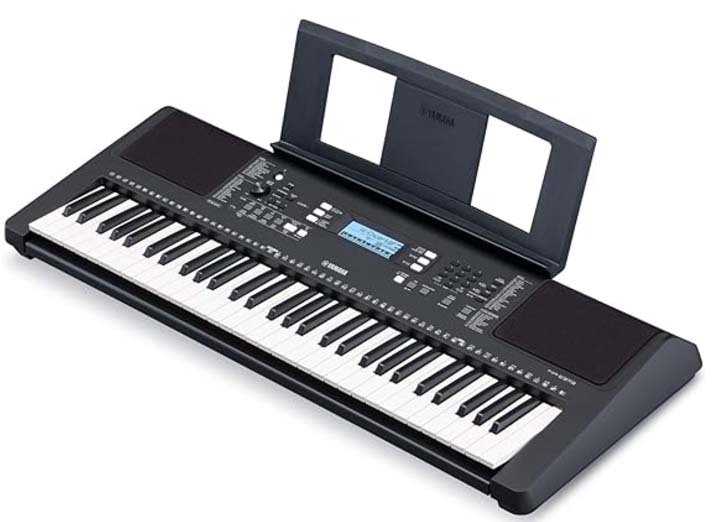
The Yamaha PSR-E373 was one of Yamaha’s popular 61-key portable keyboards for beginners, students and recreational players.
But there’s an important fact buyers need to know in 2026:
The Yamaha PSR-E373 has been discontinued.
Its successor, the Yamaha PSR-E383, now occupies essentially the same position in Yamaha’s portable-keyboard lineup.
So if you’ve found an older PSR-E373 for sale—or you’re trying to decide whether to buy the newer PSR-E383—the question is no longer simply:
“Is the Yamaha PSR-E373 a good keyboard?”
The more useful question is:
“Is the PSR-E373 still worth buying in 2026, or should I get the newer PSR-E383 instead?”
For most new buyers, our recommendation is straightforward:
Buy the Yamaha PSR-E383 unless you find the PSR-E373 at a substantially better price.
The E373 remains a capable beginner keyboard, especially if you already own one. But the E383 is newer, offers more voices and accompaniment styles, expands several features and is the more logical choice when buying new.
Let’s look at the differences.
Disclosure: Some links on Pianos-Galore are affiliate links. If you purchase through these links, we may receive a small commission at no additional cost to you.
Yamaha PSR-E373 vs PSR-E383: Quick Comparison
| Feature | Yamaha PSR-E373 | Yamaha PSR-E383 |
|---|---|---|
| Status | Discontinued | Current model |
| Keys | 61 | 61 |
| Keyboard Type | Organ-style | Organ-style |
| Touch Sensitive | Yes | Yes |
| Weighted Keys | No | No |
| Polyphony | 48 notes | 48 notes |
| Voices | 622 | 650 |
| Super Articulation Lite Voices | 11 | 12 |
| Accompaniment Styles | 205 | 260 |
| Arpeggio Types | 150 | 152 |
| DSP Effects | 38 | 41 |
| Reverb Types | 12 | 15 |
| Chorus Types | 5 | 7 |
| USB Audio/MIDI | Yes | Yes |
| Battery Operation | Yes | Yes |
| Duo Mode | Yes | Yes |
| Best Choice in 2026 | Only if attractively priced | Recommended for most buyers |
Bottom Line
Already own a PSR-E373?
Keep it. There’s no urgent reason to replace it solely with an E383.
Buying your first keyboard?
Choose the PSR-E383 in most cases.
Found a heavily discounted used or old-stock PSR-E373?
It can still be a good beginner keyboard if the price difference is substantial.
Want to learn traditional piano technique?
Consider an 88-key weighted digital piano instead.
What Was the Yamaha PSR-E373?
The Yamaha PSR-E373 is a 61-key portable keyboard designed primarily for:
- Beginners
- Students
- Hobbyists
- Families
- Casual musicians
- Players interested in many different instrument sounds
It became attractive partly because it provided features that weren’t always available on very inexpensive beginner keyboards.
These included:
- Touch-sensitive keys
- 622 voices
- 205 accompaniment styles
- 48-note polyphony
- Super Articulation Lite voices
- Built-in learning functions
- Duo mode
- USB audio/MIDI
- Battery operation
It weighs only about 10.1 pounds (4.6 kg) without batteries.
That makes it considerably easier to move than an 88-key hammer-action digital piano.
The PSR-E373 was therefore never really intended to compete directly with instruments such as Yamaha’s P-Series digital pianos.
It’s a portable keyboard, not a traditional digital piano.
That distinction is important.
Digital Piano vs Keyboard: Which Should You Buy in 2026?
The Yamaha PSR-E383: The Better Choice for New Buyers
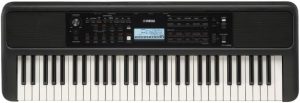
The PSR-E383 follows the same basic formula as the E373:
61 touch-sensitive keys + lots of sounds + accompaniment + learning features + portability.
Yamaha hasn’t completely reinvented the keyboard.
Instead, it has updated and expanded it.
The PSR-E383 offers:
- 61 touch-sensitive keys
- 650 voices
- 260 accompaniment styles
- 48-note polyphony
- 12 Super Articulation Lite voices
- 41 DSP effects
- 15 reverb types
- 7 chorus types
- 152 arpeggio types
- Auto Chord Play
- Keys to Success learning functions
- Duo mode
- USB audio/MIDI
- Battery operation
For someone buying today, that’s a more attractive package.
[Check Yamaha PSR-E383 Price on Amazon →]
1. Both Have 61 Touch-Sensitive Keys
This is one of the most important features of both keyboards.
Touch sensitivity means the instrument responds to how strongly you strike the keys.
Play softly and the sound can be quieter.
Play more forcefully and the sound can become louder.
That’s fundamentally different from a basic keyboard where every note plays at essentially the same volume regardless of your touch.
For beginners, touch sensitivity helps introduce the concept of musical dynamics.
But the Keys Are Not Weighted
This needs to be emphasized because buyers frequently confuse:
touch-sensitive
with
weighted.
They are not the same thing.
Both the PSR-E373 and PSR-E383 use 61-key organ-style keyboards.
They’re designed to be lightweight and responsive rather than imitate the mechanical resistance of an acoustic piano.
That’s perfectly reasonable if your priorities include:
- Portability
- Pop music
- Accompaniment
- Many sounds
- Songwriting
- Casual playing
- Learning basic keyboard skills
But if your primary goal is developing traditional piano technique, an 88-key weighted digital piano may be a better long-term choice.
88 Weighted Keys: Do You Really Need Them on a Digital Piano?
2. PSR-E383 Has More Instrument Voices
The PSR-E373 provides 622 voices.
The PSR-E383 increases that to 650 voices.
Those include much more than piano sounds.
Depending on the category, you’ll find sounds representing instruments such as:
- Pianos
- Electric pianos
- Organs
- Guitars
- Basses
- Strings
- Brass
- Woodwinds
- Synths
- Percussion
For a traditional piano student, hundreds of sounds aren’t necessary.
For a curious beginner, songwriter or recreational keyboard player, however, they can make the instrument considerably more entertaining.
3. PSR-E383 Has 260 Accompaniment Styles
This is a more substantial improvement.
The PSR-E373 provides 205 accompaniment styles.
The newer PSR-E383 increases the number to 260.
Accompaniment styles essentially allow the keyboard to function like a backing band.
You can play chords while the instrument generates accompaniment appropriate to different musical styles.
This can be useful for:
- Pop
- Rock
- Jazz
- Dance
- Ballads
- Latin music
- Country
- Traditional styles
- Songwriting
For players who enjoy playing complete arrangements rather than solo piano, accompaniment is one of the biggest reasons to choose a PSR keyboard over a piano-focused digital piano.
4. Auto Chord Play Is a Useful Addition
The PSR-E383 adds Auto Chord Play.
This allows beginners to use preset chord progressions with accompaniment styles.
Why does that matter?
One of the barriers new musicians face is coordinating:
melody + chords + rhythm
at the same time.
A preset chord progression lets the player concentrate on other aspects of the music while the keyboard provides the harmonic structure.
It’s not a substitute for eventually learning chords.
But it can make early playing more enjoyable.
5. Both Offer 48-Note Polyphony
Both models provide a maximum of 48-note polyphony.
That might seem modest when compared with digital pianos offering:
- 96
- 128
- 192
- 256
notes of polyphony.
But remember the intended buyer.
The PSR-E383 isn’t designed primarily for advanced classical repertoire with extensive sustain.
For beginner keyboard playing, 48-note polyphony is generally workable.
Don’t reject the E383 simply because another instrument advertises a much larger number.
Polyphony should be evaluated in context.
6. Super Articulation Lite Voices
One of Yamaha’s more interesting features in this range is Super Articulation Lite.
The PSR-E373 has 11 Super Articulation Lite voices.
The PSR-E383 has 12.
These sounds are designed to reproduce certain performance characteristics associated with real instruments.
The objective is to make selected non-piano voices more expressive and convincing.
This is particularly relevant if you enjoy using your keyboard for much more than piano practice.
7. Built-In Learning Features
The PSR-E383 isn’t simply a keyboard filled with sounds.
It’s also designed to help beginners learn.
Its learning functions include Yamaha’s Keys to Success and related practice tools.
These can help beginners work through music in smaller stages rather than attempting an entire song immediately.
The keyboard also includes Duo mode, which divides the keyboard into two equivalent playing ranges.
That can be useful for:
teacher + student
or
parent + child
practice.
Can the PSR-E383 Replace Piano Lessons?
No keyboard can replace good instruction in every situation.
Built-in learning features are useful for:
- Getting started
- Practicing independently
- Learning songs
- Developing familiarity with the keyboard
- Making practice more interactive
But a good teacher can identify problems involving:
- Posture
- Fingering
- Hand position
- Rhythm
- Technique
- Interpretation
that software or built-in lessons may not detect.
You can also combine a keyboard with learning apps.
Simply Piano Review 2026: Is It Good for Beginners?
8. USB Audio and MIDI Connectivity
Both the PSR-E373 and PSR-E383 support USB connectivity for audio and MIDI.
This makes the keyboard considerably more useful than an isolated beginner instrument.
Depending on your setup, USB connectivity can help you:
- Connect to a computer
- Work with music software
- Record MIDI performances
- Exchange digital audio
- Use compatible educational applications
For beginners interested in both playing and music technology, this adds long-term usefulness.
9. Battery Operation Makes the PSR-E383 Highly Portable
The PSR-E383 can run on six AA batteries as well as an AC power adapter.
At approximately 9.7 pounds / 4.4 kg without batteries, it’s also slightly lighter than the older PSR-E373.
This makes it practical for:
- Moving between rooms
- Lessons
- School
- Family trips
- Rehearsals
- Casual performances
- Homes with limited space
This is an area where a 61-key portable keyboard has a major advantage over an 88-key hammer-action digital piano.
Yamaha 61-Key Keyboard Guide: Perfect for Beginners
Yamaha PSR-E373 vs PSR-E383: Which Sounds Better?
The PSR-E383 is the newer instrument and benefits from Yamaha’s updated voice set.
However, don’t expect the difference to feel like moving from an inexpensive keyboard to a premium digital piano.
These two instruments belong to the same general family and price category.
The E383 is better viewed as an evolution of the E373 formula, not an entirely different class of instrument.
That’s another reason existing E373 owners shouldn’t feel pressured to upgrade.
Should Existing PSR-E373 Owners Upgrade to the PSR-E383?
For most owners:
Probably not.
Yes, the PSR-E383 gives you:
- More voices
- More styles
- More effects
- Auto Chord Play
- A newer feature set
But the fundamental experience remains similar:
- 61 organ-style keys
- Touch sensitivity
- 48-note polyphony
- Portable design
- Built-in speakers
- Accompaniment
- Learning functions
If your E373 is working properly and meeting your needs, I’d keep using it.
A Better Upgrade from the PSR-E373 May Be an 88-Key Digital Piano
This is an important point.
Suppose you’ve been playing the PSR-E373 for two or three years.
You’ve become more serious about piano.
You’re now practicing:
- Scales
- Chords
- Classical pieces
- Two-handed arrangements
- Pedaling
- More demanding repertoire
In that situation, moving from an E373 to an E383 may not be the most meaningful upgrade.
You might benefit more from moving to:
61 non-weighted keys → 88 weighted keys
rather than:
older 61-key keyboard → newer 61-key keyboard.
Models such as the Yamaha P-225, Roland FP-10 and other beginner digital pianos provide a very different piano-learning experience.
Best Digital Pianos for Beginners in 2026: 7 Top Picks for Learning Piano
Who Should Buy the Yamaha PSR-E383?
The PSR-E383 makes particular sense for:
Complete Beginners
It’s approachable, portable and loaded with features that encourage experimentation.
Children and Teenagers
The large selection of sounds and accompaniment styles can make practice more entertaining than a piano-only instrument.
Casual Adult Players
If you simply want to learn songs and enjoy making music at home, you may not need an expensive 88-key digital piano.
Songwriters
Multiple voices, accompaniment, arpeggios and connectivity provide more creative options than a basic piano-focused instrument.
Players Who Need Portability
At under 10 pounds without batteries, the E383 is far easier to move than most 88-key weighted instruments.
Who Should NOT Buy the PSR-E383?
It isn’t the ideal choice for everyone.
Consider something else if:
You Want Realistic Piano Action
The keys aren’t weighted.
You’re Pursuing Serious Classical Piano
An 88-key hammer-action instrument is generally a better choice.
You’re an Advanced Pianist
The E383 is primarily a beginner/recreational portable keyboard.
You Need All 88 Keys
The PSR-E383 has 61.
You Want a Professional Stage Instrument
Yamaha and other manufacturers offer much more sophisticated stage keyboards for professional performance.
PSR-E383 vs 88-Key Digital Piano
This is probably the most important buying decision for many beginners.
Choose the PSR-E383 if you value:
- Lower cost
- Portability
- Many instrument sounds
- Accompaniment styles
- Built-in learning features
- Lightweight keys
- Battery operation
- Musical experimentation
Choose an 88-key digital piano if you value:
- Traditional piano technique
- Hammer-action keys
- Full piano range
- Classical practice
- More realistic piano feel
- Long-term piano development
Neither category is automatically better.
They’re designed for different priorities.
Digital Piano vs Keyboard: Which Should You Buy in 2026?
PSR-E383 vs Yamaha P-225
These two Yamaha instruments illustrate the difference perfectly.
Yamaha PSR-E383
Better for:
- Keyboard beginners
- Portability
- Many sounds
- Accompaniment
- Casual music making
- Lower-cost entry
Yamaha P-225
Better for:
- Piano students
- 88-key practice
- Weighted-key technique
- Classical music
- More realistic piano playing
If your goal is:
“I want to learn keyboard and have fun with lots of sounds,”
I’d lean toward the PSR-E383.
If your goal is:
“I want to learn to play piano properly,”
I’d lean toward the P-225 or another suitable 88-key weighted digital piano.
What About the Yamaha PSR-E473?
The PSR-E473 occupies a more advanced position within Yamaha’s portable-keyboard family.
It becomes interesting for players who want more creative and performance-oriented features rather than simply a beginner instrument.
So the progression isn’t necessarily:
PSR-E373 → PSR-E383 → digital piano.
It could also be:
PSR-E383 → more advanced portable keyboard
depending on what kind of musician you’re becoming.
That’s why it’s important to decide whether your priority is:
piano playing
or
versatile keyboard playing.
Accessories You May Need
A few accessories can make the PSR-E383 considerably more comfortable to use.
Keyboard Stand
Choose a stable stand that allows you to position the keyboard at a comfortable playing height.
Bench
Proper seating height matters, especially when practicing regularly.
Sustain Pedal
A sustain pedal adds expressive capability and is useful as your playing develops.
Headphones
One of the greatest advantages of electronic keyboards is silent practice.
Carrying Case
Worth considering if you regularly transport the instrument.
Don’t automatically buy the largest accessory bundle available. Start with what you genuinely need.
Yamaha PSR-E373 vs PSR-E383: Frequently Asked Questions
Is the Yamaha PSR-E373 discontinued?
Yes. Yamaha now lists the PSR-E373 as a discontinued model.
What replaced the Yamaha PSR-E373?
The PSR-E383 is the newer 61-key model occupying the same general beginner/standard portable-keyboard position.
Is the Yamaha PSR-E373 still good in 2026?
Yes, particularly if you already own one. It remains a capable 61-key touch-sensitive keyboard with hundreds of voices, accompaniment styles, learning features and USB connectivity.
The issue isn’t that the E373 suddenly became bad.
It’s that new buyers now have a newer alternative.
Should I buy a PSR-E373 if I find one for sale?
Possibly—but only if the price is attractive.
If an E373 and E383 are similarly priced, I’d choose the E383.
Is the PSR-E383 good for beginners?
Yes. Beginners are one of its primary target audiences.
Does the PSR-E383 have weighted keys?
No. It has 61 touch-sensitive organ-style keys.
Can I learn piano on the PSR-E383?
Yes, especially at the beginning.
You can learn notes, chords, rhythm, melodies and many basic musical skills.
However, if your long-term goal is traditional piano technique, moving eventually to an 88-key weighted digital piano would be beneficial.
Does the PSR-E383 have 88 keys?
No. It has 61 keys.
Does the PSR-E383 have touch-sensitive keys?
Yes.
How many voices does the PSR-E383 have?
It provides 650 voices.
How many accompaniment styles does it have?
The PSR-E383 provides 260 preset accompaniment styles.
Can the PSR-E383 run on batteries?
Yes. It can operate using six AA batteries, making it useful when portability is important.
Should I upgrade from the PSR-E373 to the PSR-E383?
Not necessarily.
If your E373 still meets your needs, continue using it.
If you’ve outgrown it, consider whether an 88-key weighted digital piano might represent a more meaningful upgrade.
Final Verdict: Is the Yamaha PSR-E373 Still Worth Buying in 2026?
The Yamaha PSR-E373 was—and remains—a capable portable keyboard.
But for new buyers, its discontinued status changes our recommendation.
Already own a PSR-E373?
Keep it.
The E383’s improvements alone probably aren’t enough to justify replacing a perfectly functional E373.
Buying your first keyboard?
Choose the Yamaha PSR-E383.
You get Yamaha’s newer model with:
- 650 voices
- 260 accompaniment styles
- 12 Super Articulation Lite voices
- Expanded effects
- Auto Chord Play
- Touch-sensitive keys
- Learning functions
- USB audio/MIDI
- Battery operation
Found a heavily discounted PSR-E373?
It may still represent good value.
Just compare its price carefully with the newer model.
Serious about traditional piano?
Consider skipping both and buying an 88-key weighted digital piano instead.
That is ultimately the most important lesson from this comparison.
The PSR-E373 didn’t become obsolete because the PSR-E383 arrived.
But in 2026, the PSR-E383 is the model we’d recommend to most new buyers.
[Check Yamaha PSR-E383 Price on Amazon →]
Related Articles
- Yamaha 61-Key Keyboard Guide: Perfect for Beginners
- Best Digital Pianos for Beginners in 2026: 7 Top Picks for Learning Piano
- Best Cheap Keyboards in 2026: 5 Budget Picks That Are Actually Worth Buying
Thinking of learning piano? Try Simply Piano today and play music you love.

- Easy-to-follow lessons for beginners and advanced courses available.
- Learn at your own speed, with personalized feedback.
- Play classical and pop songs, along with Disney tunes, with tailored exercises.