Best Nord Keyboards in 2026: Which Nord Is Right for You?
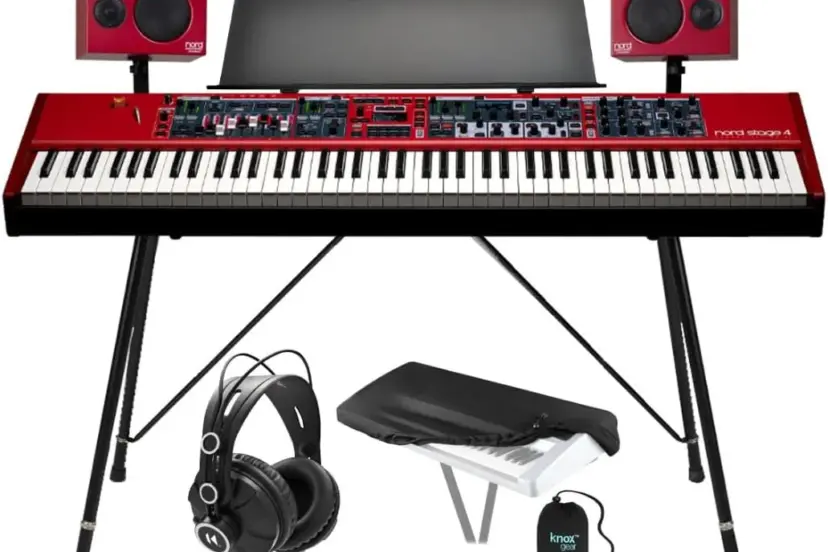
Nord keyboards are easy to recognize.
Their bright red cabinets have become a familiar sight on concert stages, in churches, recording studios and touring rigs around the world.
But choosing a Nord is not as simple as choosing the most expensive model.
The Nord Stage 4, Nord Grand 2, Nord Electro 6D and Nord Wave 2 are all professional-quality instruments, yet they are designed for very different musicians.
A pianist who primarily wants an expressive acoustic-piano experience has different needs from an organ player.
A keyboardist covering piano, organ and synthesizer sounds in a live band needs something different again.
And a sound designer may care much more about synthesis and layering than realistic piano action.
For 2026, our four Nord recommendations are:
- Nord Stage 4 88 — Best Overall Nord Keyboard
- Nord Grand 2 — Best Nord for Serious Pianists
- Nord Electro 6D 61 — Best for Organ, Electric Piano & Lightweight Gigging
- Nord Wave 2 — Best Nord for Synths & Sound Design
Rather than ranking them simply from best to worst, this guide explains which Nord keyboard is best for the way you actually make music.
Disclosure: Some links on Pianos-Galore are affiliate links. If you purchase through these links, we may receive a small commission at no additional cost to you.
Best Nord Keyboards at a Glance
| Model | Keys | Action | Best For |
|---|---|---|---|
| Nord Stage 4 88 | 88 | Triple-Sensor Hammer Action | Professional All-Round Performance |
| Nord Grand 2 | 88 | Kawai Responsive Hammer, Triple Sensor | Serious Piano Playing |
| Nord Electro 6D 61 | 61 | Semi-Weighted Waterfall | Organ, Electric Piano & Gigging |
| Nord Wave 2 | 61 | Semi-Weighted with Aftertouch | Synths, Layers & Sound Design |
The important thing to understand immediately is that these are not four versions of the same keyboard.
They are four very different tools.
What Makes Nord Different?
Nord is not primarily trying to compete with beginner digital-piano brands.
Its instruments are aimed largely at:
- Professional musicians
- Gigging keyboardists
- Touring players
- Worship musicians
- Studio musicians
- Advanced pianists
- Producers
- Sound designers
Several characteristics define the Nord approach.
1. Hands-On Controls
Nord keyboards generally avoid burying important functions inside complicated menus.
Instead, players often get direct access to:
- Piano sections
- Organ controls
- Synth controls
- Effects
- Layers
- Splits
- Drawbars
- Morph functions
- Performance settings
That matters on stage.
A performer often needs to change a sound in seconds, not navigate several menu pages.
2. Replaceable Sound Libraries
Nord users can download and replace sounds using Nord’s software ecosystem.
Depending on the instrument, this can include:
- Acoustic pianos
- Upright pianos
- Electric pianos
- Clavinets
- Synth samples
- Orchestral sounds
- Choirs
- Strings
- Vintage keyboards
This gives Nord instruments unusually long useful lives.
Instead of being permanently locked to the factory sounds, users can update and reorganize the instrument’s library.
3. Performance-Oriented Design
Nord instruments are designed with live use in mind.
Typical strengths include:
- Quick splits and layers
- Seamless sound changes
- Dedicated effects
- Physical controls
- MIDI
- Professional audio outputs
- Lightweight designs relative to many traditional stage pianos
This helps explain why Nord keyboards appear so often in professional performance environments.
4. Premium Pricing
Nord keyboards are not budget instruments.
You are paying for:
- Premium sound libraries
- Performance flexibility
- High-quality hardware
- Stage-oriented controls
- Professional connectivity
- Continued software and library support
That means a Nord is not automatically the sensible choice for a beginner who simply wants to learn piano.
For many beginners, a Yamaha P-225, Roland FP-30X, Kawai ES120 or similar digital piano may offer much better value.
Nord makes the most sense when you understand why you need Nord’s particular strengths.
1. Nord Stage 4 88 — Best Overall Nord Keyboard
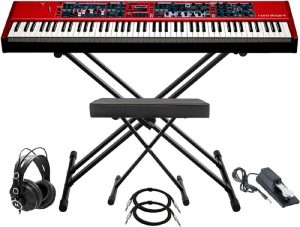
The Nord Stage 4 88 is the most complete instrument in this group.
It combines three major keyboard worlds inside one performance instrument:
- Piano
- Organ
- Synthesizer
That is what makes the Stage series so attractive to working keyboardists.
Keyboard
The Stage 4 88 uses an:
88-key Triple Sensor Hammer Action keyboard with aftertouch
This gives pianists a weighted action while retaining extensive control over synthesizer and performance functions.
Aftertouch is especially useful when playing synths because you can alter parameters by applying additional pressure after the note has already been pressed.
Piano Section
The Stage 4 gives access to Nord’s piano library and supports multiple piano layers.
Depending on installed sounds, users can work with:
- Acoustic grands
- Uprights
- Electric pianos
- Clavinets
- Digital piano sounds
For live performers who regularly switch between acoustic piano and electric piano, this is a major strength.
Organ Section
Nord has long been respected for its organ emulations.
The Stage 4 includes organ models and, importantly for traditional organ players, physical drawbars with LED indicators.
This is much more intuitive than adjusting organ registrations through a touchscreen.
Synth Section
The Stage 4 incorporates technology based on Nord’s Wave 2 synth engine.
It provides three independent synth layers, allowing sophisticated combinations of:
- Virtual analog sounds
- Samples
- Wavetables
- FM-style sounds
This transforms the Stage 4 from a premium digital piano into a much broader professional performance workstation.
Layering
One of the Stage 4’s biggest strengths is how easily multiple sounds can be combined.
You might create a performance containing:
- Acoustic piano
- Strings
- Synth pad
or:
- Hammond-style organ
- Synth bass
- Lead synth
Dedicated LED faders make the layers easier to control in real time.
Effects
Each layer can have its own effect processing.
This is important because professional players don’t always want the same chorus, delay or reverb applied to every sound.
The Stage 4 provides extensive control over:
- Reverb
- Delay
- Modulation
- Amp simulation
- Compression
- Equalization
- Rotary speaker effects
Who Should Buy the Nord Stage 4 88?
The Stage 4 88 is ideal for:
- Professional keyboardists
- Touring musicians
- Church/worship players
- Musical theater musicians
- Cover-band keyboardists
- Studio professionals
- Players requiring piano, organ and synth sounds from one instrument
Who Shouldn’t Buy It?
If you only want to practice acoustic piano at home, much of the Stage 4’s capability may be unnecessary.
A piano-focused instrument could be less expensive and simpler.
Pros
- Excellent all-round professional instrument
- 88 weighted keys
- Triple sensors
- Aftertouch
- Piano, organ and synth engines
- Three synth layers
- Extensive effects
- Excellent live controls
- Professional connectivity
Consider Before Buying
It is expensive and may be excessive for someone who primarily plays acoustic piano at home.
Best for:
Professional performers who need one keyboard to cover piano, organ and synth duties.
For players who need piano, organ and synthesizer capabilities in one professional instrument, our detailed Nord St
age 4 review takes a closer look at its three sound engines, keyboard options, layering features and live-performance controls.
[Check Nord Stage 4 88 Price on Amazon →]
2. Nord Grand 2 — Best Nord for Serious Pianists
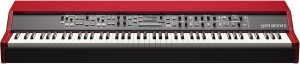
The Nord Grand 2 has a much clearer mission.
This is the Nord to consider when piano playing comes first.
Nord uses a premium Kawai hammer-action keyboard in the Grand 2.
Specifically, it has:
- 88 keys
- Kawai Responsive Hammer action
- Triple sensors
The emphasis is therefore on creating a more piano-like playing experience.
Why the Kawai Action Matters
Kawai is one of the world’s major acoustic and digital piano manufacturers.
Its involvement in the Grand 2 gives Nord access to an action developed by a company with deep piano-building expertise.
Triple sensors improve note detection, especially during fast repetitions.
That makes the Grand 2 particularly interesting for:
- Classical pianists
- Jazz pianists
- Session players
- Accompanists
- Advanced home pianists
- Musicians who spend most of their time on piano sounds
Dual Piano Layers
The Grand 2 supports two independent piano layers.
This allows combinations such as:
- Grand piano + upright
- Acoustic piano + electric piano
- Two electric pianos
You can blend or split these sounds depending on the performance.
Dual Synth Layers
Nord also gives the Grand 2 two sample-synth layers.
That means it isn’t restricted to pure piano playing.
You could combine:
- Piano + strings
- Piano + choir
- Piano + synth pad
- Electric piano + ambient texture
This gives performers considerable flexibility without turning the Grand 2 into a full Stage 4-style workstation.
Nord Triple Pedal 2
The Grand 2 includes Nord’s Triple Pedal 2.
This is significant for serious pianists because pedal response is a major part of expressive playing.
It provides a more traditional three-pedal setup instead of requiring the pianist to rely solely on a simple sustain switch.
Weight and Portability
The Grand 2 weighs approximately 21.3 kg.
That is portable compared with a console piano, but it is not something most people will casually carry under one arm.
It is better thought of as a professional transportable piano.
Grand 2 vs Stage 4 88
This is one of the most important Nord comparisons.
Choose the Stage 4 88 If:
- You need organ.
- You need deep synth capabilities.
- You perform many styles.
- Live versatility is essential.
- You want extensive splits and layers.
Choose the Grand 2 If:
- Piano feel matters most.
- You mainly play piano and electric piano.
- You want a Kawai hammer action.
- You still want layering capabilities.
- You don’t need the Stage 4’s full organ/synth architecture.
In simple terms:
Stage 4 88 = professional keyboardist
Grand 2 = professional pianist
Pros
- Premium Kawai hammer action
- Triple sensors
- Two piano layers
- Two synth layers
- Excellent Nord piano library
- Nord Triple Pedal 2 included
- Strong piano-focused performance design
Consider Before Buying
It lacks the Stage 4’s full organ and synth capabilities and is relatively heavy.
Best for:
Serious pianists who want Nord sounds with a premium piano-oriented action.
[Check Nord Grand 2 Price on Amazon →]
3. Nord Electro 6D 61 — Best for Organ, Electric Piano & Lightweight Gigging
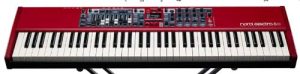
The Nord Electro 6D 61 is a completely different instrument.
It has:
- 61 keys
- Semi-weighted waterfall action
- Physical drawbars
- Organ engine
- Piano engine
- Sample synth capability
It weighs only about 8.1 kg.
This makes it dramatically easier to transport than the Grand 2 or Stage 4 88.
Why Waterfall Keys?
Waterfall-style keys are particularly popular with organ players.
Their shape and lighter action are better suited to techniques such as:
- Fast organ runs
- Glissandos
- Palm smears
- Rapid chord changes
They are not designed to imitate the heavy action of an acoustic grand piano.
That is an important distinction.
Organ Section
The Electro 6D includes models based on classic organ types such as:
- Tonewheel organ
- Vox-style organ
- Farfisa-style organ
- Pipe organs
The 6D models also have nine physical drawbars.
For organ players, this matters greatly because it allows real-time control of registration.
Piano Sounds
Although organ is one of the Electro’s biggest strengths, it also accesses Nord’s piano library.
That makes it useful for musicians who need:
- Acoustic piano
- Electric piano
- Organ
in a compact live rig.
Why Gigging Musicians Like It
At approximately 8.1 kg, the Electro 6D 61 is very easy to move compared with many professional 88-key stage pianos.
For musicians carrying their own gear several times per week, that difference becomes important.
A player can arrive at a gig with:
- Electro
- Stand
- Pedals
- Small amplification setup
without transporting an extremely heavy keyboard.
Electro 6D 61 vs Stage 4 88
Choose the Electro if:
- Organ is important.
- You prefer waterfall keys.
- Portability matters greatly.
- You don’t need 88 weighted keys.
- You don’t need a deep synthesizer engine.
Choose the Stage 4 if:
- Piano technique matters more.
- You need 88 weighted keys.
- You want a more powerful synth section.
- You require more sophisticated layering.
Pros
- Extremely portable
- Only around 8.1 kg
- Physical drawbars
- Excellent organ capability
- Nord piano library
- Good electric-piano capability
- Straightforward live controls
Consider Before Buying
61 semi-weighted keys are not ideal for serious classical piano practice.
Best for:
Organists, electric-piano players, gigging musicians and anyone prioritizing portability.
[Check Nord Electro 6D 61 Price on Amazon →]
4. Nord Wave 2 — Best for Synths & Sound Design
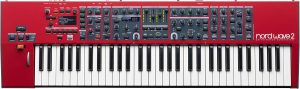
The Nord Wave 2 is the outlier in this list.
It is not primarily a digital piano.
It is a four-part performance synthesizer.
That distinction is crucial.
Four Synth Layers
The Wave 2 provides four independent layers.
Each layer can use different synthesis methods, including:
- Virtual analog
- Wavetable
- FM
- Sample playback
This makes it significantly more flexible for synthesizer programming than a conventional digital piano.
48-Voice Polyphony
The Wave 2 provides 48 voices of polyphony.
For a synthesizer, this supports substantial layering and complex patches.
Remember that synth polyphony should not be directly compared with a digital piano’s 192- or 256-note polyphony.
The instruments are doing different jobs.
Nord Sample Library
The Wave 2 includes 1 GB of memory for Nord Sample Library 3.0 and supports user-replaceable samples.
This lets musicians incorporate sounds such as:
- Strings
- Brass
- Choir
- Acoustic instruments
- Vintage synths
- Custom samples
into layered patches.
Aftertouch
The 61-key semi-weighted keyboard includes aftertouch.
This gives performers additional expression by allowing sound parameters to change according to pressure applied after the key is depressed.
For lead synth sounds, pads and expressive textures, this can be extremely useful.
Who Should Buy the Nord Wave 2?
Consider it if you are:
- A synthesizer player
- Producer
- Sound designer
- Electronic musician
- Touring keyboardist
- Composer
- Worship musician needing complex layered textures
Who Shouldn’t Buy It?
If your main goal is traditional piano practice, don’t choose the Wave 2 simply because it carries the Nord name.
You will be much better served by:
- Nord Grand 2
- Nord Stage 4 88
or potentially a less expensive conventional digital piano from another manufacturer.
Pros
- Four independent synth layers
- Virtual analog synthesis
- FM
- Wavetable
- Sample playback
- 48-voice polyphony
- 1 GB sample memory
- Aftertouch
- Excellent hands-on controls
Consider Before Buying
It is fundamentally a synthesizer, not an acoustic-piano substitute.
Best for:
Synth players, producers and musicians who prioritize sound design and layering.
[Check Nord Wave 2 Price on Amazon →]
Nord Stage 4 vs Nord Grand 2
If you’re deciding between Nord’s two premium 88-key instruments, ask one question:
Are you primarily a pianist or a keyboardist?
Choose Nord Grand 2 If:
- Piano action is your highest priority.
- You mainly play piano and electric piano.
- You want Kawai hammer action.
- Classical and jazz are important.
- You don’t need a full organ engine.
Choose Nord Stage 4 88 If:
- You cover many musical roles.
- You need organ sounds.
- Synthesizers are important.
- You perform live frequently.
- You need sophisticated splits and layers.
Nord Stage 4 vs Electro 6D
The Electro is much lighter and more focused.
Choose Electro if:
- Organ dominates your playing.
- 61 keys are enough.
- Portability is crucial.
- You want physical drawbars.
- You don’t require an advanced synth engine.
Choose Stage 4 if:
- You need the complete package.
- Piano and synth are equally important.
- You want weighted keys.
- You need more complex layers.
Nord Stage 4 vs Wave 2
These overlap in synth capability, but the difference is still clear.
The Stage 4 is a:
piano + organ + synth performance keyboard
The Wave 2 is a:
dedicated performance synthesizer
If you need convincing piano and organ capabilities alongside synths, Stage 4 wins.
If deep sound creation is your main priority, Wave 2 makes more sense.
Does Nord Make a Good Piano for Classical Music?
Yes—but choose carefully.
For classical piano, concentrate on:
Nord Grand 2
or:
Nord Stage 4 88
The Grand 2 is the more obvious piano-focused choice because of its Kawai hammer action.
The Electro 6D and Wave 2 are not designed primarily for classical piano.
Best Digital Pianos for Classical Music Practice
Which Nord Is Best for Jazz?
For jazz piano:
Nord Grand 2
is particularly compelling.
For jazz players who also use:
- Hammond organ
- Rhodes
- Clavinet
- Synths
the Stage 4 88 may be more useful.
For organ-heavy jazz:
Electro 6D 61
becomes particularly attractive.
Which Nord Is Best for Church and Worship Music?
Nord instruments are especially common in modern worship environments.
For maximum flexibility:
Stage 4 88
For piano + pads:
Grand 2
For organ and electric-piano roles:
Electro 6D
For atmospheric synth layers:
Wave 2
Different players in the same worship band might reasonably choose different Nord instruments.
Which Nord Is Best for Studio Recording?
Again, it depends on the role.
Piano-focused recording:
Grand 2
Multi-keyboard recording:
Stage 4
Vintage organ/electric piano:
Electro 6D
Synth programming:
Wave 2
Nord’s strengths in high-quality onboard sounds can also reduce reliance on software instruments in some recording situations.
Are Nord Keyboards Good for Beginners?
They are excellent instruments.
But they are usually not the best value for most beginners.
A beginner primarily needs:
- Good key action
- Reliable piano sound
- Sustain pedal
- Headphone output
- 88 keys for serious piano study
You don’t necessarily need the Stage 4’s three synth layers, organ engine and professional effects.
For beginners, instruments such as:
- Yamaha P-225
- Roland FP-10
- Roland FP-30X
- Kawai ES120
can provide excellent foundations at significantly lower prices.
Best Digital Pianos for Beginners in 2026: 7 Top Picks for Learning Piano
Are Nord Keyboards Worth the Money?
For the right musician, yes.
For the wrong musician, no.
Nord’s premium pricing makes sense when you need:
- Professional live reliability
- Rapid sound switching
- High-quality piano libraries
- Organ modeling
- Layering
- Hands-on controls
- Synth engines
- Professional performance features
If all you need is one good acoustic-piano sound for home practice, you may be paying for a great deal of functionality you will never use.
Why Do Professional Musicians Use Nord?
Three reasons stand out.
1. Fast Live Workflow
Controls are accessible.
You don’t need to spend your entire performance navigating menus.
2. Wide Range of Professional Sounds
One keyboard can cover:
- Grand piano
- Upright piano
- Rhodes-style electric piano
- Wurlitzer-style electric piano
- Organ
- Strings
- Synth pads
- Leads
3. Consistency
Touring musicians may encounter rented Nord instruments at venues and know roughly how to work with them.
That familiarity is valuable on the road.
Does Nord Have Built-In Speakers?
Many major Nord stage-oriented models do not include built-in speakers.
That is deliberate.
Professional performers typically connect their keyboards to:
- PA systems
- Stage monitors
- Keyboard amplifiers
- Studio monitors
If you’re buying a Nord primarily for home use, remember to budget for amplification or headphones where needed.
Nord vs Yamaha
Yamaha has a much broader product range.
You can buy Yamaha instruments suitable for:
- Children
- Beginners
- Home pianists
- Concert pianists
- Stage musicians
Nord is more specialized toward professional electronic keyboard performance.
For a beginner pianist:
Yamaha often makes more sense.
For a professional multi-keyboard performer:
Nord may be more attractive.
Nord vs Roland
Roland also has deep expertise in digital keyboard technology.
Roland offers:
- Beginner digital pianos
- Home digital pianos
- Stage instruments
- Synthesizers
Nord’s particular strength is its highly performance-oriented interface and sound-library ecosystem.
Roland can offer broader price ranges and sophisticated piano modeling.
Neither brand is universally better.
Nord vs Kawai
Kawai is primarily piano-focused.
If your main goal is reproducing an acoustic-piano playing experience, a Kawai digital piano may offer better value.
If you need:
- Organ
- Synth
- Layers
- Professional stage control
Nord becomes more compelling.
Which Nord Should You Buy?
Here’s the simplest answer.
You Mainly Play Piano
Choose:
Nord Grand 2
You Play Piano, Organ AND Synths
Choose:
Nord Stage 4 88
You’re Mainly an Organ/Electric Piano Player
Choose:
Nord Electro 6D 61
You’re Mainly a Synth Player
Choose:
Nord Wave 2
That is a much more useful way to choose Nord than simply buying whichever one has the highest price.
Frequently Asked Questions
What is the best Nord keyboard in 2026?
For overall versatility, our choice is the Nord Stage 4 88.
It combines 88 weighted keys with piano, organ and synth engines.
Which Nord is best for piano?
The Nord Grand 2.
Its Kawai Responsive Hammer keyboard with triple sensors makes it especially attractive to serious pianists.
Which Nord is best for live performance?
For a keyboardist who covers multiple musical roles, the Stage 4 88 is our strongest overall recommendation.
Which Nord is best for organ?
The Electro 6D 61 is particularly strong because of its waterfall action, organ models and physical drawbars.
Which Nord is best for synthesizers?
The Wave 2 is the specialist choice.
Its four-layer architecture supports virtual analog, wavetable, FM and sample-based synthesis.
Is the Nord Stage 4 good for classical piano?
Yes.
Its 88-key triple-sensor hammer action makes it suitable for serious piano playing.
However, the Grand 2’s Kawai action may appeal more to players whose primary focus is acoustic-style piano performance.
Does the Nord Grand 2 have weighted keys?
Yes.
It uses an 88-key Kawai Responsive Hammer keyboard with triple sensors.
Does the Electro 6D have weighted keys?
The Electro 6D 61 has a semi-weighted waterfall action rather than a piano-style hammer action.
Is Nord good for beginners?
Nord instruments are high-quality, but most beginners can get everything they need for piano learning from significantly less expensive digital pianos.
Why are Nord keyboards expensive?
Their pricing reflects professional sound libraries, performance controls, high-quality keybeds, hardware construction, effects, layering and live-oriented functionality.
Final Verdict: Which Nord Keyboard Is Best?
Best Overall — Nord Stage 4 88
The most complete choice for professional musicians who need piano, organ and synth sounds in one instrument.
[Check Nord Stage 4 88 Price on Amazon →]
Best for Serious Pianists — Nord Grand 2
Choose it if keyboard feel and piano performance matter more than having a full organ and synth workstation.
[Check Nord Grand 2 Price on Amazon →]
Best for Organ & Lightweight Gigging — Nord Electro 6D 61
Its 61-key waterfall action, physical drawbars and approximately 8.1 kg weight make it an excellent gigging instrument for organ and electric-piano players.
[Check Nord Electro 6D 61 Price on Amazon →]
Best for Synths — Nord Wave 2
The strongest choice here for sound designers, synth performers and musicians who need extensive layering.
[Check Nord Wave 2 Price on Amazon →]
Final Thoughts
Nord does not really make one keyboard for everybody.
That is part of the brand’s strength.
The Grand 2 is built around the pianist.
The Electro 6D is built around organ, electric piano and portability.
The Wave 2 is built around synthesis.
And the Stage 4 88 attempts to combine most of those professional performance roles into a single flagship instrument.
So the right question isn’t:
“Which Nord keyboard is the best?”
It is:
“Which Nord is designed for the kind of musician I am?”
Once you answer that, the choice becomes much easier.
Related articles:
Nord keyboards are easy to recognize.
Their bright red cabinets have become a familiar sight on concert stages, in churches, recording studios and touring rigs around the world.
But choosing a Nord is not as simple as choosing the most expensive model.
The Nord Stage 4, Nord Grand 2, Nord Electro 6D and Nord Wave 2 are all professional-quality instruments, yet they are designed for very different musicians.
A pianist who primarily wants an expressive acoustic-piano experience has different needs from an organ player.
A keyboardist covering piano, organ and synthesizer sounds in a live band needs something different again.
And a sound designer may care much more about synthesis and layering than realistic piano action.
For 2026, our four Nord recommendations are:
- Nord Stage 4 88 — Best Overall Nord Keyboard
- Nord Grand 2 — Best Nord for Serious Pianists
- Nord Electro 6D 61 — Best for Organ, Electric Piano & Lightweight Gigging
- Nord Wave 2 — Best Nord for Synths & Sound Design
Rather than ranking them simply from best to worst, this guide explains which Nord keyboard is best for the way you actually make music.
Disclosure: Some links on Pianos-Galore are affiliate links. If you purchase through these links, we may receive a small commission at no additional cost to you.
Best Nord Keyboards at a Glance
| Model | Keys | Action | Best For |
|---|---|---|---|
| Nord Stage 4 88 | 88 | Triple-Sensor Hammer Action | Professional All-Round Performance |
| Nord Grand 2 | 88 | Kawai Responsive Hammer, Triple Sensor | Serious Piano Playing |
| Nord Electro 6D 61 | 61 | Semi-Weighted Waterfall | Organ, Electric Piano & Gigging |
| Nord Wave 2 | 61 | Semi-Weighted with Aftertouch | Synths, Layers & Sound Design |
The important thing to understand immediately is that these are not four versions of the same keyboard.
They are four very different tools.
What Makes Nord Different?
Nord is not primarily trying to compete with beginner digital-piano brands.
Its instruments are aimed largely at:
- Professional musicians
- Gigging keyboardists
- Touring players
- Worship musicians
- Studio musicians
- Advanced pianists
- Producers
- Sound designers
Several characteristics define the Nord approach.
1. Hands-On Controls
Nord keyboards generally avoid burying important functions inside complicated menus.
Instead, players often get direct access to:
- Piano sections
- Organ controls
- Synth controls
- Effects
- Layers
- Splits
- Drawbars
- Morph functions
- Performance settings
That matters on stage.
A performer often needs to change a sound in seconds, not navigate several menu pages.
2. Replaceable Sound Libraries
Nord users can download and replace sounds using Nord’s software ecosystem.
Depending on the instrument, this can include:
- Acoustic pianos
- Upright pianos
- Electric pianos
- Clavinets
- Synth samples
- Orchestral sounds
- Choirs
- Strings
- Vintage keyboards
This gives Nord instruments unusually long useful lives.
Instead of being permanently locked to the factory sounds, users can update and reorganize the instrument’s library.
3. Performance-Oriented Design
Nord instruments are designed with live use in mind.
Typical strengths include:
- Quick splits and layers
- Seamless sound changes
- Dedicated effects
- Physical controls
- MIDI
- Professional audio outputs
- Lightweight designs relative to many traditional stage pianos
This helps explain why Nord keyboards appear so often in professional performance environments.
4. Premium Pricing
Nord keyboards are not budget instruments.
You are paying for:
- Premium sound libraries
- Performance flexibility
- High-quality hardware
- Stage-oriented controls
- Professional connectivity
- Continued software and library support
That means a Nord is not automatically the sensible choice for a beginner who simply wants to learn piano.
For many beginners, a Yamaha P-225, Roland FP-30X, Kawai ES120 or similar digital piano may offer much better value.
Nord makes the most sense when you understand why you need Nord’s particular strengths.
1. Nord Stage 4 88 — Best Overall Nord Keyboard
The Nord Stage 4 88 is the most complete instrument in this group.
It combines three major keyboard worlds inside one performance instrument:
- Piano
- Organ
- Synthesizer
That is what makes the Stage series so attractive to working keyboardists.
Keyboard
The Stage 4 88 uses an:
88-key Triple Sensor Hammer Action keyboard with aftertouch
This gives pianists a weighted action while retaining extensive control over synthesizer and performance functions.
Aftertouch is especially useful when playing synths because you can alter parameters by applying additional pressure after the note has already been pressed.
Piano Section
The Stage 4 gives access to Nord’s piano library and supports multiple piano layers.
Depending on installed sounds, users can work with:
- Acoustic grands
- Uprights
- Electric pianos
- Clavinets
- Digital piano sounds
For live performers who regularly switch between acoustic piano and electric piano, this is a major strength.
Organ Section
Nord has long been respected for its organ emulations.
The Stage 4 includes organ models and, importantly for traditional organ players, physical drawbars with LED indicators.
This is much more intuitive than adjusting organ registrations through a touchscreen.
Synth Section
The Stage 4 incorporates technology based on Nord’s Wave 2 synth engine.
It provides three independent synth layers, allowing sophisticated combinations of:
- Virtual analog sounds
- Samples
- Wavetables
- FM-style sounds
This transforms the Stage 4 from a premium digital piano into a much broader professional performance workstation.
Layering
One of the Stage 4’s biggest strengths is how easily multiple sounds can be combined.
You might create a performance containing:
- Acoustic piano
- Strings
- Synth pad
or:
- Hammond-style organ
- Synth bass
- Lead synth
Dedicated LED faders make the layers easier to control in real time.
Effects
Each layer can have its own effect processing.
This is important because professional players don’t always want the same chorus, delay or reverb applied to every sound.
The Stage 4 provides extensive control over:
- Reverb
- Delay
- Modulation
- Amp simulation
- Compression
- Equalization
- Rotary speaker effects
Who Should Buy the Nord Stage 4 88?
The Stage 4 88 is ideal for:
- Professional keyboardists
- Touring musicians
- Church/worship players
- Musical theater musicians
- Cover-band keyboardists
- Studio professionals
- Players requiring piano, organ and synth sounds from one instrument
Who Shouldn’t Buy It?
If you only want to practice acoustic piano at home, much of the Stage 4’s capability may be unnecessary.
A piano-focused instrument could be less expensive and simpler.
Pros
- Excellent all-round professional instrument
- 88 weighted keys
- Triple sensors
- Aftertouch
- Piano, organ and synth engines
- Three synth layers
- Extensive effects
- Excellent live controls
- Professional connectivity
Consider Before Buying
It is expensive and may be excessive for someone who primarily plays acoustic piano at home.
Best for:
Professional performers who need one keyboard to cover piano, organ and synth duties.
For players who need piano, organ and synthesizer capabilities in one professional instrument, our detailed Nord St
age 4 review takes a closer look at its three sound engines, keyboard options, layering features and live-performance controls.
[Check Nord Stage 4 88 Price on Amazon →]
2. Nord Grand 2 — Best Nord for Serious Pianists
The Nord Grand 2 has a much clearer mission.
This is the Nord to consider when piano playing comes first.
Nord uses a premium Kawai hammer-action keyboard in the Grand 2.
Specifically, it has:
- 88 keys
- Kawai Responsive Hammer action
- Triple sensors
The emphasis is therefore on creating a more piano-like playing experience.
Why the Kawai Action Matters
Kawai is one of the world’s major acoustic and digital piano manufacturers.
Its involvement in the Grand 2 gives Nord access to an action developed by a company with deep piano-building expertise.
Triple sensors improve note detection, especially during fast repetitions.
That makes the Grand 2 particularly interesting for:
- Classical pianists
- Jazz pianists
- Session players
- Accompanists
- Advanced home pianists
- Musicians who spend most of their time on piano sounds
Dual Piano Layers
The Grand 2 supports two independent piano layers.
This allows combinations such as:
- Grand piano + upright
- Acoustic piano + electric piano
- Two electric pianos
You can blend or split these sounds depending on the performance.
Dual Synth Layers
Nord also gives the Grand 2 two sample-synth layers.
That means it isn’t restricted to pure piano playing.
You could combine:
- Piano + strings
- Piano + choir
- Piano + synth pad
- Electric piano + ambient texture
This gives performers considerable flexibility without turning the Grand 2 into a full Stage 4-style workstation.
Nord Triple Pedal 2
The Grand 2 includes Nord’s Triple Pedal 2.
This is significant for serious pianists because pedal response is a major part of expressive playing.
It provides a more traditional three-pedal setup instead of requiring the pianist to rely solely on a simple sustain switch.
Weight and Portability
The Grand 2 weighs approximately 21.3 kg.
That is portable compared with a console piano, but it is not something most people will casually carry under one arm.
It is better thought of as a professional transportable piano.
Grand 2 vs Stage 4 88
This is one of the most important Nord comparisons.
Choose the Stage 4 88 If:
- You need organ.
- You need deep synth capabilities.
- You perform many styles.
- Live versatility is essential.
- You want extensive splits and layers.
Choose the Grand 2 If:
- Piano feel matters most.
- You mainly play piano and electric piano.
- You want a Kawai hammer action.
- You still want layering capabilities.
- You don’t need the Stage 4’s full organ/synth architecture.
In simple terms:
Stage 4 88 = professional keyboardist
Grand 2 = professional pianist
Pros
- Premium Kawai hammer action
- Triple sensors
- Two piano layers
- Two synth layers
- Excellent Nord piano library
- Nord Triple Pedal 2 included
- Strong piano-focused performance design
Consider Before Buying
It lacks the Stage 4’s full organ and synth capabilities and is relatively heavy.
Best for:
Serious pianists who want Nord sounds with a premium piano-oriented action.
[Check Nord Grand 2 Price on Amazon →]
3. Nord Electro 6D 61 — Best for Organ, Electric Piano & Lightweight Gigging
The Nord Electro 6D 61 is a completely different instrument.
It has:
- 61 keys
- Semi-weighted waterfall action
- Physical drawbars
- Organ engine
- Piano engine
- Sample synth capability
It weighs only about 8.1 kg.
This makes it dramatically easier to transport than the Grand 2 or Stage 4 88.
Why Waterfall Keys?
Waterfall-style keys are particularly popular with organ players.
Their shape and lighter action are better suited to techniques such as:
- Fast organ runs
- Glissandos
- Palm smears
- Rapid chord changes
They are not designed to imitate the heavy action of an acoustic grand piano.
That is an important distinction.
Organ Section
The Electro 6D includes models based on classic organ types such as:
- Tonewheel organ
- Vox-style organ
- Farfisa-style organ
- Pipe organs
The 6D models also have nine physical drawbars.
For organ players, this matters greatly because it allows real-time control of registration.
Piano Sounds
Although organ is one of the Electro’s biggest strengths, it also accesses Nord’s piano library.
That makes it useful for musicians who need:
- Acoustic piano
- Electric piano
- Organ
in a compact live rig.
Why Gigging Musicians Like It
At approximately 8.1 kg, the Electro 6D 61 is very easy to move compared with many professional 88-key stage pianos.
For musicians carrying their own gear several times per week, that difference becomes important.
A player can arrive at a gig with:
- Electro
- Stand
- Pedals
- Small amplification setup
without transporting an extremely heavy keyboard.
Electro 6D 61 vs Stage 4 88
Choose the Electro if:
- Organ is important.
- You prefer waterfall keys.
- Portability matters greatly.
- You don’t need 88 weighted keys.
- You don’t need a deep synthesizer engine.
Choose the Stage 4 if:
- Piano technique matters more.
- You need 88 weighted keys.
- You want a more powerful synth section.
- You require more sophisticated layering.
Pros
- Extremely portable
- Only around 8.1 kg
- Physical drawbars
- Excellent organ capability
- Nord piano library
- Good electric-piano capability
- Straightforward live controls
Consider Before Buying
61 semi-weighted keys are not ideal for serious classical piano practice.
Best for:
Organists, electric-piano players, gigging musicians and anyone prioritizing portability.
[Check Nord Electro 6D 61 Price on Amazon →]
4. Nord Wave 2 — Best for Synths & Sound Design
The Nord Wave 2 is the outlier in this list.
It is not primarily a digital piano.
It is a four-part performance synthesizer.
That distinction is crucial.
Four Synth Layers
The Wave 2 provides four independent layers.
Each layer can use different synthesis methods, including:
- Virtual analog
- Wavetable
- FM
- Sample playback
This makes it significantly more flexible for synthesizer programming than a conventional digital piano.
48-Voice Polyphony
The Wave 2 provides 48 voices of polyphony.
For a synthesizer, this supports substantial layering and complex patches.
Remember that synth polyphony should not be directly compared with a digital piano’s 192- or 256-note polyphony.
The instruments are doing different jobs.
Nord Sample Library
The Wave 2 includes 1 GB of memory for Nord Sample Library 3.0 and supports user-replaceable samples.
This lets musicians incorporate sounds such as:
- Strings
- Brass
- Choir
- Acoustic instruments
- Vintage synths
- Custom samples
into layered patches.
Aftertouch
The 61-key semi-weighted keyboard includes aftertouch.
This gives performers additional expression by allowing sound parameters to change according to pressure applied after the key is depressed.
For lead synth sounds, pads and expressive textures, this can be extremely useful.
Who Should Buy the Nord Wave 2?
Consider it if you are:
- A synthesizer player
- Producer
- Sound designer
- Electronic musician
- Touring keyboardist
- Composer
- Worship musician needing complex layered textures
Who Shouldn’t Buy It?
If your main goal is traditional piano practice, don’t choose the Wave 2 simply because it carries the Nord name.
You will be much better served by:
- Nord Grand 2
- Nord Stage 4 88
or potentially a less expensive conventional digital piano from another manufacturer.
Pros
- Four independent synth layers
- Virtual analog synthesis
- FM
- Wavetable
- Sample playback
- 48-voice polyphony
- 1 GB sample memory
- Aftertouch
- Excellent hands-on controls
Consider Before Buying
It is fundamentally a synthesizer, not an acoustic-piano substitute.
Best for:
Synth players, producers and musicians who prioritize sound design and layering.
[Check Nord Wave 2 Price on Amazon →]
Nord Stage 4 vs Nord Grand 2
If you’re deciding between Nord’s two premium 88-key instruments, ask one question:
Are you primarily a pianist or a keyboardist?
Choose Nord Grand 2 If:
- Piano action is your highest priority.
- You mainly play piano and electric piano.
- You want Kawai hammer action.
- Classical and jazz are important.
- You don’t need a full organ engine.
Choose Nord Stage 4 88 If:
- You cover many musical roles.
- You need organ sounds.
- Synthesizers are important.
- You perform live frequently.
- You need sophisticated splits and layers.
Nord Stage 4 vs Electro 6D
The Electro is much lighter and more focused.
Choose Electro if:
- Organ dominates your playing.
- 61 keys are enough.
- Portability is crucial.
- You want physical drawbars.
- You don’t require an advanced synth engine.
Choose Stage 4 if:
- You need the complete package.
- Piano and synth are equally important.
- You want weighted keys.
- You need more complex layers.
Nord Stage 4 vs Wave 2
These overlap in synth capability, but the difference is still clear.
The Stage 4 is a:
piano + organ + synth performance keyboard
The Wave 2 is a:
dedicated performance synthesizer
If you need convincing piano and organ capabilities alongside synths, Stage 4 wins.
If deep sound creation is your main priority, Wave 2 makes more sense.
Does Nord Make a Good Piano for Classical Music?
Yes—but choose carefully.
For classical piano, concentrate on:
Nord Grand 2
or:
Nord Stage 4 88
The Grand 2 is the more obvious piano-focused choice because of its Kawai hammer action.
The Electro 6D and Wave 2 are not designed primarily for classical piano.
Best Digital Pianos for Classical Music Practice
Which Nord Is Best for Jazz?
For jazz piano:
Nord Grand 2
is particularly compelling.
For jazz players who also use:
- Hammond organ
- Rhodes
- Clavinet
- Synths
the Stage 4 88 may be more useful.
For organ-heavy jazz:
Electro 6D 61
becomes particularly attractive.
Which Nord Is Best for Church and Worship Music?
Nord instruments are especially common in modern worship environments.
For maximum flexibility:
Stage 4 88
For piano + pads:
Grand 2
For organ and electric-piano roles:
Electro 6D
For atmospheric synth layers:
Wave 2
Different players in the same worship band might reasonably choose different Nord instruments.
Which Nord Is Best for Studio Recording?
Again, it depends on the role.
Piano-focused recording:
Grand 2
Multi-keyboard recording:
Stage 4
Vintage organ/electric piano:
Electro 6D
Synth programming:
Wave 2
Nord’s strengths in high-quality onboard sounds can also reduce reliance on software instruments in some recording situations.
Are Nord Keyboards Good for Beginners?
They are excellent instruments.
But they are usually not the best value for most beginners.
A beginner primarily needs:
- Good key action
- Reliable piano sound
- Sustain pedal
- Headphone output
- 88 keys for serious piano study
You don’t necessarily need the Stage 4’s three synth layers, organ engine and professional effects.
For beginners, instruments such as:
- Yamaha P-225
- Roland FP-10
- Roland FP-30X
- Kawai ES120
can provide excellent foundations at significantly lower prices.
Best Digital Pianos for Beginners in 2026: 7 Top Picks for Learning Piano
Are Nord Keyboards Worth the Money?
For the right musician, yes.
For the wrong musician, no.
Nord’s premium pricing makes sense when you need:
- Professional live reliability
- Rapid sound switching
- High-quality piano libraries
- Organ modeling
- Layering
- Hands-on controls
- Synth engines
- Professional performance features
If all you need is one good acoustic-piano sound for home practice, you may be paying for a great deal of functionality you will never use.
Why Do Professional Musicians Use Nord?
Three reasons stand out.
1. Fast Live Workflow
Controls are accessible.
You don’t need to spend your entire performance navigating menus.
2. Wide Range of Professional Sounds
One keyboard can cover:
- Grand piano
- Upright piano
- Rhodes-style electric piano
- Wurlitzer-style electric piano
- Organ
- Strings
- Synth pads
- Leads
3. Consistency
Touring musicians may encounter rented Nord instruments at venues and know roughly how to work with them.
That familiarity is valuable on the road.
Does Nord Have Built-In Speakers?
Many major Nord stage-oriented models do not include built-in speakers.
That is deliberate.
Professional performers typically connect their keyboards to:
- PA systems
- Stage monitors
- Keyboard amplifiers
- Studio monitors
If you’re buying a Nord primarily for home use, remember to budget for amplification or headphones where needed.
Nord vs Yamaha
Yamaha has a much broader product range.
You can buy Yamaha instruments suitable for:
- Children
- Beginners
- Home pianists
- Concert pianists
- Stage musicians
Nord is more specialized toward professional electronic keyboard performance.
For a beginner pianist:
Yamaha often makes more sense.
For a professional multi-keyboard performer:
Nord may be more attractive.
Nord vs Roland
Roland also has deep expertise in digital keyboard technology.
Roland offers:
- Beginner digital pianos
- Home digital pianos
- Stage instruments
- Synthesizers
Nord’s particular strength is its highly performance-oriented interface and sound-library ecosystem.
Roland can offer broader price ranges and sophisticated piano modeling.
Neither brand is universally better.
Nord vs Kawai
Kawai is primarily piano-focused.
If your main goal is reproducing an acoustic-piano playing experience, a Kawai digital piano may offer better value.
If you need:
- Organ
- Synth
- Layers
- Professional stage control
Nord becomes more compelling.
Which Nord Should You Buy?
Here’s the simplest answer.
You Mainly Play Piano
Choose:
Nord Grand 2
You Play Piano, Organ AND Synths
Choose:
Nord Stage 4 88
You’re Mainly an Organ/Electric Piano Player
Choose:
Nord Electro 6D 61
You’re Mainly a Synth Player
Choose:
Nord Wave 2
That is a much more useful way to choose Nord than simply buying whichever one has the highest price.
Frequently Asked Questions
What is the best Nord keyboard in 2026?
For overall versatility, our choice is the Nord Stage 4 88.
It combines 88 weighted keys with piano, organ and synth engines.
Which Nord is best for piano?
The Nord Grand 2.
Its Kawai Responsive Hammer keyboard with triple sensors makes it especially attractive to serious pianists.
Which Nord is best for live performance?
For a keyboardist who covers multiple musical roles, the Stage 4 88 is our strongest overall recommendation.
Which Nord is best for organ?
The Electro 6D 61 is particularly strong because of its waterfall action, organ models and physical drawbars.
Which Nord is best for synthesizers?
The Wave 2 is the specialist choice.
Its four-layer architecture supports virtual analog, wavetable, FM and sample-based synthesis.
Is the Nord Stage 4 good for classical piano?
Yes.
Its 88-key triple-sensor hammer action makes it suitable for serious piano playing.
However, the Grand 2’s Kawai action may appeal more to players whose primary focus is acoustic-style piano performance.
Does the Nord Grand 2 have weighted keys?
Yes.
It uses an 88-key Kawai Responsive Hammer keyboard with triple sensors.
Does the Electro 6D have weighted keys?
The Electro 6D 61 has a semi-weighted waterfall action rather than a piano-style hammer action.
Is Nord good for beginners?
Nord instruments are high-quality, but most beginners can get everything they need for piano learning from significantly less expensive digital pianos.
Why are Nord keyboards expensive?
Their pricing reflects professional sound libraries, performance controls, high-quality keybeds, hardware construction, effects, layering and live-oriented functionality.
Final Verdict: Which Nord Keyboard Is Best?
Best Overall — Nord Stage 4 88
The most complete choice for professional musicians who need piano, organ and synth sounds in one instrument.
[Check Nord Stage 4 88 Price on Amazon →]
Best for Serious Pianists — Nord Grand 2
Choose it if keyboard feel and piano performance matter more than having a full organ and synth workstation.
[Check Nord Grand 2 Price on Amazon →]
Best for Organ & Lightweight Gigging — Nord Electro 6D 61
Its 61-key waterfall action, physical drawbars and approximately 8.1 kg weight make it an excellent gigging instrument for organ and electric-piano players.
[Check Nord Electro 6D 61 Price on Amazon →]
Best for Synths — Nord Wave 2
The strongest choice here for sound designers, synth performers and musicians who need extensive layering.
[Check Nord Wave 2 Price on Amazon →]
Final Thoughts
Nord does not really make one keyboard for everybody.
That is part of the brand’s strength.
The Grand 2 is built around the pianist.
The Electro 6D is built around organ, electric piano and portability.
The Wave 2 is built around synthesis.
And the Stage 4 88 attempts to combine most of those professional performance roles into a single flagship instrument.
So the right question isn’t:
“Which Nord keyboard is the best?”
It is:
“Which Nord is designed for the kind of musician I am?”
Once you answer that, the choice becomes much easier.