Best Casio Keyboards for Home Use in 2026: 4 Top Picks
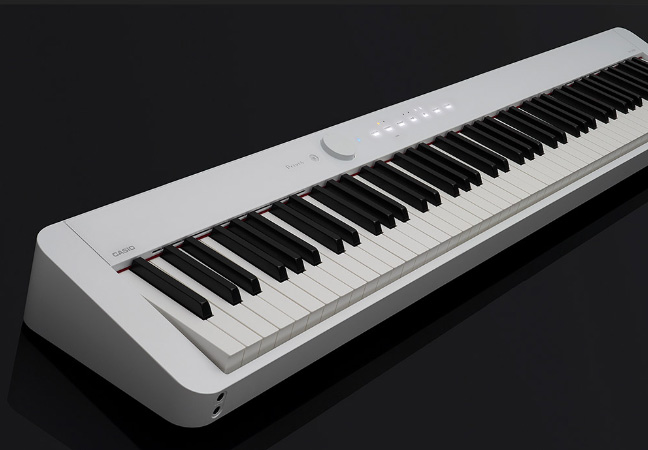
A home keyboard has to do more than simply sound good.
It needs to fit your available space, suit the person who will actually play it, remain easy to use, and ideally continue to be useful as the player’s skills improve.
That is one reason Casio remains such a practical brand for home musicians.
Its range stretches from compact 61-key keyboards for beginners and families to slim 88-key digital pianos with hammer-action keyboards designed for serious piano practice.
For 2026, our four favorite Casio choices for home use are:
- Casio CT-S300 — Best Budget Home Keyboard
- Casio CDP-S160 — Best Affordable 88-Key Home Piano
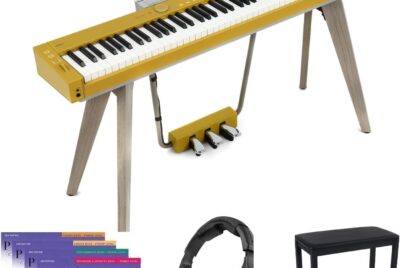
- Casio Privia PX-S1100 — Best Overall Casio for Home Use
- Casio Privia PX-S5000 — Best Premium Home Piano
These four models serve very different households.
The CT-S300 is ideal for a child, beginner or casual player.
The CDP-S160 is a better starting point for someone taking traditional piano lessons.
The PX-S1100 is our strongest all-round choice for most home pianists.
And the PX-S5000 is aimed at more experienced players who want a more sophisticated keyboard action without installing a large console piano.
This guide will help you decide which one best fits your home, skill level and musical goals.
Disclosure: Some links on Pianos-Galore are affiliate links. If you purchase through these links, we may receive a small commission at no additional cost to you.
Best Casio Keyboards for Home Use at a Glance
| Model | Keys | Action | Best For |
|---|---|---|---|
| Casio CT-S300 | 61 | Touch-sensitive | Kids, Beginners & Casual Use |
| Casio CDP-S160 | 88 | Scaled Hammer Action Keyboard II | Piano Students |
| Casio PX-S1100 | 88 | Smart Scaled Hammer Action | Most Home Pianists |
| Casio PX-S5000 | 88 | Smart Hybrid Hammer Action | Serious/Advanced Home Players |
The biggest question is therefore not simply:
“Which Casio is best?”
It is:
“What kind of playing will happen in your home?”
What Makes a Good Keyboard for Home Use?
A home instrument has different priorities from a stage keyboard.
Professional performers may prioritize:
- Audio outputs
- Splits and layers
- Rapid sound switching
- MIDI control
- Rugged touring construction
At home, you are more likely to care about:
- Size
- Noise control
- Headphones
- Ease of use
- Appearance
- Built-in speakers
- Keyboard action
- Price
- Whether the instrument can grow with the player
That makes the ideal home keyboard a balance between musical quality and practicality.
1. Casio CT-S300 — Best Budget Home Keyboard
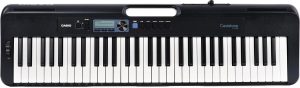
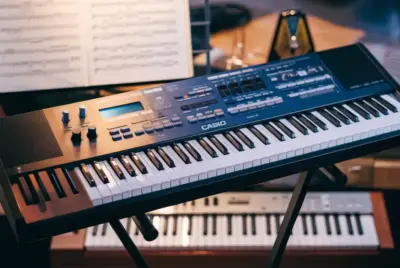
The Casio CT-S300 is one of the easiest Casio keyboards to recommend for families and first-time players.
It has:
- 61 full-size keys
- Touch response
- 400 tones
- 77 rhythms
- 60 built-in songs
- Dance Music Mode
- Pitch-bend wheel
- USB connectivity
- Built-in speakers
- Battery operation
It weighs only about 3.3 kg, making it extremely easy to move from one room to another.
Why It Works Well at Home
The CT-S300 has several advantages for casual home use.
First, it doesn’t need a permanent location.
You can place it on a stand when someone wants to practice, then move it out of the way when necessary.
Second, battery operation means you don’t always need to position it near an electrical outlet.
Third, the large selection of tones and rhythms makes it more entertaining for beginners who want to explore music beyond acoustic piano.
A child can experiment with:
- Piano
- Organ
- Strings
- Brass
- Synth sounds
- Drums
- Accompaniment rhythms
That kind of variety can make early music exploration much more engaging.
Touch Sensitivity Matters
One important feature is touch response.
If the player presses the keys gently, notes can sound softer.
Play more strongly and the notes become louder.
That is important because musical dynamics are a fundamental part of expressive playing.
For a beginner keyboard, I would strongly prefer touch sensitivity over a model where every note plays at nearly the same volume regardless of touch.
Who Is the CT-S300 Best For?
It is especially suitable for:
- Children
- First-time beginners
- Casual adult players
- Families sharing a keyboard
- Small homes
- People unsure whether they will pursue piano seriously
Where It Falls Short
The main limitation is that the CT-S300 is not a full piano substitute.
It has:
- 61 keys rather than 88
- A lightweight keyboard rather than hammer action
For basic learning, popular music and casual playing, that may be perfectly acceptable.
For serious traditional piano lessons, however, I would consider the CDP-S160 instead.
Pros
- Affordable
- 61 touch-sensitive keys
- 400 tones
- 77 rhythms
- Lightweight
- Battery powered
- Compact
- Beginner friendly
Consider Before Buying
A committed piano student may eventually outgrow the 61-key range and light action.
Best for:
Families, children and casual beginners wanting an inexpensive home keyboard.
[Check Casio CT-S300 Price on Amazon →]
2. Casio CDP-S160 — Best Affordable 88-Key Home Piano
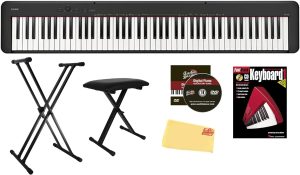
The Casio CDP-S160 moves into a completely different category.
Instead of emphasizing hundreds of sounds and rhythms, it focuses more directly on traditional piano playing.
It provides:
- 88 keys
- Scaled Hammer Action Keyboard II
- Three touch-sensitivity settings plus off
- 64-note polyphony
- 10 tones
- Layer mode
- Duet Mode
- MIDI recording
- USB-MIDI
- 8W + 8W speakers
- Optional three-pedal support
- Battery operation
For someone learning piano at home, the combination of 88 keys and hammer action is much more important than having hundreds of tones.
Why 88 Keys Matter
A standard modern acoustic piano has 88 keys.
A 61-key keyboard is perfectly adequate for many beginner exercises and popular songs, but students eventually encounter music requiring greater range.
Starting with 88 keys avoids that limitation.
It also means that the student’s spatial relationship with the keyboard more closely resembles what they will encounter on an acoustic piano.
88 Keys to Mastery: Unlocking the Full Potential of Piano PlayingWhy Hammer Action Matters
Hammer action gives the keys physical resistance designed to imitate aspects of acoustic-piano action.
This helps develop:
- Finger strength
- Dynamic control
- Articulation
- Expressive playing
- Technique that transfers more naturally to acoustic piano
This is why I would choose the CDP-S160 over the CT-S300 for someone who says:
“I’m enrolling in piano lessons and want to learn properly.”
Compact Enough for Home Use
One of the CDP-S160’s major advantages is that it remains relatively shallow despite having 88 hammer-action keys.
It is about 132 cm wide but only around 23 cm deep and weighs approximately 10.5 kg.
That makes it easier to fit into:
- Bedrooms
- Apartments
- Condominiums
- Studies
- Small music rooms
than many traditional console pianos.
Headphones Make Home Practice Easier
A digital piano’s headphone capability is one of its biggest home advantages.
Someone can practice:
- Early in the morning
- Late at night
- While another person watches television
- In an apartment with nearby neighbors
without filling the entire room with sound.
That is a major practical advantage over an acoustic piano.
Pedal Expansion
The CDP-S160 can also support Casio’s optional three-pedal unit.
That gives a developing pianist access to:
- Damper
- Soft
- Sostenuto
pedal functions.
With the compatible pedal setup, half-damper operation is also supported.
That gives the CDP-S160 more room to grow with a student.
Pros
- Full 88-key range
- Hammer-action keyboard
- Compact body
- USB-MIDI
- Recording
- Optional three-pedal setup
- Built-in speakers
- Battery operation
- Strong value
Consider Before Buying
Its 64-note polyphony and 10 tones are relatively modest.
That’s fine for most beginners, but more experienced pianists may prefer the PX-S1100.
Best for:
Piano students who want an affordable full-size home instrument.
[Check Casio CDP-S160 Price on Amazon →]
3. Casio Privia PX-S1100 — Best Overall Casio for Home Use
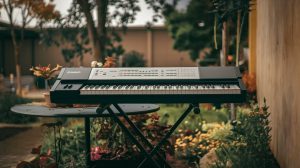
For most home pianists, the Casio Privia PX-S1100 is our strongest overall recommendation.
Why?
Because it combines:
- 88 hammer-action keys
- Good piano-focused sound
- 192-note polyphony
- Compact dimensions
- Built-in speakers
- Headphone practice
- Wireless capability
- Recording
- Optional three-pedal support
without moving into premium pricing.
It is the model in this group that best balances serious piano capability with everyday home practicality.
Smart Scaled Hammer Action
The PX-S1100 uses Casio’s Smart Scaled Hammer Action Keyboard.
Compared with a 61-key portable keyboard, it provides a substantially more piano-like playing experience.
The action is designed with different response characteristics across the keyboard range, helping reproduce some of the graded feel associated with acoustic pianos.
192-Note Polyphony
The PX-S1100 provides 192-note polyphony.
Why does this matter?
When you use the sustain pedal, notes continue sounding after your fingers leave the keys.
More complex repertoire can therefore have many notes sounding simultaneously.
Layering can also consume additional polyphony.
For most home pianists, 192 notes provides plenty of headroom.
Piano Sound
The PX-S1100 uses Casio’s Multi-Dimensional Morphing AiR Sound Source.
Its piano-focused sound system is designed to reproduce more of the tonal changes and resonance behavior associated with acoustic piano playing.
This is one of the areas where moving from a basic beginner instrument to the Privia line becomes noticeable.
Excellent for Apartments and Condominiums
One of Casio’s biggest strengths with the PX-S series is slimness.
The PX-S1100 has a front-to-back depth of only about 232 mm.
That is particularly valuable in modern homes where space is limited.
You can place it:
- Against a wall
- On a portable stand
- On an optional furniture-style stand
- In a bedroom
- In a condominium living room
- In a home studio
without the depth of a traditional upright piano.
Two Headphone Jacks
The PX-S1100 provides two headphone connections.
That can be useful for:
- Student and teacher
- Parent and child
- Duet practice
- Quiet listening together
It is a small feature, but very practical in a home setting.
Wireless Capability
With Casio’s wireless connectivity system, compatible functions include Bluetooth Audio and MIDI.
This can make it easier to work with:
- Smartphones
- Tablets
- Learning applications
- Backing tracks
- Music playback
The PX-S1100 also works with Casio’s Music Space ecosystem.
Who Is the PX-S1100 Best For?
It is especially suitable for:
- Adult beginners
- Intermediate students
- Classical learners
- Families
- Apartment dwellers
- Home pianists
- Players who want a piano that can last beyond the beginner stage
Pros
- 88 hammer-action keys
- 192-note polyphony
- Slim cabinet
- AiR sound engine
- Built-in speakers
- Headphones
- Recording
- Wireless capability
- Optional three-pedal system
- Strong long-term value
Consider Before Buying
Players who are already advanced and highly sensitive to keyboard action may want to consider the PX-S5000.
Best for:
Most home pianists—from committed beginners through intermediate players.
[Check Casio PX-S1100 Price on Amazon →]
Best 88-Key Digital Pianos in 2026: 7 Top Picks for Every Pianist
4. Casio Privia PX-S5000 — Best Premium Home Piano
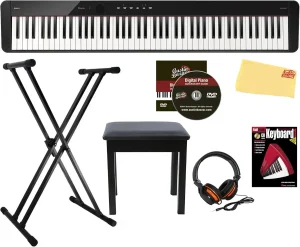
The Casio PX-S5000 is the premium choice in this guide.
Instead of simply adding hundreds of sounds, Casio puts much of the emphasis on the keyboard itself.
Its standout feature is the Smart Hybrid Hammer Action Keyboard.
The white keys use a hybrid construction incorporating spruce wood and resin.
That immediately distinguishes it from the less expensive PX-S1100.
Why Keyboard Action Matters More as You Improve
A complete beginner may not immediately notice subtle differences between digital-piano actions.
An experienced pianist often will.
As technique develops, players become more sensitive to:
- Key resistance
- Repetition
- Weighting
- Dynamic control
- Key return
- Surface texture
- Pedal response
- How easily soft passages can be controlled
This is where a premium action begins to justify its price.
Smart Hybrid Hammer Action
The PX-S5000’s action incorporates:
- 88 keys
- Hybrid wood/resin white-key construction
- Five touch-sensitivity levels
- 88-key digital scaling
- Hammer Response
- Key Off Response
- Key Off Simulator
These technologies are designed to provide more nuanced control over how notes begin and decay.
192-Note Polyphony
Like the PX-S1100, the PX-S5000 provides 192-note polyphony.
That is a useful reminder that premium instruments aren’t always better simply because every number on the specification sheet is larger.
The main reason to buy the PX-S5000 is keyboard quality and expressive control, not polyphony.
23 Tones
The PX-S5000 provides 23 built-in tones.
That may sound modest compared with a portable keyboard offering 600 tones.
But a serious pianist may prefer:
23 carefully selected sounds + premium action
over:
600 sounds + lightweight keys.
The ideal instrument depends on what you actually play.
Home-Friendly Design
Despite its premium action, the PX-S5000 remains only about 232 mm deep.
That makes it particularly appealing to someone who wants:
- Advanced piano capability
- A clean modern appearance
- Limited floor-space requirements
- A piano that doesn’t dominate the room
Paired with an appropriate stand and pedal unit, it can function as a sophisticated home piano while retaining a much lighter visual footprint than many console models.
Who Should Buy the PX-S5000?
Consider it if:
- You’re an intermediate or advanced pianist.
- Keyboard action matters greatly.
- You want a premium instrument for home use.
- You have limited space.
- You don’t necessarily need a large furniture-style digital piano.
- You want a serious instrument that can still be moved.
Pros
- Smart Hybrid Hammer Action
- Wood/resin hybrid white keys
- 88-key digital scaling
- 192-note polyphony
- Premium piano-focused design
- Slim cabinet
- Recording
- Optional three-pedal system
- Suitable for advanced playing
Consider Before Buying
A beginner probably doesn’t need to spend this much.
Its advantages become more meaningful as technique develops.
Best for:
Serious home pianists wanting a more sophisticated action in a compact instrument.
[Check Casio PX-S5000 Price on Amazon →]
CT-S300 vs CDP-S160: Which Is Better at Home?
These two models target very different beginners.
Choose CT-S300 If:
- You’re buying for a child.
- You’re not sure whether piano will become a serious hobby.
- Portability is essential.
- You want many sounds and rhythms.
- Budget is the biggest concern.
Choose CDP-S160 If:
- You’re starting formal piano lessons.
- You want 88 keys.
- You want hammer action.
- Classical music interests you.
- You want to build traditional piano technique.
The CT-S300 is the better general beginner keyboard.
The CDP-S160 is the better beginner piano.
CDP-S160 vs PX-S1100
This is probably the most useful comparison for a home piano student.
Both have:
- 88 keys
- Hammer action
- Built-in speakers
- USB connectivity
- Headphone capability
- Compact bodies
But the PX-S1100 is the more sophisticated instrument.
Choose CDP-S160 If:
- You want to minimize spending.
- You’re at the beginning of piano study.
- You mainly need the fundamentals.
- You don’t care about many extra features.
Choose PX-S1100 If:
- You expect to play for years.
- You’re already committed to learning.
- 192-note polyphony appeals to you.
- Sound refinement matters more.
- Wireless functionality is useful.
- You want greater long-term headroom.
If your budget allows, I would generally choose the PX-S1100 for long-term home ownership.
PX-S1100 vs PX-S5000
This is where the buying decision becomes more subtle.
Both provide:
- 88 keys
- 192-note polyphony
- Slim PX-S construction
- AiR sound technology
- Recording
- Built-in speakers
The key distinction is the keyboard action.
Choose PX-S1100 If:
- You’re a beginner or intermediate player.
- You want the best balance of cost and capability.
- You aren’t yet highly sensitive to action differences.
Choose PX-S5000 If:
- You’re more experienced.
- Touch matters greatly.
- You want hybrid wood/resin white keys.
- You’re prepared to pay for a more refined playing experience.
For most households, the PX-S1100 remains the sweet spot.
Which Casio Is Best for a Child?
For a young beginner, I would start with the CT-S300.
Why?
It is:
- Affordable
- Lightweight
- Touch sensitive
- Compact
- Fun
- Easy to move
- Equipped with rhythms and sounds
If the child develops a serious interest in piano and begins formal lessons, the next step could be an 88-key model such as the CDP-S160 or PX-S1100.
Which Casio Is Best for Adult Beginners?
For an adult who says:
“I definitely want to learn piano.”
I would skip the 61-key stage and start with:
CDP-S160
or preferably:
PX-S1100
if budget allows.
Adults often have a clearer idea whether they intend to continue, so buying an 88-key hammer-action piano from the beginning can make sense.
Which Casio Is Best for Classical Practice?
For classical study, prioritize:
- 88 keys
- Hammer action
- Touch response
- Pedal capability
- Good piano tone
That points toward:
CDP-S160 — beginner/budget
PX-S1100 — beginner/intermediate
PX-S5000 — intermediate/advanced
The CT-S300 can introduce someone to music, but it would not be my long-term recommendation for serious classical study.
Best Digital Pianos for Learning Classical Music in 2026
Which Casio Is Best for a Small Apartment?
All four can work, but two stand out.
Lowest Space Requirement
CT-S300
Its 61-key body is extremely compact and light.
Best Full Piano for Small Spaces
PX-S1100
Its approximately 232 mm depth makes it particularly attractive where floor space is limited.
You get 88 hammer-action keys without installing a bulky console piano.
Which Casio Is Best for Quiet Practice?
All four support headphone use, but for serious piano practice I would choose:
CDP-S160
PX-S1100
or
PX-S5000.
Headphones can make a digital piano far easier to live with in a shared home.
A student can practice for an hour without requiring everyone else in the household to hear scales repeated dozens of times.
Should You Buy a Portable Casio or a Furniture-Style Piano?
For home use, portability isn’t always necessary.
But a portable instrument has advantages.
Portable Setup Advantages
- Easier to move
- Requires less space
- Can be stored
- Easier to relocate
- Often less expensive initially
Furniture-Style Setup Advantages
- More attractive
- More stable
- Permanent pedals
- More piano-like appearance
- Encourages a dedicated practice area
A useful compromise is to buy a portable Privia and add Casio’s compatible stand and three-pedal unit.
That creates a more permanent home-piano setup without sacrificing the option to move the instrument later.
Do You Need 88 Keys at Home?
Not always.
A child or casual player may be perfectly happy with 61 keys.
But if the main purpose is learning traditional piano, I recommend 88 keys whenever practical.
The player won’t use all 88 notes immediately.
That doesn’t matter.
It simply means the instrument won’t become limited as repertoire expands.
Best 88-Key Digital Pianos in 2026: 7 Top Picks for Every Pianist
Weighted Keys vs Touch-Sensitive Keys
This distinction is often misunderstood.
Touch-Sensitive
The keyboard responds to how strongly you play.
Example:
CT-S300
Hammer Action
The keys also provide physical resistance intended to simulate characteristics of acoustic piano action.
Examples:
CDP-S160
PX-S1100
PX-S5000
For traditional piano study, hammer action is preferable.
Weighted Keys: The Foundation of Expressive Piano Performance
How Much Should You Spend on a Home Casio?
Think in terms of commitment rather than simply price.
Exploring Music
Choose the CT-S300.
Beginning Serious Piano Lessons
Choose the CDP-S160.
Committed Beginner or Intermediate Player
Choose the PX-S1100.
Experienced Player Seeking Better Touch
Choose the PX-S5000.
The mistake is either spending far more than you need—or buying so cheaply that you immediately outgrow the instrument.
7 Mistakes to Avoid When Buying a Home Keyboard
1. Choosing Based Only on Price
The cheapest keyboard isn’t automatically the best value.
2. Buying 61 Keys for Long-Term Classical Study
It can work initially, but eventually you’ll want the full piano range.
3. Confusing Touch Sensitivity With Weighted Keys
They are different features.
4. Buying Hundreds of Sounds You Won’t Use
A piano student may use only a handful.
5. Ignoring Headphone Practice
This is one of the biggest advantages of owning a digital instrument at home.
6. Forgetting About Pedals
As playing develops, pedal control becomes essential.
7. Not Planning for Progress
Ask yourself whether the instrument will still suit you in two or three years.
Frequently Asked Questions
What is the best Casio keyboard for home use in 2026?
For most home pianists, our choice is the Casio Privia PX-S1100 because it balances 88 hammer-action keys, 192-note polyphony, compact dimensions and useful modern features.
What is the best inexpensive Casio keyboard for home use?
The CT-S300 is our budget choice.
It offers 61 touch-sensitive keys, 400 tones and 77 rhythms in a lightweight design.
Which Casio is best for learning piano?
For serious learning, start with the CDP-S160 or PX-S1100.
Both provide 88 hammer-action keys.
Is the Casio CT-S300 good for children?
Yes.
Its compact dimensions, light weight, touch response and variety of sounds make it a good introduction to keyboard playing.
Is the CDP-S160 better than the CT-S300?
For traditional piano study, yes.
The CDP-S160 provides 88 hammer-action keys.
For casual playing, portability and musical exploration, the CT-S300 can be more convenient.
Is the PX-S1100 good for intermediate players?
Yes.
Its 88-key hammer action, 192-note polyphony and piano-focused sound make it a strong beginner-to-intermediate instrument.
Is the PX-S5000 worth the extra money?
For experienced players who value keyboard feel, it can be.
Its Smart Hybrid Hammer Action with wood/resin white-key construction is the primary reason to consider it over the PX-S1100.
Which Casio is best for a small apartment?
For casual playing, the CT-S300.
For serious piano playing, the PX-S1100 is one of the strongest compact choices.
Do Casio digital pianos require tuning?
No.
Unlike acoustic pianos, digital pianos don’t have strings that require regular tuning.
Final Recommendations
If you still aren’t sure, here’s the simplest decision guide.
Best Budget Home Keyboard — Casio CT-S300
Best for children, casual players and first-time beginners.
[Check Casio CT-S300 Price on Amazon →]
Best Affordable 88-Key Home Piano — Casio CDP-S160
Best for beginners taking traditional piano lessons.
[Check Casio CDP-S160 Price on Amazon →]
Best Overall Casio for Home Use — Casio PX-S1100
Our preferred choice for most committed beginners and intermediate home pianists.
[Check Casio PX-S1100 Price on Amazon →]
Best Premium Home Choice — Casio PX-S5000
Best for experienced players who want a substantially more sophisticated keyboard action in a compact instrument.
[Check Casio PX-S5000 Price on Amazon →]
Final Verdict
The best Casio for your home depends much more on the player than on the room.
If you’re introducing a child to music, the CT-S300 may be all you need.
If someone is beginning formal piano lessons, the CDP-S160 provides the important transition to 88 hammer-action keys.
If you want an instrument capable of serving a committed pianist for years, the PX-S1100 is our sweet-spot recommendation.
And if you’re an experienced pianist who values keyboard response enough to pay for a more sophisticated action, the PX-S5000 becomes the more compelling choice.
The key is not to buy the Casio with the most features.
Buy the Casio that matches how seriously you play, how much space you have, and how long you expect the instrument to serve you. For players who specifically want an 88-key hammer-action instrument, see our Best Casio Digital Pianos with Weighted Keys in 2026: 5 Models Compared.Related reading materials:
Want a great piano learning app? Try SIMPLY PIANO, the #1 piano learning app…
- Take advantage of step-by-step tutorials ideal for beginners. Advanced courses available for skilled players.
- Progress at your own pace through personalized lessons and receive instant feedback.
- Play various music genres, including classical, pop, and Disney favorites. Enhance your skills with warm-ups, exercises, and sheet music.