Best Digital Upright Pianos for Home Use: 2026 Buying Guide

A digital upright piano can be an excellent choice if you want the look and playing position of a traditional piano without the tuning, weight, and maintenance requirements of an acoustic upright. These instruments—also commonly called console digital pianos—combine a furniture-style cabinet with 88 weighted keys, built-in speakers, pedals, headphone capability, and modern digital features.
For beginners, families, returning players, and even experienced pianists, a good digital upright can provide a satisfying home practice instrument while taking up considerably less space than a grand piano.
But not all digital uprights feel or sound alike. Keyboard action, speaker quality, piano sampling or modeling, pedal response, cabinet construction, and connectivity can vary considerably from one model to another.
This guide explains what to look for and compares several popular digital upright pianos for different types of players.
What Is a Digital Upright Piano?
A digital upright piano is a digital piano housed in a console-style cabinet designed primarily for permanent or semi-permanent home use.
Unlike an acoustic upright piano, it has no strings that need tuning and no traditional acoustic soundboard-and-hammer system producing the sound. Instead, electronic sound technology recreates the tone of an acoustic piano and plays it through built-in speakers.
The keys themselves use weighted or hammer-action mechanisms to reproduce some of the resistance and response of acoustic piano keys.
This distinction is important.
An acoustic upright piano produces sound mechanically: pressing a key causes a hammer to strike a string.
A digital upright piano uses the key movement as an electronic input that triggers a sampled or modeled piano sound.
Both can have 88 keys and a traditional piano-style cabinet, but the technology inside them is fundamentally different.
Why Choose a Digital Upright Instead of an Acoustic Upright?
For many households, the biggest advantage is convenience.
An acoustic piano can provide a wonderfully organic playing experience, but it requires periodic tuning and greater consideration of temperature, humidity, placement, and maintenance.
A digital upright does not require regular tuning.
It also gives you something that can be invaluable in a family home or apartment: headphone practice.
A student can practice early in the morning or late at night without filling the house with sound. This alone can make a digital piano a better practical choice for some families.
Digital uprights may also provide features such as:
- Multiple instrument voices
- Metronomes
- Recording
- USB/MIDI connectivity
- Bluetooth on selected models
- Piano-learning app integration
- Adjustable touch sensitivity
- Dual or split keyboard modes
These features aren’t essential for learning piano, but some can make practice considerably more convenient.
Digital Upright vs Portable Digital Piano
Both instruments may have 88 weighted keys and similar sound technology.
The difference is primarily in their intended use.
A portable digital piano is usually designed to sit on a stand and can be moved relatively easily. A digital upright or console piano incorporates the keyboard, pedals, speakers, and stand into a furniture-style cabinet.
For someone who regularly performs outside the home, portability may be more important.
For a family that wants the instrument to remain in the living room, music room, or bedroom, a digital upright generally provides a cleaner, more traditional appearance and a more stable playing platform.
What Should You Look for in a Digital Upright Piano?
1. 88 Weighted Keys
If your primary goal is learning piano rather than simply playing keyboard, a full-size 88-key weighted keyboard is highly desirable.
Weighted keys create resistance under your fingers, making it easier to develop control over dynamics and technique.
More sophisticated actions attempt to reproduce the heavier feel of lower acoustic-piano keys and progressively lighter response toward the treble.
For beginners intending to progress into classical or more advanced piano repertoire, keyboard action should be one of your highest priorities.
2. Keyboard Action
Don’t judge a piano solely by whether the specification says “weighted.”
There are significant differences between keyboard actions.
Entry-level actions can be perfectly suitable for beginners, while more advanced mechanisms may provide faster repetition, better control, more realistic key movement, and improved tactile surfaces.
If possible, play the piano before purchasing it. The feel of the keyboard is highly personal.
3. Piano Sound
Digital pianos reproduce acoustic-piano sound through sampling, modeling, or combinations of digital technologies.
Listen especially to:
- Soft notes
- Loud notes
- Sustain
- Bass resonance
- Treble clarity
- Transitions between dynamic levels
A piano that sounds impressive during a quick demonstration may become tiring after months of practice if its tone lacks nuance.
Headphones can also reveal details that built-in speakers mask, so try both if possible.
4. Speaker System
Speaker specifications are easy to overlook.
If you will primarily use headphones, speaker power may be relatively unimportant. But if the piano will be played regularly for family members or guests, the built-in speaker system becomes much more significant.
Listen for balanced sound across the keyboard rather than simply maximum volume.
5. Pedals
Most furniture-style digital uprights include three pedals.
For beginners, the sustain or damper pedal is the most important. As repertoire becomes more advanced, realistic half-pedaling and the functions of the other pedals become more valuable.
6. Connectivity
USB connectivity can be useful for connecting the piano to a computer, tablet, music-learning application, or recording setup.
Some newer instruments also offer Bluetooth MIDI and/or Bluetooth audio.
Decide which features you will genuinely use rather than paying extra simply because a specification list is longer.
Six Digital Upright Pianos Worth Considering
(Disclosure: The products listed below were carefully chosen based on the favorable ratings and feedbacks given by piano buyers at Amazon. If you purchase through these links, we’ll earn a small commission from Amazon but it won’t affect the price you pay.)
Yamaha YDP-184 –Best for Serious Home Pianists
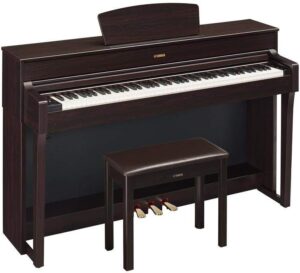
The Yamaha YDP-184 sits toward the premium end of Yamaha’s Arius home digital-piano family.
Its appeal is straightforward: it is designed for players who want a substantial home instrument with a more sophisticated keyboard action, detailed grand-piano sound, strong speaker system, and traditional cabinet appearance.
The YDP-184 is particularly worth considering for an intermediate or advanced player who practices frequently but does not want the cost, space requirements, tuning, or maintenance associated with an acoustic piano.
Best for: Serious students, intermediate and advanced home players.
Check out the price of Yamaha YDP-184 at Amazon >>
Donner DDP-100: Best for Budget-Conscious Beginners

The Donner DDP-100 takes a simpler approach.
Its primary attraction is affordability combined with 88 weighted keys and a furniture-style cabinet.
Rather than providing a huge collection of advanced features, it focuses on delivering the basics required for home piano practice.
This can make it appealing to first-time buyers who want something that looks and feels more like a permanent piano than a portable keyboard.
Best for: Beginners and families working with a tighter budget.
The Donner DDP-100 reviews frequently commend its fully weighted keys and authentic piano sound, positioning it as an excellent choice for beginners seeking an affordable digital piano.
Check out the price of Donner DDP-100 at Amazon >>
Casio Privia PX-870: Best Balance of Features and Home Design

The Casio PX-870 has long been attractive to home users because it combines a relatively compact cabinet with an emphasis on acoustic-piano-style playing.
Its integrated speaker design and weighted keyboard make it particularly suitable for a living room or dedicated practice area.
Casio’s Privia line has traditionally emphasized compactness, which can be useful where floor space matters.
Best for: Home players wanting a balance between appearance, piano feel, and digital convenience.
The Casio Privia PX-870 reviews often highlight its realistic key action and rich sound quality, making it a top choice for those seeking an authentic piano experience in a digital format.
Check out the price of Casio PX-870 at Amazon >>
Yamaha YDP-145: Best for Beginners Who Want an Established Piano Brand

The Yamaha YDP-145 provides many of the advantages people seek in a home digital piano: a full-size weighted keyboard, Yamaha piano sound, integrated pedals, headphone practice, and a traditional-looking cabinet.
It is particularly attractive to beginners who expect to keep playing for several years and prefer to buy into an established acoustic- and digital-piano ecosystem.
Best for: Beginners, families, and developing pianists.
The Yamaha YDP-145 reviews frequently commend its authentic CFX Grand Piano sound and responsive Graded Hammer Standard (GHS) keyboard action, making it a compelling choice for both beginners and seasoned pianists seeking a quality digital piano.
Check out the price of Yamaha YDP-145 at Amazon >>
Casio Privia PX-770: Best for Smaller Rooms
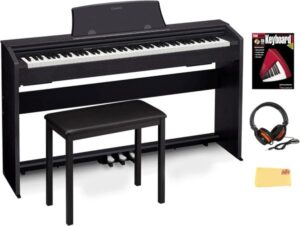
The PX-770 is another console-style Privia aimed at home players.
Its relatively slim cabinet makes it attractive for bedrooms, apartments, and other locations where a traditional acoustic upright may be impractical.
It provides the basic characteristics most piano students need: 88 weighted keys, pedals, built-in speakers, headphone practice, and a stable cabinet.
Best for: Beginners and intermediate players with limited space.
The Casio Privia PX-770 reviews frequently commend its authentic piano feel and compact design, making it an excellent choice for beginners and intermediate players seeking a quality digital piano for home use.
Check out the price of Casio PX-770 at Amazon >>
Kawai KDP 120: Best for Players Who Prioritize Piano Feel
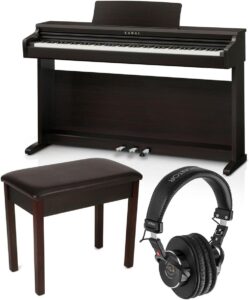
Kawai has a long history of building acoustic pianos, and that experience influences its digital-piano designs.
The KDP120 is aimed squarely at home practice. Its weighted action and piano-oriented sound system make it especially worth considering for players who care more about piano fundamentals than having dozens of novelty voices and accompaniment features.
Best for: Students and intermediate pianists who prioritize keyboard feel and acoustic-piano character.
The Kawai KDP120 reviews frequently commend its authentic piano feel and compact design, making it an excellent choice for beginners and intermediate players seeking a quality digital piano for home use
Check out the price of Kawai KDP 120 at Amazon >>
Comparison Table
| Model |
Strongest Point |
Best For |
| Yamaha YDP-184 | Premium home experience | Serious/intermediate players |
| Donner DDP-100 | Affordability | Budget beginners |
| Casio PX-870 | Features + cabinet design | General home use |
| Yamaha YDP-145 | Balanced beginner package | Students and families |
| Kawai KDP120 | Piano-oriented feel | Developing pianists |
Are Digital Upright Pianos Good for Beginners?
Yes—provided you choose an instrument with an appropriate keyboard action.
A digital upright can actually be an excellent beginner instrument because it combines the fundamental piano layout with conveniences that encourage practice.
Headphones are particularly valuable.
Beginners often need to repeat scales, exercises, and difficult passages many times. Being able to do this privately can make regular practice easier for both the student and everyone else in the household.
A built-in metronome can also help students develop timing, while recording functions allow them to listen critically to their own playing.
See our Best Beginner Piano Keyboards Buyer’s Guide.
Digital Upright or Acoustic Upright: Which Should You Buy?
Neither is universally better.
Choose an acoustic upright if your priorities include natural acoustic resonance, mechanical action, traditional craftsmanship, and the experience of playing a real acoustic instrument—and you are comfortable with tuning and maintenance.
Choose a digital upright if your priorities include:
- Headphone practice
- No regular tuning
- Lower maintenance
- Digital connectivity
- Recording capabilities
- Multiple sounds
- Easier placement
- More predictable ownership costs
Serious pianists should ideally play both before deciding.
How Much Space Does a Digital Upright Need?
One of the major attractions of console digital pianos is their relatively shallow footprint.
However, don’t measure only the piano.
Allow enough room for the bench and for the pianist to sit comfortably. You also need access to electrical outlets and, depending on the instrument, room for ventilation and cable connections.
Measure the intended location before ordering.
This is particularly important when buying online, where cabinet dimensions can look deceptively small in photographs.
Maintenance and Care
Digital upright pianos require considerably less routine maintenance than acoustic pianos, but they are not maintenance-free.
Keep the instrument away from excessive heat, moisture, and direct sunlight. Dust the cabinet regularly and clean the keys according to the manufacturer’s instructions.
Avoid placing drinks on the piano. Liquid entering the electronics or keyboard mechanism can cause serious damage.
Cables and power adapters should also be inspected periodically.
For instruments that support firmware updates, check the manufacturer’s website occasionally for relevant updates.
Frequently Asked Questions
Is a digital upright piano the same as an acoustic upright?
No. An acoustic upright produces sound through strings, hammers, and a soundboard. A digital upright electronically reproduces piano sounds through speakers while using a console-style cabinet and weighted keyboard to approximate the experience of an acoustic instrument.
Do digital upright pianos need tuning?
No. Because they don’t use acoustic strings to generate their sound, normal digital pianos do not require periodic tuning.
Are 88 weighted keys necessary for beginners?
They aren’t absolutely necessary for someone’s first few lessons, but they are strongly preferable if the student’s goal is to develop traditional piano technique and progress to more advanced repertoire.
Is a digital upright better than a portable digital piano?
It depends on how you intend to use it. A console digital piano usually offers a more stable, furniture-like home setup with integrated pedals. A portable digital piano is preferable when mobility and storage are priorities.
Can advanced pianists use digital upright pianos?
Yes. Premium digital uprights can be excellent practice instruments. However, advanced pianists should pay particular attention to keyboard action, pedal response, speaker quality, and dynamic control.
How long can a digital piano last?
A well-built digital piano can provide many years of service, but unlike acoustic pianos, digital instruments contain electronic components that can eventually become obsolete or require repair. Build quality, usage, environment, and availability of replacement parts all affect longevity.
Final Thoughts
The best digital upright piano isn’t necessarily the one with the longest feature list.
For a beginner, good weighted keys, dependable piano sound, comfortable pedals, and a suitable price may matter much more than Bluetooth or hundreds of additional voices.
For an experienced player, keyboard action, dynamic control, pedaling, speaker performance, and tonal realism deserve greater attention.
And for a family, practical considerations—headphone practice, cabinet size, durability, and ease of use—may ultimately determine which piano gets played most often.
The most useful question, therefore, isn’t simply “Which digital upright piano is best?”
It’s:
“Which piano best matches the player, the room, the budget, and the way the instrument will actually be used?”
Answer that first, and choosing among the available models becomes much easier.
These models come from brands with very different strengths. For a broader perspective, see our comparison of top digital piano manufacturers and what each one does best.
Yamaha’s home digital pianos use several different weighted-key systems. Our guide to Yamaha’s 88-key hammer-action models explains how these actions compare and which types of players they suit.
Casio also offers home-oriented digital pianos with full-size hammer-action keyboards. Our comparison of Casio weighted-key models for home and portable use can help narrow the choices.
If classical study is your main goal, see our guide to digital pianos suited to classical practice for models chosen with realistic touch, expressive response and long-term technique development in mind.
If Yamaha is on your shortlist for a home instrument, our guide to Yamaha digital pianos with convincing grand-piano sound compares models that emphasize sampling quality, resonance and expressive response.
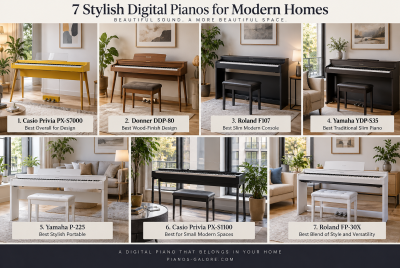
Buyers who prefer something less traditional may also want to consider modern alternatives to conventional digital uprights, including slim and minimalist designs.
—————————-
Searching for a piano learning app? Check out SIMPLY PIANO – the #1 piano learning app…

- Follow step-by-step tutorials ideal for beginners. Advanced players can challenge themselves with higher-level courses.
- Learn at your pace with personalized lessons and real-time feedback.
- Play a range of music, from classical to popular hits, including Disney songs. Deepen your skills with warm-ups, exercises, and sheet music.
——————-
Related piano articles
Revealing Yamaha Upright Pianos Review: 4 Top-Rated Models
The Rising Popularity of Upright Pianos: Reasons Behind the Trend
10 Facts Every Pianist Should Know About Upright Pianos
Best Yamaha Vertical Pianos: 4 Models to Consider
Digital Piano Buying Guide
Learn More About Digital Pianos
How Digital Pianos Work
A digital upright piano can be an excellent choice if you want the look and playing position of a traditional piano without the tuning, weight, and maintenance requirements of an acoustic upright. These instruments—also commonly called console digital pianos—combine a furniture-style cabinet with 88 weighted keys, built-in speakers, pedals, headphone capability, and modern digital features.
For beginners, families, returning players, and even experienced pianists, a good digital upright can provide a satisfying home practice instrument while taking up considerably less space than a grand piano.
But not all digital uprights feel or sound alike. Keyboard action, speaker quality, piano sampling or modeling, pedal response, cabinet construction, and connectivity can vary considerably from one model to another.
This guide explains what to look for and compares several popular digital upright pianos for different types of players.
What Is a Digital Upright Piano?
A digital upright piano is a digital piano housed in a console-style cabinet designed primarily for permanent or semi-permanent home use.
Unlike an acoustic upright piano, it has no strings that need tuning and no traditional acoustic soundboard-and-hammer system producing the sound. Instead, electronic sound technology recreates the tone of an acoustic piano and plays it through built-in speakers.
The keys themselves use weighted or hammer-action mechanisms to reproduce some of the resistance and response of acoustic piano keys.
This distinction is important.
An acoustic upright piano produces sound mechanically: pressing a key causes a hammer to strike a string.
A digital upright piano uses the key movement as an electronic input that triggers a sampled or modeled piano sound.
Both can have 88 keys and a traditional piano-style cabinet, but the technology inside them is fundamentally different.
Why Choose a Digital Upright Instead of an Acoustic Upright?
For many households, the biggest advantage is convenience.
An acoustic piano can provide a wonderfully organic playing experience, but it requires periodic tuning and greater consideration of temperature, humidity, placement, and maintenance.
A digital upright does not require regular tuning.
It also gives you something that can be invaluable in a family home or apartment: headphone practice.
A student can practice early in the morning or late at night without filling the house with sound. This alone can make a digital piano a better practical choice for some families.
Digital uprights may also provide features such as:
- Multiple instrument voices
- Metronomes
- Recording
- USB/MIDI connectivity
- Bluetooth on selected models
- Piano-learning app integration
- Adjustable touch sensitivity
- Dual or split keyboard modes
These features aren’t essential for learning piano, but some can make practice considerably more convenient.
Digital Upright vs Portable Digital Piano
Both instruments may have 88 weighted keys and similar sound technology.
The difference is primarily in their intended use.
A portable digital piano is usually designed to sit on a stand and can be moved relatively easily. A digital upright or console piano incorporates the keyboard, pedals, speakers, and stand into a furniture-style cabinet.
For someone who regularly performs outside the home, portability may be more important.
For a family that wants the instrument to remain in the living room, music room, or bedroom, a digital upright generally provides a cleaner, more traditional appearance and a more stable playing platform.
What Should You Look for in a Digital Upright Piano?
1. 88 Weighted Keys
If your primary goal is learning piano rather than simply playing keyboard, a full-size 88-key weighted keyboard is highly desirable.
Weighted keys create resistance under your fingers, making it easier to develop control over dynamics and technique.
More sophisticated actions attempt to reproduce the heavier feel of lower acoustic-piano keys and progressively lighter response toward the treble.
For beginners intending to progress into classical or more advanced piano repertoire, keyboard action should be one of your highest priorities.
2. Keyboard Action
Don’t judge a piano solely by whether the specification says “weighted.”
There are significant differences between keyboard actions.
Entry-level actions can be perfectly suitable for beginners, while more advanced mechanisms may provide faster repetition, better control, more realistic key movement, and improved tactile surfaces.
If possible, play the piano before purchasing it. The feel of the keyboard is highly personal.
3. Piano Sound
Digital pianos reproduce acoustic-piano sound through sampling, modeling, or combinations of digital technologies.
Listen especially to:
- Soft notes
- Loud notes
- Sustain
- Bass resonance
- Treble clarity
- Transitions between dynamic levels
A piano that sounds impressive during a quick demonstration may become tiring after months of practice if its tone lacks nuance.
Headphones can also reveal details that built-in speakers mask, so try both if possible.
4. Speaker System
Speaker specifications are easy to overlook.
If you will primarily use headphones, speaker power may be relatively unimportant. But if the piano will be played regularly for family members or guests, the built-in speaker system becomes much more significant.
Listen for balanced sound across the keyboard rather than simply maximum volume.
5. Pedals
Most furniture-style digital uprights include three pedals.
For beginners, the sustain or damper pedal is the most important. As repertoire becomes more advanced, realistic half-pedaling and the functions of the other pedals become more valuable.
6. Connectivity
USB connectivity can be useful for connecting the piano to a computer, tablet, music-learning application, or recording setup.
Some newer instruments also offer Bluetooth MIDI and/or Bluetooth audio.
Decide which features you will genuinely use rather than paying extra simply because a specification list is longer.
Six Digital Upright Pianos Worth Considering
(Disclosure: The products listed below were carefully chosen based on the favorable ratings and feedbacks given by piano buyers at Amazon. If you purchase through these links, we’ll earn a small commission from Amazon but it won’t affect the price you pay.)
Yamaha YDP-184 –Best for Serious Home Pianists
The Yamaha YDP-184 sits toward the premium end of Yamaha’s Arius home digital-piano family.
Its appeal is straightforward: it is designed for players who want a substantial home instrument with a more sophisticated keyboard action, detailed grand-piano sound, strong speaker system, and traditional cabinet appearance.
The YDP-184 is particularly worth considering for an intermediate or advanced player who practices frequently but does not want the cost, space requirements, tuning, or maintenance associated with an acoustic piano.
Best for: Serious students, intermediate and advanced home players.
Check out the price of Yamaha YDP-184 at Amazon >>
Donner DDP-100: Best for Budget-Conscious Beginners
The Donner DDP-100 takes a simpler approach.
Its primary attraction is affordability combined with 88 weighted keys and a furniture-style cabinet.
Rather than providing a huge collection of advanced features, it focuses on delivering the basics required for home piano practice.
This can make it appealing to first-time buyers who want something that looks and feels more like a permanent piano than a portable keyboard.
Best for: Beginners and families working with a tighter budget.
The Donner DDP-100 reviews frequently commend its fully weighted keys and authentic piano sound, positioning it as an excellent choice for beginners seeking an affordable digital piano.
Check out the price of Donner DDP-100 at Amazon >>
Casio Privia PX-870: Best Balance of Features and Home Design
The Casio PX-870 has long been attractive to home users because it combines a relatively compact cabinet with an emphasis on acoustic-piano-style playing.
Its integrated speaker design and weighted keyboard make it particularly suitable for a living room or dedicated practice area.
Casio’s Privia line has traditionally emphasized compactness, which can be useful where floor space matters.
Best for: Home players wanting a balance between appearance, piano feel, and digital convenience.
The Casio Privia PX-870 reviews often highlight its realistic key action and rich sound quality, making it a top choice for those seeking an authentic piano experience in a digital format.
Check out the price of Casio PX-870 at Amazon >>
Yamaha YDP-145: Best for Beginners Who Want an Established Piano Brand
The Yamaha YDP-145 provides many of the advantages people seek in a home digital piano: a full-size weighted keyboard, Yamaha piano sound, integrated pedals, headphone practice, and a traditional-looking cabinet.
It is particularly attractive to beginners who expect to keep playing for several years and prefer to buy into an established acoustic- and digital-piano ecosystem.
Best for: Beginners, families, and developing pianists.
The Yamaha YDP-145 reviews frequently commend its authentic CFX Grand Piano sound and responsive Graded Hammer Standard (GHS) keyboard action, making it a compelling choice for both beginners and seasoned pianists seeking a quality digital piano.
Check out the price of Yamaha YDP-145 at Amazon >>
Casio Privia PX-770: Best for Smaller Rooms
The PX-770 is another console-style Privia aimed at home players.
Its relatively slim cabinet makes it attractive for bedrooms, apartments, and other locations where a traditional acoustic upright may be impractical.
It provides the basic characteristics most piano students need: 88 weighted keys, pedals, built-in speakers, headphone practice, and a stable cabinet.
Best for: Beginners and intermediate players with limited space.
The Casio Privia PX-770 reviews frequently commend its authentic piano feel and compact design, making it an excellent choice for beginners and intermediate players seeking a quality digital piano for home use.
Check out the price of Casio PX-770 at Amazon >>
Kawai KDP 120: Best for Players Who Prioritize Piano Feel
Kawai has a long history of building acoustic pianos, and that experience influences its digital-piano designs.
The KDP120 is aimed squarely at home practice. Its weighted action and piano-oriented sound system make it especially worth considering for players who care more about piano fundamentals than having dozens of novelty voices and accompaniment features.
Best for: Students and intermediate pianists who prioritize keyboard feel and acoustic-piano character.
The Kawai KDP120 reviews frequently commend its authentic piano feel and compact design, making it an excellent choice for beginners and intermediate players seeking a quality digital piano for home use
Check out the price of Kawai KDP 120 at Amazon >>
Comparison Table
| Model |
Strongest Point |
Best For |
| Yamaha YDP-184 | Premium home experience | Serious/intermediate players |
| Donner DDP-100 | Affordability | Budget beginners |
| Casio PX-870 | Features + cabinet design | General home use |
| Yamaha YDP-145 | Balanced beginner package | Students and families |
| Kawai KDP120 | Piano-oriented feel | Developing pianists |
Are Digital Upright Pianos Good for Beginners?
Yes—provided you choose an instrument with an appropriate keyboard action.
A digital upright can actually be an excellent beginner instrument because it combines the fundamental piano layout with conveniences that encourage practice.
Headphones are particularly valuable.
Beginners often need to repeat scales, exercises, and difficult passages many times. Being able to do this privately can make regular practice easier for both the student and everyone else in the household.
A built-in metronome can also help students develop timing, while recording functions allow them to listen critically to their own playing.
See our Best Beginner Piano Keyboards Buyer’s Guide.
Digital Upright or Acoustic Upright: Which Should You Buy?
Neither is universally better.
Choose an acoustic upright if your priorities include natural acoustic resonance, mechanical action, traditional craftsmanship, and the experience of playing a real acoustic instrument—and you are comfortable with tuning and maintenance.
Choose a digital upright if your priorities include:
- Headphone practice
- No regular tuning
- Lower maintenance
- Digital connectivity
- Recording capabilities
- Multiple sounds
- Easier placement
- More predictable ownership costs
Serious pianists should ideally play both before deciding.
How Much Space Does a Digital Upright Need?
One of the major attractions of console digital pianos is their relatively shallow footprint.
However, don’t measure only the piano.
Allow enough room for the bench and for the pianist to sit comfortably. You also need access to electrical outlets and, depending on the instrument, room for ventilation and cable connections.
Measure the intended location before ordering.
This is particularly important when buying online, where cabinet dimensions can look deceptively small in photographs.
Maintenance and Care
Digital upright pianos require considerably less routine maintenance than acoustic pianos, but they are not maintenance-free.
Keep the instrument away from excessive heat, moisture, and direct sunlight. Dust the cabinet regularly and clean the keys according to the manufacturer’s instructions.
Avoid placing drinks on the piano. Liquid entering the electronics or keyboard mechanism can cause serious damage.
Cables and power adapters should also be inspected periodically.
For instruments that support firmware updates, check the manufacturer’s website occasionally for relevant updates.
Frequently Asked Questions
Is a digital upright piano the same as an acoustic upright?
No. An acoustic upright produces sound through strings, hammers, and a soundboard. A digital upright electronically reproduces piano sounds through speakers while using a console-style cabinet and weighted keyboard to approximate the experience of an acoustic instrument.
Do digital upright pianos need tuning?
No. Because they don’t use acoustic strings to generate their sound, normal digital pianos do not require periodic tuning.
Are 88 weighted keys necessary for beginners?
They aren’t absolutely necessary for someone’s first few lessons, but they are strongly preferable if the student’s goal is to develop traditional piano technique and progress to more advanced repertoire.
Is a digital upright better than a portable digital piano?
It depends on how you intend to use it. A console digital piano usually offers a more stable, furniture-like home setup with integrated pedals. A portable digital piano is preferable when mobility and storage are priorities.
Can advanced pianists use digital upright pianos?
Yes. Premium digital uprights can be excellent practice instruments. However, advanced pianists should pay particular attention to keyboard action, pedal response, speaker quality, and dynamic control.
How long can a digital piano last?
A well-built digital piano can provide many years of service, but unlike acoustic pianos, digital instruments contain electronic components that can eventually become obsolete or require repair. Build quality, usage, environment, and availability of replacement parts all affect longevity.
Final Thoughts
The best digital upright piano isn’t necessarily the one with the longest feature list.
For a beginner, good weighted keys, dependable piano sound, comfortable pedals, and a suitable price may matter much more than Bluetooth or hundreds of additional voices.
For an experienced player, keyboard action, dynamic control, pedaling, speaker performance, and tonal realism deserve greater attention.
And for a family, practical considerations—headphone practice, cabinet size, durability, and ease of use—may ultimately determine which piano gets played most often.
The most useful question, therefore, isn’t simply “Which digital upright piano is best?”
It’s:
“Which piano best matches the player, the room, the budget, and the way the instrument will actually be used?”
Answer that first, and choosing among the available models becomes much easier.
These models come from brands with very different strengths. For a broader perspective, see our comparison of top digital piano manufacturers and what each one does best.
Yamaha’s home digital pianos use several different weighted-key systems. Our guide to Yamaha’s 88-key hammer-action models explains how these actions compare and which types of players they suit.
Casio also offers home-oriented digital pianos with full-size hammer-action keyboards. Our comparison of Casio weighted-key models for home and portable use can help narrow the choices.
If classical study is your main goal, see our guide to digital pianos suited to classical practice for models chosen with realistic touch, expressive response and long-term technique development in mind.
If Yamaha is on your shortlist for a home instrument, our guide to Yamaha digital pianos with convincing grand-piano sound compares models that emphasize sampling quality, resonance and expressive response.
Buyers who prefer something less traditional may also want to consider modern alternatives to conventional digital uprights, including slim and minimalist designs.
—————————-
Searching for a piano learning app? Check out SIMPLY PIANO – the #1 piano learning app…
- Follow step-by-step tutorials ideal for beginners. Advanced players can challenge themselves with higher-level courses.
- Learn at your pace with personalized lessons and real-time feedback.
- Play a range of music, from classical to popular hits, including Disney songs. Deepen your skills with warm-ups, exercises, and sheet music.
——————-
Related piano articles
Revealing Yamaha Upright Pianos Review: 4 Top-Rated Models
The Rising Popularity of Upright Pianos: Reasons Behind the Trend
10 Facts Every Pianist Should Know About Upright Pianos
Best Yamaha Vertical Pianos: 4 Models to Consider
Digital Piano Buying Guide
Learn More About Digital Pianos
How Digital Pianos Work