Best 88-Key Digital Pianos in 2026: 7 Top Picks for Every Pianist
If you’re serious about learning or playing piano, an 88-key digital piano is often the best place to start.
Why 88 keys?
Because that’s the same number found on a standard acoustic piano. An 88-key instrument gives you the full musical range needed for everything from beginner exercises to advanced classical repertoire, jazz, pop, accompaniment, and composition.
But having 88 keys doesn’t automatically make one digital piano as good as another.
The biggest differences are often found in keyboard action, piano sound, polyphony, speakers, portability, pedals, connectivity, and overall playing experience.
For 2026, our seven top choices are:
Yamaha P-225 — Best Overall
Roland FP-30X — Best for Realistic Piano Practice
Kawai ES120 — Best Piano-Focused Choice
Casio Privia PX-S1100 — Best Slim & Portable Choice
Yamaha P-525 — Best Premium Portable
Alesis Prestige Artist — Best Affordable Step-Up Piano
Donner DEP-20 — Best Feature-Rich Budget Choice
Whether you’re buying your first piano or upgrading to something more capable, this guide will help you determine which 88-key digital piano best matches your needs.
Disclosure: Some links on Pianos-Galore are affiliate links. If you purchase through these links, we may receive a small commission at no additional cost to you.
Best 88-Key Digital Pianos at a Glance
| Model | Best For | Keyboard | Polyphony |
|---|---|---|---|
| Yamaha P-225 | Best Overall | GHC | 192 |
| Roland FP-30X | Serious Piano Practice | PHA-4 Standard | 256 |
| Kawai ES120 | Piano-Focused Players | Responsive Hammer Compact | 192 |
| Casio PX-S1100 | Small Spaces & Portability | Smart Scaled Hammer Action | 192 |
| Yamaha P-525 | Advanced/Premium Players | GrandTouch-S | 256 |
| Alesis Prestige Artist | Affordable Step-Up | Graded Hammer Action | 256 |
| Donner DEP-20 | Budget & Features | Weighted | 128 |
There is no single best piano for everyone.
The Yamaha P-525, for example, is substantially more sophisticated than a typical beginner instrument—but many beginners don’t need to pay for everything it provides.
The goal is to find the right piano for your playing level and priorities.
Why Choose an 88-Key Digital Piano?
A standard modern acoustic piano has 88 keys—52 white and 36 black.
Smaller 61- and 76-key instruments can be perfectly adequate for some musicians, particularly keyboard players and beginners learning basic songs.
However, 88 keys provide several long-term advantages.
Full Piano Range
You have access to the same note range used by acoustic pianos.
This becomes increasingly important as you progress into:
- Classical repertoire
- Jazz
- Advanced arrangements
- Two-handed accompaniment
- Music requiring extreme bass or treble notes
No Need to Upgrade Because of Range
A beginner may use only a few octaves.
But if you start with 61 keys and become serious about piano, you may eventually need a larger instrument.
Buying 88 keys from the beginning eliminates that particular reason to upgrade.
Better Preparation for Acoustic Piano
If your 88-key digital piano also has a good weighted hammer action, moving between it and an acoustic piano should feel more natural than moving from a lightweight keyboard.
88 Keys Doesn’t Necessarily Mean Weighted Keys
This is one of the most important things to understand before buying.
An instrument can have 88 keys without having realistic piano action.
There are several broad types of keyboard action:
Non-weighted
Light action commonly found on portable electronic keyboards.
Semi-weighted
Adds some resistance but usually doesn’t reproduce the hammer mechanism of an acoustic piano very closely.
Hammer action
Uses a mechanism designed to recreate more of the resistance associated with acoustic-piano hammers.
Graded hammer action
The lower keys feel heavier while the higher keys become progressively lighter, imitating an acoustic piano more closely.
For serious piano study, I generally recommend weighted hammer action, particularly for classical music.
If Yamaha is already on your shortlist, our comparison of Yamaha models for progressing pianists can help you decide whether a portable, home or premium model makes the most sense.
1. Yamaha P-225 — Best Overall 88-Key Digital Piano
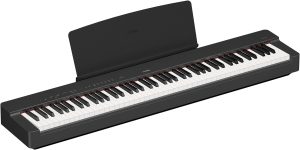
For the widest range of players, the Yamaha P-225 earns our Best Overall recommendation.
It provides:
- 88-key Graded Hammer Compact (GHC) keyboard
- Yamaha CFX concert-grand piano sound
- VRM Lite
- 192-note polyphony
- 24 voices
- Split, Dual, and Duo modes
- USB audio/MIDI
- 20 rhythms
- Optional three-pedal compatibility
- Two headphone connections
The P-225 weighs approximately 11.5 kg (25 lb 6 oz) and is only about 272 mm deep without the music rest.
Why It’s Our Best Overall Choice
The P-225 doesn’t dominate every specification in this article.
The P-525 has a more sophisticated keyboard.
The FP-30X offers higher polyphony.
Other instruments offer more sounds.
But the P-225 combines the qualities that matter to a very broad range of pianists:
good weighted action + strong piano sound + compact dimensions + manageable weight + useful connectivity.
That makes it suitable for:
- Beginners
- Intermediate players
- Adults returning to piano
- Students
- Home musicians
- Apartment dwellers
GHC Keyboard
Yamaha’s Graded Hammer Compact action was designed to maintain weighted piano response while allowing the instrument itself to remain relatively shallow.
That’s particularly useful if you want 88 weighted keys but don’t want a large furniture-style piano dominating the room.
Yamaha CFX Sound
The P-225 uses Yamaha’s CFX concert-grand piano sound together with VRM Lite, which recreates aspects of the sympathetic resonance occurring in acoustic pianos.
192-Note Polyphony
The P-225 provides 192-note maximum polyphony.
That’s more than sufficient for most beginner and intermediate piano playing, including sustained passages and layering.
Pros
- 88 weighted GHC keys
- Yamaha CFX sound
- VRM Lite
- 192-note polyphony
- Compact dimensions
- Relatively lightweight
- USB audio/MIDI
- Excellent all-rounder
Possible Drawback
More advanced pianists may eventually want a more sophisticated action such as Yamaha’s GrandTouch-S.
Best for:
Most buyers wanting an excellent balance of touch, sound, portability and price.
[Check Yamaha P-225 Price on Amazon →]
2. Roland FP-30X — Best for Realistic Piano Practice
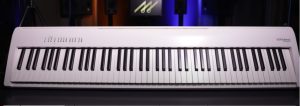
The Roland FP-30X is particularly attractive to players who put keyboard action and serious piano practice near the top of their priorities.
Roland equips it with:
- 88-key PHA-4 Standard keyboard
- Escapement
- Ivory Feel key surfaces
- SuperNATURAL Piano technology
- 256-note polyphony
- 321 available tones through the instrument/app ecosystem
- 11W x 2 amplification
- Bluetooth Audio
- Bluetooth MIDI
- USB audio/MIDI
- Optional three-pedal system
PHA-4 Standard Keyboard
The PHA-4 Standard is one of the main reasons the FP-30X is so frequently considered by serious students.
It incorporates hammer action, escapement and textured key surfaces.
Keyboard feel is subjective, so I won’t say Roland’s action is automatically “better” than Yamaha or Kawai.
But if possible, this is an instrument worth playing before buying.
256-Note Polyphony
The FP-30X provides 256-note maximum polyphony, giving it considerable headroom for advanced playing, sustain and layered sounds.
Strong Connectivity
Bluetooth Audio allows you to stream music through the piano’s speakers, while Bluetooth MIDI provides wireless communication with compatible applications.
USB also supports MIDI and audio.
Speakers
The FP-30X uses two 12 cm speakers powered by 11W x 2 amplification.
That’s useful for players who want satisfying home volume without immediately connecting external speakers.
Pros
- PHA-4 Standard hammer action
- Escapement
- Ivory Feel
- 256-note polyphony
- Strong speaker system
- Bluetooth Audio/MIDI
- USB audio/MIDI
- Excellent long-term practice instrument
Possible Drawback
At approximately 14.8 kg (32 lb 11 oz), it’s noticeably heavier than some competing portable models.
Best for:
Students and serious home pianists who place a high priority on keyboard feel and long-term practice.
[Check Roland FP-30X Price on Amazon →]
3. Kawai ES120 — Best Piano-Focused Choice
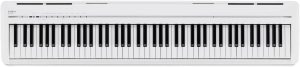
The Kawai ES120 takes a refreshingly piano-centered approach.
Kawai is a major acoustic-piano manufacturer, and the ES120 incorporates technologies derived from that piano-building background.
It provides:
- 88-key Responsive Hammer Compact action
- Grade-weighted hammers
- Matte key surfaces
- SK-EX, EX and K-60 piano recordings
- 88-key stereo sampling
- 192-note polyphony
- 25 sounds
- 20W speaker output
- Bluetooth MIDI
- Bluetooth Audio
- USB-MIDI
- Optional three-pedal systems
Responsive Hammer Compact Action
The ES120 uses grade-weighted hammers.
That means the action changes across the keyboard to reproduce the heavier bass and lighter treble behavior associated with acoustic pianos.
SK-EX Piano Sound
Kawai’s sound system incorporates recordings of instruments including the Shigeru Kawai SK-EX concert grand, using 88-key stereo sampling.
The ES120 also provides resonance features such as:
- Damper Resonance
- String Resonance
- Key-off effects
with additional adjustments available through Kawai’s Virtual Technician/PianoRemote system.
Lightweight for an 88-Key Hammer-Action Piano
At approximately 12 kg (26.5 lb) without the music rest, the ES120 remains reasonably portable.
Pros
- Grade-weighted hammer action
- 192-note polyphony
- SK-EX/EX piano sounds
- 88-key stereo sampling
- Bluetooth Audio/MIDI
- Relatively lightweight
- Strong piano-oriented design
Possible Drawback
If you want hundreds of sounds and extensive arranger features, the ES120 isn’t designed primarily for that purpose.
Best for:
Pianists who care more about piano touch and sound than having a huge collection of extra features.
[Check Kawai ES120 Price on Amazon →]
4. Casio Privia PX-S1100 — Best Slim & Portable Choice
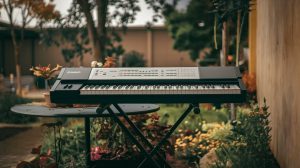
One challenge with 88-key instruments is unavoidable:
88 keys require width.
Casio addresses the other dimensions by making the PX-S1100 unusually slim.
It combines:
- 88-key Smart Scaled Hammer Action keyboard
- 192-note polyphony
- Multi-dimensional Morphing AiR sound source
- 18 tones
- MIDI recording
- Audio recording
- Built-in speakers
- Bluetooth audio/MIDI functionality through its supplied wireless adapter
- Battery or AC operation
The result is particularly attractive for players with limited room.
Why Slim Design Matters
Not everyone has a dedicated music room.
Your piano might need to fit into:
- An apartment
- Bedroom
- Home office
- Dormitory
- Multipurpose living area
A slim 88-key instrument allows you to retain the full piano range without committing to a large cabinet.
Battery Operation
The PX-S1100 can also run on batteries.
That’s unusual for a full-size hammer-action digital piano and increases its flexibility for musicians who occasionally play away from a fixed setup.
Pros
- Very slim design
- 88 hammer-action keys
- 192-note polyphony
- Audio and MIDI recording
- Wireless functionality
- Battery operation
- Attractive minimalist appearance
Possible Drawback
The compact hammer-action design has its own feel, so piano-focused players should compare it with Yamaha, Roland and Kawai if possible.
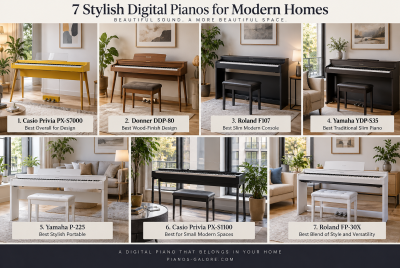
The PX-S1100 is also notable for its exceptionally slim, minimalist appearance. If design matters as much as keyboard feel, see our comparison of the best stylish digital pianos for modern homes.
Best for:
Apartment dwellers and musicians wanting an exceptionally space-conscious 88-key digital piano.
[Check Casio Privia PX-S1100 Price on Amazon →]
5. Yamaha P-525 — Best Premium Portable 88-Key Piano
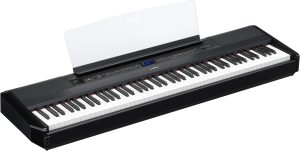
The Yamaha P-525 is where this comparison moves decisively into premium territory.
Yamaha gives it:
- 88-key GrandTouch-S keyboard
- Wooden white keys
- Synthetic ebony and ivory keytops
- Escapement
- Yamaha CFX concert-grand sound
- Bösendorfer Imperial grand sound
- Virtual Resonance Modeling
- Grand Expression Modeling
- Binaural sampling
- 256-note polyphony
- Extensive sound library
- 16-track MIDI recording
- USB audio recording
- Bluetooth Audio/MIDI in supported markets
GrandTouch-S Keyboard
This is the biggest reason to consider the P-525.
The keyboard incorporates wooden white keys, escapement and synthetic ebony/ivory surfaces.
Experienced pianists are more likely to appreciate improvements in:
- Repetition
- Dynamic control
- Key stability
- Fine expression
- Response
than a complete beginner.
Two Premium Grand Piano Characters
The P-525 gives you both:
Yamaha CFX
and
Bösendorfer Imperial
grand-piano sounds.
This gives advanced players substantially more tonal choice than simply offering dozens of generic piano presets.
Full VRM and Grand Expression Modeling
Unlike the P-225’s VRM Lite implementation, the P-525 uses Yamaha’s fuller Virtual Resonance Modeling along with Grand Expression Modeling.
These technologies are intended to reproduce more of the complex interaction and tonal variation of an acoustic grand.
Recording
The P-525 supports up to 16-track MIDI recording and WAV audio recording to USB memory.
That gives serious musicians much more room for composition and performance analysis.
Is It Really Portable?
Technically, yes.
Practically, remember that it weighs approximately 22 kg (48 lb 8 oz).
It’s better thought of as a premium digital piano that can be transported rather than a keyboard you’d casually carry around every day.
Pros
- GrandTouch-S action
- Wooden white keys
- CFX + Bösendorfer Imperial
- VRM
- Grand Expression Modeling
- 256-note polyphony
- Sophisticated recording
- Premium sound and action
Possible Drawback
It’s considerably heavier and more expensive than what most beginners need.
Best for:
Advanced players and serious pianists wanting premium action and sound without committing to a permanent console digital piano.
[Check Yamaha P-525 Price on Amazon →]
Yamaha P-225 vs P-525
These two instruments show how wide the 88-key digital-piano category really is.
| Feature | Yamaha P-225 | Yamaha P-525 |
|---|---|---|
| Keys | 88 | 88 |
| Action | GHC | GrandTouch-S |
| Wooden white keys | No | Yes |
| Main piano | CFX | CFX + Bösendorfer |
| VRM | VRM Lite | Full VRM |
| Polyphony | 192 | 256 |
| Weight | 11.5 kg | 22 kg |
| Best For | Most players | Advanced/premium |
The P-525 isn’t simply a P-225 with extra sounds.
You’re paying for significant upgrades in keyboard action, piano modeling, sound options, recording and amplification.
For most beginners, I’d still choose the P-225.
For an experienced pianist, the P-525 becomes much more compelling.
6. Alesis Prestige Artist — Best Affordable Step-Up Piano
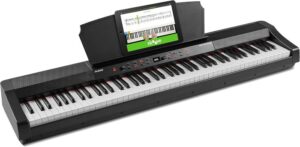
The Alesis Prestige Artist deserves inclusion because it provides some unusually strong specifications for value-conscious buyers.
Alesis equips it with:
- 88 full-size graded hammer-action keys
- Adjustable touch response
- 30 multi-sampled voices
- 256-note polyphony
- 50W speaker system
- OLED display
- Split and Layer modes
- Lesson Mode
- Record Mode
- USB-MIDI
- Stereo outputs
- Two headphone connections
Graded Hammer Action
Unlike Alesis’s entry-level semi-weighted Recital, the Prestige Artist uses graded hammer action.
That’s a meaningful distinction for traditional piano playing.
256-Note Polyphony
The Prestige Artist matches the FP-30X and P-525 on the headline maximum-polyphony figure at 256 notes.
Of course, polyphony alone doesn’t determine piano quality, but it provides plenty of headroom for demanding music and layered sounds.
50W Speakers
The built-in micro-array system provides 50 watts total amplification (25W x 2).
That’s a substantial specification for a portable digital piano in this category.
Recording and Lesson Features
Record Mode lets you capture a performance and listen back, while Lesson Mode divides the keyboard into two identical pitch zones for teacher/student practice.
Pros
- 88 graded hammer-action keys
- 256-note polyphony
- 30 multi-sampled sounds
- 50W speaker system
- OLED display
- Lesson Mode
- Recording
- Strong value proposition
Possible Drawback
Players prioritizing the most refined piano action and acoustic-piano modeling should also compare Yamaha, Roland and Kawai.
Best for:
Value-conscious pianists wanting to step beyond an entry-level digital piano without immediately entering premium pricing.
[Check Alesis Prestige Artist Price on Amazon →]
7. Donner DEP-20 — Best Feature-Rich Budget Choice
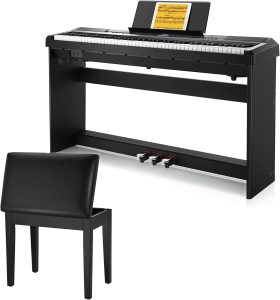
The Donner DEP-20 takes the budget category in a different direction.
It combines:
- 88 weighted keys
- 128-note polyphony
- 238 tones
- Dual 25W speakers
- USB-MIDI
- Dual headphone connections
- Audio input/output
- Split functionality
- Three-pedal configurations depending on package
The DEP-20 is particularly attractive for buyers who want lots of features for the money.
238 Sounds
Compared with piano-focused instruments such as the Kawai ES120, the DEP-20 offers a much larger collection of instrument sounds.
That can be appealing for:
- Pop musicians
- Songwriters
- Recreational players
- Students exploring different musical styles
- Families sharing one instrument
128-Note Polyphony
128-note polyphony should be sufficient for most beginner and intermediate playing.
Again, don’t assume the piano with the highest polyphony number is automatically the best.
Keyboard action, sound quality, speakers and overall playing experience matter too.
Who Should Consider It?
I’d particularly consider the DEP-20 if your budget is limited and you want an 88-key weighted instrument with lots of sounds and features.
Pros
- 88 weighted keys
- 238 sounds
- 128-note polyphony
- Powerful speaker specification
- USB-MIDI
- Lots of functionality for the price
Possible Drawback
Piano-focused students should compare its action and piano sound against instruments such as the Roland FP-30X, Yamaha P-225 and Kawai ES120.
Best for:
Budget-conscious players wanting maximum features from an 88-key weighted digital piano.
[Check Donner DEP-20 Price on Amazon →]
Which 88-Key Digital Piano Is Best for Beginners?
My first choice for most beginners is the Yamaha P-225.
It provides:
- 88 weighted keys
- Good piano sound
- 192-note polyphony
- Compact dimensions
- Manageable weight
- Enough capability to continue into intermediate playing
The Roland FP-30X is an excellent alternative for a beginner who already knows they’re serious about piano.
For buyers on tighter budgets, consider the Alesis Prestige Artist or Donner DEP-20, depending on pricing.
Best Digital Pianos for Beginners in 2026: 7 Top Picks for Learning Piano
Which 88-Key Digital Piano Is Best for Intermediate Players?
I’d shortlist:
Yamaha P-225
Roland FP-30X
Kawai ES120
These three strike particularly good balances between price, portability and piano-focused capability.
The right choice may ultimately come down to which keyboard action and piano sound you personally prefer.
Which Is Best for Advanced Pianists?
The Yamaha P-525.
Its GrandTouch-S keyboard with wooden white keys, CFX and Bösendorfer Imperial sounds, full VRM and Grand Expression Modeling put it in a different category from typical entry-level instruments.
Advanced pianists should nevertheless play competing premium instruments before buying whenever possible.
At this level, personal preference becomes increasingly important.
Which 88-Key Piano Is Best for Classical Music?
I’d concentrate on:
Roland FP-30X
Kawai ES120
Yamaha P-225
and, for advanced players,
Yamaha P-525
For classical study, I’d prioritize:
- Keyboard action
- Dynamic control
- Piano sound
- Pedal support
- Polyphony
rather than the number of instrument sounds.
Which 88-Key Piano Is Best for Small Spaces?
The Casio PX-S1100 deserves serious consideration.
But don’t overlook the Yamaha P-225.
At approximately 272 mm deep, the P-225 is also impressively compact for a full 88-key weighted instrument.
The Kawai ES120 is approximately 28 cm deep without its music rest, so it too works well in relatively confined spaces.
Which 88-Key Digital Piano Is Easiest to Move?
Among our piano-focused choices:
Yamaha P-225 — 11.5 kg
Kawai ES120 — 12 kg without music rest
Alesis Prestige Artist — approximately 12.8 kg
Roland FP-30X — 14.8 kg
Yamaha P-525 — 22 kg
If you’re moving the instrument frequently, a few kilograms make a surprisingly large difference.
Best 88-Key Piano by Type of Player
If you don’t want to analyze dozens of specifications, here’s the shortcut:
Complete beginner → Yamaha P-225
Serious piano student → Roland FP-30X
Piano-focused player → Kawai ES120
Apartment/small space → Casio PX-S1100
Advanced pianist → Yamaha P-525
Value-conscious step-up buyer → Alesis Prestige Artist
Budget/features buyer → Donner DEP-20
That’s more useful than simply ranking seven instruments from “best” to “worst,” because they’re designed for different buyers.
Portable vs Console 88-Key Digital Pianos
All seven principal recommendations in this article are essentially portable/slab-style instruments.
That doesn’t mean they must remain on temporary X-stands.
Many can be paired with:
- Dedicated furniture stands
- Three-pedal systems
- Benches
- Permanent home setups
This can effectively transform a portable digital piano into something much closer to a console-style home instrument while retaining the ability to separate the keyboard later.
A true console digital piano makes more sense when:
- The instrument will never be moved.
- Furniture appearance matters.
- Integrated pedals are essential.
- You want a permanent practice station.
Portable 88-key models make more sense when flexibility matters.
88-Key Digital Piano vs 61-Key Keyboard
This comes down to musical purpose.
Choose an 88-key digital piano if:
- You want to learn traditional piano.
- You play classical music.
- Weighted action matters.
- You want full-range repertoire.
- You’re taking formal piano lessons.
Choose a 61-key keyboard if:
- Maximum portability matters.
- You want hundreds of sounds.
- You’re interested in accompaniment.
- Songwriting is your priority.
- You primarily play pop/electronic music.
- You want a lower-cost recreational instrument.
Digital Piano vs Keyboard: Which Should You Buy?
Are 88 Weighted Keys Worth It?
For serious piano playing, yes.
You can certainly learn basic music on a smaller keyboard.
But an 88-key weighted instrument gives you:
- Full acoustic-piano range
- More realistic resistance
- Better preparation for acoustic piano
- Room for advanced repertoire
- Less likelihood of outgrowing the keyboard
If budget allows and you know piano is going to be a serious pursuit, I’d usually buy 88 weighted keys from the beginning.
Frequently Asked Questions
What is the best 88-key digital piano in 2026?
For most players, our overall recommendation is the Yamaha P-225 because it combines GHC weighted action, Yamaha CFX sound, VRM Lite, 192-note polyphony and compact dimensions.
Advanced players should consider the Yamaha P-525, while piano-focused buyers should also look closely at the Roland FP-30X and Kawai ES120.
Is an 88-key digital piano good for beginners?
Yes.
In fact, an 88-key weighted digital piano is an excellent choice for a beginner who intends to study piano seriously.
Does an 88-key keyboard have the same number of keys as a real piano?
Yes. A standard modern acoustic piano has 88 keys.
Does 88 keys mean fully weighted?
No.
The number of keys and the keyboard action are separate specifications.
Always check whether the instrument uses non-weighted, semi-weighted, hammer-action or graded hammer-action keys.
How much polyphony do I need?
For most beginners, 64–128 notes can be sufficient.
More advanced players may appreciate 192 or 256 notes, particularly when using sustain heavily or layering sounds.
Which 88-key digital piano has wooden keys?
Among the models in this guide, the Yamaha P-525 uses wooden white keys in its GrandTouch-S keyboard.
Which 88-key piano is best for apartments?
The Casio PX-S1100 is particularly attractive because of its slim design.
The Yamaha P-225 and Kawai ES120 are also relatively compact options.
Is the Roland FP-30X good for classical music?
Yes. Its 88-key PHA-4 Standard hammer-action keyboard, escapement, Ivory Feel and 256-note polyphony make it a strong choice for classical students.
Is the Kawai ES120 good for serious piano learning?
Yes. It uses Kawai’s Responsive Hammer Compact action with grade-weighted hammers and provides 192-note polyphony.
Do digital pianos need tuning?
No.
Digital pianos don’t contain acoustic strings, so they don’t require traditional piano tuning.
Final Verdict: Which 88-Key Digital Piano Should You Buy?
If you want the simplest answer:
Best Overall — Yamaha P-225
The Yamaha P-225 is my recommendation for the largest number of buyers.
It combines 88 GHC weighted keys, CFX piano sound, VRM Lite, 192-note polyphony and compact dimensions without moving into premium pricing.
[Check Yamaha P-225 Price on Amazon →]
Best for Serious Piano Practice — Roland FP-30X
The FP-30X stands out with its PHA-4 Standard keyboard, escapement, 256-note polyphony and strong connectivity.
[Check Roland FP-30X Price on Amazon →]
Best Piano-Focused Choice — Kawai ES120
Choose the ES120 if your priorities are piano action and acoustic-piano character rather than a huge feature list.
[Check Kawai ES120 Price on Amazon →]
Best Slim Choice — Casio Privia PX-S1100
Choose the PX-S1100 when space, appearance and portability are major considerations.
[Check Casio PX-S1100 Price on Amazon →]
Best Premium Portable — Yamaha P-525
For serious and advanced players, the P-525 provides GrandTouch-S action, wooden white keys, CFX and Bösendorfer Imperial piano sounds, full VRM and 256-note polyphony.
[Check Yamaha P-525 Price on Amazon →]
Best Affordable Step-Up — Alesis Prestige Artist
Its graded hammer-action keyboard, 256-note polyphony and 50W speaker system give the Prestige Artist an impressive specification for value-oriented buyers.
[Check Alesis Prestige Artist Price on Amazon →]
Best Feature-Rich Budget Choice — Donner DEP-20
Choose the DEP-20 if you’re trying to maximize features, sounds and weighted-key functionality on a tighter budget.
[Check Donner DEP-20 Price on Amazon →]
Ultimately, don’t choose an 88-key digital piano by specifications alone.
If you have an opportunity to try your shortlist in person, do it.
Two pianos can both have 88 weighted keys and excellent specifications yet feel very different under your fingers.
The best 88-key digital piano is the one that matches your skill level, budget, musical goals—and makes you want to keep playing.
If you are still deciding which manufacturer to trust, see our guide to digital piano brands and their strengths before comparing individual models.
If Yamaha is one of the brands on your shortlist, our comparison of Yamaha digital pianos with 88 weighted keys explains the differences in action, feel and intended use across several models.
Players who want to combine full-sized piano playing with recording and virtual instruments should also compare our best 88-key MIDI keyboards.
Keyboard action is only part of the buying decision when the instrument will remain permanently visible; our guide to attractive 88-key pianos for the home explores the design side as well.
The ES120 is one of the strongest piano-focused choices in this category, and our Kawai model comparison shows how it differs from the ES520, ES920 and KDP120.