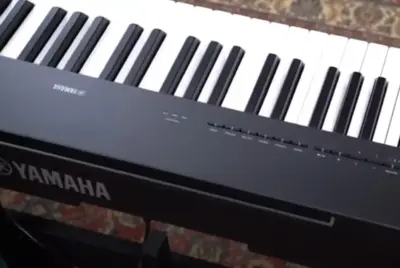
Yamaha CP88 Review 2026: Still One of the Best Stage Pianos Money Can Buy?
The Yamaha CP88 isn’t new.
And in the fast-moving world of digital keyboards, that immediately raises a question:
Is the Yamaha CP88 still worth buying in 2026?
For many serious pianists, the answer may be yes.
Instead of trying to compete with feature-packed workstations containing thousands of sounds, sequencers and complicated menus, Yamaha designed the CP88 around a simpler idea:
Give professional pianists an excellent 88-key action, great acoustic and electric piano sounds, straightforward controls and the connections needed for the stage and studio.
The result is a stage piano that has aged remarkably well.
And Yamaha hasn’t simply left it frozen in time.
Software updates have continued expanding the CP platform, with CP OS v2.0 adding an improved generation of Yamaha CFX and Bösendorfer concert-grand sounds plus useful performance improvements.
But the CP88 isn’t inexpensive.
It doesn’t have built-in speakers.
It weighs about 41 pounds.
And musicians who need deep synthesis, organ controls or workstation functionality may find better choices elsewhere.
So who should actually buy it?
Let’s take a detailed look.
Disclosure: Some links on Pianos-Galore are affiliate links. If you purchase through these links, we may receive a small commission at no additional cost to you.
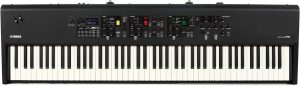
Yamaha CP88 at a Glance
| Feature | Yamaha CP88 |
|---|---|
| Keys | 88 |
| Action | Natural Wood Graded Hammer, Triple Sensor |
| Keytops | Synthetic Ebony & Ivory |
| Sound Engine | AWM2 |
| Maximum Polyphony | 128 notes |
| Main Sections | Piano, Electric Piano, Sub |
| Acoustic Piano Focus | Yamaha CFX/CFX2, S700, Bösendorfer and others |
| Effects | Dedicated section effects + Master Delay/Reverb/EQ |
| USB Audio/MIDI | Yes |
| MIDI IN/OUT | Yes |
| Balanced XLR Outputs | Yes |
| Built-In Speakers | No |
| Weight | 18.6 kg / 41 lb |
| Best For | Serious Pianists, Stage & Studio |
| Biggest Strength | Piano Action + Sounds + Live Workflow |
| Biggest Limitation | Premium Price / No Speakers |
Quick Verdict
The Yamaha CP88 remains an excellent choice for the pianist who wants a serious 88-key stage instrument without spending half the performance navigating menus.
Its combination of Natural Wood graded-hammer action, Yamaha and Bösendorfer piano sounds, excellent electric pianos, hands-on effects and professional connectivity continues to make it highly competitive.
[Check Yamaha CP88 Price on Amazon →]
What Exactly Is the Yamaha CP88?
The CP88 is a professional stage piano.
That distinction matters.
It isn’t primarily designed to sit permanently in a living room like a furniture-style digital piano.
And it isn’t a full workstation built around sequencing and deep production features.
Its purpose is more focused:
play great keyboard sounds on stage and in the studio, with fast access to the controls musicians actually need.
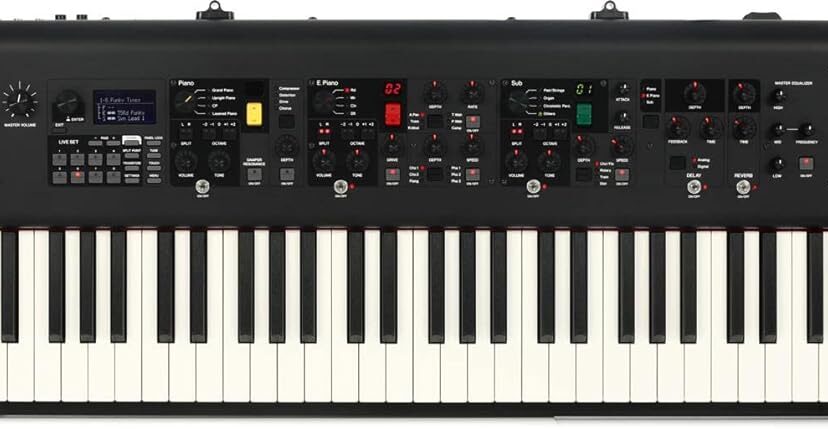
Yamaha organizes the instrument around three primary sound sections:
- Piano
- Electric Piano
- Sub
Each section can be switched on or off independently.
That makes it easy to create combinations such as:
Grand piano + strings
Electric piano + pad
Piano + synth bass
or use a single piano sound by itself.
The CP88’s Biggest Strength: The Keyboard
For a serious pianist, this is where the CP88 begins to justify its price.
The CP88 uses Yamaha’s 88-key Natural Wood Graded Hammer keyboard with triple sensors.
The white keys incorporate wood, while the keytops use synthetic ebony and ivory surfaces.
More importantly, the action is graded.
That means the lower register feels heavier while the upper register becomes progressively lighter, reflecting an important characteristic of acoustic-piano action.
Why Triple Sensors Matter
Triple-sensor detection becomes particularly useful when playing repeated notes.
On a simpler digital-piano action, you may need to allow a key to return farther before the next note can be triggered.
A third sensor allows quicker repetition without requiring the key to return completely to its starting position.
For repertoire involving:
- Rapid repeated notes
- Trills
- Fast classical passages
- Jazz
- Virtuosic playing
this can make the keyboard feel more responsive.
Is the CP88 Action Like an Acoustic Piano?
It is designed specifically for pianists, and its Natural Wood graded action is one of the strongest reasons to consider the instrument.
But no digital stage-piano action should automatically be described as identical to an acoustic grand.
Acoustic pianos themselves vary considerably.
A concert grand feels different from an upright.
One grand can feel different from another.
The more useful question is:
Does the CP88 provide enough resistance, control and repetition for serious piano playing?
For many experienced players, yes.
If keyboard feel is your number-one buying criterion, however, try the CP88 yourself whenever possible.
Yamaha CFX: The Flagship Grand Piano Connection
Yamaha’s CFX is its flagship concert grand.
That name matters because the CP88 draws heavily on Yamaha’s own acoustic-piano heritage.
The instrument includes premium grand-piano voices associated with instruments such as:
- Yamaha CFX
- Yamaha S700
- Bösendorfer Imperial
That gives the CP88 several distinctly different acoustic-piano characters rather than simply variations of one generic grand.
CFX vs Bösendorfer: Why Having Both Matters
The Yamaha and Bösendorfer piano sounds don’t merely exist to make the specification list longer.
They offer different tonal personalities.
The CFX can work beautifully when you want a piano that cuts clearly through a mix.
The Bösendorfer-derived sound provides another tonal character that can work particularly well for solo playing, ballads and repertoire where a different kind of warmth and richness is desirable.
This is partly personal preference.
But having both available gives the performer useful choices.
CP OS v2.0 Makes the CP88 More Interesting in 2026
One reason the CP88 remains relevant is Yamaha’s ability to update the platform.
CP OS v2.0 introduced a new CFX2 concert grand piano voice.
It also refined the Bösendorfer Imperial 290 voice.
That means someone evaluating the CP88 today isn’t necessarily evaluating exactly the same instrument described in reviews from several years ago.
The operating system has evolved.
Other v2.0 improvements include:
- New Live Sets
- USB host functionality
- Output gain control
- Seamless Section Sound Switching
- Expanded user Live Set pages
- Tap-tempo delay
- Damper resonance control
This is important when evaluating an established digital instrument.
Older hardware isn’t automatically obsolete if the manufacturer continues meaningfully improving its software.
Electric Pianos: One of the CP88’s Greatest Strengths
A stage pianist rarely needs acoustic grand piano alone.
Electric piano is central to:
- Jazz
- Funk
- Soul
- R&B
- Pop
- Rock
- Gospel
- Fusion
The CP88 provides a strong collection of electric-piano sounds inspired by classic tine and reed instruments.
And Yamaha doesn’t stop at the basic samples.
The Electric Piano section includes dedicated effects designed for shaping these sounds in real time.
Effects Without Menu Diving
This is where the CP88’s design philosophy becomes particularly obvious.
Rather than forcing the player to open menus and edit multiple pages, Yamaha provides physical controls.
The three sound sections have their own effects.
The instrument also provides master:
- Delay
- Reverb
- EQ
with dedicated controls.
For live playing, this is enormously useful.
Imagine you’re performing and the electric piano needs more drive.
You don’t want to:
- Open a menu.
- Find effects.
- Select the correct layer.
- Scroll through parameters.
- Adjust a value.
- Close the menu.
You want to reach for a control and change it.
That is what the CP philosophy is built around.
One-to-One Interface: A Major Reason Professionals Like the CP88
Many modern keyboards are extraordinarily powerful.
But that power can come with complexity.
The CP88 deliberately pushes in the opposite direction.
Important controls are physically accessible.
That means the front panel itself tells you much of what the instrument is doing.
This can be particularly valuable on stage where:
- Lighting may be poor.
- Time between songs may be short.
- Another musician may change the set list.
- You may need to alter a layer instantly.
- Something may need adjusting in the middle of a song.
A touchscreen can be elegant.
A physical knob can sometimes be faster.
Piano, Electric Piano and Sub: A Clever Layout
The CP88 divides its sounds into three logical sections.
Piano
Primarily for acoustic-piano voices.
Electric Piano
For electric pianos and related keyboard sounds.
Sub
For additional sounds such as:
- Strings
- Pads
- Synths
- Brass
- Bass
- Other supporting instruments
This makes layering intuitive.
For example:
Piano + strings
Activate Piano.
Activate Sub.
Select strings.
Adjust the balance.
Play.
That’s much faster than constructing a multi-part patch on some workstation keyboards.
Splits and Layers
Stage musicians frequently need more than one sound at once.
You might need:
- Piano in the right hand
- Bass in the left
or:
- Electric piano across the keyboard
- Strings layered underneath
or:
- Piano + pad
The CP88 is designed to make these kinds of combinations fast to create and easy to control.
This is a significant advantage for live musicians who need flexibility without workstation-level programming.
Seamless Sound Switching
Another useful live-performance feature is seamless switching.
Changing sounds can be awkward if the previous sound cuts off immediately.
The CP system is designed to allow smoother transitions.
And CP OS v2.0 expanded this with Seamless Section Sound Switching, allowing sustained section sounds to continue until released.
For live performers, these small workflow improvements can matter much more than adding another hundred sounds.
128-Note Polyphony: Is That Enough?
The CP88 has a maximum polyphony of 128 notes.
Some modern digital pianos advertise 192 or 256.
Should that worry you?
For most CP88 applications, no.
Polyphony is only one specification.
The important question is whether the instrument can handle the music and layering you actually perform without unwanted note stealing.
For typical stage-piano performance, 128-note polyphony is substantial.
Don’t reject an otherwise excellent instrument merely because another piano has a larger polyphony number.
No Built-In Speakers: Problem or Not?
The CP88 does not have built-in speakers.
For some buyers, that’s a disadvantage.
For the target buyer, it often isn’t.
Professional stage musicians normally connect to:
- PA systems
- Stage monitors
- Keyboard amplifiers
- Powered speakers
- In-ear monitoring
Studio musicians may connect to:
- Studio monitors
- Audio interfaces
- Mixing systems
Adding built-in speakers would increase weight and size for a feature many professional users wouldn’t need.
But Home Buyers Should Think About This
If you’re buying the CP88 primarily for home practice, remember:
You will need headphones or external amplification.
That should be included in your budget.
If you simply want an all-in-one digital piano for the living room, there may be more practical choices.
[Internal link: Best Digital Pianos for Home Use]
Professional XLR Outputs
One feature that separates serious stage instruments from many home digital pianos is professional connectivity.
The CP88 provides balanced XLR left/right outputs.
It also provides conventional 1/4-inch outputs.
Balanced XLR connections are particularly useful when connecting directly to professional mixing consoles and PA systems.
For a touring musician or stage technician, this is a meaningful advantage.
USB Audio and MIDI
The CP88 also provides USB audio and MIDI connectivity.
That makes it useful in the studio as well as on stage.
You can integrate the instrument with compatible:
- Computers
- DAWs
- Virtual instruments
- MIDI systems
- Recording setups
This means the CP88 can serve both as an instrument and as a controller within a larger production environment.
MIDI IN and OUT
Traditional MIDI connections are also included.
That’s valuable for musicians using:
- External synth modules
- Additional keyboards
- MIDI controllers
- Hardware rigs
The CP88 can therefore become the centerpiece of a more elaborate stage setup.
Four-Zone Master Keyboard Capability
The CP88 can also operate as a master keyboard with multiple zones.
This allows advanced users to control external hardware or software from different regions of the keyboard.
For example, you could configure different zones to control:
- CP88 internal piano
- External synth
- Software instrument
- Sound module
This extends the CP88 beyond its onboard sounds.
The CP88 Weighs 18.6 kg: Portable, But Not Light
The CP88 weighs approximately:
18.6 kg / 41 lb
That’s reasonable for an 88-key professional instrument with Natural Wood graded-hammer action.
But don’t mistake “stage piano” for “ultralight keyboard.”
If you carry it:
- Up staircases
- Across parking lots
- Into venues
- Several nights per week
41 pounds becomes noticeable.
Add:
- Case
- Stand
- Pedals
- Cables
and your total load increases considerably.
CP88 vs CP73
This is the obvious Yamaha comparison.
The CP73 has:
- 73 keys
- Balanced Hammer action
- Smaller dimensions
- Approximately 13.1 kg / 28.9 lb weight
The CP88 has:
- 88 keys
- Natural Wood Graded Hammer action
- Triple sensors
- Approximately 18.6 kg / 41 lb weight
Choose the CP88 If:
- You’re primarily a pianist.
- You want the complete 88-key range.
- Graded action matters.
- Acoustic-piano playing is central.
Choose the CP73 If:
- Portability matters more.
- You mainly play in bands.
- Electric piano is particularly important.
- 73 keys are enough.
- You regularly carry your own gear.
The CP73 isn’t simply a smaller CP88.
The keyboard actions are fundamentally different.
Yamaha CP88 vs Yamaha P-525
This is another useful comparison because both are premium 88-key Yamaha instruments.
But they’re designed around different priorities.
CP88
Best for:
- Stage
- Studio
- Professional connectivity
- Fast sound changes
- Electric pianos
- Live effects
- Performance control
P-525
Best for:
- Home practice
- Serious piano study
- Built-in speakers
- Players wanting a more conventional premium portable digital piano
The P-525 includes built-in amplification.
The CP88 assumes you are part of a professional audio environment.
So don’t decide simply by asking which one is “better.”
Ask where you’ll actually use it.
Yamaha CP88 vs Nord Stage
The Nord Stage series is one of the CP88’s most obvious professional competitors.
But their philosophies differ.
Nord Stage models place greater emphasis on combining:
- Piano
- Organ
- Synth
inside one comprehensive performance keyboard.
The CP88 is more strongly centered on:
- Acoustic piano
- Electric piano
- Supporting keyboard sounds
- Straightforward live operation
Choose CP88 If:
Piano and electric piano are your priorities.
Consider Nord Stage If:
Organ and deeper synth functionality are equally important.
Players who need more than a piano-focused stage instrument may also want to consider how the Nord Stage 4 combines piano, organ and synthesizer capabilities in a single professional keyboard.Is the CP88 Good for Classical Piano?
Yes, with qualifications.
The 88-key Natural Wood graded-hammer action makes it capable of serious piano playing.
Triple sensors help with repetition.
Its acoustic-piano voices are strong.
But the CP88 is fundamentally a stage piano.
If you’re buying an instrument exclusively for classical practice at home, you should also consider premium digital pianos designed more specifically around that use.
For a classical pianist who also performs professionally, however, the CP88 becomes much more compelling.
[Internal link: Best Digital Pianos for Classical Music Practice]
Is the CP88 Good for Jazz?
Very much so.
Jazz players can benefit from:
- Acoustic grand sounds
- Excellent electric pianos
- Responsive action
- Effects
- Splits
- Layers
- Professional outputs
- Fast front-panel control
For a jazz pianist moving between acoustic piano, Rhodes-style sounds and layered textures, the CP88 is particularly well suited.
Is the CP88 Good for Church and Worship Music?
Yes.
Modern worship keyboardists often need:
- Acoustic piano
- Electric piano
- Pads
- Strings
- Splits
- Layers
- Fast sound changes
The CP88 handles those tasks well.
If extensive organ and synth functionality is essential, however, you may want to compare it with Yamaha’s YC line or a Nord Stage.
Is the CP88 Good for Studio Recording?
Yes.
This may actually be one of its strongest secondary uses.
The combination of:
- High-quality onboard sounds
- 88-key action
- USB audio/MIDI
- Traditional MIDI
- Professional outputs
- Master keyboard functions
makes it useful as both an instrument and controller.
A studio musician could use the CP88’s onboard piano sounds for one session and use the same keyboard to control a software piano or synthesizer for another.
Is the Yamaha CP88 Good for Beginners?
Technically, yes.
Economically, probably not.
A beginner could certainly learn on the CP88.
In fact, its 88-key weighted action would provide an excellent foundation.
But beginners generally don’t need to spend this much.
Excellent instruments such as:
- Yamaha P-225
- Roland FP-10
- Roland FP-30X
- Kawai ES120
can provide the fundamentals needed for piano learning at considerably lower cost.
The CP88 becomes easier to justify when the player already knows why they need:
- Professional outputs
- Stage workflow
- Premium action
- Electric pianos
- Master keyboard functions
- Extensive live controls
Best Digital Pianos for Beginners in 2026: 7 Top Picks for Learning Piano
8 Things We Love About the Yamaha CP88
1. Natural Wood Graded Hammer Action
One of the strongest reasons for serious pianists to consider it.
2. Yamaha CFX Piano Sounds
Yamaha draws on its own flagship concert-grand heritage.
3. Bösendorfer Sounds
Having another premium grand character expands tonal possibilities.
4. Excellent Electric Pianos
A major strength for jazz, funk, soul, pop and stage musicians.
5. Hands-On Interface
Minimal menu diving.
6. Professional XLR Outputs
Exactly what many live musicians want.
7. USB Audio/MIDI
Excellent for studio integration.
8. Yamaha Continues Updating It
CP OS updates have helped the instrument remain relevant.
5 Things to Consider Before Buying the CP88
1. It Isn’t Cheap
This is a professional instrument.
2. No Built-In Speakers
You’ll need external amplification or headphones.
3. 41 Pounds Is Still 41 Pounds
It is transportable, but not lightweight.
4. Synth Capabilities Aren’t Its Main Strength
Players focused heavily on synthesis may prefer another instrument.
5. Organ Specialists Have Better Options
The CP88 includes useful organ-type sounds, but it isn’t primarily an organ-performance instrument with dedicated drawbar architecture.
Who Should Buy the Yamaha CP88?
The CP88 is particularly well suited to:
Professional Pianists
Especially those who need a serious action away from an acoustic piano.
Gigging Keyboardists
Particularly when piano and electric piano dominate the set.
Jazz Musicians
The combination of acoustic and electric piano sounds is especially useful.
Worship Musicians
Piano, pads, strings, splits and layers cover many contemporary worship requirements.
Studio Players
USB audio/MIDI and excellent onboard sounds make the CP88 a strong studio centerpiece.
Experienced Home Pianists
Provided they understand that external amplification is required.
Who Should NOT Buy the Yamaha CP88?
You may want something else if:
- You’re a complete beginner on a limited budget.
- You need built-in speakers.
- You want a furniture-style home piano.
- You need an arranger keyboard.
- Deep synthesis is your primary interest.
- Organ performance is your main priority.
- You need an extremely lightweight gigging keyboard.
Frequently Asked Questions
Is the Yamaha CP88 still worth buying in 2026?
Yes, particularly for serious pianists and professional performers.
Its Natural Wood graded-hammer action, strong acoustic and electric piano sounds, intuitive controls and professional connectivity remain highly competitive.
Continued CP OS updates also help extend its usefulness.
Does the Yamaha CP88 have weighted keys?
Yes.
It has 88 Natural Wood Graded Hammer keys with triple sensors and synthetic ebony and ivory keytops.
Does the Yamaha CP88 have wooden keys?
The CP88’s Natural Wood keyboard incorporates wood into its key construction and is designed specifically for serious piano playing.
Does the Yamaha CP88 have built-in speakers?
No.
You’ll need headphones or external amplification.
How much does the Yamaha CP88 weigh?
Approximately 18.6 kg or 41 pounds.
Is the Yamaha CP88 good for classical music?
Yes.
Its 88-key graded-hammer action and triple-sensor design make it suitable for serious piano repertoire, although dedicated premium home digital pianos may be more convenient for players who never perform.
Is the Yamaha CP88 good for jazz?
Yes.
Jazz is arguably one of its strongest applications because of its combination of acoustic piano, electric piano, responsive action and real-time effects.
Which is better: CP88 or CP73?
Choose the CP88 if piano feel and 88 keys matter most.
Choose the CP73 if portability is more important and 73 balanced-hammer keys meet your needs.
Is the CP88 better than the Yamaha P-525?
Not universally.
The CP88 is better suited to professional stage and studio work.
The P-525 may be more convenient for home piano use because of its built-in speaker system and different piano-oriented feature set.
Can the CP88 be used as a MIDI controller?
Yes.
It offers MIDI connectivity, USB-MIDI and master-keyboard functionality for integration with external hardware and software.
Yamaha CP88 Review: Final Verdict
So, is the Yamaha CP88 still one of the best stage pianos money can buy in 2026?
For the right pianist, absolutely.
Its age doesn’t automatically make it obsolete.
In fact, the CP88 demonstrates something important about professional musical instruments:
A great keyboard action doesn’t become bad because another year passes.
Neither does an intuitive interface.
Neither do great piano sounds.
And Yamaha’s continued CP OS development has helped keep the platform more current than its original release date might suggest.
The CP88’s strengths remain compelling:
88 Natural Wood graded-hammer keys.
Triple sensors.
Yamaha concert-grand sounds.
Bösendorfer piano sounds.
Excellent electric pianos.
Immediate hands-on controls.
Professional XLR outputs.
USB audio and MIDI.
Its weaknesses are equally clear.
There are no built-in speakers.
It isn’t inexpensive.
At 41 pounds, you will know you’re carrying it.
And musicians wanting deep organ or synthesizer capabilities may find another instrument better suited to their needs.
But if you’re a pianist first—and you need an instrument capable of moving confidently between stage, studio, rehearsal and serious practice—the Yamaha CP88 remains an exceptionally compelling professional tool.
Our Rating by Category
| Category | Verdict |
|---|---|
| Keyboard Action | Excellent |
| Acoustic Piano Sounds | Excellent |
| Electric Pianos | Excellent |
| Live Controls | Excellent |
| Connectivity | Excellent |
| Portability | Good |
| Home Convenience | Fair–Good |
| Synth Capability | Good |
| Beginner Value | Limited |
| Professional Value | Excellent |
Best For:
Serious pianists, gigging professionals, jazz players, worship musicians and studio keyboardists.
[Check Yamaha CP88 Price on Amazon →]
The CP88 doesn’t try to be everything to everyone.
And perhaps that’s exactly why it still works so well.
It’s a stage piano designed for pianists—and Yamaha has stayed remarkably focused on that mission. —————————Looking to learn piano or to improve your playing skill? Check out SIMPLY PIANO app.

- Start with beginner tutorials or explore advanced courses for seasoned players.
- Learn at your own pace with lessons tailored to your skill level, and get real-time feedback.
- Play a variety of music, from classical masterpieces to popular hits and Disney songs. Improve with warm-ups, personalized exercises, and sheet music.