Best Affordable Digital Pianos with Good Sound Quality in 2026
Buying an affordable digital piano no longer means settling for poor sound, springy keys, or an instrument you’ll quickly outgrow.
Today’s entry-level and lower-midrange digital pianos can offer 88 full-size keys, realistic hammer action, convincing acoustic-piano sounds, built-in speakers, headphone practice, and computer or app connectivity at prices far below premium home and stage pianos.
The challenge is deciding where to spend your money.
Should you prioritize the most realistic keyboard action? Better speakers? A more sophisticated piano sound? Portability? Bluetooth?
And how much do you really need to spend?
In this guide, we’ll look at several affordable digital pianos that provide particularly good combinations of sound quality, keyboard feel, features, and value.
Disclosure: Some links on Pianos-Galore are affiliate links. If you purchase through these links, we may receive a small commission at no additional cost to you.
What Does “Affordable” Mean for a Digital Piano?
There is no universal definition.
A $200 keyboard may be affordable to one buyer, while another may consider a $700 digital piano affordable compared with spending thousands of dollars on an acoustic piano.
For this guide, we’re concentrating primarily on entry-level and value-oriented 88-key digital pianos rather than toys or inexpensive arranger keyboards.
The goal isn’t simply to find the cheapest piano.
It’s to find instruments that are affordable without sacrificing the features that matter most for actually learning and playing piano.
What Matters Most in an Affordable Digital Piano?
When your budget is limited, specifications can become distracting.
Manufacturers may advertise hundreds of sounds, accompaniment styles, effects, apps, and other features.
For a piano-focused player, I’d prioritize these five things.
1. Keyboard Action
If you’re learning traditional piano, an 88-key weighted hammer action is one of the most valuable features you can buy.
Weighted keys provide resistance that helps approximate the physical response of an acoustic piano.
Better actions also provide graded weighting, meaning lower keys feel heavier than higher keys.
2. Piano Sound
Don’t judge sound quality by the number of voices.
A digital piano with 10 excellent sounds can be a much better piano than a keyboard with 500 mediocre ones.
Listen particularly to:
- Main grand-piano tone
- Bass response
- Treble character
- Dynamic changes
- Sustain
- Sound through headphones
- Sound through the built-in speakers
3. Polyphony
Polyphony refers to how many notes the digital piano can produce simultaneously.
This doesn’t mean you need 256 fingers.
Pedaling, layered sounds, stereo samples, resonance processing, and sustained notes can consume additional polyphony.
For beginners, even relatively modest polyphony can be sufficient. More advanced players and those using layers may benefit from greater capacity.
4. Speakers
Speaker specifications don’t tell the entire story, but they’re important if you primarily play at home without headphones.
A more expensive digital piano may provide a substantially more satisfying experience simply because its speaker system reproduces the piano sound more convincingly.
5. Headphone and USB Connectivity
A headphone output is one of the great advantages of a digital piano.
You can practice late at night without disturbing anyone.
USB connectivity can also allow the instrument to communicate with:
- Computers
- Tablets
- Learning applications
- Recording software
These features can make an affordable instrument considerably more useful.
Best Affordable Digital Pianos to Consider
1. Roland FP-10 — Best Overall Value for Piano Feel
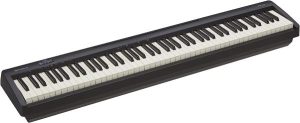
Check out the price of Roland FP-10 at Amazon
The Roland FP-10 remains one of the strongest affordable digital pianos for buyers who put keyboard feel near the top of their priorities.
Its biggest attraction is Roland’s PHA-4 Standard keyboard.
This is an 88-key hammer-action mechanism with escapement and Ivory Feel surfaces. For an instrument in the affordable category, it provides a substantial playing experience.
The FP-10 also uses Roland’s SuperNATURAL Piano sound engine.
Why Consider the Roland FP-10?
- 88 weighted hammer-action keys
- PHA-4 Standard action
- Escapement
- SuperNATURAL piano sound
- Built-in speakers
- Headphone capability
- Bluetooth MIDI
- USB connectivity
- Compact cabinet
Who Is It Best For?
The FP-10 makes particular sense for:
- Beginners taking formal lessons
- Classical piano students
- Adults returning to piano
- Players prioritizing keyboard feel
- Small apartments or bedrooms
- Buyers wanting a piano that can support developing technique
Potential Drawbacks
The FP-10 deliberately keeps its physical interface fairly simple.
Players who want lots of obvious front-panel controls, accompaniment styles, or a huge sound library may prefer another type of keyboard.
But for someone whose priority is playing piano, that simplicity isn’t necessarily a disadvantage.
Best for: Buyers who want excellent weighted-key feel without moving into a much more expensive instrument.
2. Alesis Recital Pro — Best Budget-Friendly 88-Key Option
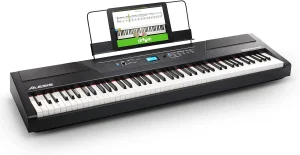
The Alesis Recital Pro takes a slightly different approach.
It aims to provide the major features beginners expect from a digital piano at a relatively accessible price.
It includes 88 hammer-action keys with adjustable touch response and 12 onboard voices.
Those sounds include piano as well as electric piano, organ, strings, synth, and other useful options.
Why Consider the Recital Pro?
- 88 hammer-action keys
- Adjustable touch response
- 12 sounds
- Built-in speakers
- Headphone output
- Layer and split functions
- Lesson mode
- USB-MIDI
- Battery operation option
That last feature is unusual for a full-size hammer-action instrument.
Who Is It Best For?
- Budget-conscious beginners
- Students
- Casual home players
- Families wanting an 88-key starter instrument
- Players wanting more sounds and controls than a minimalist digital piano
Potential Drawback
Players who become serious about acoustic-piano technique may eventually want a more sophisticated keyboard action.
That’s where spending more on something such as the Roland FP-10 can become worthwhile.
Best for: Buyers who want a lot of beginner-friendly functionality for the money.
3. Yamaha P-225 — Best Step-Up Choice
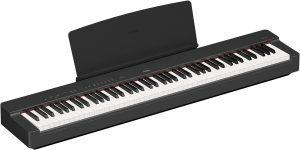
The Yamaha P-225 costs more than the most basic entry-level instruments, so I would describe it as our step-up value choice rather than the cheapest recommendation.
But the additional money buys meaningful improvements.
It uses Yamaha’s 88-key Graded Hammer Compact (GHC) keyboard and a piano sound based on Yamaha’s flagship CFX concert grand.
Yamaha specifies 192-note polyphony and 24 onboard voices.
The P-225 also incorporates Yamaha’s Virtual Resonance Modeling Lite (VRM Lite) to reproduce some of the resonance interactions associated with an acoustic piano.
Why Consider the Yamaha P-225?
- 88 GHC weighted keys
- Yamaha CFX piano sound
- 192-note polyphony
- 24 voices
- VRM Lite
- Built-in speakers
- USB audio/MIDI
- Dual, split and Duo functions
- Compatible with optional three-pedal systems
- Compact design
At approximately 11.5 kg / 25 lb 6 oz, it is also relatively manageable for an 88-key weighted digital piano.
Who Is It Best For?
- Serious beginners
- Intermediate pianists
- Adults returning to piano
- Players wanting a longer-term instrument
- Buyers willing to spend more for improved sound and features
Why Include a More Expensive Piano in an “Affordable” Guide?
Because lowest price and best value aren’t the same thing.
If spending somewhat more today means you’re less likely to replace the instrument in two years, the more expensive piano can ultimately be the more economical purchase.
Best for: Buyers willing to move above entry level for a more sophisticated piano experience.
4. Roland FP-30X — Best Upgrade for a Serious Beginner

Check out the price of Roland FP-30X at Amazon
It retains the PHA-4 Standard keyboard but adds a stronger overall feature set, including a more capable speaker system and expanded connectivity.
This makes it worth considering for someone who likes the FP-10’s keyboard but wants an instrument with greater long-term flexibility.
Why Consider the FP-30X?
- 88-key PHA-4 Standard hammer action
- SuperNATURAL Piano sound
- Built-in speakers
- Bluetooth connectivity
- USB audio/MIDI
- Additional sounds
- Greater connectivity than the FP-10
- Compatible with a more complete home setup
FP-10 or FP-30X?
Choose the FP-10 if your main priorities are:
- Weighted-key feel
- Piano sound
- Lower price
- Basic home practice
Choose the FP-30X if:
- You expect to keep the piano for several years
- Better onboard sound matters
- Connectivity matters
- You want greater flexibility
Best for: Serious beginners and developing players who can stretch their budget.
Quick Comparison
| Model | Keys | Main Strength | Best For |
|---|---|---|---|
| Roland FP-10 | 88 weighted | Keyboard action/value | Traditional piano learning |
| Alesis Recital Pro | 88 hammer action | Features for the money | Budget beginners |
| Yamaha P-225 | 88 weighted | Sound + long-term value | Serious beginners/intermediate |
| Roland FP-30X | 88 weighted | Step-up performance | Developing pianists |
Which Affordable Digital Piano Is Best for Beginners?
For a beginner taking traditional piano lessons, my priorities would be:
88 keys → hammer action → good piano sound → pedal → headphones → connectivity.
The Roland FP-10 is particularly attractive because it puts a relatively sophisticated keyboard action into an affordable instrument.
The Alesis Recital Pro may make sense when budget is tighter.
If you can spend more, the Yamaha P-225 and Roland FP-30X become stronger long-term choices.
Should a Beginner Buy 88 Keys?
If you’re serious about learning traditional piano, I generally recommend 88 keys when the budget and available space permit.
An acoustic piano has 88 keys, and more advanced repertoire eventually uses a broad range of the keyboard.
However, a smaller keyboard isn’t useless.
A 61-key instrument can be perfectly adequate for:
- Musical exploration
- Very young beginners
- Basic chords
- Pop music
- Songwriting
- MIDI input
- Casual playing
The key is understanding what you’re buying.
Weighted vs Semi-Weighted Keys
This is another area where beginners can easily become confused.
Weighted hammer-action keys are generally preferable when the goal is traditional piano technique.
Semi-weighted keys provide some resistance but don’t reproduce the mechanical characteristics of an acoustic-piano action as closely.
For:
- Classical piano
- Formal lessons
- Technique development
I’d favor hammer action.
For:
- Synth playing
- Music production
- Portability
- Casual keyboard playing
lighter actions can make sense.
Is Sound Quality or Keyboard Feel More Important?
Ideally, you want both.
But when the budget is limited, a student learning traditional piano should pay particularly close attention to keyboard action.
Why?
You can eventually improve the listening experience with good headphones or external speakers.
You cannot replace the physical keyboard mechanism without replacing the instrument.
That’s one reason the FP-10 is so attractive in this category.
Don’t Judge a Digital Piano by Speaker Volume Alone
A louder piano isn’t necessarily a better-sounding piano.
Speaker size and amplifier power matter, but so do:
- Piano sampling/modeling
- Resonance processing
- Dynamic response
- Speaker placement
- Cabinet design
Headphones can also reveal details that small built-in speakers don’t reproduce particularly well.
Whenever possible, audition a digital piano both through its speakers and headphones.
What About Used Digital Pianos?
Buying used can stretch your budget considerably.
But be careful with older digital instruments.
Unlike acoustic pianos, electronic instruments contain technology that evolves relatively quickly.
Before buying used, check:
- Every key
- Velocity response
- Speakers
- Headphone output
- Pedal input
- USB/MIDI connections
- Buttons and controls
- Power supply
- Display, if applicable
Also check whether the manufacturer still provides drivers, software support, and replacement accessories.
A very old digital piano isn’t automatically a bargain simply because it originally cost much more.
Should You Buy a Bundle?
Amazon and other retailers frequently sell digital pianos in bundles containing:
- Stand
- Bench
- Headphones
- Sustain pedal
- Dust cover
- Instructional materials
Bundles can represent good value—but compare the included accessories carefully.
An inexpensive X-style stand or basic sustain switch may eventually be replaced.
Don’t assume a $100 bundle premium means you’re receiving $100 worth of accessories that you would have chosen yourself.
Frequently Asked Questions
What is the best affordable digital piano with weighted keys?
The Roland FP-10 is particularly compelling because its PHA-4 Standard action provides a substantial weighted playing experience at an entry-level price.
However, prices change frequently, so compare current deals before purchasing.
What is the best cheap digital piano for beginners?
The Alesis Recital Pro is worth considering when price is a major concern and you still want 88 hammer-action keys.
If your budget permits, compare it directly with the Roland FP-10.
Is the Yamaha P-225 good for beginners?
Yes. Yamaha equips it with 88 GHC weighted keys, CFX-based piano sound and 192-note polyphony. It is particularly attractive for beginners who want an instrument they are less likely to outgrow quickly.
Is the Roland FP-10 good for classical piano?
Its 88-key PHA-4 Standard hammer action makes it well suited to beginning and intermediate classical study.
Advanced pianists may eventually want a higher-level instrument.
Do I need weighted keys to learn piano?
You can begin learning notes, chords and basic music on an unweighted keyboard.
However, if your goal is to develop traditional acoustic-piano technique, weighted hammer-action keys are strongly preferable.
How much should I spend on my first digital piano?
There isn’t one correct amount.
Rather than choosing a fixed dollar figure, establish your budget and then prioritize an 88-key hammer action, convincing piano sound, headphone output and appropriate pedal support.
Spending slightly more can sometimes save money if it prevents an early upgrade.
Can an affordable digital piano sound like an acoustic piano?
Modern digital pianos can reproduce acoustic-piano sounds remarkably well, particularly through good headphones.
However, a digital instrument still produces sound electronically and doesn’t duplicate every physical interaction of strings, hammers and a wooden soundboard.
Yamaha or Roland—which is better for beginners?
Both make excellent beginner and intermediate instruments.
Rather than choosing solely by brand, compare equivalent models based on keyboard feel, sound, speakers, connectivity and price.
If possible, play both before deciding.
Final Thoughts
You don’t need to spend thousands of dollars to start learning piano on a good instrument.
The affordable digital-piano market now offers genuinely capable choices.
For a buyer prioritizing keyboard feel and value, the Roland FP-10 is particularly compelling.
For someone working with a tighter budget who still wants 88 hammer-action keys, consider the Alesis Recital Pro.
If you’re willing to spend more for a piano you may keep longer, compare the Yamaha P-225 and Roland FP-30X.
Most importantly, don’t let an enormous list of features distract you from what matters.
For a piano student, start with:
88 weighted keys, good piano sound, comfortable playing response, headphone practice and a proper sustain pedal.
Everything else is secondary.
Related articles: