Roland RD-2000: Great Performance for Serious Piano Players
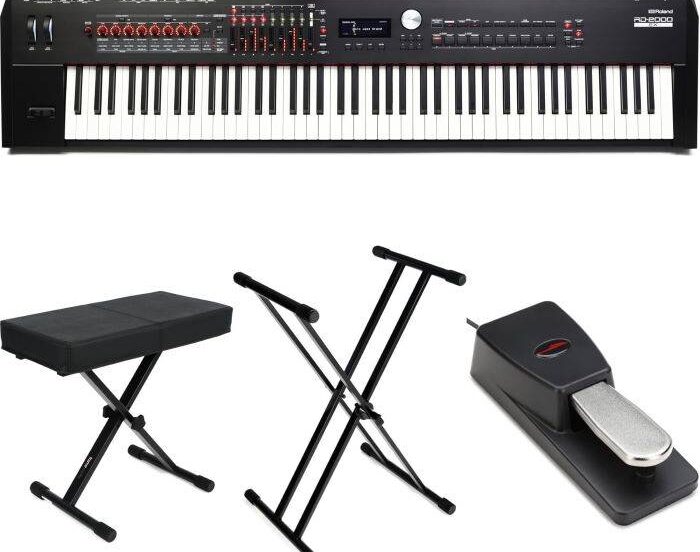
The Roland RD-2000 has been one of Roland’s flagship stage pianos for serious performers, touring musicians, church keyboardists, and studio players. With its 88-key PHA-50 hammer-action keyboard, dual sound engines, extensive real-time controls, multiple zones, professional audio outputs, and strong computer integration, it is much more than a conventional digital piano.
But there is an important question for buyers in 2026:
Is the original Roland RD-2000 still worth buying now that Roland offers the newer RD-2000 EX?
For many musicians, the answer can still be yes—particularly if you already own an RD-2000 or find one at an attractive price. The reason is unusual: Roland allows the original RD-2000 to be upgraded with the principal additional V-Piano sounds included in the RD-2000 EX.
This guide examines what the RD-2000 does well, where it has limitations, how it differs from the RD-2000 EX, and who should consider buying one today.
What Is the Roland RD-2000?
The Roland RD-2000 is an 88-key professional stage piano designed primarily for musicians who need high-quality piano sounds combined with extensive control over other sounds, software instruments, and performance setups.
That distinction matters.
A home digital piano is usually designed to reproduce the experience of having an acoustic piano in your living room. It may have built-in speakers, an integrated stand, and three pedals.
The RD-2000 is designed for a different environment.
It has:
- No built-in speakers
- Professional XLR and 1/4-inch outputs
- Extensive knobs and sliders
- Multiple MIDI zones
- Audio/MIDI over USB
- A rugged stage-oriented chassis
- More than 1,100 onboard tones
- Advanced sound layering and control
Think of it as part stage piano, part master MIDI controller, and part performance workstation.
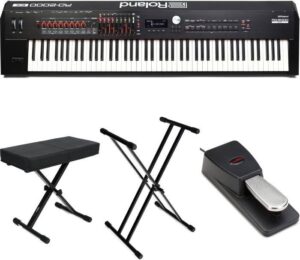
Check out the price of Roland RD-2000 at Amazon >>
Roland RD-2000 Key Specifications
The RD-2000 remains an impressively equipped instrument.
Its main specifications include:
- 88-note PHA-50 keyboard
- Hybrid wood and molded-key construction
- Escapement simulation
- Ivory/ebony-style key surfaces
- Two independent sound engines
- V-Piano acoustic-piano technology
- SuperNATURAL sound engine
- More than 1,100 tones
- Eight assignable performance zones
- 16 internal parts
- Eight illuminated knobs
- Nine illuminated sliders
- 300 Programs
- 100 Scenes
- USB audio/MIDI interface
- XLR and 1/4-inch main outputs
- Separate sub outputs
- MIDI In/Out/Thru capability
- Audio recording/playback via USB flash drive
The RD-2000 measures approximately 55.6 inches (1,412 mm) wide, weighs about 47 lb 14 oz (21.7 kg), and therefore sits firmly in the professional rather than ultra-portable stage-piano category.
The PHA-50 Keyboard: One of the RD-2000’s Biggest Strengths
The keyboard is one of the strongest reasons to consider the RD-2000.
Roland’s PHA-50 progressive hammer-action keyboard combines wooden components with molded materials. The goal is to reproduce much of the substantial feel associated with an acoustic grand while maintaining the durability needed for an electronic instrument that may be transported regularly.
The action is progressively weighted, meaning the lower keys have a heavier response than the upper keys, similar to an acoustic piano.
It also incorporates escapement simulation.
For pianists coming from an acoustic instrument, this makes the RD-2000 substantially more convincing than a lightweight synthesizer action.
Is the PHA-50 Good for Classical Piano?
Yes.
A classical player should find the weighted action capable of supporting expressive playing, dynamic control, and technically demanding repertoire.
However, the RD-2000 is still a stage piano rather than a complete acoustic-grand replacement.
The instrument’s lack of built-in speakers means the final playing experience also depends greatly on your headphones, monitors, or amplification system.
If your only purpose is practicing classical piano at home, a furniture-style digital piano might provide a simpler overall solution.
But if you want a serious piano action and professional performance capabilities, the RD-2000 becomes much more attractive.
Two Independent Sound Engines
One of the RD-2000’s defining characteristics is its use of two different sound technologies.
V-Piano Technology
Roland uses its V-Piano modeling technology for the main acoustic-piano sounds.
Rather than relying solely on conventional recorded samples, modeling mathematically recreates aspects of the behavior of a piano.
One advantage is extensive responsiveness and full polyphony for the V-Piano engine.
Roland also provides Piano Designer parameters that allow players to customize aspects of the piano sound rather than simply selecting a preset and accepting it as-is.
This can be particularly useful for professional players who need a sound to fit a particular band, venue, recording, or musical style.
SuperNATURAL Sound Engine
The second sound engine handles electric pianos and many of the RD-2000’s additional instrument sounds.
It includes:
- Electric pianos
- Clavinets
- Organs
- Synth sounds
- Strings
- Brass
- Ensemble sounds
- Other keyboard and instrumental tones
The SuperNATURAL engine provides up to 128-note polyphony.
For a stage musician, the significance is clear: you aren’t limited to playing acoustic piano.
One RD-2000 can cover much of the keyboard work required for pop, rock, jazz, worship music, theater, studio work, and other performance environments.
More Than 1,100 Sounds
The RD-2000 contains more than 1,100 tones.
However, sound quantity shouldn’t be confused with sound quality.
For most professional musicians, the important question isn’t whether the instrument contains 1,100 sounds or 2,000 sounds. It is whether the sounds you actually use—piano, electric piano, organ, strings, pads, synths—work well in a real performance.
The RD-2000’s advantage is that these sounds can be combined into sophisticated performance setups using its zones and controller system.
Eight Zones: Why the RD-2000 Is More Than a Piano
The RD-2000 supports eight fully assignable zones within a performance setup.
This is an extremely important feature for live musicians.
Imagine a worship keyboardist who wants:
- Grand piano across most of the keyboard
- Strings layered underneath
- A pad controlled by a slider
- A bass sound assigned to the lowest octave
- An external software synthesizer controlled from another zone
The RD-2000 can be configured to manage setups of this type.
Each zone can control internal sounds, external instruments, or software-based instruments.
This transforms the RD-2000 into the center of a sophisticated performance rig.
Nine Sliders and Eight Knobs
Stage musicians often need to change things immediately.
You don’t want to navigate through several menus in the middle of a performance simply to reduce the strings or bring up a pad.
The RD-2000 provides:
- Nine sliders
- Eight rotary knobs
with visual indicators.
They can be used for sound levels, effects, zone control, and other parameters.
This hands-on interface is one of the major differences between a professional stage piano and many conventional digital pianos.
Scenes and Programs
Performance setups can be saved so that you don’t need to rebuild your sound configuration before every song.
The RD-2000 provides Programs for complex setups and Scenes for convenient recall.
For a gigging musician, this can be tremendously useful.
A set might require:
Song 1: Acoustic piano
Song 2: Piano + pad
Song 3: Rhodes + strings
Song 4: Split bass + organ
Song 5: Piano controlling a software synthesizer
Instead of manually reconstructing these combinations, the RD-2000 allows prepared setups to be recalled.
Electric Piano Sounds
The RD series has strong historical associations with professional stage keyboards, and the RD-2000 includes a broad collection of electric-piano sounds.
These include recreations inspired by classic electric-piano instruments along with sounds connected to Roland’s own earlier products such as the RD-1000 and MKS-20.
For jazz, funk, R&B, pop, fusion, and many contemporary worship settings, electric-piano quality can be almost as important as acoustic-piano quality.
Vintage-style effects further help shape these sounds.
The RD-2000 as a MIDI Controller
This is one of the areas where the instrument becomes especially attractive to modern performers.
Many professional keyboardists now combine hardware keyboards with:
- MainStage
- Logic Pro
- Ableton Live
- Software synthesizers
- Sample libraries
- Virtual orchestral instruments
The RD-2000 can serve as a master controller for these systems.
Its zones can combine internal Roland sounds with external software instruments, providing a single performance interface rather than requiring separate controllers.
For musicians who work this way, the RD-2000’s controller features may be just as important as its own piano sounds.
USB Audio and MIDI
The RD-2000 includes a USB audio/MIDI interface.
This allows audio and MIDI communication with a computer through USB and can simplify both studio and live configurations.
The USB audio interface supports 24-bit processing and sample rates up to 192 kHz.
For studio musicians, this means the RD-2000 can sit at the heart of a software-based production setup while still functioning as the main weighted keyboard.
Professional Audio Outputs
The connection options reflect the instrument’s stage orientation.
The RD-2000 includes:
- Balanced XLR main outputs
- 1/4-inch main outputs
- Separate sub outputs
- Headphone output
- Pedal connections
- MIDI connections
- USB computer connection
- USB memory connection
The XLR outputs are particularly useful for professional stage setups because the keyboard can connect conveniently with mixing consoles and PA systems.
Does the Roland RD-2000 Have Built-In Speakers?
No.
This is one of the most important things prospective buyers should understand.
You will need:
- Headphones,
- Studio monitors,
- Keyboard amplification, or
- A PA system.
For touring performers this is normal.
For someone wanting a piano to place in the living room and simply switch on and play, it may be inconvenient.
This is why the RD-2000 should not automatically be compared with furniture-style home digital pianos.
They serve different purposes.
RD-2000 vs RD-2000 EX: What’s the Difference?
This is the most important update for buyers in 2026.
Roland introduced the RD-2000 EX in 2024.
Check out the price of Roland RD-2000EX at Amazon >>
The newer instrument retains the fundamental RD-2000 platform—including the PHA-50 keyboard, dual-engine architecture, controller system, and professional stage features—but expands the V-Piano sound selection.
The RD-2000 EX comes with two additional V-Piano Expansion titles installed:
German Concert
This expansion provides additional concert-grand-style voices aimed at both solo and ensemble performance.
Essential Upright
This expansion adds modeled upright-piano sounds with a more intimate tonal character.
That distinction is important because the RD-2000 EX is not a completely redesigned successor with an entirely different keyboard and control system.
It is essentially an expanded evolution of the RD-2000 platform.
Can the Original RD-2000 Be Upgraded to RD-2000 EX?
Yes—and this makes the original RD-2000 unusually interesting in the used market.
Roland offers an RD-2000 EX Upgrade through Roland Cloud.
It adds the German Concert and Essential Upright V-Piano Expansions to the original RD-2000.
This means an owner of the original model doesn’t necessarily need to replace the entire keyboard simply to gain the major EX sound additions.
For someone considering a used RD-2000 in 2026, this upgrade path can materially affect the buying decision.
Should You Buy an Original RD-2000 in 2026?
Potentially, yes.
The original RD-2000 remains a very capable professional instrument.
It makes particular sense if:
- You find one at a significant discount compared with an RD-2000 EX
- You value the PHA-50 keyboard
- You need extensive controller capabilities
- You use software instruments
- You perform professionally
- You are comfortable adding the EX upgrade if desired
However, if the price difference between an original RD-2000 and a new RD-2000 EX is relatively small, buying the EX may be the simpler choice.
Always compare actual current prices rather than assuming the older model is automatically cheaper.
Who Is the RD-2000 Best For?
Professional Stage Performers
This is its natural environment.
The combination of high-quality piano action, multiple sound engines, zones, controller features, professional outputs, and rugged construction makes it particularly suited to live performance.
Church and Worship Keyboardists
The RD-2000 can work extremely well in church environments where musicians frequently combine piano, strings, pads, organs, and software instruments.
Its zoning and real-time sliders are especially useful for controlling layered sounds during a service.
Studio Musicians
The PHA-50 keyboard and USB audio/MIDI functionality make the RD-2000 an excellent centerpiece for a studio built around software instruments.
Pianists Who Also Need Synth/Controller Functions
A pianist who wants one excellent weighted keyboard capable of controlling a much larger rig is exactly the type of player the RD-2000 was designed to serve.
Who Might NOT Need the RD-2000?
Absolute Beginners
A beginner can certainly learn on it, but it may be unnecessary.
The RD-2000’s advanced zones, controllers, outputs, MIDI functions, and professional features add complexity and cost that many new students will never use.
People Who Want Built-In Speakers
The RD-2000 has none.
A home digital piano may be much more convenient.
Musicians Who Move Their Keyboard Constantly
At approximately 21.7 kg or almost 48 pounds before adding a case, stand, pedals, and other equipment, the RD-2000 isn’t lightweight.
Regular touring musicians should factor transportation into the purchasing decision.
Pros and Cons of the Roland RD-2000
Pros
- Excellent PHA-50 weighted keyboard
- Strong acoustic-piano modeling
- Extensive electric piano and ensemble sounds
- More than 1,100 tones
- Eight assignable zones
- Excellent physical controls
- Professional XLR outputs
- USB audio/MIDI
- Strong master-controller capabilities
- Original model can be upgraded with EX piano sounds
- Suitable for stage and studio use
Cons
- No built-in speakers
- Heavy compared with many portable keyboards
- More complicated than most beginners need
- Large number of functions creates a learning curve
- Requires external amplification for normal room playback
- New buyers should compare its price carefully with the newer RD-2000 EX
Roland RD-2000 Quick Comparison
| Feature | RD-2000 |
|---|---|
| Keys | 88 |
| Keyboard | PHA-50 progressive hammer action |
| Key construction | Hybrid wood/molded |
| Main piano technology | V-Piano |
| Secondary engine | SuperNATURAL |
| V-Piano polyphony | Full |
| SuperNATURAL polyphony | 128 voices |
| Tones | 1,100+ |
| Performance zones | 8 |
| Sliders | 9 |
| Knobs | 8 |
| Built-in speakers | No |
| USB audio/MIDI | Yes |
| XLR outputs | Yes |
| Weight | Approx. 21.7 kg / 47 lb 14 oz |
| EX upgrade available | Yes |
Frequently Asked Questions
Is the Roland RD-2000 still good in 2026?
Yes. Its PHA-50 keyboard, V-Piano technology, extensive controller functions, professional outputs, and software integration remain highly capable. The availability of the EX upgrade also helps extend the usefulness of the original model.
What replaced the Roland RD-2000?
Roland introduced the RD-2000 EX in 2024 as the expanded flagship version of the platform. The newer model includes additional V-Piano expansions.
Can I upgrade my RD-2000 to an RD-2000 EX?
Roland offers an EX upgrade for the original RD-2000 through Roland Cloud. It adds the German Concert and Essential Upright V-Piano Expansion titles.
Does the RD-2000 have weighted keys?
Yes. It uses Roland’s PHA-50 progressive hammer-action keyboard with hybrid wood and molded construction, escapement, and textured key surfaces.
Does the Roland RD-2000 have built-in speakers?
No. You need headphones or external amplification.
Is the RD-2000 good for classical music?
Yes. The PHA-50 keyboard and V-Piano engine provide the weighted response and dynamic range needed for serious piano playing. However, players primarily interested in home classical practice may prefer a digital piano with integrated speakers and pedals.
Is the RD-2000 good for church use?
It can be excellent for church and worship environments because its eight zones, sliders, layered sounds, external-instrument control, and professional audio outputs make complex live setups easier to manage.
Can the RD-2000 control software instruments?
Yes. It is designed to work as a sophisticated MIDI controller and can combine internal sounds with computer-based virtual instruments.
How heavy is the Roland RD-2000?
It weighs approximately 21.7 kg, or 47 lb 14 oz.
Is a used Roland RD-2000 worth buying?
Potentially. A well-maintained used RD-2000 at a sufficiently attractive price can represent very good value, particularly because it can be upgraded with the EX V-Piano expansions. Check the physical condition, key action, controls, outputs, pedals, and USB/MIDI functions before purchasing.
Final Verdict: Is the Roland RD-2000 Worth It?
The Roland RD-2000 remains a formidable professional stage piano.
Its greatest strength isn’t any single specification. It is the way several capabilities come together:
serious piano action + high-quality piano sounds + extensive stage controls + MIDI functionality + software integration.
For a beginner who simply wants to learn piano at home, much of this capability is unnecessary.
For a professional keyboardist, studio musician, worship player, or pianist who needs one keyboard to control an elaborate live or software-based rig, the RD-2000 remains highly relevant.
And the arrival of the RD-2000 EX hasn’t made the original model obsolete.
In some respects, it has made the original RD-2000 more interesting: buyers now have the option of purchasing a well-priced original instrument and adding Roland’s EX sound expansion.
For someone buying new, however, the RD-2000 EX should also be compared carefully before making a decision.
The bottom line:
Buy the RD-2000 for its combination of piano feel and professional control—not simply because it has more than 1,100 sounds.
That’s where this stage piano continues to stand out.
Check out the price of Roland RD-2000 at Amazon >>
If your priority is recording rather than live performance alone, our guide to home-recording keyboards with strong MIDI and USB connectivity compares more compact options designed specifically for studio use.
Related Piano Articles
Best Roland Digital Pianos for Beginners: Top Picks for 2025
Roland Electric Keyboards for Performance & Portability
The Best 88-Key Piano Keyboards: Find the Perfect One for You
Top 4 Roland Digital Pianos for 2025: Cutting-Edge Technology
Top Roland Digital Pianos for 2026: Cutting-Edge Technology