Best Digital Pianos for Learning Classical Music in 2026
Learning classical piano places different demands on an instrument than casual keyboard playing.
You may be able to learn melodies, chords, and basic music theory on almost any keyboard. But classical piano technique eventually requires much more: control over dynamics, repeated notes, pedaling, wide keyboard range, and the ability to play softly or powerfully with precision.
That is why choosing the right digital piano matters.
For most students serious about learning classical music, the priorities should be:
- 88 full-size keys
- Weighted hammer action
- Good dynamic response
- Convincing acoustic-piano sound
- Sustain pedal support
- Headphone capability
- A keyboard action that won’t quickly limit developing technique
Fortunately, you no longer need an acoustic grand piano to begin serious classical study. Modern digital pianos can provide a highly capable practice instrument at a fraction of the cost and space requirements of an acoustic piano.
In this guide, we’ll look at four digital pianos worth considering for classical students in 2026, ranging from affordable beginner models to instruments suitable for more serious long-term study.
Disclosure: Some links on Pianos-Galore are affiliate links. If you purchase through these links, we may receive a small commission at no additional cost to you.
Can You Learn Classical Piano on a Digital Piano?
Yes.
A good digital piano can be entirely suitable for beginning and intermediate classical study, provided it has an appropriate keyboard action.
The important distinction is between a digital piano and a lightweight electronic keyboard.
A typical inexpensive keyboard may have:
- 61 or 76 keys
- Light spring-action keys
- No graded weighting
- Limited pedal capability
That can be perfectly adequate for casual music-making, but it doesn’t reproduce the resistance and response of an acoustic-piano keyboard very closely.
A piano-focused digital instrument usually provides 88 weighted hammer-action keys, making it much better suited to developing classical technique.
As students become highly advanced, access to a good acoustic piano can become increasingly valuable. But a quality digital piano can still remain extremely useful for everyday practice, particularly when headphone practice or limited space makes an acoustic instrument impractical.
Why 88 Keys Matter for Classical Music
A standard modern acoustic piano has 88 keys.
Beginners may initially use only a relatively small portion of that range, but classical repertoire eventually expands substantially in both directions.
As a student progresses through composers such as:
- Bach
- Mozart
- Beethoven
- Chopin
- Schumann
- Debussy
- Rachmaninoff
the full keyboard becomes increasingly important.
Buying an 88-key instrument from the beginning also reduces the likelihood that you’ll need to replace the piano simply because the student’s repertoire has outgrown a smaller keyboard.
Why Weighted Keys Matter
Weighted keys are even more important than the number of keys.
On an acoustic piano, pressing a key moves a physical action that ultimately causes a hammer to strike strings.
This creates resistance under the fingers.
Digital piano manufacturers use hammer mechanisms to approximate this physical response.
Graded Hammer Action
A graded keyboard makes lower-register keys heavier and higher-register keys progressively lighter.
This resembles an important characteristic of acoustic-piano actions.
For classical students, weighted graded keys help develop:
- Finger strength and control
- Dynamic sensitivity
- Articulation
- Balance between the hands
- Control at soft volumes
- More transferable technique when moving to an acoustic piano
Touch Response Matters Too
A keyboard can be weighted without necessarily being highly responsive.
Classical music depends heavily on dynamics.
The pianist needs to produce:
pp — very soft
through
mf — moderately loud
all the way to
ff — very loud
and everything in between.
A good digital piano should respond naturally to changes in playing force.
This is one reason keyboard action should receive more attention than novelty features such as hundreds of instrument voices.
Pedaling Is Essential for Classical Piano
Beginning students may initially use only the sustain pedal.
But classical repertoire eventually requires increasingly sophisticated pedal technique.
A digital piano intended for long-term study should ideally support:
- Sustain/damper
- Half-pedaling
- Soft pedal
- Sostenuto pedal
Not every beginner needs all three immediately.
However, compatibility with a proper three-pedal unit can be valuable if the student expects to continue into intermediate and advanced repertoire.
Best Digital Pianos for Classical Music Students
1. Roland FP-10 — Best Affordable Choice for Classical Beginners
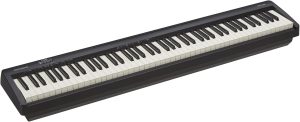
Check out the price of Roland FP-10 at Amazon
The Roland FP-10 is one of the most compelling entry-level digital pianos for students primarily concerned with developing piano technique.
Its biggest strength is its PHA-4 Standard keyboard.
This provides:
- 88 weighted keys
- Progressive hammer action
- Escapement simulation
- Ivory Feel key surfaces
For an affordable digital piano, that is a strong keyboard specification.
Roland combines this with its SuperNATURAL Piano sound technology.
Why the FP-10 Works Well for Classical Study
A beginner learning classical music doesn’t necessarily need:
- 500 sounds
- Drum rhythms
- Accompaniment styles
- Elaborate performance controls
What matters much more is whether the keyboard responds appropriately to the student’s fingers.
That is where the FP-10 makes sense.
Other Useful Features
- Built-in speakers
- Headphone capability
- Bluetooth MIDI
- USB connectivity
- Compact design
- Metronome
- Twin Piano mode
Twin Piano can be particularly useful during lessons because teacher and student can play within similar pitch ranges on opposite halves of the keyboard.
Who Is the FP-10 Best For?
- Beginning classical students
- Children taking formal piano lessons
- Adult beginners
- Students moving from an unweighted keyboard
- Buyers prioritizing keyboard action over extra features
Limitations
The built-in speaker system is relatively modest, and the instrument’s control interface is intentionally minimal.
Students who expect to keep the piano for many years may eventually appreciate the greater speaker power, connectivity, and pedal options of the FP-30X.
Best for: Classical beginners who want strong weighted-key feel at a relatively accessible price.
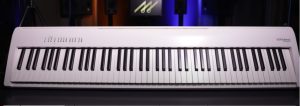
2. Roland FP-30X — Best Overall for Serious Beginners
Check out the price of Roland FP-30X at Amazon
The Roland FP-30X takes the basic strengths of the FP-10 and builds a more capable instrument around them.
It uses the same PHA-4 Standard keyboard with escapement and Ivory Feel, providing 88 weighted keys suitable for serious piano study. Roland’s specifications confirm this keyboard configuration.
Where the FP-30X gains an advantage is in the complete package.
It offers:
- More powerful onboard speakers
- Greater sound selection
- Bluetooth Audio and MIDI
- USB audio/MIDI
- Better connectivity
- More flexible pedal options
- 256-note maximum polyphony
Why It Is Particularly Good for Classical Students
The FP-30X has enough capability to serve a beginner well beyond the first few years of lessons.
That matters.
The cheapest piano isn’t always the least expensive choice over time if you have to replace it after two years.
A student who begins on the FP-30X can develop considerably before the instrument itself becomes the limiting factor.
Three-Pedal Capability
With Roland’s optional stand and pedal unit, the FP-30X can be converted into a more complete home-piano setup.
This becomes increasingly useful as classical repertoire demands more sophisticated pedaling.
Who Is It Best For?
- Serious beginners
- Intermediate classical students
- Families expecting long-term piano study
- Adults returning to classical piano
- Students who want a portable instrument that can also become a permanent home setup
Best for: Most serious beginners who want one digital piano they can keep for several years.
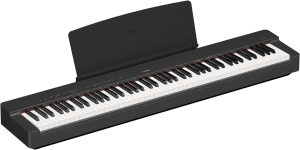
3. Yamaha P-225 — Best Yamaha Choice for Classical Students
Check out the price of Yamaha P-225 at Amazon
The Yamaha P-225 is another strong option for classical study.
It uses Yamaha’s Graded Hammer Compact (GHC) 88-key action, with heavier response in the bass and lighter response toward the treble.
The P-225 also uses a piano sound derived from Yamaha’s flagship CFX concert grand and incorporates Virtual Resonance Modeling Lite to reproduce some of the resonance interactions found in an acoustic piano.
Maximum polyphony is 192 notes.
Why the Yamaha P-225 Is Attractive for Classical Practice
Yamaha has extensive experience building both digital and acoustic pianos.
For classical students, the combination of:
- Full 88-key range
- Weighted graded action
- CFX-based piano sound
- Resonance modeling
- Pedal-unit compatibility
makes the P-225 particularly interesting.
It also contains 50 classical preset songs, which can be useful as reference or practice material.
Compact Design
Despite its full-size keyboard, the P-225 weighs only about 11.5 kg / 25 lb 6 oz, making it much easier to move than a traditional acoustic piano or console-style digital.
This can matter for:
- Students living in apartments
- College students
- Families with limited space
- Players who occasionally need to move the instrument
Three-Pedal Support
The P-225 is compatible with Yamaha’s optional LP-1 or FC35 three-pedal units.
That makes it a more convincing long-term classical instrument than a digital piano limited to a simple on/off sustain switch.
Who Is It Best For?
- Serious beginners
- Intermediate pianists
- Yamaha fans
- Students who value portability
- Classical players wanting a compact full-size instrument
Best for: Students wanting a compact Yamaha with a strong combination of piano sound, weighted action and long-term features.
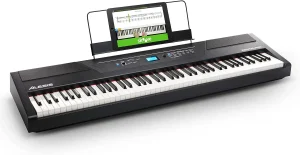
4. Alesis Recital Pro — Best Budget Option
Check out the price of Alesis Recital Pro at Amazon
The Alesis Recital Pro occupies a different position.
Its attraction is price.
It provides:
- 88 hammer-action keys
- Adjustable touch response
- Built-in speakers
- Headphone output
- USB-MIDI
- Layer and split functions
- Multiple instrument voices
For a family with a limited budget, this can provide a more appropriate starting point than purchasing an inexpensive unweighted keyboard.
Is It as Good for Classical Technique as the Roland or Yamaha?
I would not rank it above the FP-10, FP-30X, or P-225 purely for keyboard feel.
If the budget permits, those instruments are stronger long-term classical choices.
But the Recital Pro fills an important role.
A student can begin with:
88 keys + hammer action
without immediately paying for a more expensive instrument.
That is significantly better for traditional piano development than starting on a small unweighted keyboard merely because the latter has more sounds and features.
Who Is It Best For?
- Budget-conscious beginners
- Families unsure how long a child will continue lessons
- Adult beginners testing their commitment
- Students who need 88 keys at the lowest practical budget
Best for: Classical beginners whose budget is the primary constraint.
Quick Comparison
| Model | Key Action | Best For | Long-Term Classical Potential |
|---|---|---|---|
| Roland FP-10 | PHA-4 Standard | Budget/serious beginner | Very good |
| Roland FP-30X | PHA-4 Standard | Serious beginner/intermediate | Excellent |
| Yamaha P-225 | GHC | Serious beginner/intermediate | Excellent |
| Alesis Recital Pro | Hammer action | Budget beginner | Good starter |
Roland FP-10 vs FP-30X for Classical Music
Because both use Roland’s PHA-4 Standard action, the decision isn’t primarily about keyboard feel.
Choose the FP-10 if:
- Budget is important
- You’re just beginning
- Basic speakers are sufficient
- You don’t need extensive connectivity
Choose the FP-30X if:
- You expect to continue studying for years
- Stronger speakers matter
- You want better pedal options
- Bluetooth Audio matters
- Greater connectivity is useful
For a committed student, I would generally favor the FP-30X if the budget allows.
Yamaha P-225 vs Roland FP-30X
This is perhaps the most interesting comparison in this guide.
Both provide:
- 88 weighted keys
- Built-in speakers
- Strong acoustic-piano sounds
- Three-pedal compatibility
- Bluetooth features
- USB connectivity
- Compact formats
The difference comes down partly to keyboard feel and sound preference.
The Roland uses PHA-4 Standard action with escapement and textured key surfaces.
The Yamaha uses its newer compact GHC action and CFX-based piano sound with VRM Lite.
I would not choose between them purely from specifications.
If possible, play both.
A classical pianist may immediately prefer the feel or tone of one over the other.
What About More Advanced Classical Players?
As students progress, higher-level instruments become increasingly worth considering.
Features that may matter more include:
- More sophisticated hammer actions
- Wooden-key components
- Better repetition
- More precise dynamic control
- More advanced pedal sensing
- Stronger speaker systems
- More detailed resonance modeling
For example, Yamaha’s P-525 uses its GrandTouch-S keyboard with wooden white keys, escapement, 256-note polyphony, CFX and Bösendorfer Imperial piano sounds, full Virtual Resonance Modeling, and Grand Expression Modeling.
Roland’s FP-90X moves to the higher-level PHA-50 hybrid wood/plastic keyboard and PureAcoustic Piano Modeling.
These are more expensive instruments, so I would mention them as step-up options rather than automatically place them in the main affiliate list unless you confirm current Amazon availability.
Is a Digital Piano Enough for Advanced Classical Music?
This requires some nuance.
A high-quality digital piano can be an excellent practice instrument even for advanced musicians.
However, advanced classical pianists should ideally have regular access to a good acoustic piano as well, particularly when preparing repertoire for acoustic performance.
Why?
An acoustic grand responds through an extremely complex mechanical and acoustic system involving:
- Hammers
- Strings
- Dampers
- Soundboard
- Pedals
- Mechanical repetition
- Sympathetic resonance
Premium digital instruments reproduce many aspects impressively, but they are not physically identical.
For a beginning student, this distinction may matter relatively little.
For an advanced pianist preparing a Beethoven sonata or Chopin étude for performance, it becomes increasingly significant.
Portable Digital Piano vs Console Digital Piano
The models in our main recommendations are portable/slab-style instruments.
That has several advantages:
- Lower weight
- Smaller footprint
- Easier transportation
- Often lower price
But a classical student who will never move the piano may prefer a console digital piano.
Furniture-style digital pianos typically provide:
- Stable stands
- Integrated three-pedal systems
- Larger speaker cabinets
- More traditional appearance
Check this out: Best Digital Upright Pianos for Home Use: 2026 Buying Guide.
Do Classical Students Need Headphones?
Not necessarily—but headphone capability is one of the biggest advantages of digital pianos.
Classical practice involves repetition.
Scales, arpeggios, exercises, and difficult passages may be played dozens of times.
Headphones allow students to practice:
- Early in the morning
- Late at night
- In apartments
- Without disturbing family members
Good headphones may also reveal details that small onboard speakers don’t reproduce as clearly.
But students should also practice regularly through the piano’s speakers so they learn how their playing projects into a room.
What About the Sustain Pedal Included in the Box?
This is often overlooked.
Many portable digital pianos include a small pedal or footswitch.
That’s enough to get started, but serious classical students should eventually consider a better continuous damper pedal or full three-pedal system when their instrument supports one.
Half-pedaling becomes increasingly useful as repertoire advances.
Don’t Buy Based on Polyphony Alone
Manufacturers often advertise:
- 64-note polyphony
- 128-note polyphony
- 192-note polyphony
- 256-note polyphony
More is generally useful, but polyphony alone doesn’t determine whether a piano is good for classical music.
Keyboard action and dynamic response are usually more important.
A piano with 256-note polyphony but poor key response can be less useful to a classical student than an instrument with lower polyphony and a much better action.
Do You Need Hundreds of Sounds?
No.
For serious piano study, you may spend 95% of your time using one or two acoustic-grand-piano sounds.
Additional sounds can certainly be enjoyable, but they shouldn’t determine your purchase.
Prioritize:
- Keyboard action
- Piano sound
- Pedal support
- Dynamic control
- Speaker/headphone quality
- Connectivity
Then consider additional voices.
Frequently Asked Questions
What is the best digital piano for a classical beginner?
For most serious beginners, the Roland FP-30X is an especially strong choice because it combines the PHA-4 weighted action with good speakers, useful connectivity, and long-term expandability.
The FP-10 is excellent when the budget is tighter.
Is the Yamaha P-225 good for classical piano?
Yes. It provides 88 weighted GHC keys, Yamaha CFX-based piano sound, 192-note polyphony and compatibility with a three-pedal system.
Do you need 88 keys to learn classical piano?
You don’t need the entire 88-key range for your first lessons, but I strongly recommend 88 keys if classical piano is the long-term goal.
More advanced repertoire eventually uses the full range.
Are weighted keys necessary?
For serious classical-piano study, weighted hammer-action keys are strongly preferable.
They help students develop technique that transfers more naturally to acoustic pianos.
Which is better for classical music: Yamaha or Roland?
Both produce excellent digital pianos.
The better choice depends partly on the player’s preference for keyboard action and sound.
Try equivalent models side by side whenever possible.
Is the Roland FP-10 enough for classical music?
For beginning and much intermediate study, yes.
Its PHA-4 Standard action makes it particularly attractive at its price point.
Advanced players may eventually prefer a higher-level keyboard action and more sophisticated pedal and sound system.
Can I learn Chopin on a digital piano?
Yes.
A quality weighted 88-key digital piano can support learning Chopin repertoire.
As the repertoire becomes more technically demanding, practicing regularly on a good acoustic piano or higher-end digital instrument becomes increasingly valuable.
Can I use headphones for all my practice?
You can use headphones extensively, but it is useful to practice through speakers as well.
Playing into a room helps you judge projection, balance, pedaling, and tonal control differently.
What’s more important for classical music—sound or key action?
Both matter, but if forced to prioritize at the beginner level, I would place keyboard action very high on the list.
Developing physical technique on a suitable action is fundamental.
Final Thoughts
The best digital piano for learning classical music isn’t necessarily the instrument with the most sounds, the largest display, or the longest specification list.
For a classical student, the fundamentals matter more:
88 keys + realistic hammer action + good dynamic response + convincing piano sound + appropriate pedal support.
If budget is limited, the Roland FP-10 provides an unusually capable starting point.
For a more serious beginner who wants an instrument that can remain useful for years, compare the Roland FP-30X and Yamaha P-225.
If the budget is extremely tight, the Alesis Recital Pro provides a way to begin with a full-size hammer-action keyboard rather than settling immediately for an unweighted instrument.
Most importantly, if possible, involve the student’s piano teacher in the decision and try the instruments personally.
Specifications can narrow down the shortlist.